The claim that most citizens are familiar with the details of the EPS affair — its outcome, the damage caused, and the names of those accused — is not entirely accurate. Yet at the mention of this case, everyone will recall two figures: Bojana Savović and Jasmina Paunović. These are the women — prosecutors — whose public profiles were carefully crafted by pro-Western media, turning them into symbols of an alleged fight against corruption and resistance to the “corrupt system” — the so-called “Serbian Lauras.”
FROM A MARGINAL CLERK TO A NATIONAL HEROINE
The investigation, which from the very beginning was conducted sloppily and, moreover, unacceptably slowly, was taken over after their dismissal by the editorial desk of the United Group. Predictably, the decision of Chief Public Prosecutor Nenad Stefanović to change the composition of the team handling the case was assessed by United Group’s investigative team as a scandalous attack on the independence of the prosecution — all while deliberately ignoring the fact that, at that moment, the public had no insight into the amount of damage, the quality of the investigation, or the problems that had arisen due to the unprofessional handling of the data. Instead, citizens were subjected for months to indoctrination by a narrative in which the prosecutors were portrayed as victims of an “evil boss,” and every attempt to question their work was presented as proof of political pressure. In all of this, the crucial fact was blatantly overlooked — that the Chief Public Prosecutor of the Higher Public Prosecutor’s Office in Belgrade was not engaged in politics and that, unlike them, he did not obtain his position through political proportions. But that did not interest the investigative team of United Media, who subordinated facts to the task of turning these “independent prosecutors,” whose pockets — in addition to their state salary — were being filled through grants and donations from foreign sponsors, into future political heroines.
The struggle and “suffering” of the fake Lauras was supposed to evoke Laura Kövesi, who went from a protest slogan to an instrument for imposing a narrative in which no one dared ask the elementary question: what is actually written in the case files? What is the real scale of the damage? And was the investigation carried out professionally, in a timely manner, and without the concealment of key evidence? Because anyone who dared to ask such a question would immediately be labeled a regime bot “helping to cover up corruption.”
WHAT WAS (NOT) SAID?
And what did the public never fully hear about the EPS affair — or more precisely, what did it hear? Everything the public was ever given about this affair was a political story. Yet the real problem in the case had nothing to do with political background, as had been claimed for months, but with a series of mistakes made by the so-called Lauras.
Prosecutor Jasmina Paunović initially dismissed the case, stating that there were no elements for prosecution. However, the Court of Appeals returned the case to her, and together with Bojana Savović she assessed the damage at half a million euros. But…
Documents later revealed that at the very first meetings with the police, Savović stated that there were no elements of a criminal offense because, as she claimed, responsible persons in EPS did not intend to abuse their position — rather, they acted to avoid damage. Later, on multiple occasions, the prosecutors ignored new evidence, and even after receiving additional police reports, they took no concrete action.
But the “Laura” assessment was not only unusable — the subsequent investigation revealed that the damage was far greater. From the initial half a million dollars, the new investigation showed that the damage in EPS had reached 7.5 million dollars.
And the one thing the public never heard during the aggressive media campaign promoting the “Lauras” was the new expert report — and the fact that five additional individuals were indicted.

FROM “LAURA” TO PROGLAS
The protests under the slogan of the “Lauras” were presented as a fight for the independence of the judiciary, but in reality they were the first public test of a broader political-judicial structure that would only later receive its formal name — ProGlas. Despite undeniable facts showing that they conducted the investigation poorly, the two prosecutors became carriers of a symbol of alleged institutional resistance.
It is noteworthy that the protests began at a moment when none of the key facts of the case were known — the extent of the damage, the reason for the new expert assessment, the course of the proceedings. Instead, the public was offered a story of the personal drama of the prosecutors, accompanied by media repetition of the claim that they were “removed” because they were supposedly closer to the truth than the regime was willing to tolerate.
Thus the protest became a general rehearsal for a new political structure. In the front rows appeared some “new” faces — Miša Majić, Bojana Savović, Jasmina Paunović, Milena Božović, Radovan Lazić…
It is important to understand that the protest functioned as a symbolic platform on which all professional NGOs with the same goal of exerting political influence over an entire branch of government came together — a branch which, in principle, should not be politically or ideologically colored.
The trajectory that leads from the protest of the “fake Lauras” to the emergence of the political initiative ProGlas is proof that there were no improvisations or coincidences.
For decades, NGOs quietly built their network, waiting for the ideal moment to step into the public sphere. The green light came with the constitutional amendments, when they had, in the highest position, an almost irremovable key figure — the Supreme Public Prosecutor, Zagorka Dolovac. On one side, individuals openly took political positions; on the other, support flowed from within the institutions themselves, revealing — through a series of tragedies that struck Serbia — the full extent of the civil-sector malignancy cultivated by Western services.
ProGlas was presented to the public as an initiative of “independent intellectuals,” but it soon became clear that this “independence” was owed to projects financed from abroad, as well as to personnel long involved in judicial activism.
VICTIM OR PART OF THE SYSTEM?
The name of Jasmina Paunović became recognizable only after her reassignment in the EPS case. This prosecutor — whom colleagues reliably claim spent more working hours outside her duties than within them — suddenly became a symbol of institutional resistance.
It is telling that one of Paunović’s most striking public appearances was recorded after the end of her official career. Instead of withdrawing from the public eye, she gradually aligned herself — through the political initiative ProGlas — with the most recognizable faces of the blockades, and recently, in the podcast “Svedok vremena” (“Witness of Time”), positioned herself as a logical candidate for the so-called “student list,” which, as it turns out, has nothing in common with students except the name, but has a great deal to do with the structures of ProGlas.
Her acceptance of the invitation, justified by claiming that it was the “duty of all free-thinking people,” does not appear merely as a personal political impulse, but as part of a strategic plan in which she is assigned the role of a “moral witness.”
What is consistently omitted in media portrayals of Jasmina Paunović is her family background. The woman who spent her professional life as part of the very system she now bitterly criticizes is the wife of a man still employed in the Ministry of Health, and the mother of a man employed in the Ministry of Defence.
These details are far from irrelevant — they are pieces of information that, within the judicial system, naturally raise questions about potential conflicts of interest, influence channels, and communication pathways within the institution itself.
In the judiciary — where professional distance and impartiality are essential — the fact that a prosecutor’s husband works in one ministry, and her son in another, both directly connected to the same system in which she herself recently served, should have been an issue warranting scrutiny and analysis.
How is it possible that the same media raising dust about alleged pressure on the prosecutor persistently ignore these facts?
In any other case, such information would be considered relevant for assessing independence. But when it comes to Paunović, everything is swept under the rug because it does not fit the narrative of a victim.
Even more interesting is that these relationships were not discussed when she entered the political sphere. When a prosecutor — whose public function is constitutionally forbidden from political engagement — suddenly becomes a political activist, every connection she has to state structures takes on new weight. She is no longer simply a public official, but a double actor on the political field.
JENNINGS, HILL, WOMEN IN BLACK
When one follows the political and activist rise of the group around ProGlas, it becomes impossible not to notice their continuous connection with representatives of foreign missions in Serbia. This layer of the story has never been properly explained, even though it is precisely this element that shows that a movement presenting itself as “civic” is in fact in a very firm alliance with certain international structures.
The first moment when the public turned away from the so-called “Lauras” occurred when Bojana Savović and Jasmina Paunović posed for a photo with then–U.S. Ambassador to Serbia, Christopher Hill. The second came after Savović received an award from the NGO Women in Black, making it clear to the broader public that these prosecutors were not merely ordinary institutional figures, but part of a sector funded for years by the West.
Much was brought to light during the constitutional changes. A certain David Reece Jennings, envoy of the U.S. Department of Justice, first appeared publicly in 2020.
For years, Jennings held the status of a “guest prosecutor” and engaged in numerous activities in which he appeared within the same circle of people and the same NGOs that would later become key actors in protests and blockades—and, above all, actors undermining institutions from within.
Jennings maintained years-long communication with several individuals who are now central figures in ProGlas, yet not once was it explained what the nature of that communication was, why it was so intensive, or under which mandate he operated. Particularly indicative is his communication with Jasmina Paunović, who possessed neither expertise, nor career achievements, nor any qualifications that would recommend her as part of a professional intellectual elite. From today’s perspective—when one examines Paunović’s performance, details of the EPS investigation, and the narrative constructed around her—it is clear that a special propaganda operation was underway. And behind much of it stood the special U.S. prosecutor who for years shared a wall in his office with Serbia’s Chief Public Prosecutor, Zagorka Dolovac.
To this day, no document, no official statement, no institutional confirmation has clarified what exactly Jennings was doing inside the Republic Public Prosecutor’s Office, nor who approved his appointment. After Christopher Hill left the post of U.S. Ambassador, Jennings’ nameplate was quietly removed — almost as if he had never been there.
But he was there… And not only was he there, he even retained his position as “guest prosecutor” in the Balkans. Recently, Jennings held a training session at a faculty in Podgorica, making it clear that the democratic deep state has no intention of simply leaving this region — or perhaps even the lives of certain women from within the prosecutorial system.
A “STUDENT LIST” WITH NO STUDENTS
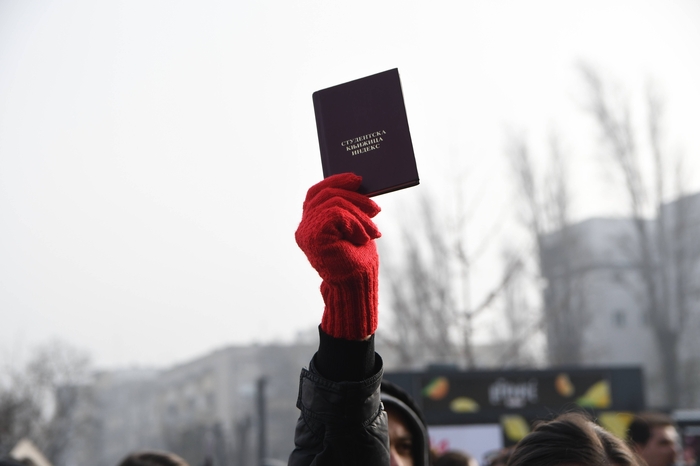
Let us return to the main protagonists of this story and their connection to the protests. The old, worn-out opposition neither has the energy nor enjoys the trust of the people, so the idea of a “student list” appeared as one of the most aggressively promoted models of a new political agenda. At first glance, it was obvious that there were neither students nor authentic young forces involved, but rather a construction seeking to present itself as a youth movement, while in the background stood a long-established network. Instead of the original student revolt, the public has, after a year, been served a bare political project with personnel from the same circles who have for years rotated between the NGO sector, judicial positions, the media, and protest organizations.
There are still no concrete names of this list presented publicly, but what is known — and what the “students” from the NGO sector have confirmed — is that there will be no students on it. Some political amateurs even claim that it does not matter who will be on the list; what matters is the idea. Except that there is no idea.
Still, some of the names being mentioned in public are far from a good idea. A pensioner, NGO activists, media operatives, and individuals who have for years been embedded in political-judicial structures — all of them connected precisely with ProGlas…
Into such a construction fits perfectly Jasmina Paunović, who did not hesitate to accept the role of a “candidate” on a list without students. To someone who wishes to believe in the authenticity of the movement, this may sound strange, but within the context of ProGlas, it is perfectly logical. A face is needed that carries symbolic weight, and a career ending in retirement together with a mythologized EPS backstory make for ideal material — especially in Serbia, where “historic events” occur daily and are forgotten after seven days. What remains is only the impression created by the media, and whoever leaves the stronger impression — wins.
FOLLOW THE INSTRUCTIONS
The construction of the “student uprising” began to fall apart the moment Luka Stevanović, a student of the Faculty of Economics in Kragujevac, was arrested after voluntarily turning himself in to the Higher Court in Belgrade, defending himself against charges of attempting the violent overthrow of the constitutional order.
According to information that surfaced during the investigation, Stevanović was not one of the ordinary students, but an operational link between student groups and the structure led by Miša Majić.
Stevanović was in direct communication with Majić, from whom he received daily instructions: where, when, and how to organize blockades; how to change routes, banners, slogans, and social media messaging; how to communicate in the media; what to mention; and whom to put in the spotlight.
Such data seriously undermined the narrative of the spontaneity of student energy, as all activities occurring on the ground were connected to instructions coming “from above,” circulated through channels such as Signal and Telegram.
Media outlets like N1 and Nova S covered the protests with enthusiasm that exceeded the role of mere reporting. According to claims by investigative bodies, they were part of the same structure. This was evident not only through biased reporting but also through their willingness to offer journalists a place on the electoral list. For example, part of the communication between Majić and student Stevanović also went through Žaklina Tatalović, who did not hesitate to say that she “wants to be on the student list,” but that she must ask the company owner, not the editor.
THE MASKS HAVE FALLEN
The student groups did not emerge spontaneously. Just as a network was built within the judiciary, the same process took place within the universities. According to investigative findings, these groups were formed through a network involving mentorship structures, NGO workshops, student programs, and the influence of numerous professors — all of whom, without exception, are connected to ProGlas.
From the very first media spin about the “Lauras” to today’s “student list without students,” one thing cannot be overlooked. The events that have shaken Serbia over the past three years — from the staged “fake Lauras,” to the instrumentalization of Ribnikar, Dubona, and Nadstrešnica — were not accidental. They were attempts by the same people and the same civil-sector structures tied to Western intelligence services to use emotional manipulation and tragedies to push Serbia back into another October 5th — into the status of a Western colony, aligning it with the bloc of post-national, hollow political playgrounds.
A pattern emerges: the same people, the same structures, and the same external influence, wearing different masks, trying to present themselves as an “independent elite,” while in reality working for years to undermine institutions from within. This cannot be hidden behind a new name, nor can it be sustained by borrowing “new energy” for the long term.
Students were merely a mask, while the real actors were pensioners, NGO activists, media operatives, and individuals deeply rooted in the same network that has for decades lived off foreign grants and political activism under the guise of “fighting for democracy.”
This is why the stories of the “Lauras,” ProGlas, Jennings, Hill, the NGO sector, and the “student uprising” are not separate episodes but parts of a single operation that unfolded in several phases. In every phase, the key targets were the state institutions, and the key tool was manipulating public opinion — aided by media that long ago stopped pretending to be neutral.