Just as during the wartime negotiations and the numerous proposals for political solutions and territorial reorganization of Bosnia and Herzegovina, now, more than three decades later, the greatest controversy has once again arisen over division and borders—in other words, “over the map.” This is entirely logical, since it is one of the most vital questions for every individual, family, company, institution, village, and city—in other words, for society as a whole. It determines within which system, from the standpoint of its territorial framework—legal-political, economic, cultural, educational, religious, and otherwise—daily life and functioning will take place.
WHAT IS THE CROAT ENTITY AND WHAT WOULD HAPPEN TO BOSNIA AND HERZEGOVINA?
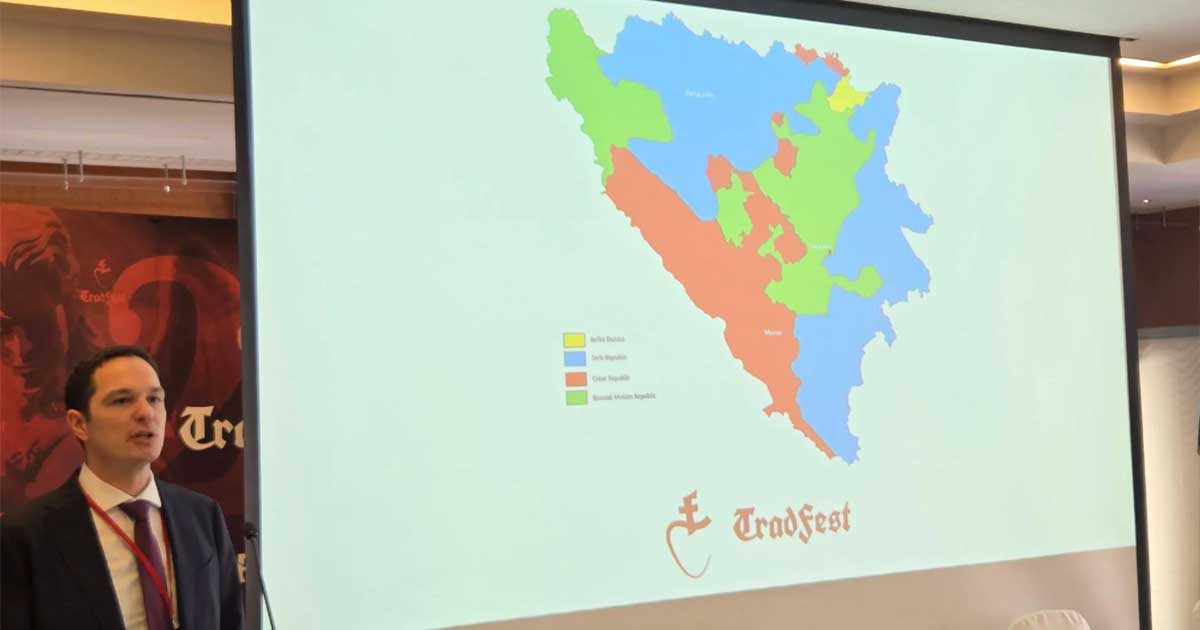
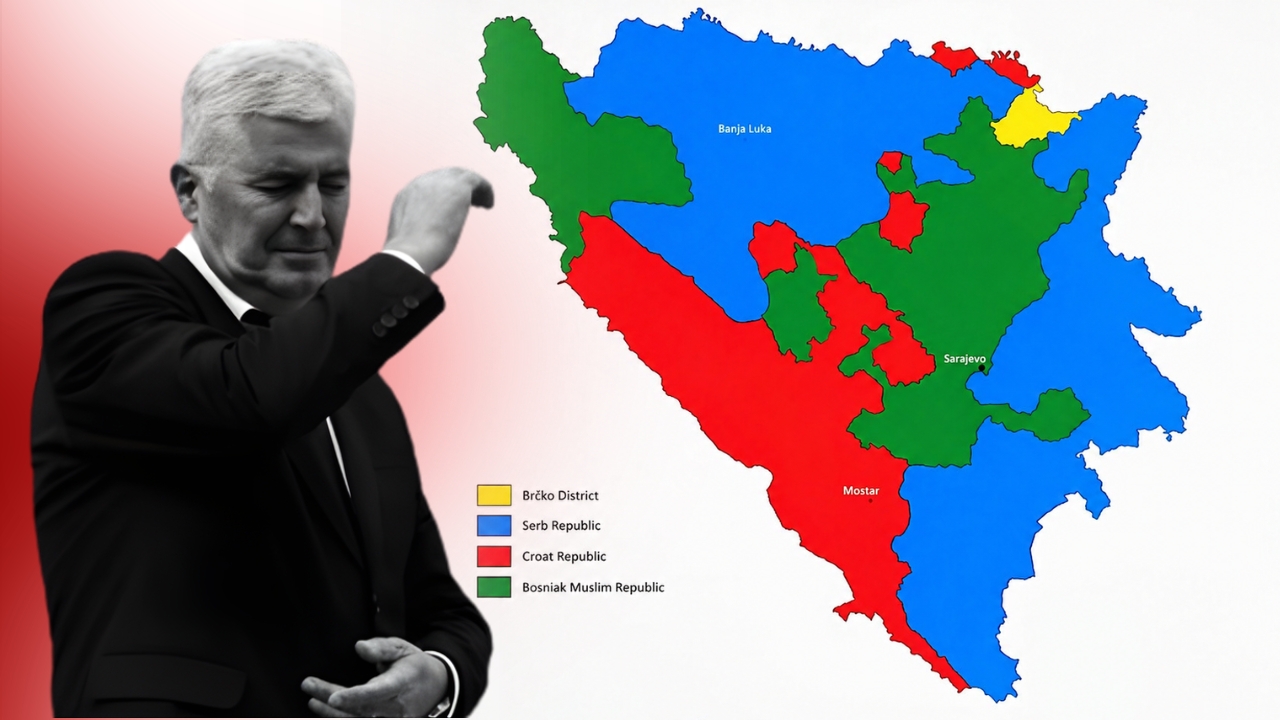
That is why it came as no surprise that on April 25, 2026, during the second day of the international conservative gathering TradFest held at the Hotel Dubrovnik under the theme “The Fall of Liberalism and the Rise of Christian Nations,” the idea of a third (Croat) entity once again provoked significant attention and controversy. Namely, a proposal for the territorial reorganization of Bosnia and Herzegovina was presented during the panel titled “Bosnia and Herzegovina: A Failed State and the Necessity of a Third, Croat Entity.” Tensions were further heightened by an indicative detail carrying the weight of a political message: the lecturer and presenter of the new “map” came from the institution bearing the resonant name University of Defence and Security ‘Dr. Franjo Tuđman’. Additional “specific political weight” was provided by the presence of several important figures from the Croatian political and religious scene, such as Cardinal Vinko Puljić.
In what way is the proposal for a new division of Bosnia and Herzegovina aligned with, and in what way does it depart from, the “Dayton map”? Most notably, it does not (at least for now and in this version) infringe upon the territory or borders of Republika Srpska, nor are there indications that it would erode its status. Accordingly, the “smaller entity”—as the Sarajevo political-media milieu often dismissively refers to Republika Srpska—would not necessarily have any reason to oppose such a proposal. On the contrary, Republika Srpska could support it, which it indeed does in its political struggle with Muslim/Bosniak unitarists. True, the proposal implies the continued existence of the condominium of Brčko District, i.e. maintaining the status quo of its fragmenting position between the eastern and western “lungs” of Republika Srpska and its role as “scissors over the umbilical cord” of the Corridor—an arbitration legacy of the post-Dayton period.
Thus, the political-territorial redefinition presented at the Zagreb gathering would apply only to the second entity—the Federation of Bosnia and Herzegovina. Accordingly, its ten cantons as federal units, along with their constitutions, laws, assemblies, governments, police forces, and other functions, would be abolished. This would mean that the Federation of Bosnia and Herzegovina itself, as one of the two entities, would cease to exist—which further means the end of the validity of the Dayton Agreement and the Constitution of Bosnia and Herzegovina derived from it, upon which the existence and organization of Bosnia and Herzegovina according to the “1+2+3 formula” is based: one internationally recognized state, two constituent entities, and three constituent peoples.
The presented map indicates that the hypothetical third, Croat entity would fully encompass the two current cantons with Croat ethnic majorities—the West Herzegovina Canton (No. 8) and Canton 10 (No. 10), as well as the mixed Croat-Muslim/Bosniak Herzegovina-Neretva Canton (No. 7). Connected to them would also be the predominantly Croat parts of the likewise mixed Central Bosnia Canton (No. 6), in the form of a highly fragmented panhandle—a complicated territorial “extension” into central Bosnia, with little territorial compactness, albeit with a strained territorial continuity (particularly questionable being the corridor connection to Jajce via Vlašić). Separated from this whole, but still part of the envisioned Croat entity, would also be the Croat enclaves of Usora and Žepče in central Bosnia, as well as the Orašje and Odžak-Domaljevac periclaves which, although separated, currently form the Posavina Canton (No. 2).
THE EXISTENTIAL NECESSITY OF BOSNIAN CROATS
The need of Bosnian Croats to form their own entity is entirely understandable and almost existential in nature. Within the Federation of Bosnia and Herzegovina, they exist in an amorphous condition, surrounded by a pronounced Muslim/Bosniak demographic majority. They occupy a subordinate political, educational, cultural, and overall social position. They have been manipulatively outvoted even in the election of the Croat member of the Presidency of Bosnia and Herzegovina, who attains office thanks to orchestrated votes from the other side in order to be acceptable to the so-called political Sarajevo and aligned with civicist (that is, centralist) policies.
The relatively better position of Croats in western Herzegovina and the Neretva Valley, geographically “leaning” toward Croatia (Dalmatia), cannot compensate for the catastrophic situation of those in central Bosnia, who are dispersed territorially, demographically thinned by war, and exposed to large-scale emigration. Therefore, taking the example of Republika Srpska as a lesson, they justifiably believe that a single political-territorial unit of their own—even if territorially fragmented—would provide them with security, sustainability, functionality, and an equal status vis-à-vis Muslim/Bosniak hegemony, unitarism, demographic superiority, and assimilative capacity.
Croat demands for a third entity arise from time to time, and they are similar both in political-legal and territorial terms. But why has this issue emerged precisely at this moment? The Croat political factor and its foreign patrons have assessed that the geopolitical timing is favorable. In other words, “the signal light has turned on” indicating that this is the right—and perhaps the last—moment to place such a demand before international actors and their internal Muslim/Bosniak partner. In accordance with the spirit and participants of the Zagreb gathering, conservative and sovereigntist forces in the world are on the rise, while the Croats are, naturally, ideologically adaptable when national interests are at stake. Due to the overheated global military-political climate, especially the increasingly complicated relations between the United States and the European Union, they believe that under the cover of this “shadow” they can now resolve their major issue. In the context of the conflict involving the United States and Israel against Iran, they assess that the Islamic world is currently at a low point of popularity and support in the West, and that this is projected onto the Muslim/Bosniak factor in Bosnia and Herzegovina, especially within the Federation, making the opportunity too important to miss.
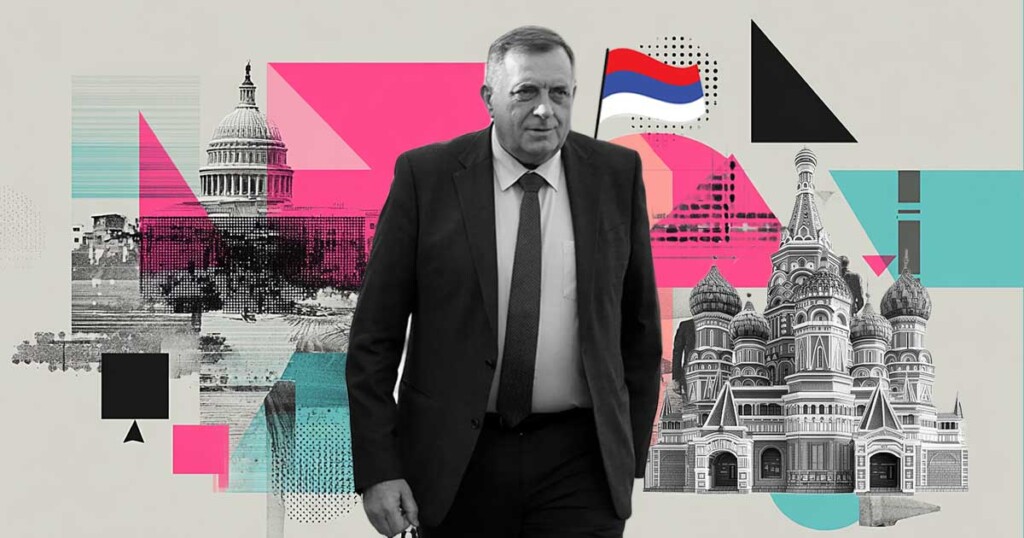
On the internal Bosnian-Herzegovinian level, the Croats believe that optimal conditions have emerged. Both their own and the Serbian dissatisfaction with Muslim/Bosniak centralism, pseudo-civic politics, majoritarianism, and increasingly pronounced militarism has reached its peak. At the same time, the possibility of politically exploiting the status of being the alleged sole victim and loser of the war, the Dayton Agreement, and the “impossible state” of Bosnia and Herzegovina has diminished. Since, through Dodik’s “arrangement” with the Americans, the sharp edge of attacks against Republika Srpska as the “usual culprit” has been blunted, it is realistic to expect that pressure would be redirected toward the Croat factor in the Federation of Bosnia and Herzegovina—and therefore such a scenario should be preempted.
The inability of the so-called political Sarajevo to extend and consolidate its authority “from the Una to the Drina and from the Sava to the Adriatic” has become apparent, as has the limited success of its officials’ international lobbying and complaints around the world. At the same time, in the “Bosnian-Herzegovinian preference game,” the Croat-Serb “pair” is effectively “cutting off” the Muslim/Bosniak “third player.” In other words, the position of Republika Srpska regarding the improvement of Croat status—and even the establishment of a Croat entity—is not merely restrained and principled, but openly supportive.
HOW SHOULD REPUBLIKA SRPSKA POSITION ITSELF?
Why, however, could such support from the standpoint of the interests of Republika Srpska prove problematic and purposeless? One should not forget that the Croats already had their own political-territorial unit within Bosnia and Herzegovina, but abolished it themselves—albeit at the request of Western patrons (primarily the United States)—for anti-Serb reasons. Even before the formal outbreak of armed conflict, they proclaimed the Croatian Community of Herzeg-Bosnia on November 18, 1991, and later, in the midst of war, transformed and renamed it the Croatian Republic of Herzeg-Bosnia on August 28, 1993. Reluctantly, but still by their own decision, they dismantled and dissolved it through the Washington Agreement on March 18, 1994 (although it continued functioning by inertia until August 1996), in the name of forming the colloquially known Muslim-Croat Federation, that is, the Federation of Bosnia and Herzegovina. All of this was done for the sake of a military alliance with the Muslim/Bosniak side: first to facilitate the Croatian seizure of most of the Republic of Serbian Krajina during Operations “Flash” and “Storm,” and later for joint military action aimed at territorially reducing Republika Srpska in order to “force” it into the forthcoming Dayton framework. Even before the war, they symbolically tied together the flags bearing the Croatian checkerboard and the crescent moon and jointly organized the illegitimate anti-Serb referendum on the independence of Bosnia and Herzegovina. In other words, the Croats’ motivation to inflict damage on the Serbs proved stronger than their own self-interest. After all of that, what is it that they want now?
The assumption that the Croat aspiration for a third entity of their own would not infringe upon the status and territory of Republika Srpska may prove to be a very dangerous trap. “Unpacking Dayton” would hardly proceed without the involvement of a West traditionally unfriendly toward the Serbs, particularly an European Union frustrated by its own decline, which could produce unforeseeable negative consequences. If Banja Luka silently or openly accepts the formation of a Croat entity, this would consequently mean the creation of a Muslim/Bosniak political-territorial unit as well, on approximately the amount of territory where Muslims had an overall absolute settlement majority even before the war—roughly one quarter of Bosnia and Herzegovina. Such an outcome would certainly satisfy neither the so-called political Sarajevo nor the population that has been propagandistically conditioned for decades toward the preservation of a unified Bosnia and Herzegovina. Moreover, such a Muslim/Bosniak entity would itself be divided into a central Bosnian fragment and an Una-Sana fragment.
Republika Srpska could find itself in an extremely delicate position if it were subjected to pressure and ultimatums demanding territorial concessions to the third (Croat) entity, and in an even more difficult position if compensation were demanded for the future Muslim/Bosniak entity as well. For example, would Republika Srpska be expected to relinquish the area around Šipovo and Mrkonjić Grad (the strategically important Klekovača-Vitorog “anvil”) in order to connect the two aforementioned fragments? What would happen if a new tripartite Bosnia and Herzegovina were transformed into a stronger, genuine federal or regional state with reduced powers for the entities, meaning a new stripping away of competencies from Republika Srpska? After all, it is well known that tripartite state structures tend to be more durable and more difficult to disintegrate than bipartite ones.
How would Republika Srpska respond if the Croats attempted to establish their entity “on the ground,” and the Muslim/Bosniak side answered with armed force, preventing through a short but limited conflict—and through ethnic cleansing, as the stronger side—the territorial consolidation of such an entity, at least in central Bosnia? Would Republika Srpska stand aside peacefully and merely receive Croat refugees from that area, that is, from the (semi-)encircled towns of Jajce, Gornji Vakuf-Uskoplje, Novi Travnik, Vitez, Busovača, Kiseljak, Kreševo, as well as Žepče and Usora? Or would it, willingly or unwillingly, be drawn into war, particularly since threats to its own population and territory could not be excluded?
And if, in such a way, the “Dayton Bosnia and Herzegovina” were already entering a process of fundamental redefinition—or perhaps even complete disappearance from the political map—many additional questions would arise. Why should Republika Srpska not connect and widen the Corridor by dissolving the Brčko District? In the same context, would it not be geopolitically and geostrategically reasonable to incorporate the security-threatening Orašje and Odžak-Domaljevac bridgehead of Croatia across the Sava River? Why should the Goražde panhandle, which disrupts the territorial compactness of the eastern part of Republika Srpska, continue to exist? Why should the ethnically homogeneous Serb municipalities of Drvar, Glamoč, Grahovo, Petrovac, and the predominantly Serb parts of the municipalities of Ključ, Sanski Most, and Krupa—currently within the Federation of Bosnia and Herzegovina—remain outside Republika Srpska?
Ultimately, in new geopolitical circumstances, would not both the hypothetical Croat entity (perhaps a renewed Croatian Republic of Herzeg-Bosnia) and Republika Srpska proclaim independence and/or join Croatia and Serbia respectively—and what kind of future would then await the residual Muslim/Bosniak post-Dayton structure?