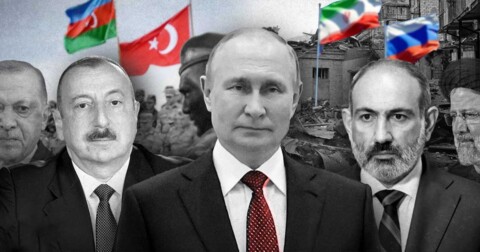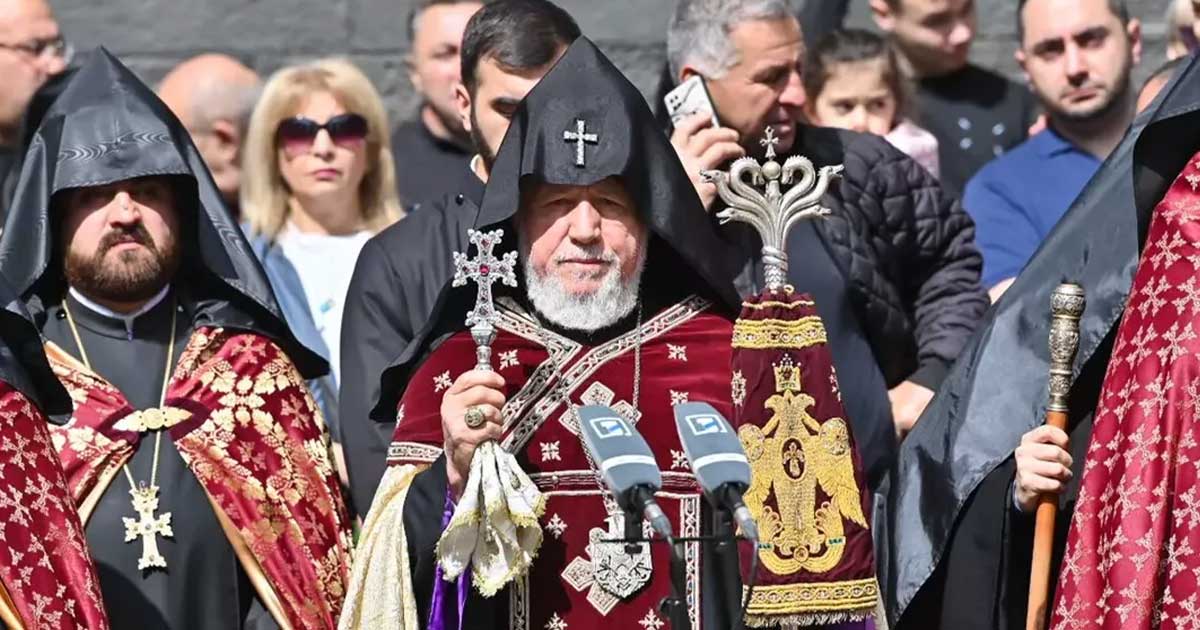
The conflict in Armenia continues — the Prime Minister of Armenia, Nikol Pashinyan, has launched an unprecedented campaign against the Armenian Apostolic Church (AAC) and the Catholicos of All Armenians, Garegin II. Undoubtedly, the conflict has a political and economic background.
The anti-church movement called “New Armenia, New Patriarch” was created by supporters of the current authorities immediately after the “Velvet Revolution” of 2018. Tensions between the Armenian authorities and the Church further escalated after the Second Nagorno-Karabakh War in 2020. At that time, Catholicos Garegin II joined calls for Pashinyan’s resignation.
After the final transition of Nagorno-Karabakh under Azerbaijani control in September 2023, Garegin II stated that the cause of the tragedy of the Karabakh Armenians was “the policy pursued by the Armenian authorities toward Artsakh and the division of the Armenian people.” Affected by such a principled position of the Church, Pashinyan encouraged, in every way, a propaganda campaign against Garegin II, accompanied by demonstrations of force and insulting actions toward the Catholicos and the clergy of the AAC.
Armenian media then emphasized: “the anti-church movement is directed by the highest echelons of power. This once again demonstrates that during the time of Nikol Pashinyan, the anti-church wave has reached unprecedented proportions.”
“RUSSIAN TRACES” IN THE COUP PLAN
Representatives of the authorities do not hesitate to use the rostrum of the National Assembly to make statements directed against the Church and the Catholicos whenever they have the opportunity. The Prime Minister stated in parliament: “If the Church has bad relations with the government, then it has bad relations with God.”
Nikol Pashinyan and his team intensified pressure on the Armenian Apostolic Church, especially after talks between the head of the Armenian government and David Cohen, Deputy Director of the Central Intelligence Agency. Pashinyan thus rather absurdly accused the AAC of a thousand-year betrayal of the Armenian people in the interests of third powers, claiming that it is an “agent of influence.” He supported attacks on Holy Etchmiadzin with suspicions that the Church was concealing taxable income. He did not stop at discrediting the Church but attempted to construct a more complex narrative: “in the preparation for the 44-day war, our allies participated—not on our side. And I know at least two Collective Security Treaty Organization member states that took part in it.”
Pashinyan then linked the alleged agreement of Orthodox CSTO member states—without naming them directly—with Azerbaijan and protests by the Armenian opposition, including recent ones in which clergy participated.
The information-analytical portal Civic.am, close to the ruling party “Civil Contract,” published material allegedly provided by a “reliable source within the opposition,” titled “The Opposition’s Coup Plan.” The plan allegedly outlines a program for removing Pashinyan from power in eight stages, pointing to “Russian traces.” It further claims that funds for implementing the “plan” were allegedly to be provided by Gazprom Armenia and South Caucasus Railway (subsidiaries of Russia’s Gazprom and Russian Railways), as well as the already arrested Samvel Karapetyan, owner of the company “Electric Networks of Armenia,” a key asset of the Russian Tashir Group. Once again, no convincing evidence was presented.
“THE SINISTER PLAN OF CRIMINAL CLERGY”
Already the day after the publication of the “Coup Plan,” the Prime Minister of Armenia, Nikol Pashinyan, stated that law enforcement agencies had foiled nothing less than a “massive and sinister” plan by “criminal-oligarchic clergy” to destabilize the situation in the country. Despite the obvious absurdity of the accusations, the Investigative Committee of the Republic of Armenia proceeded to carry out the orders of the authorities. The statement notes that, at the proposal of the investigator, the prosecutor decided to initiate criminal proceedings against 16 individuals, 15 of whom were detained.
In total, more than 90 searches were conducted in the homes of opposition members. Among the suspects are deputies from the “Armenia” and “Etchmiadzin” factions, as well as supporters of the “Holy Struggle” movement.
Official Yerevan is attempting to convince the population that the repressions against the Armenian Apostolic Church and the opposition are part of the fight against terrorism, but it does not provide convincing evidence, which calls into question the legality of the arrests even among neutral observers. At the same time, information is being circulated that opposition figures allegedly sought to coordinate their activities with the Russian side. For Western audiences, Pashinyan presents these processes as an unusual form of resistance to “Russian influence.”
Most analysts consider it clear that Western backers have offered a classic scenario of consolidating power through the creation of an image of an internal threat. Particularly cynical are the terrorism accusations against individuals whose only “crime” was organizing peaceful protests against territorial concessions.
THE DIASPORA UNANIMOUS IN CONDEMNING THE AUTHORITIES
The sixteen-million-strong Armenian diaspora, unlike the governments of the countries in which they live, has also demonstrated rare unity in condemning the actions of the leadership of the Republic of Armenia.
In United Kingdom, the persecution of the Armenian Apostolic Church was described as a “desperate attempt to preserve a destructive course.” In France, it was warned that weakening the Church would allow “all external forces to subjugate the country.” In the United States, attention was drawn to “attacks on Christians,” while in Germany it was emphasized that there is an attempt to “place one of the oldest Christian institutions under state control.” Similar statements also came from Armenians in Italy, Lebanon, and Russia.
Such a broad international response indicates that the entire process is perceived as political repression. At the same time, representatives of the business community warn that the arrest of major investors creates a toxic climate for capital investment.
Armenians, faithful to their centuries-old tradition, point out that in the context of the modern globalist worldview, the primary targets are those states and institutions that possess a clearly expressed identity and, especially, deeply rooted values of national identity. Among these values, the Armenian Church, by all indications, remains the strongest factor.
The target of the anti-religious campaign is not only traditional Churches—on the contrary, it deliberately begins with the strongest structures, which is tacitly supported or at least not opposed by sectarian communities. However, over time, they too will inevitably be targeted. It is no coincidence that similar anti-clerical campaigns, following a comparable pattern, are taking place in other countries as well.
In the Armenian case, the catalyst for this process has also been provocations triggered by false statements made by the head of Azerbaijan’s religious affairs body.
THE CHURCH – A STUMBLING BLOCK ON THE PATH OF GEOPOLITICAL REORIENTATION
In the post-Soviet space, the tasks of “color revolutions” include not only the ideological shaping of the population in a Euro-Atlantic spirit, but also the reshaping of traditional confessions, including through persecution. A striking example is Ukraine, where the Ukrainian Orthodox Church (Moscow Patriarchate) became the target of persecution by the pro-Western regimes of Petro Poroshenko and Volodymyr Zelenskyy. Now a similar scenario threatens Armenia.
The government of Nikol Pashinyan, which is pursuing a policy of geopolitical reorientation of the country from Russia and Iran toward Azerbaijan, Turkey, and the Euro-Atlantic community (primarily the United States, European Union, and United Kingdom), is waging a struggle against the Armenian Apostolic Church (AAC), one of the pillars of Armenian identity. It has gone so far that, disregarding state laws and church rules, Pashinyan intends to depose the Catholicos of All Armenians, Garegin II, whom he refers to by his secular name, Ktrij Nersisyan.
It should be noted that one of Pashinyan’s supports consists of sectarian groups, many of whose members belong to various branches of Protestantism.
Another group consists of Pashinyan’s supporters within the AAC itself. A notable example is Arakel Karamyan, head of the Kotayk Diocese of the AAC, whose son, Argishti Karamyan, under Pashinyan held the positions of Chairman of the Investigative Committee of Armenia, Deputy Head of the State Control Service of Armenia (2019–2020), and Director of the National Security Service of Armenia (2020).
THE SIGNIFICANT LETTER OF POPE LEO XIV
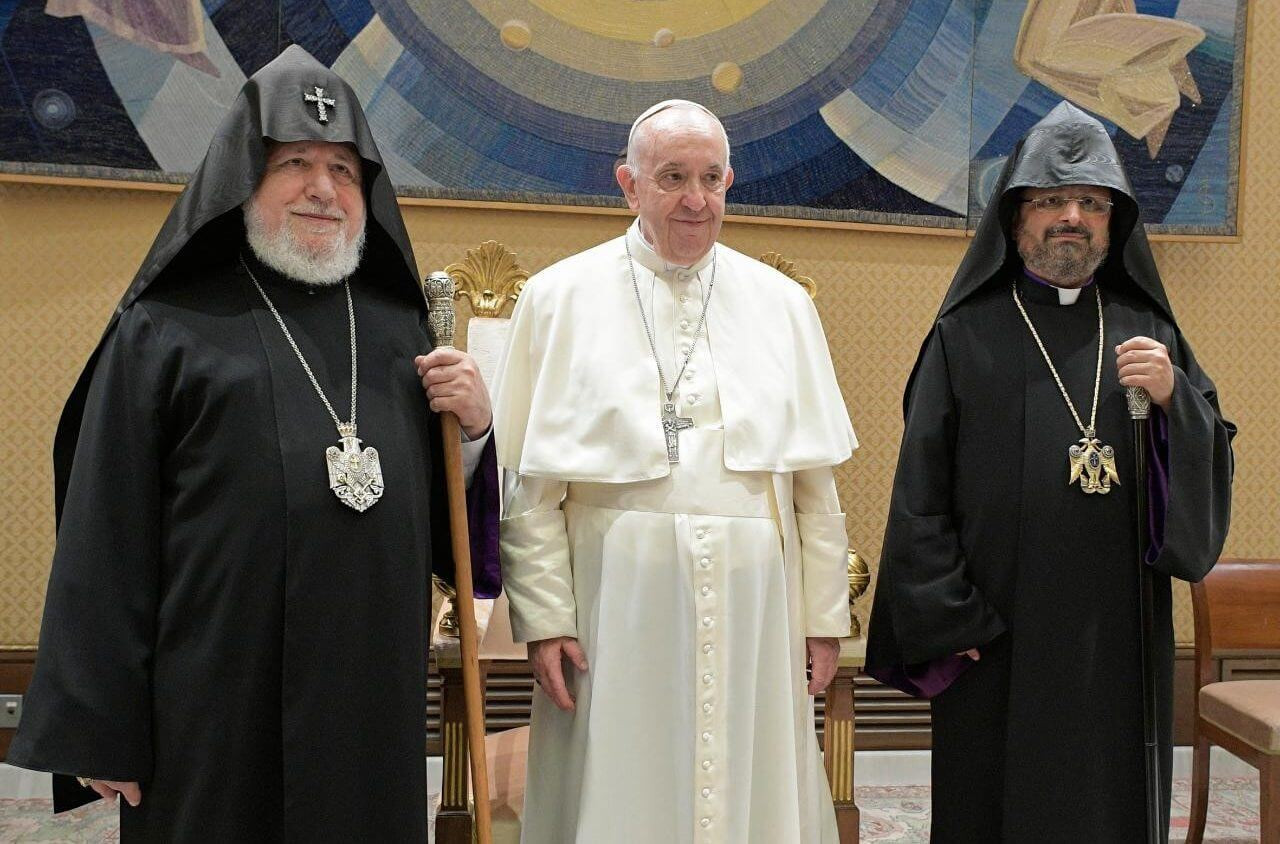
However, sectarian groups and figures such as Arakel Karamyan are not the most powerful allies of the current Armenian authorities in their conflict with the AAC. Far more concerning is the fact that under Pashinyan there has been a continuation of the intensive development of cooperation between official Yerevan and the Holy See, whose head is the supreme pontiff of the Roman Catholic Church—a process that began during the time of Serzh Sargsyan.
Recent developments clearly demonstrate how the Holy See is attempting to weaken the AAC. In the context of Pashinyan’s attacks on Garegin II, on July 24, 2025, the content of a letter sent by Pope Leo XIV to the Catholicos of the Great House of Cilicia, Aram I, was made public (within the AAC there are two Catholicosates—the Etchmiadzin and the Cilician, the latter based in Antelias in Lebanon). The Pontiff thanked the delegation of the Catholicosate of the Great House of Cilicia for participating in the liturgy marking the beginning of his pontificate and expressed readiness to continue cooperation with Aram I and other spiritual leaders.
This letter is not an insignificant event. On the contrary, it raises several questions. First, the Holy See has traditionally had a rather reserved attitude toward the AAC. Despite theological particularities, the Armenian Apostolic Church is much closer to the Russian Orthodox Church and other local Orthodox churches than to the Roman Catholic Church. Therefore, the question arises: what prompted such attention from the Pope toward one of the Armenian Catholicoi?
THE CONNECTION OF ETCHMIADZIN WITH RUSSIA – A SERIOUS ACCUSATION
From a purely human perspective, the ignoring of the Catholicos of All Armenians by Pope Leo XIV is unclear. The current pontiff was elected on May 8. Already the next day, Garegin II, on behalf of the Armenian Apostolic Church (AAC) and its faithful, sent congratulations to the newly elected Pope. Aram I sent his congratulations somewhat later, on May 10. Nevertheless, the Pope did not send a letter to the Catholicos of All Armenians.
What does this mean? It indicates that the Holy See also has ties with forces supporting the struggle of Nikol Pashinyan against the AAC.
One of the ideological premises of Pashinyan’s camp is the claim that the AAC is a conduit of Russian influence. Since, within that logic, Turkey is portrayed as a historical adversary of the Armenians instead of Russia, the connection of Etchmiadzin with Russia is presented as a serious accusation.
In addition, Archbishop Ezras Nersisyan, the brother of the Catholicos of All Armenians, is the head of the Russian and New Nakhichevan Diocese of the AAC, headquartered in Moscow. Given the anti-Russian nature of Pashinyan’s policies, it is not difficult to assume that, in the event of the removal of Garegin II, the head of that diocese would also be replaced.
As the campaign against the AAC is directly linked to the spread of Russophobia, Turkophilia, and Euro-Atlanticism in Armenia, control of Holy Etchmiadzin by Pashinyan’s camp would represent a threat to Russia’s national security, since thousands of believers within the Armenian community in Russia could be exposed to ideological influence of a Russophobic character.
DISUNITY WITHIN THE ARMENIAN CHURCH
The case of the letter from Pope Leo XIV also reveals a lack of unity between the Etchmiadzin and Cilician Catholicosates within the AAC.
Despite a meeting of representatives of the two Catholicoi in Etchmiadzin at the end of June, on July 9 a statement by Aram I was published, which, among other things, stated: “Shame, a thousandfold shame, that such an unhealthy and anti-national atmosphere has arisen in the life of our beloved homeland, Armenia. Unfortunately, in the Armenian language there are not enough words to describe my pain and bitterness. Particularly deeply shameful and condemnable is the atmosphere that has recently prevailed in two institutions engaged in state and patriotic building of our country—the Holy Etchmiadzin and the National Assembly. Indeed, in the life of any nation, church, or organization, there may be mistakes, shortcomings, polarization, and confrontation. However, this should be resolved within appropriate processes and in a calm atmosphere, in order to find suitable solutions. Unfortunately, I have not been in the homeland for six years. In recent days I have thought a lot about coming to Armenia, so that I could help in easing the storm that has arisen…”
However, he continues, unfounded and ongoing statements in the National Assembly and on social networks, which distort our moral, spiritual, and national values, as well as the arrests that have taken place, do not encourage him to direct his steps toward the homeland. Nevertheless, he states that he will always remain committed to coming to the homeland in order to consult with Garegin II, Catholicos of All Armenians, Prime Minister Nikol Pashinyan, and other responsible figures, so that together they may find appropriate solutions for overcoming the difficult situation in Armenia.
It is, however, striking that the Catholicos of the Great House of Cilicia did not provide a clear assessment of the processes unfolding in Armenia. It is precisely Pashinyan’s supporters in the National Assembly who are conducting a campaign against the AAC, to which Aram I himself belongs. And it is precisely Pashinyan—who organized repressions against Armenian clergy—together with his supporters, who is pursuing an anti-national policy, calling for capitulation before Turkey and Azerbaijan.
(To be continued)