Information about the protests that began on November 26 in Bulgaria and escalated on December 1 has drawn the attention of global media. According to various estimates, around 50,000 people gathered in Sofia, while another 10,000 protested in major cities such as Plovdiv, Varna, Burgas, Ruse, Stara Zagora, Shumen, and Pleven. What particularly stands out is the fact that most participants are young — the so-called Generation Z.
Most international publications cite the proposed 2026 state budget as the main trigger for the protests, along with corruption accusations directed at the ruling coalition — GERB, BSP, and There Is Such a People. Protest slogans target former Prime Minister and GERB leader Boyko Borissov, as well as Delyan Peevski, head of DPS–New Beginning, who is seen as part of the coalition but operates from the shadows.
The budget dispute surfaced after clashes within the Budget Committee and the reaction of the “We Continue the Change – Democratic Bulgaria” (PP–DB) bloc, which initially attempted to portray the demonstrations as entirely their own — focused solely on the budget and not calling for the government’s resignation. That narrative later shifted.
SEVERAL VERSIONS OF THE NATURE OF THE PROTESTS
There are several interpretations of the goals behind the protests: some believe the demonstrations are intended to shift responsibility onto the caretaker government and create a “pressure-release valve,” given that after the New Year Bulgaria will face debates over the deteriorating financial situation of its citizens and the expected negative consequences of entering the eurozone. Others see the protests as an attempt by political parties to reshape their positions. Meanwhile, some analysts argue that events are unfolding under external influence and that Bulgaria is preparing for the replacement of its exhausted political actors.
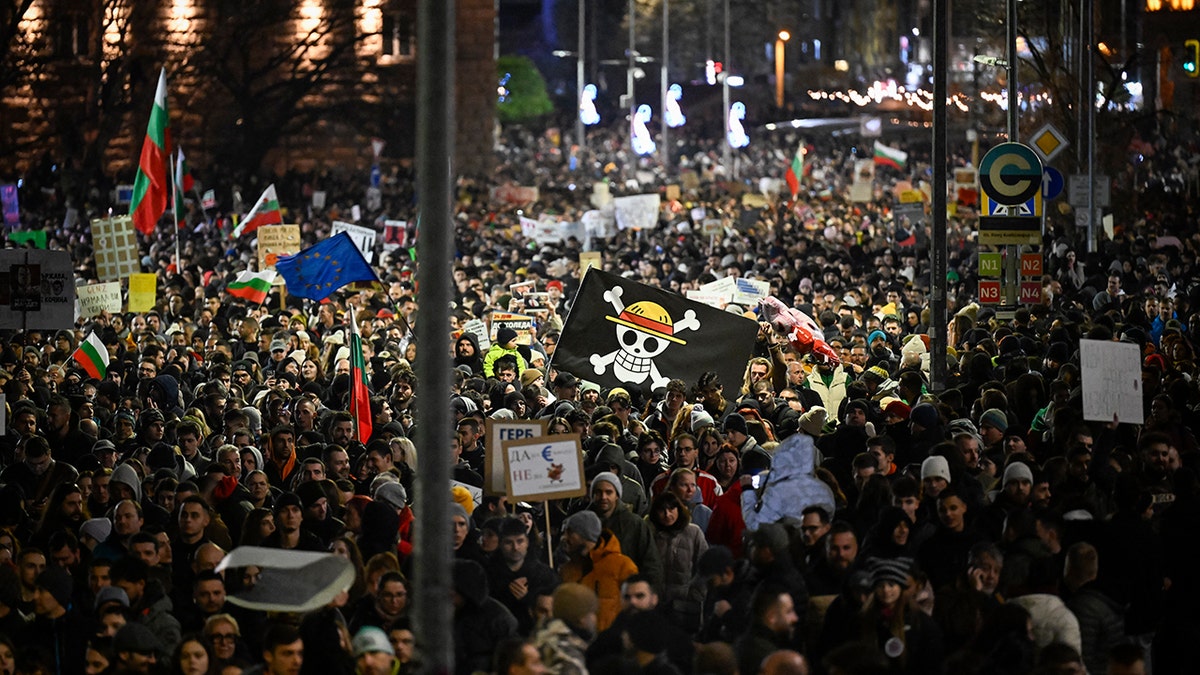
On December 1, the protest escalated into a large-scale action, joined by people with completely opposing ideological and political views. Representatives of PP–DB were protesting—supposedly against the budget and in defense of the eurozone. There were others as well: those opposed to the eurozone, those against corruption, those against Borissov and Peevski, and individuals like Manol Glishev, who loudly protested dressed in military attire with Ukrainian patches. There were also anti-NATO groups, and more. A highly diverse crowd which, at one moment, grew suspiciously large—now united around the demand for the government’s resignation.
REBELLION OR FARCE?
Financial journalist Stefan Antonov described the PP–DB protest against the budget as a farce, noting that PP representative Assen Vassilev is leading a rebellion against deficits he himself created.
Antonov writes: “From the 2021 budget revision to the 2023 budget, all of the state’s financial plans were drafted by Assen Vassilev — both the annual budgets and their amendments. Over those three years, Vassilev’s budgets resulted in Bulgaria taking on loans equal to 16% of GDP.”
In his view, most people protesting against the budget do not know what they actually want, how to achieve it, or what consequences it may cause.
In the end, it became clear that the budget was not the main topic of the protest — and the subsequent course of events confirmed this.
WHO SENT THE PROVOCATEURS?
On the evening of December 1, the protest in Sofia — which according to some estimates gathered between 30,000 and 50,000 people — took on a very different shape.
Escalation followed: garbage containers were set on fire, shop windows were smashed, and the party club of GERB and the headquarters of “DPS – New Beginning” were attacked and vandalized. There were masked individuals as well. During the unrest in Sofia, 71 people were detained; property damage was reported on buildings and cars, and during a search of one man, police found 31,000 leva distributed in envelopes by denomination and addresses across Sofia.
Around midnight, clashes broke out — masked men threw bottles at police officers, garbage bins were set on fire, and the police used tear gas.
This was followed by mutual accusations among political parties regarding the unrest: who sent the provocateurs, and for what purpose.
Some saw Borissov’s hand behind the orchestrated riots.
Others suspected he was trying to step aside from his position in order to avoid the political fallout from the expected “hungry protests” early in 2026 following the euro’s introduction — shifting responsibility onto the caretaker government.
A third group accused President Rumen Radev. The portal “Afera” published a video featuring protest participants who claimed that their friends had been offered money — allegedly on behalf of President Radev — to provoke the police and then accuse them of aggression.
A fourth version emerged: “the government staged the chaos so that Radev could be blamed.”
A UKRAINIAN BILLION FOR THE ‘PRO-RUSSIAN’ RADEV?
The version linking Radev to the riots continued circulating.
Journalist Sonya Koltuklieva from the PIK portal raised additional questions, pointing out claims that businessmen Plamen and Atanas Bobokov were supposedly prepared to invest a billion in the president and his political project. She publicly asked how Plamen Bobokov — a businessman and honorary consul of Ukraine — developed such close relations with the allegedly pro-Russian Radev. She also noted that Atanas Bobokov’s son, Bozhidar Bobokov, was detained after the protests for vandalism, together with the man in whose possession 31,000 leva were found. His father denied his son’s participation in the riots and claimed he was a victim. The Ministry of Interior confirmed that the money found on the other suspect had been sorted by denomination and addresses across Sofia.
Rumors about a possible political project of President Radev have been circulating for a long time. Some theories discuss whether an early or late government resignation would affect Radev’s future political ambitions.
Radev, who uses more moderate rhetoric regarding the war in Ukraine, is closer to the new American administration than Borissov, Peevski, or PP–DB. He also enjoys a high political rating, though lower than during his first term.
Although Radev’s opponents accuse him of pro-Russian leanings — and he is often portrayed that way by some Russian and Western media — it should be noted that his statements are in reality far more balanced. Some analysts even describe him as too close to the American side. He was also active in the “Three Seas Initiative.”
Today, as Hungary emerges as Europe’s leader in maintaining good relations with the new U.S. administration, another interesting moment stands out.
The recent visit of Hungarian Foreign Minister Péter Szijjártó to Sofia — during which he met exclusively with President Rumen Radev, without speaking to the Bulgarian prime minister or even the Bulgarian foreign minister — has been labeled a diplomatic precedent with a clear political message.
FOR AND AGAINST SOROS
In the context of ongoing geopolitical shifts, the conversations between Trump and Putin, new political trends, and the absence of a fully accredited U.S. ambassador in Sofia, several Bulgarian politicians have already executed abrupt public pivots. Delyan Peevski — sanctioned under the so-called “Magnitsky” Act, one of the main figures targeted by the protests and widely written about in Western media — unexpectedly initiated the formation of a parliamentary commission to investigate George Soros’s activities in Bulgaria. Boyko Borissov, on the other hand, opposed the commission and openly sided with Soros. Yet, during the visit of a Chinese delegation to Sofia, he removed the Ukrainian flag from the GERB office, and after the massive protests — many of which were directed against him — he adopted a completely new line. From being a defender of Ukraine, he suddenly remembered his previously stated opinions about ships in the Black Sea and his long-held claim that Ukraine “cannot win the war.” He softened his tone and began speaking about peace, urging his colleagues in the European People’s Party to follow Trump’s approach. PP–DB, who have taken an aggressively pro-Ukrainian and confrontational stance, are viewed by analysts as lacking long-term political prospects — and will find it much more difficult to change their rhetoric. Yet political U-turns continue.
Following the mass protests of December 1, the very next day Rosen Zhelyazkov’s government withdrew the proposed 2026 budget. The formal pretext for the demonstrations was thereby removed.
Although PP–DB initially insisted they were demanding only changes to the budget — not the resignation of the government — chants of “Resignation!” grew louder at the rallies. After the budget was withdrawn, PP–DB immediately called for the government’s resignation, threatening to continue the protests over which they were increasingly losing control — since the gatherings were now drawing a far larger crowd than PP–DB could ever mobilize. And the composition of the participants had become extremely diverse.
A DISCREDITED GOVERNMENT — RESIGNATION INEVITABLE
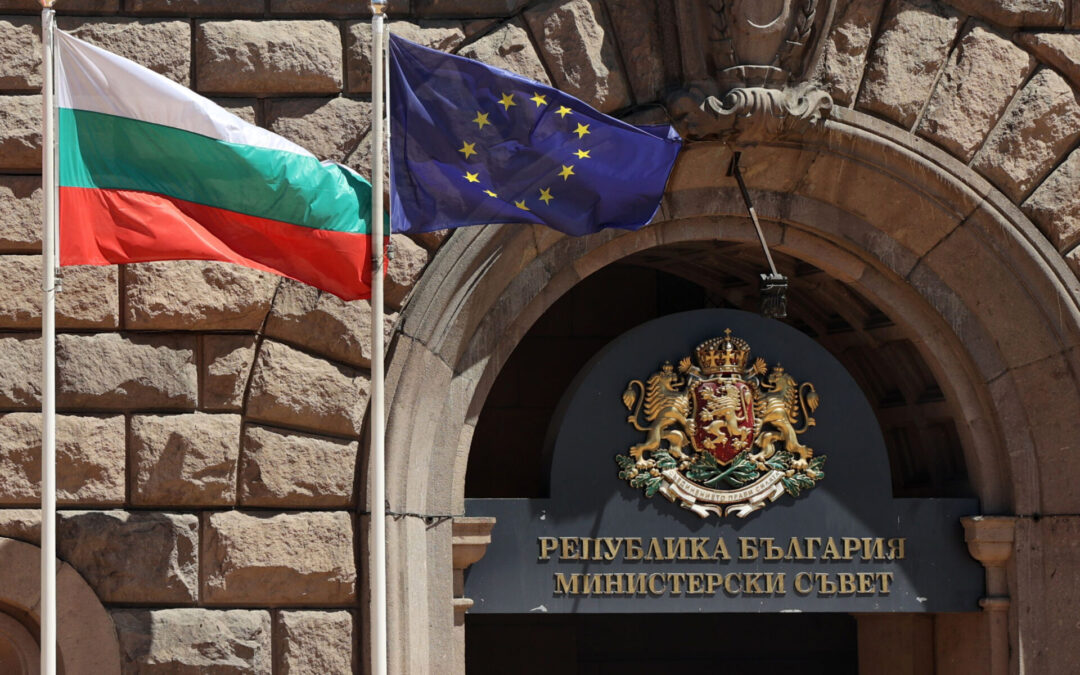
After the December 1 protests, Bulgarian President Rumen Radev addressed the nation, effectively endorsing the demonstrations and calling for the government’s resignation—placing one state institution directly against another, a move that nonetheless reflects the sentiments of a significant part of Bulgarian society. It is worth noting that it was Radev who, through his caretaker government, first brought Kiril Petkov and Asen Vasilev onto the political stage; yet the current protests clearly go far beyond PP–DB.
In his address, Radev stated:
“The long-concealed discontent of Bulgarians has poured into the streets. Thousands in the capital and in larger cities chanted ‘Resignation.’ They were not deterred by the merchants of fear, nor by the cut electricity, nor by the broken escalators in the metro. They were not confused by the attempts of the political class and its media spokespersons to sow division among the demonstrators.”
He added:
“Attempts to portray the protest as a revolt against the budget underestimate the very nature of the event. Claims that it is solely a youth uprising diminish the importance of the process, because the squares were filled with people of all generations.”
In his appeal, Radev also said:
“I address you with the belief that we must not miss this chance to change Bulgaria. Experience tells us why we gathered. History teaches us that every attempt to privatize a protest steals hope from the majority. We will need unity, determination, and wisdom to protect civil peace from provocations.”
And he concluded:
“The government has been discredited; resignation is inevitable; early elections are the only way forward.”
By doing so, he effectively endorsed the protests and called for their continuation. And the protests will continue—new dates have already been announced.
Bulgarian geopolitical analyst Boyan Choukov writes on his Telegram channel that no political party in Bulgaria is capable of mobilizing such a massive turnout, and that PP–DB has nothing to do with the majority of demonstrators, who are predominantly young people and students. It is also significant that in the provinces, rallies were held precisely in cities with major universities. He cites the example of the Plovdiv protest, where a PP–DB representative attempted to address the crowd but was booed and prevented from speaking.
Delyan Peevski has called a counter-protest for December 9.
Another large protest is expected on December 10.
It is important to note that there are people who want the government to resign but refuse to join the demonstrations because they do not want to march alongside PP–DB.
The media technology behind the protests—specially produced songs, memes, and the strong support from outlets such as Radio Free Europe, as well as the promotion of a single visual symbol, the “pig”—increasingly resembles the playbook of color revolutions.