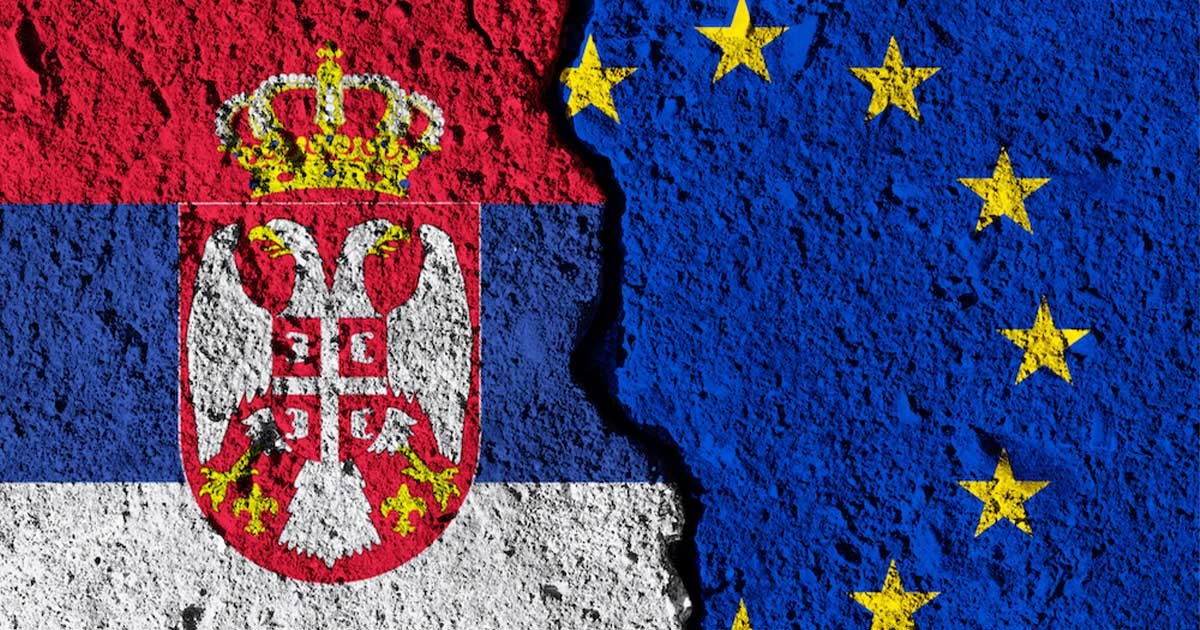
The “European perspective” of Belgrade is becoming increasingly uncertain, conditioned by ever more explicit demands and reform prerequisites. In this context, the announced withdrawal of EU funds and their potential redirection toward the civil sector, as well as strategic frameworks such as the EU Strategy for the Danube Region (EUSDR), create a strong impression that Serbia, in its current constellation and with its foreign policy orientation, does not fit the measure of the West. From the meeting rooms of Brussels these days come relentless messages, shaped into the latest European Commission report devoted to the Serbian government.
EUROINTEGRATION THROUGH THE EYE OF A NEEDLE
Serbia has been formally on the European path for years. According to official data, since 2000, through various instruments of pre-accession assistance (IPA) and other EU funds, Serbia has received more than 7 billion euros in non-refundable aid for reforms in the fields of justice, public administration, agriculture, education, and infrastructure. However, recently, signals from Brussels indicate that financial support could be withheld if the expected progress in judicial reform, the fight against corruption, and media freedom is not achieved.
Another, no less important issue is the alignment of Serbia’s foreign policy with EU positions. In the official 2023/2024 progress report on Serbia, one of the main problems cited is precisely the lack of alignment in the field of foreign and security policy — especially regarding matters related to Russia and Ukraine. This reflects chronic problems: reform stagnation, process fatigue, and a policy leaning toward “playing both sides.”
Formally, however, the report from November 8, 2023, states that “no backsliding has been recorded in any area.” Beyond formalities, Serbia is facing increasing demands:
– It must show concrete progress in institutional independence, the judiciary, and public procurement.
– It must align its foreign policy with that of the EU: impose sanctions on Russia and adopt joint positions.
– It must redirect or channel funds and activities toward civil society, as Brussels increasingly emphasizes “support for the civil sector” as an indicator of genuine democratic transition.
Serbia is at a crossroads: it will either make the imposed adjustments that would allow it to pass through the eye of the needle of the European process, or it will remain “stuck” — formally holding candidate status, but without real, substantial progress. The key demand is the renunciation of Russia.
WITHDRAWAL AND REDIRECTION OF FUNDS?
One of the most intriguing topics is the announcement that funds — which until now have been directed toward state institutions, infrastructure projects, and large investments — could be redirected toward strengthening civil society. Through this, the EU indicates that the money could be allocated for democratic support, which includes financing non-governmental organizations, transparency, and citizen participation.
At the same time, this is a demand directed at Serbia to allow funds to flow into the civil sector, outside strictly state-controlled structures. This serves both to test the level of pluralism and autonomy of sectors outside of government and to apply additional pressure on the Serbian authorities.
Although publicly available sources contain no clear statement that the EU has directly announced a “withdrawal” of funds from Serbia, there is growing discussion about a possible shift in focus. For example, the civil sector in Serbia can participate through the CERV program (EU budget of 1.55 billion euros for 2021–2027), which supports civil organizations in candidate countries, including Serbia. Thus, the goal is not so much the abolition of aid as its “redirection.” If the state wishes to maintain the previous financial flow, it must meet the set conditions — most importantly, turning its back on Russia.
For the authorities in Belgrade, accustomed to administrative control over project allocation, such a decision would create serious pressure. If the EU wants less political control over funds and greater transparency, the rules of the game change. The key question arises: “Is the government ready to let the civil sector act independently — and be paid for it?” And here we come to the next dimension — political pressure.
GEOPOLITICAL ARMOR
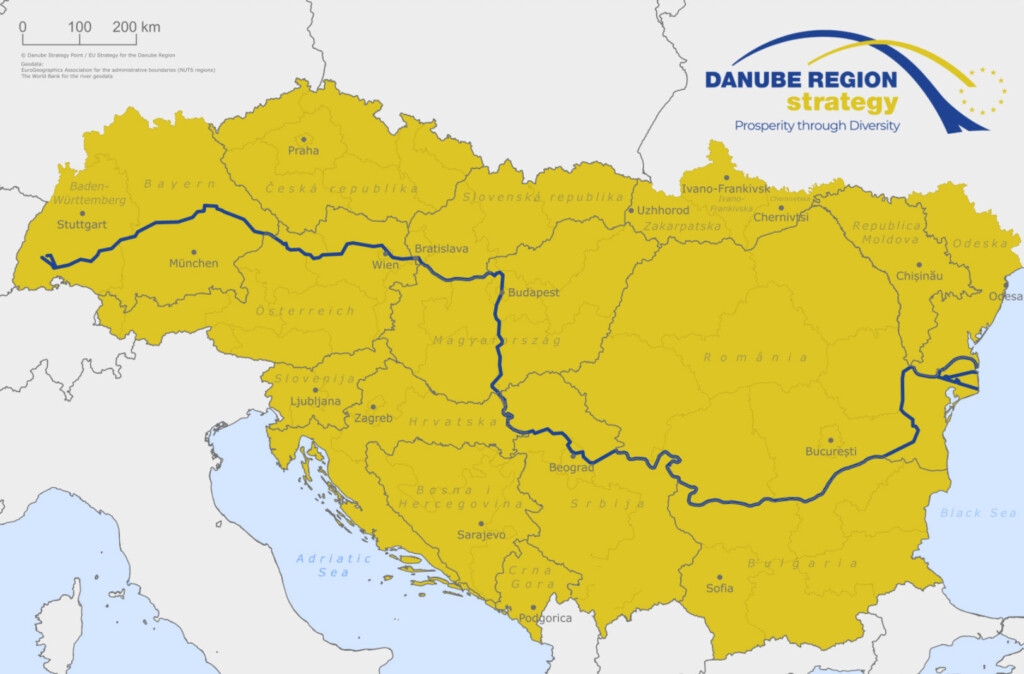
At the same time, while debates continue about European funds and reforms, the macro-regional strategy of the Danube Basin — the EU Strategy for the Danube Region (EUSDR) — is gaining significance. It unites EU member states and candidate countries (including Serbia) under four pillars: connecting the region, protecting the environment, building prosperity, and strengthening the region through institutions.
However, the strategic framework of the EUSDR is increasingly interpreted not only as a tool for regional cooperation but also as a means of shaping a geopolitical agenda. Some authors suggest that the EUSDR functions as a “geopolitical armor against Russia.” In the joint statement of ministers responsible for implementing this strategy, held on October 19, 2022, it is clearly stated: “We strongly condemn Russia’s unprovoked and unjustified aggression against Ukraine…” In other words, this framework is no longer merely infrastructural but also political and security-oriented.
For Serbia, which maintains close relations with Russia — politically, culturally, and in the energy sector — this means additional pressure. Being part of the Danube Strategy also implies a declarative alignment with those who see Russia as a challenge and a threat. Serbia thus faces a choice of positioning itself — either by passively accepting the role of a “club member” with clear geopolitical implications or by adopting a restrained stance that places it on the margins of key decision-making processes.
In other words, Serbia fits “the measure of the West” only to the extent that it accepts the roles the West assigns: to be a bridge toward the Balkans, a factor of stability, to implement the reforms the West expects, and to align its foreign policy accordingly. But such acceptance comes with a price — for that role is both demanding and tightly controlled.
PRESSURE ON THE SERBIAN LEADERSHIP
President Vučić has long been the central figure in Serbian politics — and, in the context of the European path, a key one. But today, both his position and Serbia’s are under mounting pressure. First, internal — through demands for reforms, protests, and the strengthening of civil society — and then external, through messages from Brussels and increasing geopolitical expectations.
Brussels has publicly demanded concrete steps from Serbia. European Commission President Ursula von der Leyen has repeatedly emphasized that “Serbia is the only country in Europe that has not imposed sanctions on Moscow,” while EU High Representative Kaja Kallas stated that Serbia “faces a strategic choice — between East and West.” Reports from the European Commission indicate that reforms in the areas of rule of law and the fight against corruption in Serbia have “stagnated,” further intensifying the political pressure on the government in Belgrade.
In this context, a recent interview President Vučić gave to the German magazine Cicero drew particular attention. The conversation began with a question that has become symbolic of the relationship between Serbia and the West:
“Wouldn’t it be easier for you if you broke ties with Russia?” the journalist asked the Serbian president.
“It’s not that simple. In Serbia, we face problems that other European countries do not,” Aleksandar Vučić replied.
He went on to speak about annual consumption of Russian gas, Serbia’s strong and growing industry, and the fact that 54.5% of the Balkans’ exports to Europe come from Serbia. He explained everything in terms familiar to the Western public — economic and capitalist categories.
THE STING THE EU DOES NOT FORGIVE
The Serbian president’s view of the current geopolitical realignments, which has been closely analyzed by the public and widely reported in almost all Russian media, was as follows:
“Just ask the president of Ukraine, Volodymyr Zelensky, which Balkan country has provided Ukraine with the most financial and humanitarian (!) aid. The answer might surprise you. We want to become a member of the European Union. But you must understand that there are various reasons why we also maintain contacts with Russia. You may be tired of hearing them, but they are important to us.”
When asked about his presence at the Victory Day Parade in Moscow, Vučić offered a brief but powerful historical reflection:
“Look at it from our perspective. Except for 1948 and 1949, every year after the end of the Second World War, we have attended the Russian military parade. Why? Because the Red Army and the Yugoslav partisans liberated Belgrade and Serbia together. That is part not only of Russian but also of our history. And you know, frankly speaking, I see those discussions as a one-sided attack on us. I haven’t met with Putin for three years and three months, and before the war in Ukraine, I met with him at least three times a year. Many European leaders have visited him or spoken to him by phone in the meantime. I have not. But it was my duty to attend that event.”
These quotes clearly illustrate the position Serbia currently finds itself in: caught between the need to demonstrate loyalty to the European path and its historical and economic ties with Russia. It is precisely this balance — which the president is trying to maintain — that has become the central point of criticism from Brussels.
For Vučić, this means he can no longer play for time, as the question of relations with Moscow has become the key measure of his foreign policy stance. For Brussels, it is a test of Serbia’s sincerity on its European path. And for the domestic public, it is a question of national dignity and economic survival.
Serbia now faces a crucial question: how far are we willing to go to become a “Serbia to the measure of the West,” and how much are we ready to build a Serbia on our own terms — even if it lies outside the perfect European map?

IF I FORGET YOU, RUSSIA?
The uncertainty hanging over the heads of Serbs concerns one question: what would happen to Serbia if it renounced Russia and made a decisive turn toward the West? At first glance, the answer seems simple — it would be a signal that Brussels and Washington would welcome, perhaps even reward. But beneath the surface lies a series of deep consequences that would be felt in politics, the economy, and society.
Economically speaking, Serbia is firmly tied to the European market, with over 65% of its exports going to EU countries and only about 6–7% to Russia. However, more than 80% of the gas consumed in Serbia comes from Russia, and the Balkan Stream (part of the TurkStream pipeline) forms the backbone of the national energy system. A complete break with Moscow at this point would mean that Belgrade must secure new sources of supply. This would require massive investments — the construction of new terminals and potential connections to networks in Bulgaria or Greece. In the short term, it would almost certainly lead to a rise in energy prices and increased pressure on the national budget.
Politically, such a step would represent a turning point. Brussels would interpret it as proof of a clear commitment to European values. Stronger support for reforms and new financial assistance packages might follow, but so would greater expectations in terms of “foreign policy alignment.” In other words, Brussels would demand not only a declarative but also a practical distancing from all Russian economic and security structures within the country.
INTRODUCTION TO NEW DIVISIONS
The internal impact would be even more significant. Public opinion in Serbia views Russia unreservedly as a “traditional ally” and a defender of Serbian interests in the UN Security Council. A complete renunciation of that bond could trigger a wave of discontent, new protests, and fresh political divisions. For the government in Belgrade, it would mean a loss of support, particularly among conservative and nationally oriented voters. In the context of the current protests, it would be political hara-kiri.
On the other hand, Moscow’s response would not be absent. At the very least, it would involve the suspension or limitation of energy cooperation, the withdrawal of Russian capital from certain sectors (such as the oil industry or railways), and a shift in its stance within the UN Security Council regarding Kosovo’s status. This last point makes Serbia–Russia relations especially sensitive, as Moscow, along with China, has so far been the only reliable partner that has not recognized Kosovo’s independence and has repeatedly used its veto power on documents unfavorable to Belgrade.
There also remains the question of whether Serbia would, in reality, gain accelerated EU membership. Judging by the experience of other Western Balkan states, the path would still be long, filled with conditions, monitoring, and reform requirements. The only difference would be that Serbia would lose its strategic foothold in the East without yet gaining a full seat at the table in Brussels.
Serbia might earn more sympathy within European institutions, but it would face internal upheavals, rising costs, and the loss of one of its few remaining geopolitical advantages — its relationship with Moscow.
Therefore, it is most accurate to say today: Serbia stands not only before the wall of Brussels but also on the brink of losing its balance. Any move to one side or the other carries its own price — economic, political, and, if we are to be honest, historical.