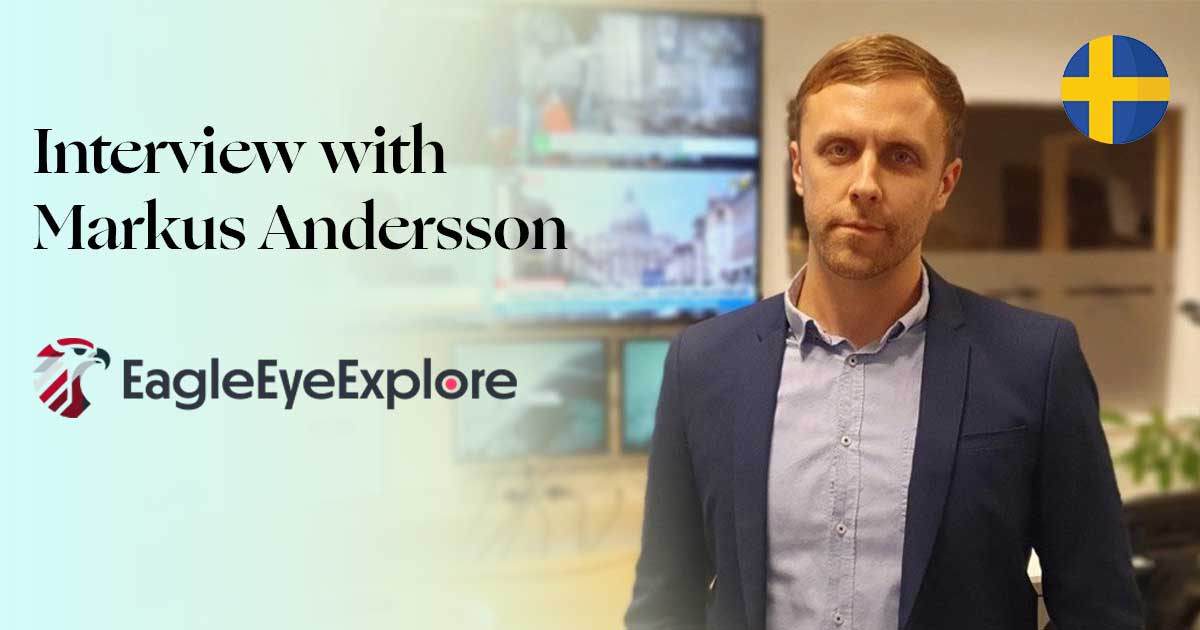
I have known Swedish journalist Markus Andersson for several years now, and I gladly read what he publishes, because he does so with a thorough understanding of the topics he writes about, with professional balance and without calculation.
Unfortunately, the reason for this conversation is not the exemplary reporting of the media outlets that Markus Andersson edits, but rather the pressures these independent, truly autonomous media are facing.
The media outlets edited by Andersson, which are not part of the Swedish media chorus but instead have authentic and notable solo performances, recently had their bank accounts blocked, putting the survival of these independent media at risk.
One would think that in a country such as Sweden—whose name in Serbia and the Balkans we often use when we want to highlight the highest economic, social, and overall living standards—such a thing would not be possible.
People in Serbia and the Balkans are not very familiar with your newspaper Nya Dagbladet, which is published in Swedish. On the other hand, your online edition The Nordic Times is available in English and therefore accessible to us. Could you explain the context? What kind of newspaper is it, and what makes it distinctive on the Swedish media scene?
Nya Dagbladet is a Swedish daily newspaper founded in 2012. From the very beginning, it has maintained a consistently independent profile, which makes it quite unusual within the Swedish media landscape. We are not part of a large media group, we are not owned by venture capital or industrial interests, nor are we affiliated with any political party, either in Sweden or abroad.
What sets Nya Dagbladet apart is our effort to maintain a truly free and intellectually honest journalistic line in areas where the Swedish media climate is often strongly shaped by ideology and establishment consensus. This includes geopolitics, war and peace, Russia, China, and Iran, as well as issues of health, personal integrity, surveillance, self-sufficiency, culture, and the deeper direction of societal development.
During the COVID period, for example, we questioned lockdown policies, mass vaccination, vaccine contracts, and reports of side effects at a time when this was highly unusual in Sweden. We have also sought to maintain a more neutral and fact-based approach to international conflicts, including Ukraine, and the broader geopolitical shift currently taking place in the world.
Our ambition is not to create polarization or “clickbait,” but to provide serious journalism that helps people navigate reality, make better decisions, and gain a deeper understanding of society. Nya Dagbladet is a broad publishing project covering politics, economics, culture, health, spirituality, and personal development. The Nordic Times is our international English-language edition, with a similar foundational approach, but as a separate editorial product with its own profile, audience, and contributors.
When in Serbia we say “independent media,” we usually mean media funded by the United States or the European Union, or by national foundations from EU member states. Such media, under the banner of high journalistic standards and independence, in reality quite visibly contribute to the political agenda of their financiers. What does it mean in Sweden to be an independent media outlet?
For us, independence has a very concrete meaning. It is not enough to call oneself independent. One must truly be free from the actors that usually influence media: the state, political parties, large corporate groups, venture capital, industrial interests, or foreign financiers. Nya Dagbladet has no such dependencies. We are politically unaffiliated and have no owners with an external political or industrial agenda.
We have also not been able to rely on Swedish state press subsidies. On the contrary, we have been denied support, even though we objectively met the criteria. This says something about how the Swedish system functions in practice: even formally neutral support mechanisms can be used in ways that disadvantage media that do not fit within the dominant corridor of opinion.
Our independence is reflected in our reporting. We are able to follow the facts wherever they lead, to reassess issues when new information emerges, and to report on uncomfortable topics without first considering whether a financier, a political party, or a powerful interest might feel offended. For me, that is the true meaning of independence.

Your newspaper Nya Dagbladet was denied banking services by the bank in Sweden through which you operate. What exactly happened?
The conflict began at the end of 2022, after we had maintained a functional banking relationship for about three years with Länsförsäkringar Bank. The broader context was that the journalism of Nya Dagbladet had attracted international attention. An American nonprofit philanthropic foundation, dealing with issues such as nuclear risk, artificial intelligence risks, and other major global concerns, gained trust in our work and proposed that we establish a Swedish foundation that would support independent journalism such as that represented by Nya Dagbladet.
The foundation was meant to be independent from the newspaper, although some of the people involved were naturally the same. We informed our bank about the entire process—the purpose, the donor, and the planned structure. The bank was thus involved throughout the entire process and, as we understood, had internally reviewed the key elements.
When the foundation was established and transferred its initial capital into the account, the bank suddenly froze the foundation’s account and the funds in it. No reasonable explanation was given. Soon after, the bank began taking measures against the media company behind Nya Dagbladet, then against an IT company within the same group, and finally even against the private bank accounts of members of the editorial team.
The consequences were extremely serious. By freezing and closing the accounts, the newspaper was prevented from receiving advertising payments and other income, and we were unable to pay rent, salaries, and invoices in the usual way. We were practically just a few days away from technical bankruptcy. At the same time, we were trying to find new banking solutions and engaged lawyers, as we believed the bank had violated both its own rules and Swedish law.
What was the reason your funds were blocked? Was it pressure from certain centers of power on your independent position—as you mentioned while preparing this interview that it appears a third party may have intervened—or is it something else?
Formally, the bank used so-called “Know Your Customer” (KYC) procedures as its instrument. We were required to answer questions about hundreds of transactions and to provide extremely extensive documentation. We experienced this as an administrative overload attack rather than a standard banking review.
The key point is that we were able to explain the transactions. The bank was not able to point to a single transaction that was illegal or even substantially suspicious. There was no police report, no criminal charges, nor anything the bank could present as unlawful or in violation of its own rules. Nevertheless, the funds were frozen and the accounts were closed.
An important detail is also the timeline. The bank did not reject the project from the outset. On the contrary, it followed the process, received information about the foundation, its purpose, and its donor, and allowed the account to be opened and the initial capital to be deposited. If it had considered the project unacceptable from the beginning, it would have been reasonable to reject it immediately. The fact that it first participated in the process and then, at the last moment, froze the account and proceeded to take measures against the entire media organization makes the situation highly suspicious.
We cannot say with certainty who may have contacted the bank or which exact interests were involved. But in our assessment, this was not a routine customer review process. It more closely resembles an intervention by an actor with significant resources or influence. What may have been perceived as a threat is the fact that a truly independent Nordic newspaper would receive funding to expand its work.
This must also be understood in the context of Sweden. Sweden has long had strong informal power structures and deep ties to United States strategic interests. The country’s rapid path toward NATO shows how strong that orientation has become. In that context, it is not unreasonable that newspapers maintaining an independent and neutral line on issues such as Russia, China, war, peace, and geopolitics may be perceived as a problem by powerful interests.
Your claim that your personal bank accounts were also targeted seems particularly important. What exactly happened?
The method was similar, although private accounts were not frozen in advance in the same way. The bank closed my personal bank accounts, as well as those of our news editor Isak Boman, as part of a broader attack on the media organization.
What was striking is that the bank did not provide any specific reason. Under Swedish law, private individuals have stronger protection than companies: the bank must have grounds and usually must state them, and certain notice periods must be respected. In our case, the bank did not even comply with the legally required 30-day notice period. Such rapid and severe measures are normally associated with very serious situations, such as suspicions of terrorism or organized crime. Of course, no such accusations existed.
This also points to a broader problem in Sweden. Banks have become extremely arrogant toward ordinary clients, small entrepreneurs, and smaller organizations. There are no state-owned banks, and there is no practical guarantee that an individual or company can obtain or retain a bank account—even though a bank account is essential for functioning in modern society. Legal protection is weak, especially for companies, but private individuals are also vulnerable.
Did you encounter support from colleagues in Sweden or from the European Federation of Journalists? What do your journalistic associations say?
Support from media colleagues and major institutions in Sweden has been very limited. A few smaller and independent media outlets reported on the case, as well as one left-wing newspaper, but the main media institutions have largely remained silent.
We have not seen clear engagement from the Swedish financial supervisory authority, nor from journalistic organizations. When we requested comments, the response was often silence or “no comment.” This is striking, because this case does not concern only Nya Dagbladet. It raises a fundamental question: can banks in practice shut down a media outlet simply by closing its accounts?
Part of the explanation likely lies in the nature of the Swedish media landscape itself. It is highly concentrated, with very few truly independent media outlets. Many local newspapers have been acquired by large media groups, and there are also foreign ownership interests. This creates a narrow and polarized environment in which few are willing to stand up in defense of a media outlet that deviates from the dominant line.
You mentioned during the preparation of this interview the support from your readers, which we can agree is extremely important. I also read somewhere that you managed to raise the funds needed for legal expenses. What do your readers say about the situation you found yourselves in regarding the bank’s attempts to deny you its services?
Reader support has been decisive. Many people donated money to ensure our survival and to allow us to continue the legal proceedings. But the support was not only financial. We received a large number of emails, phone calls, and personal messages from people who were shocked by the bank’s behavior.
For many readers, our case has become symbolic. In recent years, more and more ordinary people and small businesses in Sweden have experienced arbitrary treatment by banks. Because of that, many see our legal case as something that does not concern only Nya Dagbladet, but also their own right to participate in society without being arbitrarily excluded from the banking system.
That is precisely why we decided to go all the way. We are not pursuing this case only for ourselves, but also to draw a line against the abuse of power by banks.
You also mentioned some positive signals observed during the ongoing legal procedure. Do you expect the court to recognize the importance of freedom of journalism, which should be able to operate without obstruction?
We have received some positive signals during the process. The bank initially tried to avoid the substance of the case and to completely withdraw from the lawsuit, but it did not succeed. That was an important partial victory.
At the same time, our view of the Swedish legal system is, unfortunately, not very optimistic. The system is heavily burdened by rising crime, gang violence, and overcrowded detention facilities, which, among other things, has led to our case being postponed for another six months. There is also a worrying degree of politicization, especially at lower court levels. We have seen many cases in Sweden where courts do not appear as secure and independent as one would expect.
Of course, we hope that the court will understand that this is a matter of principle involving freedom of the press, freedom of association, and the ability of independent journalism to survive. But nothing can be taken for granted.
I enjoy reading your online English-language edition The Nordic Times. I don’t believe in absolute objectivity, but I deeply respect when editors, without hesitation, give space in their media to everyone relevant to present their views in a respectful manner. Why did you establish The Nordic Times, and what does the media landscape in Sweden look like? Are Swedish media open to all topics and professional to the extent I mentioned—that everyone can freely and politely express what they have to say?
The Nordic Times was founded because we identified a clear gap. Despite the presence of large and well-funded media outlets in the Nordic countries, there was, in practice, no English-language daily with an international orientation and a genuinely independent profile. The Nordic Times is therefore an extension of our publishing work through Nya Dagbladet, but at the same time a separate product with its own profile, audience, and contributors.
We noticed real international interest in such a voice. Readers have found the publication not only in Sweden and the Nordic region, but also in the United States, China, Germany, United Kingdom, and other parts of Europe. There is a clear demand for factual, well-structured, and well-researched journalism—without sensationalism and without the strong ideological filtering that often characterizes major media outlets.
The Nordic media landscape, like the Swedish one, is highly concentrated. There are very few truly independent media outlets. Swedish media have also often been oriented toward preserving a certain international image of Sweden: that of a moral model, a highly lawful society, and a kind of humanitarian conscience. At the same time, those same media have often downplayed or minimized serious social problems, including rising crime, insecurity, and the consequences of highly irresponsible migration policies.
When Nya Dagbladet and The Nordic Times reach readers outside Sweden, they also influence the perception of Sweden and its political establishment. I believe that is one of the reasons why our work has been perceived as unsettling by parts of the establishment.
I asked the previous question with the European Union in mind, where some media outlets have been banned. Three years ago, my wife and I visited Rome and met a couple from France. Without exaggeration, they were first completely surprised, and then delighted, that in Serbia it is possible to freely access virtually all media services—from Russia and China to the United States, the European Union, the Middle East, and other parts of the world. That, of course, does not mean the Serbian media scene is without major flaws. Does media censorship exist in what we call the West? I ask because censorship or media control does not always have a strict legal face that clearly dictates what can and cannot be published. It has many forms and faces. It seems to me that in this conversation we have touched on a type of pressure on media that is hidden behind well-known “banking smiles.”
Yes, censorship certainly exists in the West, but it often looks different from classic state censorship. In the EU, we now have direct examples, such as the blocking of Russian media and domains following the escalation of the war in Ukraine. This has significantly limited the ability of ordinary people in Sweden and across Europe to access different perspectives and form their own judgments.
However, the most common form of censorship in Sweden is more informal. It operates through uniformity, social stigmatization, economic pressure, and institutional barriers. Individuals and media outlets that deviate from the accepted line may be excluded, discredited, or deprived of the practical ability to function. The denial of state press support to a media outlet that meets the criteria is one example. Allowing banks to arbitrarily close the accounts of media companies is another. There are also legal risks and regulations that make certain types of reporting more difficult—for example, reporting on migration, crime, and other sensitive social issues.
As a result, many journalists and media outlets engage in self-censorship in advance. They know which topics are “dangerous,” which formulations may create problems, and which perspectives may lead to them being labeled unacceptable.
In this way, censorship in the West often has a friendly face. It does not always appear as a formal ban on paper. It can come through banks, advertisers, platforms, subsidy bodies, social stigma, and media campaigns. The effect, however, is the same: certain perspectives are pushed out of public discourse.

Some media outlets in the Balkans loudly claimed a few years ago that China would seize natural and infrastructure assets from Montenegro because the country could no longer repay its infrastructure loans. This was announced and “explained” for months, yet it never happened. Montenegro eventually reached an agreement with China and managed to restructure its debt, but no media follow-up ever came. That bubble of misinformation simply remained in the public space. How well is the public in Sweden informed about countries like Russia or China—and potentially tomorrow India and others? Or are we in Europe condemned to understand these countries through controlled narratives that are not necessarily accurate?
Public opinion in Sweden regarding Russia and China is shaped by a very one-sided media environment. Russia, in particular, has been heavily demonized, especially after Sweden’s alignment with NATO and EU security policy, as well as the war in Ukraine. In my view, the climate has often been not only anti-Russian but, more broadly, anti-Slavic—even though at the same time the narrative presents Sweden as one of the greatest supporters of Ukrainians.
This has affected not only the Russian state but also ordinary Russians living in Sweden or visiting as tourists. Sanctions and the breakdown of normal relations with Russia have had tangible consequences for Swedish citizens and businesses, particularly through the energy crisis and rising costs. Yet the public has often not been honestly informed about why people are becoming poorer, nor about the role played by cutting off Russian energy and normal trade relations. Instead, the debate is framed in moralistic and simplified terms.
A similar pattern—though expressed somewhat differently—applies to China. Sweden remains economically deeply connected to China, yet public discourse often pretends that China can simply be ignored or treated solely as a threat. At the same time, China has in some respects been more open toward Sweden than Sweden has toward China—for example, by allowing visa-free entry for Swedish citizens, while Sweden has not offered the same to Chinese nationals. This illustrates the imbalance that often characterizes the Swedish establishment’s approach.
Nya Dagbladet has tried to fill a major information gap in this area. We began increasing our coverage of Ukraine, Russia, and the broader geopolitical conflict as early as 2014, after the Maidan events and the start of low-intensity warfare. We have also extensively covered China and the emerging multipolar world.
Our position is not “pro-Russian” or “pro-Chinese” in any simplistic sense. It is neutral, factual, and independent. However, in Sweden even neutrality is often considered unacceptable if it challenges the dominant Western narrative. This makes our position almost unique in the Nordic media landscape.
Even many so-called independent media outlets in Sweden do not maintain a truly neutral stance on Russia, China, or the broader geopolitical transformation now underway. We believe that Swedish and Nordic readers need to understand that a multipolar world is not a theory—it is already taking shape. The West must catch up with reality.
The situation is serious. Many people are becoming poorer and insufficiently informed. But we also see reasons for hope. More and more people are “waking up,” questioning dominant narratives, and seeking independent sources. This is not a top-down change, but a bottom-up one. Nya Dagbladet and The Nordic Times are gaining increasing attention because people recognize the need for journalism that is not controlled by dominant narratives. Change will take time, but we believe it will come through the work of genuinely independent media and engaged readers.
Finally, I would like to thank you for drawing attention to these issues in Sweden and the Nordic countries!