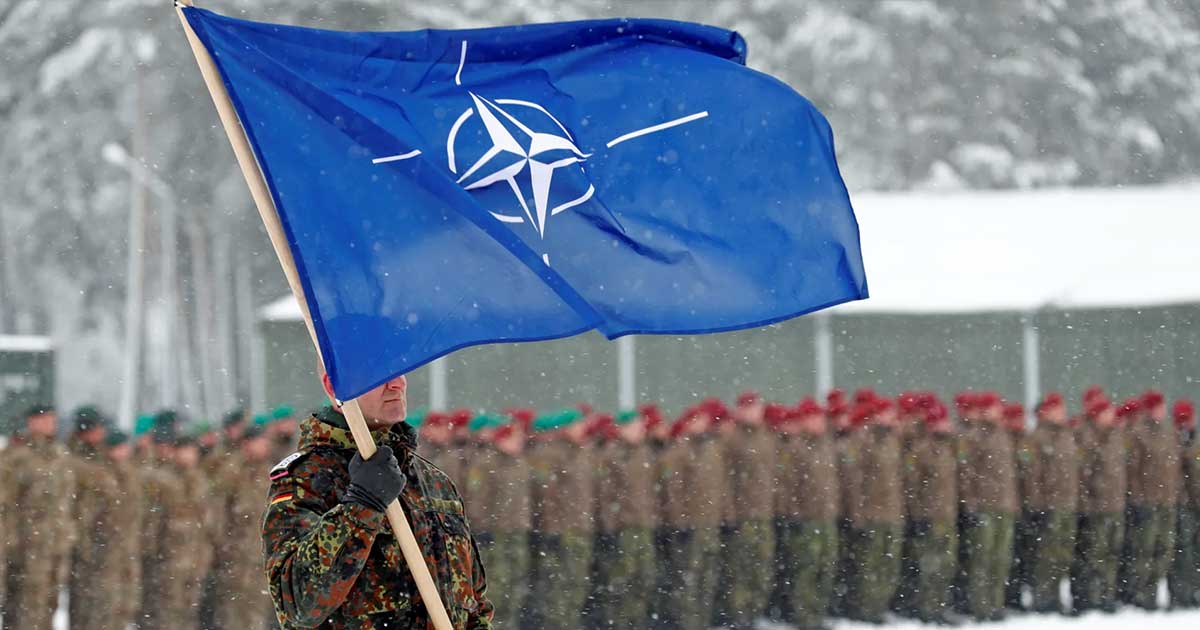
If the former Soviet satellites of the Cold War era, rushing into the embrace of NATO and the EU after the fall of the Berlin Wall, believed that they would find comfort and security in the “den” of their new patron, they were bitterly mistaken. Within these organizations of “Western Civilization” (Samuel Huntington), they expected milk and honey—above all democracy, economic prosperity, and a cheap “security umbrella.” But what did they actually receive?
They received tragicomic, orchestrated elections in which the winner is usually the one who is supposed to win—that is, the candidate preferred by Washington, Brussels, London, or Berlin. They received a new form of limited sovereignty, one that requires the disciplined implementation of a “common foreign policy,” which is, as a rule, contrary to national interests. They received “debt slavery,” “wild” privatization, and the sell-off of economic assets to foreign owners. They received general decadence, the growth of social pathologies, the displacement of spiritual and moral values in favor of consumerism, and demographic decline of catastrophic proportions. And they were met with something they had feared only in their darkest forebodings—a steadily rising price and increasingly risky obligations within a military alliance where membership implies not only the unquestioning acceptance of foreign bases on national territory, the purchase of expensive weapons, and counterproductive confrontation with other countries and great powers, but also participation in wars aimed at advancing the objectives of the “Empire.”
“WHEN IT’S TIME TO DRINK — OH-HO-HO, BUT WHEN IT’S TIME TO PAY — WHAT’S THAT?”
All of this might somehow be tolerated and endured as long as the shooting is taking place in someone else’s country. The former Central European and Balkan signatories of the Warsaw Pact, now loyal subjects of the North Atlantic Alliance, naively believed that the proxy war would remain confined to the Ukrainian theater. Lulled by Westernization, they thought they would remain untouched, even that they would profit like vultures from another nation’s misfortune—territorially as well, through the western regions of Ukraine. They forgot one elementary fact: that they are situated along the historical and geopolitical zonal boundary running through the heart of Europe from north to south, that is, along the transgressive-regressive frontier between East and West. This belt, stretching from the Baltic to the Mediterranean, appears in geopolitical theories, concepts, and practical doctrines under various names and territorial configurations—Sanitary Cordon, Zone of Dilemma, Intermarium, Zone of European Neutrals, Gray Zone, Gateway Region, Conflict Belt, New Europe, Middle Europe, Greater Eastern Europe… Yet it always serves a similar function: that of a buffer zone.
Such geopolitically sensitive areas, as a rule, pay a high price for their position. That price is reflected in the creation and disappearance of entire states, shifting borders, political instability, revolutionary changes of government, foreign interventions, religious and national conversions, abrupt ideological realignments, transitions from one sphere of influence to another, economic crises, armed conflicts, destruction, and enormous human losses. The same is true today, since these countries find themselves on the “front line.” The newest “Eastern Front” no longer implies that projectiles fall only on the regions of Donetsk and Luhansk, on Kharkiv, Kyiv, and Zaporizhzhia, or, alternatively, on Kursk, Belgorod, Crimea, Moscow, and Saint Petersburg. Countries located within the contact zone and directly or indirectly involved in the conflict on the side of the West are increasingly exposed as well—Lithuania, Latvia, Estonia, Poland, Moldova, Romania, Bulgaria, and others. The principal instruments now “in play” are drones of various types and purposes—long-range drones, swarm systems, naval drones, and others. They strike targets, miss them, are shot down, fall due to electronic jamming, or are diverted from their intended courses. Some are of NATO origin, some Ukrainian, some Russian, and some from other sources altogether.
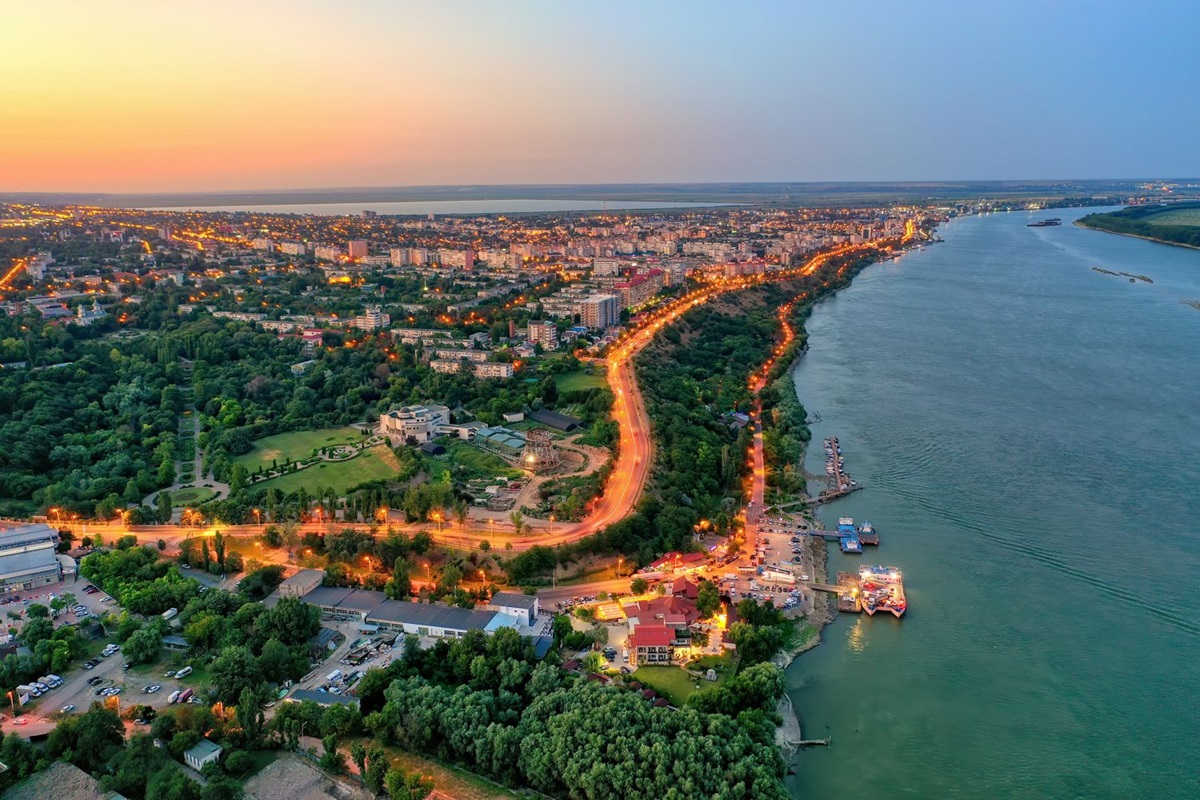
THE GROWING IMPORTANCE OF GALAȚI AND OTHER DANUBE PORTS
A precedent, a paradigm-shifting and far-reaching change—a “new reality”—was heralded by the crash of a drone into a residential building in the Romanian city of Galați at the end of May 2026. Galați (pronounced Galați by Romanians) is an important city on the left bank of the Danube in its lower course, approximately eighty kilometers from its deltaic mouth into the Black Sea. It occupies a distinctive and favorable position—at the point where Europe’s second-longest river makes a large bend and changes its orientation from south–north to west–east. Galați lies at the confluence of the Siret, a left-bank tributary, with the Danube, and not far from the Prut, another left-bank tributary of the river. It is located only about ten kilometers from the tripoint (in the Danube riverbed) of Romania, Moldova, and Ukraine. It is the most populous Romanian city on the Danube, with around 200,000 inhabitants (more than, for example, Niš), home to Romania’s largest steelworks, a shipyard established at the end of the nineteenth century, and the country’s most important river port. The city’s importance was only partially reduced by the construction of a “shortcut”—the Cernavodă–Constanța Canal—which shortened the navigable route by approximately 400 kilometers (the main route was completed in 1984).
It is difficult not to notice that over the past several months drones have increasingly been falling on NATO’s forward-positioned member states—all three Baltic countries, Finland on several occasions, and even a naval drone discovered near the Greek Ionian island of Lefkada. The drones that struck two Azerbaijani cargo vessels in Russia’s Taganrog Bay in the Sea of Azov killed five crew members and wounded three others. It is indicative that these incidents have generally involved drones launched by the Ukrainian side, which has routinely justified them as unintended mistakes, understandable wartime incidents, electronic course deviations caused by Russian actions, and similar explanations.
What is the broader contemporary geocommunicational, geopolitical, and geostrategic significance of Galați in the context of the war in Ukraine and the downing of the aforementioned drone? As expected, Russia was immediately blamed for the crash of the drone. Russia responded logically that no evidence had been presented to support the accusation. According to reports, the drone was of a Russian type—which does not necessarily mean it was launched from Russian positions—and had been diverted from its course by a Ukrainian air-defense strike above the city of Reni, another important port located on the left bank of the Danube, this one in Ukraine. Further downstream, along the Kiliya branch—the navigable northern channel of the Danube Delta that also forms the Romania–Ukraine border—lies the Ukrainian port city of Izmail, which has already been subjected to air strikes, and closer to the river mouth, the town of Kiliya itself. Nor should the possible importance of Giurgiulești be overlooked—a small town and modest port in politically fragile Moldova. Although Moldova’s access to the Danube is only 430 meters long, it is nevertheless sufficient to make it a Danubian country. It is evident that the “specific weight” of the Lower Danube ports is increasing as navigation in the Black Sea becomes ever more risky. And this applies not only to civilian and commercial shipping, but even more so to military maritime activity.
ROMANIA IN A DIFFICULT POSITION
Were Galați, the damaged apartment building, and the two injured civilians merely “collateral damage”? The incident was interpreted as an attack on Romania—a member of the European Union and, more importantly, a member of NATO—which could potentially trigger far-reaching consequences. Brussels officials reacted swiftly, and considerably more loudly than their counterparts in Washington. Statements quickly multiplied, claiming that “European airspace had been violated,” that “the sovereignty not only of Romania but of the European Union had been threatened,” that “Russia has long ceased to respect borders,” that it was necessary to “provide Kyiv with additional financial and military assistance,” and that “investment in Europe’s defense must be increased.” At the same time, direct Russian-Ukrainian military operations are evidently spreading into the Budjak region, moving ever closer to the Danube Delta and the Romanian-Ukrainian border.
Romania itself is deeply involved—both directly and indirectly—in the Ukrainian conflict and in the broader competition for influence in the Black Sea basin. Its orientation is strongly anti-Russian, making it a clear representative of the West and, in geopolitical and geostrategic terms, the southeastern cornerstone of the Atlanticist Three Seas Initiative. Romania has placed its territory, territorial waters, airspace, and other capabilities at NATO’s disposal.
For example, the Alliance has undertaken the expansion and extension of the runway at the strategically positioned military base near the town of Câmpia Turzii, not far from Cluj, on the Transylvanian Plateau.
Likewise, near the town of Deveselu, approximately fifty kilometers southeast of Craiova in the Wallachian Plain, construction began in 2014 on a NATO missile base within a former Romanian Air Force installation dating from the Warsaw Pact era. The purpose of the facility was to deploy systems designed to counter intercontinental ballistic missiles and intermediate-range missiles. Russian officials characterized this move—as well as reports that a portion of the nuclear warheads stationed at the Incirlik base in Turkey could be relocated there—as both a threat and a legitimate target in the event of a conflict. One detail is worth noting: Deveselu is located only 150 kilometers from the border with Serbia.

THEN CAME CONSTANȚA…
That the situation had become far more serious, that something much larger was gathering beyond the horizon, and that Galați had merely been a prelude, became clear in early June when a naval drone struck port facilities in Constanța, while several others were reportedly detected operating nearby.
Constanța (with a population of approximately 250,000) is Romania’s largest Black Sea port. It serves as the starting point of Pan-European Transport Corridor IV, the Danube River Corridor VII, and the most important trans-European waterway connecting the North Sea with the Black Sea. It is also the hub of Romania’s principal railway route, the “Sun Highway” motorway, oil pipelines connecting the country’s interior to coastal terminals, and major petrochemical facilities located along the seashore.
The city hosts a naval base and, 26 kilometers northwest of the urban area, the dual-use civilian and military Mihail Kogălniceanu Airport, equipped with a 3,500-meter runway. It is not difficult to guess that the modernization and expansion of these facilities were carried out under the sponsorship of the United States. As a result, Constanța has rapidly increased in importance as a strategic launching platform for Western activities in the Black Sea, Caucasus, and Caspian regions. Its significance has grown especially since Russia’s incorporation of Crimea and the outbreak of the Ukrainian proxy conflict.
As for the strike on Constanța—according to the author’s interpretation, all doubt has been removed—it was carried out by a Ukrainian drone. Likewise, the vast majority of other “stray drones” that have crashed in the territories of so-called allied countries neighboring or located near Ukraine have also, according to this interpretation, been Ukrainian. This raises an unavoidable question: Is Kyiv grasping at a last straw by attempting to draw all of these countries into its war with Russia? Above all, Romania. For its own benefit—and, of course, at the expense of others.