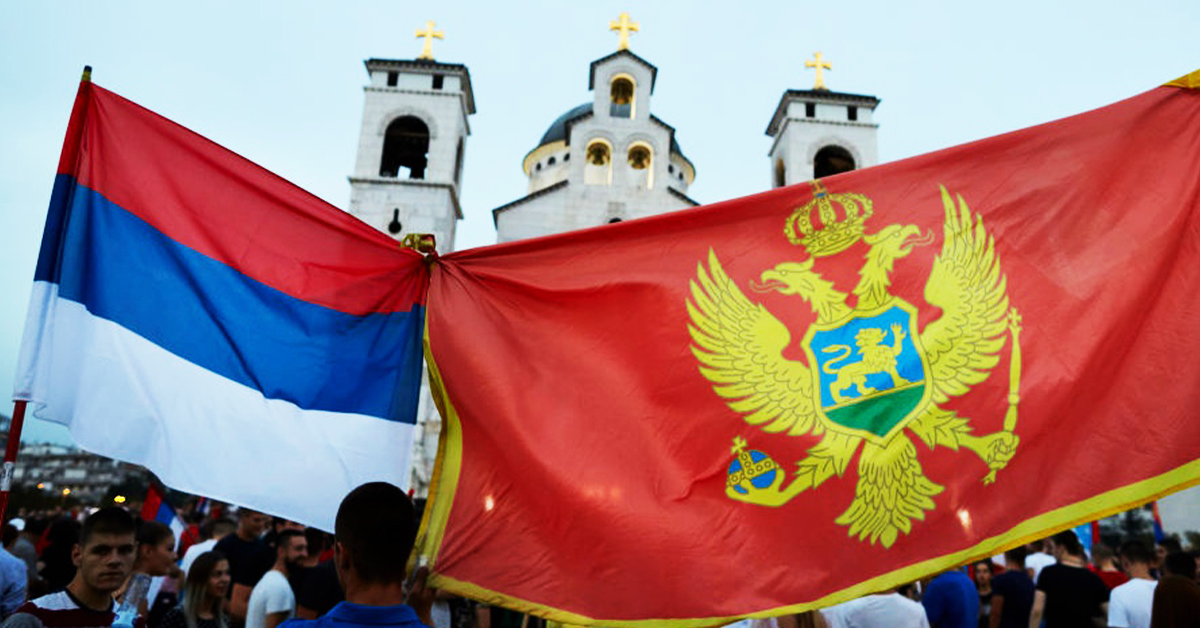
Compromises that Serbian politics in Montenegro obviously must accept at this moment are tied to the key gains that the Collective West managed to secure during Đukanović’s rule and its then-global hegemony. As I already pointed out in the previous text, these include state independence, Montenegro’s membership in NATO, European integration, and the recognition of the so-called Republic of Kosovo. The necessity of political compromise in these matters is directly connected to the electoral and parliamentary strength of the Serbian political option in Montenegro, which after twenty-four years of discrimination and marginalization is participating in the exercise of power for the first time, but it is also connected to the dominant reliance on Brussels by the central state of the Serbian people, which reduces the room for maneuver of Serbian politics in the region.
TOLERATING EURO-ATLANTIC GAINS
The situationally compromised acceptance in the public sphere of these inherited coordinates of Montenegrin political life should not, however, in the consciousness of the Serbian political and intellectual elite in Montenegro, be equated with permanent passive reconciliation. The temporary nature of compromise with evil and injustice is indicated by Njegoš’s wisdom — evil is endured out of fear of something worse. Interpreting these verses from The Mountain Wreath, Saint Bishop Nikolaj says: “By enduring evil, all living beings expect liberation from evil and hope for a happier life, not only on the other side of the grave, but also on this one. All living beings sigh under the yoke of suffering, but all live in hope of the imminent arrival of happiness.” In other words, a temporary compromise with evil and injustice makes sense only if one knows why evil is being endured. Endurance without meaning and hope for victory is nothing other than slavish submission.
Thought-out compromises (that is, tolerating the key Euro-Atlantic gains in Montenegro) first of all presuppose the existence of an assessment of the degree of damage caused by individual compromises, because not all compromises are equally painful and harmful, not only for Serbian national policy in Montenegro, but also for the Serbian nation as a whole.
The least damage to Serbian national policy can be caused by a compromise with the fact of Montenegro’s state independence, because Montenegrin state independence, as history shows, does not necessarily have to diverge from the Serbian national idea. In other words, Montenegrin statehood does not have to be, as historically it was not, a negation of the Serbian nation in Montenegro.
A CONSTITUTIONAL AGREEMENT SIMILAR TO THE BELGIAN MODEL
Within the current “civic” constitutional framework, which serves exclusively the assimilation of Serbs into a political Montenegrin nation and does not correspond to the social reality of Montenegro as reflected in the latest census, Montenegrin statehood acts as a negation of the Serbian national identity of a huge number of Montenegrins (the relative majority which, through the official language, nationally identified itself as belonging to the Serbian corpus). Montenegrin statehood, and together with it Montenegrin society, can only be stabilized and emerge from the current state of high polarization under the condition that the existing assimilationist constitutional framework is changed. A new constitutional agreement of majority Montenegro would, for the sake of such social and state stabilization, have to separate national from state identity, and constitute the state as a community of two constituent peoples – national Serbs and national Montenegrins – within a constitutional model of governance similar to the Belgian one. This would have to be the medium-term goal of Serbian national policy in Montenegro, which, in the event of a new electoral victory of the current ruling coalition, would be addressed after the 2027 elections.
The Serbian parties that are part of the current ruling majority can hardly initiate constitutional revision before the 2027 elections without jeopardizing the survival of the ruling coalition programmatically founded on the “Barometer 26” platform. However, this cannot prevent them from announcing to their electorate before the elections what they intend to undertake after the 2027 elections, should they remain in power. Voters should be convinced that they are part of a clear and firm political project, one that is not abandoned and on which work is carried out daily, above all in accordance with political strength that is directly proportional to the degree of electoral support.
MEMBERSHIP IN NATO LESS HARMFUL THAN MEMBERSHIP IN THE EU
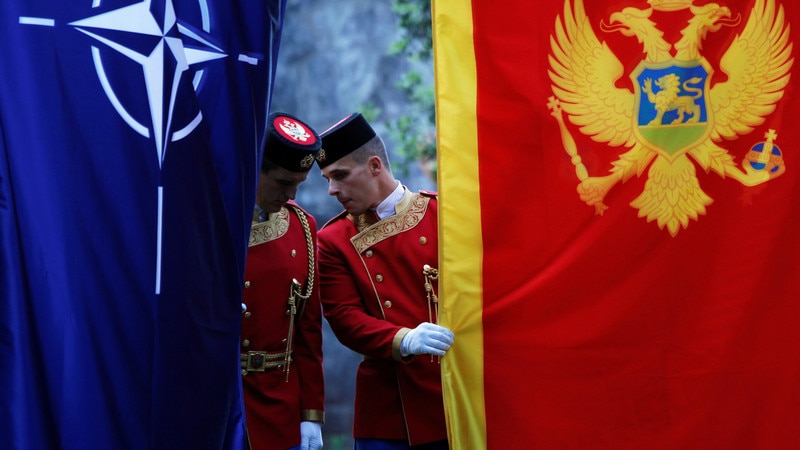
The compromise acceptance of Montenegro’s membership in NATO by Serbian political parties is considerably more painful from the perspective of the Serbian national interest as a whole. This is already due to the fact that the inclusion of the countries of former Yugoslavia into NATO serves exclusively the pacification of the Serbs as “little Russians,” while pacification above all implies the liquidation of the key preconditions upon which a revitalization of Serbian integralism could in the future be carried out. Bearing in mind that the degree of legal and political harmonization within the Western military alliance, especially in the current circumstances of the obvious crisis of the Euro-Atlantic partnership, is significantly lower than within the European Union, the compromise acceptance of Montenegro’s membership in NATO is, from the standpoint of Serbian national interests, far less harmful than Montenegro’s potential membership in the European Union.
Given the accelerated transformation of the European Union from a primarily economic into a primarily military-political alliance, as well as the intention of the Brussels-based left-liberal globalist elite to federalize the existing confederal form, Montenegro’s membership in the European Union would create an almost impassable legal, political, economic, and cultural barrier in the middle of the Serbian national space, one that from the side of the Republic of Serbia and Republika Srpska would be harder to cross than the Austro-Hungarian border on the Drina once was in the past.
LIMITED POLITICAL ACTION
Viewed from that perspective, the main task of Serbian politics in Montenegro would be to block the accession negotiations with the European Union.
However, such an approach, bearing primarily in mind the numerical strength (that is, the blackmailing capacity) of the Serbian political parties within the ruling coalition, would lead to their almost certain removal from power, which would open the possibility for the eventual return of the DPS to government (for example as a minority partner). Moreover, by such a move the Serbian parties would present themselves as an unreliable political partner during a sensitive pre-election period, since open obstruction of the EU accession negotiations would violate the agreement — Barometer 26 — upon which the current ruling coalition rests.
As part of the ruling coalition, Serbian parties are significantly limited in their political action by the fact that the completion of accession negotiations by the end of 2026 has been highlighted as the main trump card of all constituents of this coalition in the electoral race against Đukanović’s DPS.
TWO POSSIBILITIES FOR ACTION
Despite all this, two possibilities are opening for discreet and subtle action by Serbian political parties against Montenegro’s European integration. Bearing in mind that the European Commission, due to the blockage of admitting new members as a consequence of the halted institutional reform of the EU, but also because of the divisions caused by the war in Ukraine, apparently is not ready to admit the states of the so-called Western Balkans into full membership, Serbian parties should for tactical reasons advocate exclusively for Montenegro’s full membership in the EU, which подразumeva the right to vote on issues decided within the EU by consensus. Likewise, in their foreign policy contacts, using the experience of official Banja Luka, they should take advantage of the current American administration’s lack of interest in the European integration of Balkan countries, as well as the disagreements existing along the Washington–Brussels axis. In other words, a greater American presence in Montenegro could wisely be used to obstruct European integration and strengthen the Eurosceptic position of Serbian politics in Montenegro.

HEGEMONIZATION OF THE SERBIAN ELECTORATE
The emotionally most painful national compromise is certainly the acceptance of the fact that Montenegro has recognized the so-called Kosovo. However, under current circumstances Serbian politics in Montenegro can influence this fact no more than it can influence Montenegro’s membership in NATO. Moreover, the obligations of the Serbian political option in Montenegro, weak in every sense, toward the status of Kosovo and Metohija are in any case incomparably smaller than the obligations borne by official Belgrade.
In order for Serbian politics in Montenegro to remain in power in the medium-term perspective and, above all, to initiate changes to the existing harmful constitutional model, the homogenization of the Serbian electorate around one strong party is necessary, and at this moment that is certainly the New Serbian Democracy (NSD). The formation of numerous small Serbian parties in Montenegro only contributes to the dispersal of Serbian votes and the consequent weakening of the political influence of the Serbs.
RETURN TO PAŠIĆ’S MOTTO: SERBS, GATHER TOGETHER
It seems that the Serbs have not learned the lesson on which, due to political short-sightedness, naive idealism, and unhealthy ambitions, they failed at the beginning of the political life of the Kingdom of Serbs, Croats and Slovenes. Namely, the parliamentary elections of 1923 and 1925 were in fact a national plebiscite. In response to Radić’s aspiration for the Croatian Republican Peasant Party (HRSS) to be the sole legitimate representative of the Croats, Pašić called on the Serbs, under the slogan “Serbs, gather together,” to unite around the Radicals. In this regard, Marko Pavlović points out that in 1923 Pašić told Lazar Marković that “the Democratic and Agrarian parties should be weakened and undermined,” because they were “unnatural creations, formed as a result of unhealthy and unsound aspirations to weaken and break up the main Serbian party, the Radical Party,” and this at a time when the Croats and Slovenes were grouping themselves “on a national basis.”
The corruption scandal that erupted in 1926, at the center of which was Pašić’s son, became the ideal opportunity for King Alexander, inclined toward personal rule, and of course Stjepan Radić and the Croats, to settle accounts with the aging Serbian leader. About this, Marko Pavlović writes: “Seeing that Pašić had been cornered, he believed (S. Radić, author’s note) that the right moment had arrived for his overthrow. From Pašić’s fall, Radić wanted to extract a double gain: to strengthen his positions in the government and before the Croatian masses, for whom Pašić still embodied ‘Serbian hegemonism.’”
When in 1939 the Croats received a “state within a state” — the Banovina of Croatia — the Croats, plebiscitarily gathered around the Croatian Peasant Party (HSS), no longer faced a single strong Serbian party, nor a living King. First they destroyed the strong Serbian party by exploiting the King’s ambitions, and then they killed the King as well. The gathering of Serbs around Stojadinović’s JRZ was merely a belated and short-lived echo of the once dominant position of Pašić’s Radicals within the Serbian electorate. After Stojadinović’s fall, there was no longer a Serbian political force capable of opposing the aspirations of Croatian political circles to unilaterally and asymmetrically federalize the Kingdom.
Similar Serbian power ambitions and the same Serbian enemies, who in the meantime have merely changed their appearance, could in this pre-election period sink the most relevant Serbian party in Montenegro, should the opportunity arise. For the enemies of the Serbs still fear most the strength of that old Pašić slogan — “Serbs, gather together.”