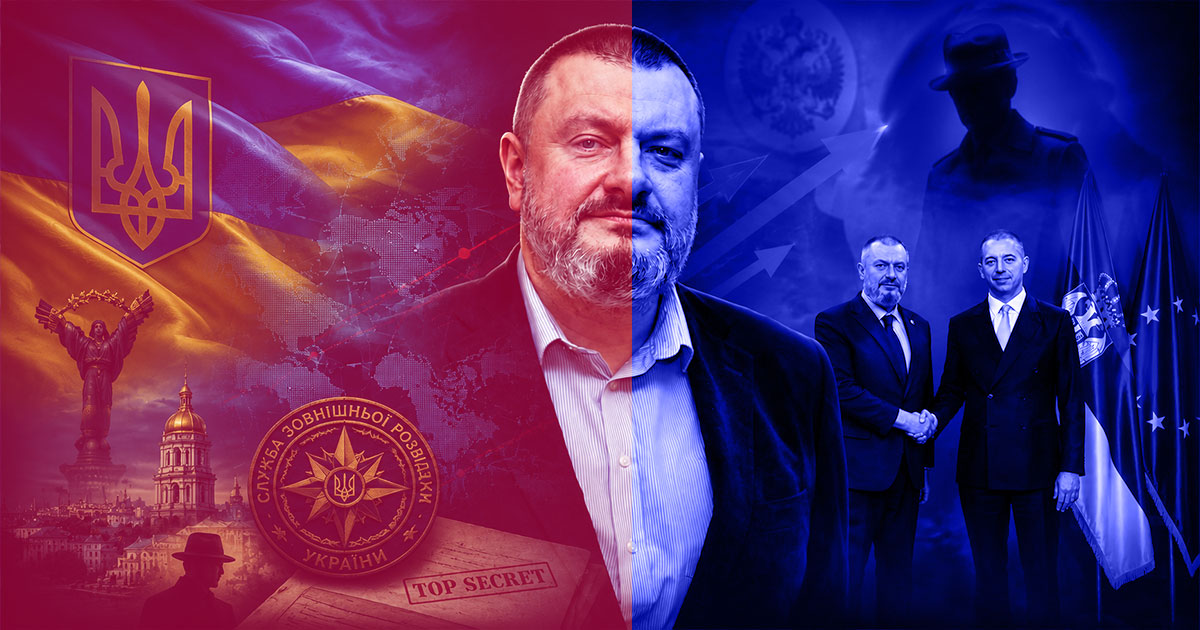
At the end of November 2025, when Volodymyr Zelenskyy appointed Reserve Major General Oleksandr Lytvynenko as Ukraine’s new ambassador to Serbia, it was already possible to reasonably assume that the Kyiv government would launch an intensive and comprehensive intelligence and propaganda campaign in Serbia. Lytvynenko had previously served as the head of Ukraine’s Foreign Intelligence Service (since 2021) and as Secretary of the National Security and Defense Council of Ukraine (since 2024). Moreover, the appointment of the country’s former chief intelligence officer as ambassador to the only European state that had not imposed sanctions on Russia—and one who had also received training at the United Kingdom’s Royal College of Defence Studies (RCDS) in London and NATO’s George C. Marshall European Center for Security Studies in Garmisch-Partenkirchen—was clearly intended to be far more than a routine diplomatic posting.
FIGHTING SERBIAN HISTORICAL “MYTHS”
Within just a few months of the new ambassador’s arrival, it became evident that Lytvynenko viewed Serbia as a battlefield in the war that the Kyiv government is waging against Russia in pursuit of the geostrategic and geoeconomic interests of the West, primarily those of the European Union and the United Kingdom. Consistent with this understanding of his diplomatic assignment, Lytvynenko, through numerous interviews, launched an intensive cognitive campaign aimed at the “demythologization” of the Serbian people’s collective historical memory. Its objective was to reshape the dominant Serbian perception of Russia and the Russian people—considered the principal source of Serbian Russophilia—as well as to alter the prevailing Serbian understanding of Ukrainians as the historical Little Russians and of Ukraine as one of the three historical Russian lands: Great, Little, and White Russia.
At the same time, Ambassador Lytvynenko developed an intensive campaign in the Serbian media that, in essence, amounted to counterintelligence activity directed against what Western political circles describe as the “Russian disinformation campaign.” This second component of his public engagement is closely linked to his campaign against Serbian historical “myths,” since the dominant Serbian understanding of the causes of the current war in Ukraine—and the prevailing support within Serbian public opinion for Russia in that conflict—stems primarily from the perception of Ukraine as Little Russia, forcibly separated from Great Russia.
KYIV TAKES THE OFFENSIVE, MOSCOW REMAINS DEFENSIVE
Ambassador Lytvynenko’s repeated public statements assuring the Serbian public that the Kyiv government respects Serbia’s territorial integrity are certainly not sufficient to alter the collective Serbian perception of Ukraine as Little Russia and Ukrainians as Little Russians. For Serbs to adopt the historical interpretation advocated by Lytvynenko, they would first have to cease regarding Montenegro and Republika Srpska (i.e., Bosnia and Herzegovina) as historical Serbian lands, while simultaneously accepting nations that emerged on what they consider their historical national territory as historical nations.
Regardless of the fact that changing the centuries-old, deeply rooted Serbian historical perception of Russia and Ukrainian identity is indeed an ambitious undertaking for the former chief of Ukraine’s intelligence service now serving as ambassador to Serbia, his intensive propaganda and intelligence activities could nevertheless achieve a degree of success and substantially alter the character of Serbian-Russian relations, primarily to the detriment of Serbia’s broader national interests. This is particularly true when one considers the political, media, and intelligence support that the Kyiv ambassador receives from Brussels and NATO structures, which has, at least in part, contributed to the accommodating attitude of the Serbian authorities toward his propaganda and intelligence activities. In this regard, it is evident that Ambassador Lytvynenko operates in close coordination—with joint public appearances, newspaper columns, and other activities—with the European Union’s ambassador to Serbia, Andreas von Beckerath, who has maintained close ties with the Kyiv government since the 2014 Maidan events, when he served as Sweden’s ambassador to Ukraine. By contrast, official Moscow has pursued an entirely defensive information policy in Serbia, apparently relying by inertia on the enduring strength and presumed permanence of traditional Serbian Russophilia.
CONCEALING THE FACTS: WHO WANTED THE WAR?
That Lytvynenko has been granted access in Belgrade—not only to media outlets close to the Serbian opposition, but to the broader media landscape as well—thanks to strong backing from Brussels and the accommodating attitude of the Serbian authorities, was demonstrated by his latest interview with Tanjug. In that interview, Lytvynenko once again repeated all of the key propaganda narratives of the Kyiv government directed at the Serbian public, ranging from reaffirming support for Serbia’s territorial integrity, to suggesting that Serbia should impose sanctions on Russia, to arguing that Russia alone wanted this war while the Zelenskyy government seeks peace.
Naturally, he said nothing about what the author presents as the true cause of the war: that the government in Kyiv, which came to power in the wake of the bloody Maidan events, sought—in the interests of the collective West—to draw Ukraine into NATO with the aim of containing and weakening Russia, while forcibly Ukrainizing or expelling the predominantly Russian population of Donbas and Little Russia. Accordingly, Lytvynenko’s assurances to the Serbian public that the authorities in Kyiv desire peace while only President Putin wants war obscure what the author describes as the central issue—that the Ukrainian authorities, together with their Western allies, seek a form of “peace” that would not eliminate the causes of the conflict and would therefore remain a threat to the security and sovereignty of the Russian Federation.
PREPARING ZELENSKYY’S VISIT
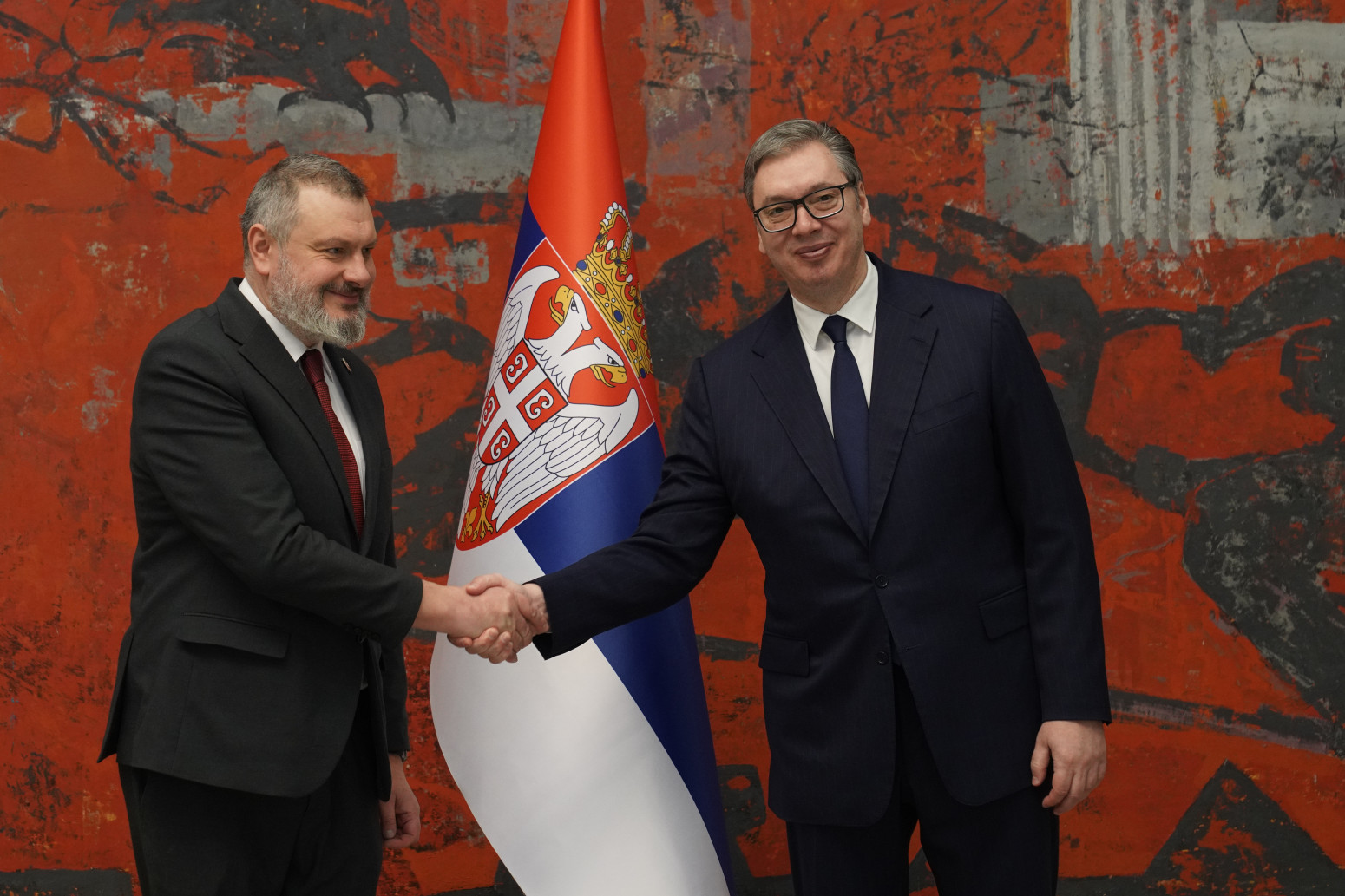
In the same interview, Lytvynenko confirmed earlier rumors that Aleksandar Vučić had officially invited Volodymyr Zelenskyy to visit Serbia and that the visit would take place within the coming months. This information points to what the author portrays as the second, and more significant, aspect of Ambassador Lytvynenko’s activities in Serbia. During the eight months of his diplomatic service in Belgrade, cooperation between the Serbian authorities and the government in Kyiv expanded and intensified considerably, a process in which the new Ukrainian ambassador undoubtedly worked in coordination with representatives of the European Union. During this period, not only was President Zelenskyy’s visit to Serbia scheduled, but Belgrade also hosted the Speaker of the Verkhovna Rada, Ruslan Stefanchuk.

According to the author, the visit of the Ukrainian parliamentary speaker on July 7 of this year was conducted in a manner that clearly reflected the influence of the “intelligence officer in diplomatic attire,” Oleksandr Lytvynenko. Just as Lytvynenko, in the author’s view, regularly lectures the Serbian people on history in a manner inconsistent with diplomatic etiquette, advises Serbia’s political leadership on the foreign policy it should pursue, and uses Belgrade’s hospitality to wage a propaganda and intelligence campaign against Russia, Stefanchuk likewise used his visit to Belgrade to declare that “Serbs are not Little Russians,” that Serbs are a distinct historical nation just as Ukrainians and Moldovans are, and that Russia is “aggressive, dictatorial, and anti-European,” arguing that, because of Russia, both Ukraine and Serbia should be admitted to the European Union as soon as possible.
HISTORY LESSONS FROM KYIV’S NAZIS
Although these openly Russophobic statements, according to the author, constituted an abuse of the host country’s hospitality aimed at undermining the traditionally close relations between Serbs and Russians, no official reaction from Belgrade followed either Stefanchuk’s remarks or, for that matter, the similar activities of Ambassador Lytvynenko. Indeed, the author asks how the Serbian authorities could have responded to the Russophobic statements made by the Speaker of the Ukrainian Parliament under the roof of the Serbian National Assembly when, just one day earlier, the Speaker of the National Assembly, Ana Brnabić, had likewise stated that “Serbs are not little Russians,” that Serbia enjoys very close relations with Ukraine, and that its relationship with the Russian Federation “is not without disagreements”. Instead of a diplomatic protest from the host country—which, according to the author, had yielded to pressure from Brussels and allowed Kyiv’s Nazis to lecture Serbia in the middle of Belgrade on history and foreign policy—the expected response came from official Moscow, serving, in the author’s view, as indirect evidence that cooperation between Serbian officials and the Kyiv government is harmful to Serbian-Russian relations. Speaking on behalf of the Russian Ministry of Foreign Affairs, Maria Zakharova immediately stated that Stefanchuk had turned the press conference in the Serbian National Assembly “into an anti-Russian event,” while also noting that the Serbian authorities had once again failed to respond appropriately..
FROM POLITICAL TO ECONOMIC COOPERATION
Alongside efforts to intensify political cooperation between Kyiv and Belgrade, Ambassador Oleksandr Lytvynenko has also devoted considerable attention to expanding economic cooperation between Ukraine and Serbia. Lytvynenko arrived in Serbia at a time when the Kyiv government had renewed its interest in concluding a Free Trade Agreement between the two countries. In May of this year, the Serbian-Ukrainian Business Forum was held in Belgrade, during which previously suspended negotiations on a bilateral Free Trade Agreement were officially resumed.
After total bilateral trade declined in 2022 ($333.8 million) and 2023 ($328.7 million) compared to 2021 ($450.2 million), overall trade reached $442.2 million in 2025, nearly returning to its pre-war level. During the first quarter of 2026 alone, total trade had already reached $153 million and, according to some projections, could exceed $600 million by the end of the year, surpassing even the record level recorded in 2019.
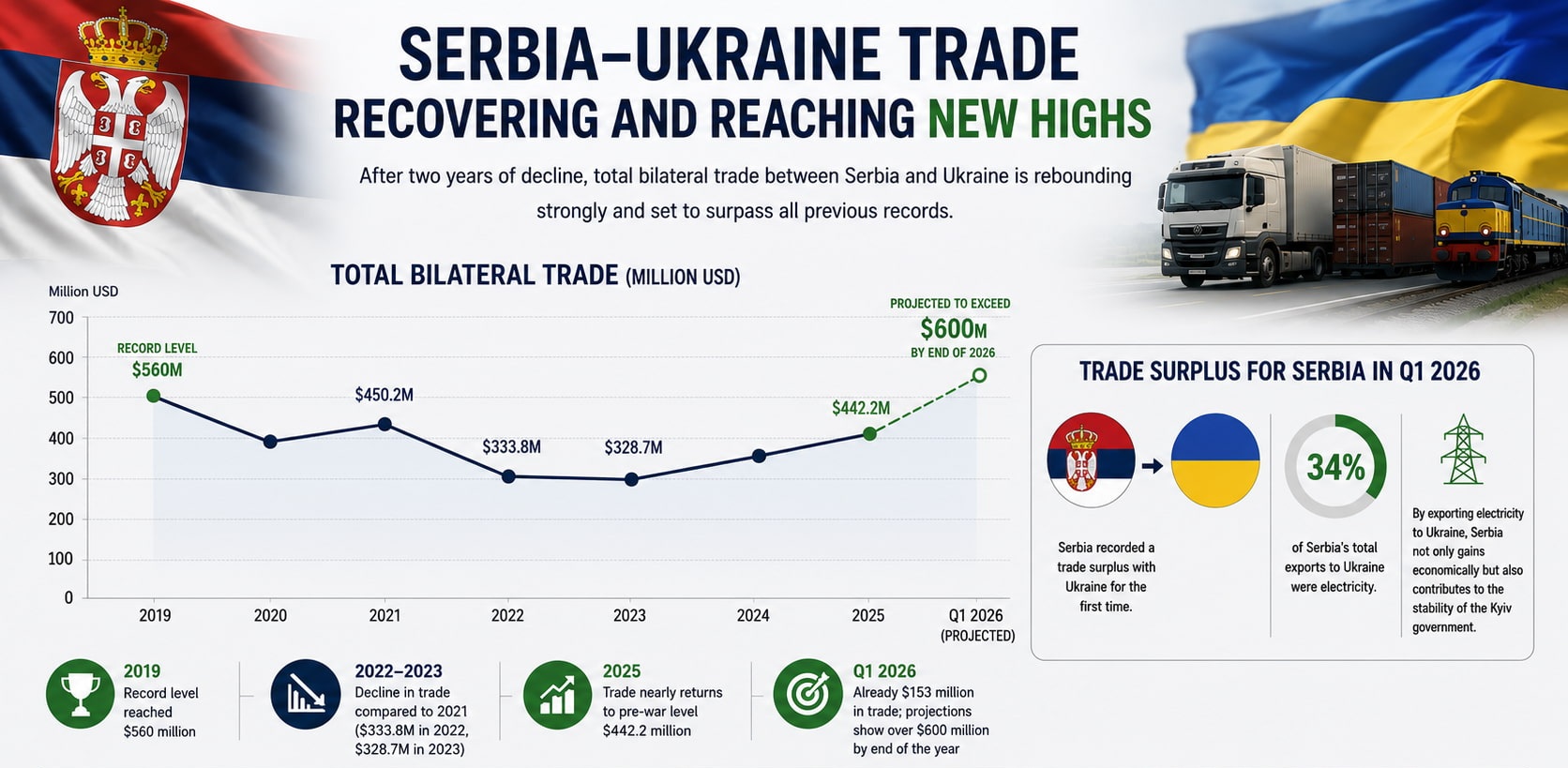
In the first quarter of 2026, Serbia recorded a trade surplus with Ukraine for the first time, largely due to exports of electricity, which accounted for 34 percent of Serbia’s total exports to Ukraine and, according to the author, carry not only financial but also significant geopolitical implications. The author argues that by supplying electricity to Ukraine, Serbia is directly helping to sustain the Kyiv government. Serbia’s second most valuable export to Ukraine is mineral fertilizer, exported by Elixir Group. The company owns mineral and chemical fertilizer plants in Šabac and Prahovo, while its leading figures, particularly Stanko Popović, have previously been linked in media reports to former Democratic Party Agriculture Minister Dušan Petrović, Ružica Đinđić, Mlađan Dinkić, and Dragoljub Marković.
THE SAPUNDŽIJA CASE, OR WHY THE ABSENCE OF SANCTIONS IS A FIG LEAF
Aware that the media landscape in Serbia is fully open to his propaganda activities, and that political and economic cooperation between Kyiv and Belgrade continues to intensify, the current ambassador of the Kyiv government, Oleksandr Lytvynenko, has little reason to be concerned about Serbia’s refusal to impose sanctions on Russia. Earlier this year, Foreign Minister Marko Đurić stated that “of all the assistance provided by Southeastern Europe to the people of Ukraine, Serbia accounts for 93 percent”. If, in the near future, relations between Belgrade and Kyiv continue to improve politically and economically while relations between Belgrade and Moscow deteriorate in parallel, then Serbia’s refusal to impose sanctions on the Russian Federation may ultimately become nothing more than a fig leaf.
That such an outcome is entirely possible is demonstrated not only by the unrestricted and, according to the author, undiplomatic activities of the current Ukrainian ambassador in Belgrade, but also by the appointment of Andon Sapundži as Serbia’s new ambassador to Kyiv in October 2024. His wife is none other than Viktoriia Borodina, a former senior Ukrainian diplomat who, following Viktor Yushchenko’s Orange Revolution, served as Second Secretary of Ukraine’s Mission to the European Union. According to the author, this raises serious questions regarding Ambassador Sapundži’s diplomatic and security credibility, while also giving rise to concerns about the potential leakage of security-sensitive information from Serbian diplomatic channels and the possibility of undue influence over Serbia’s embassy in Kyiv.