Helsing’s first experience on the Ukrainian battlefield, discussed in the previous article, became a classic example of how a country at war can be used as a testing ground for experimental military technologies developed by Western manufacturers. Although Ukraine’s experience, where the HX-2 unmanned aerial vehicle is being employed against Russian military equipment, deserves careful analysis by Serbian military experts, the broader trends and overall developments are far more significant. As already noted, thanks to a successful marketing campaign, the HX-2 has even been presented as one of the potential pillars of industrial mobilization in the event of a wider military conflict between Russia and Europe. However, any mobilization presupposes the existence of sufficient manufacturing capacity, and it is precisely the data concerning Helsing’s production capabilities—as well as the quality of its products—that remain highly contradictory.
THE GAP BETWEEN PLANS AND REALITY
In February 2025, Helsing announced its intention to deliver 6,000 HX-2 drones to Ukraine. At the time, the company stated that its first factory in southern Germany (with production facilities located near Munich) was capable of manufacturing more than 1,000 drones per month, and that all 6,000 aircraft would be delivered during 2025.
However, in January 2026, Bloomberg, citing sources and an internal presentation by the German Ministry of Defense, reported that Ukraine had suspended additional orders. According to those reports, field trials conducted by the 14th Regiment of the Armed Forces of Ukraine revealed problems with the HX-2’s takeoff performance, while some of the promised artificial intelligence-based capabilities—terminal guidance, mid-course navigation, and visual target recognition—were absent. Communication system failures caused by Russian electronic warfare systems were also recorded.
Perhaps the most noteworthy fact is that, even a year later, the company had still not completed the delivery of the announced 6,000 drones. Fulfillment of that contract continues to this day, which may indirectly indicate Helsing’s limited manufacturing capacity and the disparity between its actual production capabilities and the ambitious plans it presented publicly.
It is important to emphasize that such discrepancies between announced capabilities and actual deliveries are not unique to Helsing. Rather, they are a common problem among many Western startup companies seeking to attract investment and secure major contracts despite not yet having established serial production capabilities.
For Serbia, this provides an important lesson: when selecting defense suppliers, particularly for high-technology systems, it is not sufficient to rely solely on presentations, marketing, or political backing. Independent field testing, as well as the possibility of localizing production, are of decisive importance. In this regard, Serbia’s defense industry, which already possesses significant experience in manufacturing artillery systems and ammunition, could provide a solid foundation for the development of indigenous unmanned systems tailored to domestic requirements. Achieving this, however, requires above all a systematic engineering approach and long-term development, rather than political will alone.

THE EUROPEAN COUNTERPART TO PALANTIR
Despite a series of obvious shortcomings, Helsing remains a highly interesting case for analysis. Its activities are not limited to the production of loitering munitions. On the contrary, the company seeks to introduce to the European market an equivalent to the solutions offered by the American companies Palantir and Anduril Industries, primarily their Gotham and Lattice platforms. In this context, the HX-2 represents only one element of a much broader ecosystem in which unmanned aerial vehicles serve as the strike component within an integrated chain that combines reconnaissance, target designation, and target destruction.
The central element of this system is the Altra software platform, while its logical extension is the prospective CA-1 Europa unmanned fighter aircraft.
Altra is a software platform for reconnaissance, target designation, and fire control, designed to integrate all elements of the battlefield into a unified command system. As stated on the company’s official website:
“Altra intelligently connects all elements of the battlefield to transform the accuracy, speed and robustness of modern land forces.”
NETWORK-CENTRIC DATA SHARING SYSTEM
The platform uses artificial intelligence to accelerate target detection, localization, fire mission allocation, and target destruction. In practical terms, it is a software solution designed for a network-centric system of data sharing and command, both at the tactical and operational-tactical levels.
Functionally, Altra consists of several modules:
- Altra Ground Station – ground command station;
- Altra ISR – reconnaissance, surveillance, and intelligence-gathering module;
- Altra Strike – strike module;
- Altra Indirect Fires – artillery and indirect fire control module.
It goes without saying that Helsing’s robotic weapons systems will be fully integrated with the Altra platform. This potentially enables a single operator to control multiple unmanned aerial vehicles simultaneously, forming what has long been referred to in military literature as a “drone swarm.”
In September 2025, Helsing announced a partnership with the Danish company Systematic aimed at integrating the Altra platform with its SitaWare C4ISR command and control system. The objective of this cooperation is summarized by the slogan: “fewer operators, more drones” during reconnaissance-strike missions. In other words, the goal is to maximize the efficiency of existing technologies while partially compensating for the chronic manpower shortages characteristic of most post-industrial countries.
ALTRA – THE PLATFORM NATO IS COUNTING ON
According to Helsing’s estimates, this approach can accelerate mission execution by up to ten times compared to current practice, in which a single drone is operated by an entire team of personnel, while the analysis of combat operations is still largely performed manually. It is particularly noteworthy that this cooperation is being financed under the British ASGARD program, whose objective is to improve target designation and fire control capabilities within the British Army.
The solutions developed under the Altra project are also being integrated into other NATO-approved programs related to the development of swarm-based reconnaissance and strike capabilities. In other words, we are witnessing an effort to create European counterparts to the digital platforms designed for conducting network-centric warfare.
It is particularly noteworthy that the official status of the German Altra platform is as follows: the system has been documented, is being used under combat conditions in conjunction with HX-2 drones, and is currently being integrated into command structures. This suggests that the German software is already being tested within the Ukrainian Unmanned Systems Forces, meaning that it has progressed beyond the purely theoretical stage of development and is providing European NATO members with an opportunity to introduce modern data-sharing and command systems.
For Serbia, which—as noted in previous analyses—still lacks a unified digital platform for managing its diverse weapons systems of Russian, Chinese, Israeli, and French origin, the emergence of such systems in neighboring countries and among potential adversaries is a clear signal that technological lag in this field is becoming an increasingly serious problem. Even if Serbia is not currently in a position to develop its own equivalent of platforms such as Altra, it should strive to establish at least a basic digital coordination system capable of integrating its existing communications, reconnaissance, and target designation assets. Otherwise, there is a risk that its armed forces will continue to remain a “patchwork system” composed of insufficiently interconnected subsystems, making them particularly vulnerable to disorganization during the very first hours of any potential armed conflict. It is precisely for this reason that studying the operating principles of the Altra platform provides a better understanding of the minimum requirements that a modern digital military infrastructure must meet in order to enhance the combat effectiveness of the armed forces.

THE CA-1 EUROPA UNMANNED FIGHTER
While the HX-2 and Altra are Helsing’s current projects, which can be regarded as conceptually mature and transformed into tangible products, the company’s plans for future developments present an even more compelling picture. They offer numerous reasons for reflection, particularly considering that the German Ministry of Defense stands behind the company as its principal institutional sponsor.
During the Cold War, Germany effectively lost its sovereign aerospace industry. National development programs were gradually displaced under the political and administrative influence of the United States and France, while the domestic aviation industry was largely limited to licensed production and participation in joint international projects.
Given today’s complex military and geopolitical environment, it is reasonable to assume that any competent ministry of defense would seek to restore a national manufacturer of aerospace platforms. It is precisely in this context that Helsing and its CA-1 Europa project should be viewed—an attempt to apply the logic of “cheap, mass-produced, and autonomous,” previously demonstrated with small robotic systems, to the class of full-fledged combat aircraft.
The CA-1 Europa was unveiled in September 2025 as a full-scale mock-up at the Grob Aircraft factory near Munich. The company describes it as an autonomous unmanned combat aerial vehicle (UCAV) with a weight of between three and five tons. Development of the first prototype is currently underway.
Technical specifications of the CA-1 Europa
- Length: approximately 11 meters;
- Wingspan: 10 meters;
- Maximum takeoff weight: approximately 4 tons;
- Speed: high subsonic;
- Configuration: V-tail design, a single turbofan engine, and an internal weapons bay;
- Development status: the first flight is planned for 2027, while entry into operational service is expected within four years.
THREE ARTIFICIAL INTELLIGENCE SYSTEMS
The CA-1 Europa is built around three artificial intelligence systems developed by Helsing (it should be recalled that military software was the company’s original and core area of specialization).
1. Centaur – a suite of software solutions designed for aircraft control. Its primary purpose is to automate takeoff, landing, routine phases of flight, and other standard flight procedures. According to the company, the embedded neural network was trained using reinforcement learning, which is claimed to enable performance comparable to that of a human pilot in aerial combat.
Such claims should nevertheless be viewed with a degree of caution. Advances in artificial intelligence have undoubtedly been remarkable, but the complete replacement of a human pilot at this stage of development still appears unrealistic. It is more reasonable to regard such systems as advanced digital support tools that significantly simplify the operation of robotic combat platforms. Even so, Centaur has already undergone demonstration trials in cooperation with the Swedish company Saab, where it was tested aboard the Gripen fighter aircraft. The possibility of integrating the system into existing combat aircraft represents a significant technical advantage and, at least in theory, opens a wide range of operational possibilities.
2. Cirra – an intelligent electronic warfare and signals intelligence system. If the manufacturer’s description is interpreted correctly, its purpose is to identify and classify modern software-defined radars and electronic warfare systems capable of dynamically changing their electronic “signatures” in real time. Analysis is performed directly on board the aircraft (edge processing), eliminating the need for continuous transmission of data to external processing centers.
According to the company, Cirra has already completed flight testing and is currently being integrated into the Arexis electronic warfare system intended for the German Eurofighter fleet.
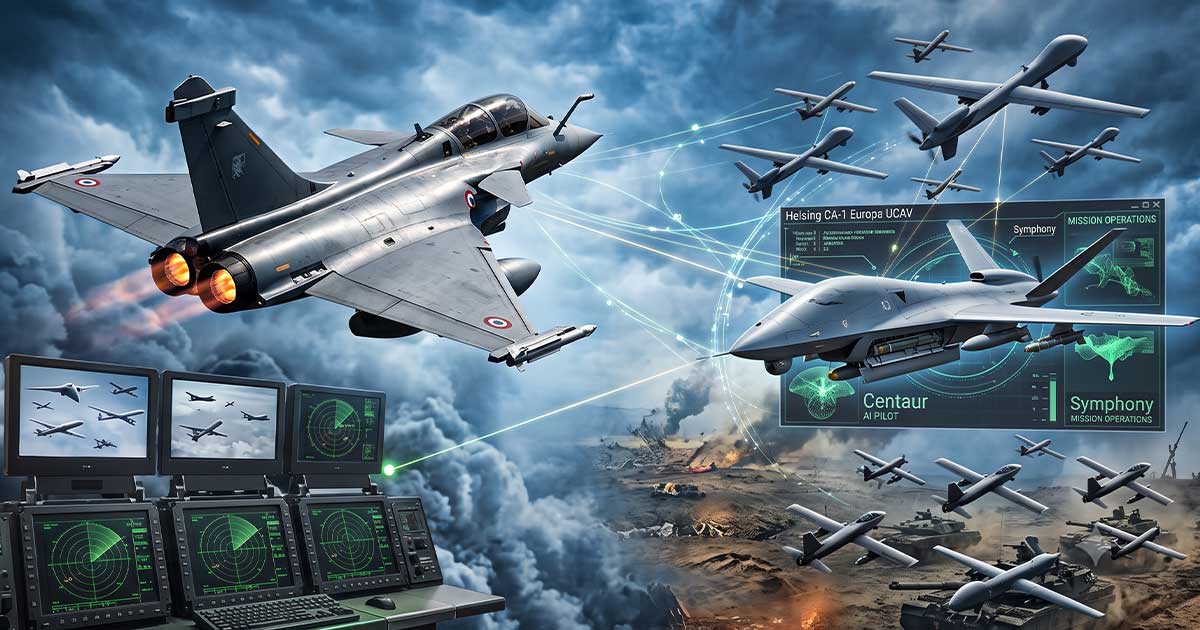
3. Symphony – a mission management system that coordinates the operation of multiple deployed combat platforms, enables the rapid creation of a unified battlefield picture, and continuously updates operational capabilities. In terms of its intended role, it can be regarded as the European equivalent of Anduril Industries’ Lattice platform, discussed in the previous section.
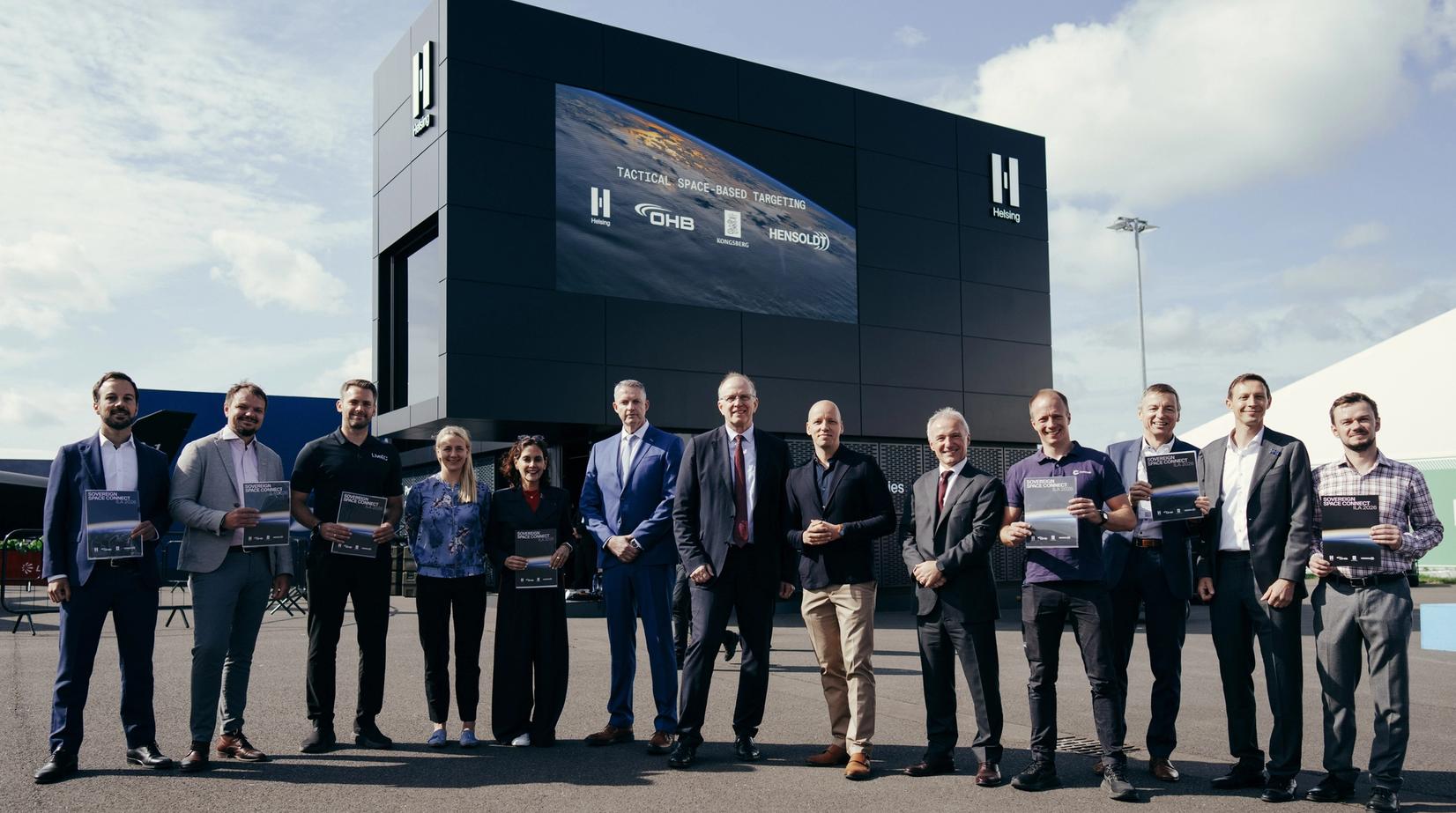
In February 2026, Helsing and HENSOLDT—one of Europe’s leading manufacturers of defense sensor systems, with annual revenues of approximately €2.46 billion—announced a strategic partnership to equip the CA-1 Europa with state-of-the-art sensor technologies. The cooperation includes the integration of radar systems, electro-optical sensors, self-protection systems, and electronic warfare capabilities.
The key element of this partnership is the integration of the MDOcore (Multi-Domain Operations Core) software platform, which serves as the foundation for data exchange across different operational domains. In essence, MDOcore can be described as a universal military “translator” that enables real-time data exchange between a wide variety of platforms, regardless of the communication protocols they use.
The platform collects and analyzes information obtained from radar, electro-optical, and electronic warfare systems, creating a unified operational picture of the battlefield. At the same time, it has been developed as an open modular architecture, allowing the integration of equipment from different manufacturers and rapid software updates, including adaptation to emerging threats.
As a result of this cooperation, Helsing unveiled the CA-1 Electronic Attack (CA-1EA) variant in June 2026—a specialized unmanned aircraft designed for electronic warfare.
THE MILITARY THINKING OF NATO’S LEADING STATES
Taken as a whole, the CA-1 Europa is presented as an “attritable, mass-producible platform” capable of operating independently, as part of a drone swarm, or as an unmanned “loyal wingman” accompanying piloted combat aircraft. It is, of course, integrated into a unified ecosystem together with the Altra platform, reflecting the increasingly prominent concept of “intelligent mass,” which combines large numbers of low-cost robotic systems with high-end platforms for command, coordination, and data processing.
This vision is also reflected in the words of Helsing’s Vice President for Air Programs, Stephanie Lingemann, who states:
“The future of combat aviation lies in attritable systems, where software and intelligence are the key technologies.”
Even if the CA-1 Europa project ultimately remains at the prototype stage, it clearly illustrates the direction in which the military thinking of NATO’s leading states is evolving: a gradual transition from expensive manned platforms toward mass-produced autonomous systems capable of operating in a complex electronic warfare environment.
For Serbia, which recently acquired French Rafale fighter aircraft, this represents a significant challenge. Without adequate support from AWACS, modern network-centric protocols, and an integrated digital infrastructure, even the most advanced fighters could eventually become less effective than numerous, lower-cost unmanned platforms equipped with advanced artificial intelligence systems.
This does not, of course, mean that Serbia should abandon the procurement of Rafale aircraft. On the contrary, their combat value must be complemented by the development of electronic warfare capabilities, autonomous interceptor drones, and modern digital integration systems. Otherwise, there is a risk that substantial investments in manned aviation may fail to achieve their expected operational effect.
SCALABILITY AND TRENDS
The story of Helsing is far more than that of a single military startup. Above all, it illustrates the profound structural transformation currently taking place within the global defense industry.
The production model that emerged during the Cold War has proven incapable of meeting the demands of modern—and, more importantly, real—warfare. Wars of attrition require mass production, low costs, and rapid adaptation rather than technological masterpieces. If software and microelectronics are set aside for a moment, today’s conflicts are, to a large extent, fought with aircraft whose designs resemble those of the early interwar period, as well as missile systems that are, in essence, modern reinterpretations of the concepts behind Germany’s V-1 and V-2 rockets.
It is precisely this approach that has proven effective. Large-scale armed conflicts require, above all, mass, practicality, and the ability to manufacture quickly—not flawless technical perfection.
These are precisely the demands that the new generation of defense companies seeks to meet, and Helsing is one of the most representative examples. Emerging from the IT sector, such companies are attempting to transform the defense industry into a system of affordable, easily manufactured, and rapidly scalable solutions. In a globalized economy, where an unmanned aerial vehicle can be assembled from commercially available components, their primary product is no longer the aircraft or the hardware itself, but advanced neural networks, algorithms, and software.
Nevertheless, it would be wrong to conclude that this production model automatically solves every problem. Helsing’s example demonstrates that startups, just like large corporations, can bring insufficiently refined products to market, overstate their capabilities, and use war zones as testing grounds for improving their technology rather than as environments in which to demonstrate the maturity of a finished product. The principal difference is that they do so more quickly, at lower cost, and with a greater willingness to learn from their own mistakes.
SERBIA RISKS FALLING BEHIND
For Serbia, which possesses its own defense industry but has yet to orient it toward the mass production of modern robotic systems, the example of Helsing demonstrates that, with the right organizational approach, it is possible to establish serial production relatively quickly, even with limited financial resources. This, however, requires a shift in development priorities. Instead of relying primarily on the procurement of expensive imported systems, greater emphasis could be placed on the development and production of indigenous unmanned platforms using commercially available components and flexible software solutions. Serbia’s defense industry already possesses considerable expertise in the production of ammunition and artillery systems, providing a solid foundation for integration with modern drone platforms. The greatest obstacle to this process is not technological, but primarily organizational and political. Without a serious strategic shift in this direction, Serbia risks falling behind even some less-developed neighboring countries that are already actively studying the lessons of the war in Ukraine and adapting them to their own requirements.
The central question that still remains unanswered is whether this new model—mass-produced, software-defined, and autonomous systems—can truly transform the balance of power on the modern battlefield. Or will it, over time, become a victim of bureaucratization just as the previous model did, losing its flexibility and evolving into yet another “closed cycle” in which enormous resources are spent not on increasing actual combat capability, but on the continuous modernization of software and the maintenance of ever more complex systems?
For now, there is no clear answer to that question. Yet the very fact that it is now being asked in earnest speaks volumes about the depth of the transformation taking place within the modern defense industry