After the Second World War, the Western military-industrial complex—primarily the American one—under the influence of large-scale military conflicts, mechanisms of administrative pressure, and financial interests, built a system that could be described as state socialism for the chosen few. Dozens of the largest corporations—Lockheed, Boeing, Northrop, General Dynamics, and Raytheon—received contracts under a “cost-plus-fixed-profit” model, which guaranteed them virtually zero risk and multi-billion-dollar revenues regardless of how effective the weapons they produced actually were. Projects were developed over decades, their budgets increased many times over, while congressmen and generals spent years “selling” extremely complex (and not always justified) programs to taxpayers by invoking the Soviet threat. That system produced remarkable technological achievements—stealth bombers, nuclear aircraft carriers, satellite reconnaissance, and the internet. But at the same time, it also generated enormous inefficiency—a whole series of military-technical projects that were difficult to scale, cost trillions of dollars, and failed to deliver strategic results when the time came for their actual use.
The Cold War ended, but the system did not disappear. It merely consolidated into three or four super-corporations—Lockheed Martin, Boeing, and Northrop Grumman—which continued to extract trillions from government budgets while offering increasingly complex, more expensive, and less practical military systems.
STARTUPS ARE TRANSFORMING THE DEFENSE INDUSTRY
When the large-scale conflict in Ukraine began in 2022, this system was confronted with a reality for which it proved completely unprepared. A war of attrition demanded mass production rather than superior tactical and technical performance. It required low cost rather than extreme technological sophistication. It required rapid adaptation rather than development cycles lasting an entire decade. Despite the enormous influx of government funding, the traditional military-industrial complex was unable to provide either inexpensive weapons, flexible solutions, or a rapid increase in production. It proved to be too expensive, too slow, and far too bureaucratic.
It was precisely this vacuum that new actors stepped into. Startups backed by venture capital, unburdened by the legacy of the Cold War, unconstrained by “cost-plus-fixed-profit” contracts, and independent of senators whose states depended on the defense industry. At their core, these were IT companies entering the defense sector, bringing with them a different management culture and a different way of thinking.
One such market participant was the Bavarian startup Helsing SE.
Founded in 2021, Helsing transformed in just four years into one of Europe’s most valuable defense companies, with an estimated valuation of around €12 billion and approximately €1.3 billion in raised investment capital. Having started as a company specializing in military software based on artificial intelligence, Helsing quickly shifted toward hardware production—it acquired aircraft manufacturer Grob Aircraft and launched the production of its own strike drones. Today, its products—primarily loitering attack drones—are being used in Ukraine, tested during NATO exercises, and are even being considered as one of the potentially key elements of NATO’s mobilization readiness for conducting large-scale combat operations.
As with most manufacturers of robotic weapons systems, the story of Helsing is not one of the triumph of cutting-edge technology. It is the story of how private capital and venture investment culture are filling the gap in the market left by corporate giants that have gradually lost the ability to produce inexpensive weapons on a large scale.
For that reason, Helsing’s successes, failures, and future prospects can be viewed as an illustration of the transformation currently taking place within the Western defense industry—a process that will, to a large extent, shape the structure of armed forces and the way they are equipped over the coming decade.
HF-1 – THE “UKRAINIAN BLUEPRINT”
Helsing first came into the public spotlight after its products appeared on the Ukrainian battlefield—but, contrary to a highly aggressive PR campaign, that debut was nowhere near triumphant. During 2024, the startup signed a contract to supply 4,000 HF-1 loitering attack drones to the Armed Forces of Ukraine, and by mid-2025 Ukraine had received approximately 2,200 aircraft of this model.
It can fairly be said that everything that followed amounted to a complete failure.
The Ukrainian units that received the German drones almost immediately encountered their poor performance. The main complaints concerned the weak warhead, unreliable and unnecessarily complex software, as well as their excessively high price. At this point, it is appropriate to refer to several quotations from Western media outlets, which reported quite extensively on the failures of the German company. Bloomberg quoted a member of the Ukrainian Armed Forces’ Unmanned Systems Forces as saying:
“We’re talking about a product made from cheap components that is being sold as premium technology. I can say that with certainty because I took it apart.”
According to him, the drone’s actual value did not exceed 100,000 hryvnias (around €2,200), while Helsing was selling it for €16,700. In addition, journalists cited figures from a presentation by the German Ministry of Defense, according to which only one quarter of the HF-1 drones successfully took off during frontline testing.
It is also worth recalling perhaps the most illustrative quote from an article published by Die Welt, which likewise cited the words of a Ukrainian operator from the Unmanned Systems Forces:
“We did all the dirty work for Helsing.”
The newspaper obtained internal Ukrainian documents that recorded numerous shortcomings of the delivered drones. Among them were defective rudders, lengthy assembly times, and “abnormal behavior in flight.” In reports by the Armed Forces of Ukraine, the HF-1 was even directly assessed as “unfit for flight.”
Around 40% of the delivered drones were never used. Nearly one in five units was lost due to Russian electronic warfare systems, which was particularly ironic given that Helsing had marketed its drones as being resistant to electronic jamming. At the same time, the three artificial intelligence-based guidance systems announced by the manufacturer—terminal guidance, mid-course guidance, and visual target recognition—either did not exist in practice or were incapable of functioning reliably under real combat conditions.
THE CONTRACT WAS REVISED IN FAVOR OF THE HX-2
The story of the HF-1 is a classic example of how even a high-tech product that successfully passes proving-ground trials can prove almost useless under real combat conditions. For Serbia, which is actively procuring expensive systems (Rafale, PULS, CM-400AKG) but still lacks a fully developed infrastructure for their effective deployment, this case provides an additional argument that a high price and a well-known supplier do not guarantee combat effectiveness. On the contrary, the Ukrainian experience suggests that inexpensive and simple FPV drones, produced locally, often outperform costly imported systems when their actual cost-effectiveness in combat is taken into account. In this context, Serbia could reconsider its procurement approach: instead of striving for “European quality,” greater attention should be devoted to developing domestic production and refining the tactics for employing already proven solutions.
Helsing, of course, disputed these claims, but production of the HF-1 was soon discontinued, while the Ukrainian side froze additional orders. The story would probably have ended there had Helsing not already enjoyed the direct support of the German Ministry of Defense. The German military leadership had—and still has—its own interest in testing the products of the national defense industry under real combat conditions. Under such pressure, which Kyiv could hardly resist given that Berlin is one of the key financial backers of the Ukrainian economy, the contract was revised in favor of another unmanned aerial vehicle model—the HX-2.
Thus, Helsing’s first experience on the Ukrainian battlefield became a classic example of how a country at war can be used as a testing ground for experimental military technologies developed by Western manufacturers. In essence, the Ukrainian military assumed the role of a proving ground, identifying shortcomings that the manufacturer later corrected during the further development of the system. At the same time, it was precisely this painful experience that laid the foundation for the evolution of Helsing’s products—the transition from the unsuccessful HF-1 model to the new HX-2.
HX-2: TECHNICAL CHARACTERISTICS AND COMBAT EMPLOYMENT
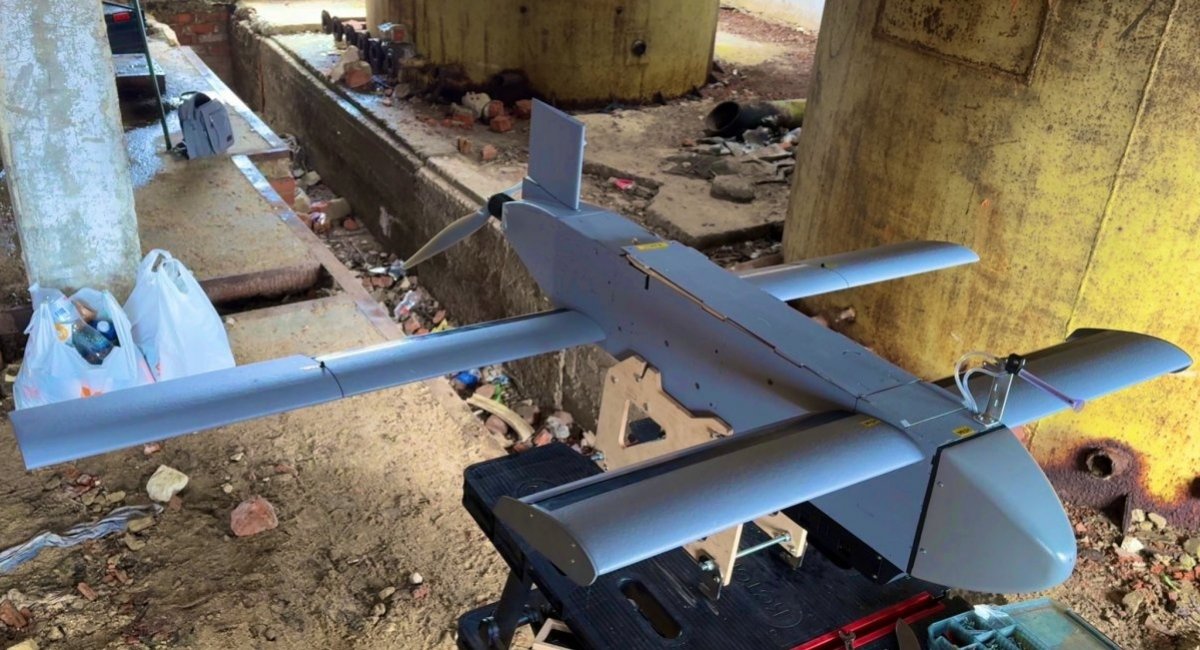
The HX-2, introduced in late 2024, became Helsing’s flagship product and a direct—albeit delayed—response to the widespread use of Russian Lancet loitering munitions. It is an electrically powered unmanned system featuring an X-wing (cross-wing) configuration with a pusher propeller, designed from the outset for mass production and low unit manufacturing costs.
The aircraft weighs approximately 12 kilograms, can reach a maximum speed of 220 to 250 km/h, and is capable of striking targets at distances of up to 100 kilometers. It is equipped with a shaped-charge warhead weighing up to 4.5 kilograms, intended for destroying artillery systems, armored vehicles, and fortified positions. Its airframe is made of composite materials, reducing the aircraft’s detectability by radar systems.
The cost of a single drone is estimated at around €17,500. It should be emphasized, however, that this is a very high price, particularly when the HX-2 is compared with the American-Ukrainian Hornet drone, which has similar technical characteristics and the same tactical role but costs approximately €4,000.
The key technical feature of the HX-2, as well as of most next-generation robotic systems currently used in Ukraine, is its software. Its integrated neural network enables the drone to carry out missions even under conditions of complete GPS signal and radio communication jamming by using preloaded mapping data and navigating according to terrain features.

THE MOVE IS NOW UP TO SERBIAN MILITARY EXPERTS
According to the manufacturer, the HX-2 is capable of independently locating, identifying, and attacking targets even in the absence of a signal or continuous communication with the operator, while the human operator still retains the authority to give final approval for the strike, in accordance with the “human-in-the-loop” principle. In addition, the drones can, at least in theory, be networked into swarms through the Altra platform (which will be discussed in more detail in the next article), allowing a single operator to control multiple aircraft simultaneously.
Deliveries of the HX-2 to Ukraine began in late 2024. According to representatives of Helsing, “thousands” of drones of this type have been delivered to Ukraine to date, while around 70% of combat missions reportedly result in successful target strikes. These claims are difficult to verify or refute independently, but it is undisputed that the drone’s testing and operational use in Ukraine has attracted a certain degree of interest within NATO.
Thus, during 2026, the U.S. Armed Forces tested the HX-2 as part of military exercises in Lithuania, while in May of the same year the company successfully carried out the first launch of the drone from a vessel off the coast of Plymouth. The HX-2 has been officially approved for use on the Ukrainian battlefield and incorporated into the central procurement system of the Armed Forces of Ukraine, with a monthly delivery cycle of 400 to 600 aircraft.
For Serbia, whose armed forces have traditionally relied on heavy armored vehicles and conventional aviation, the widespread proliferation of such loitering munitions in the region—particularly within the JDODC concept—means that tanks and artillery systems could be exposed to threats at depths of up to 100 kilometers behind the front line. For this very reason, Ukraine’s experience, where the HX-2 and similar systems are being used against Russian equipment, deserves careful analysis by Serbian military experts. It demonstrates which tactics and countermeasures are the most effective, while also providing insight into the real cost of this form of warfare, in which every drone that is shot down requires an economically comparable response.
(To be continued)