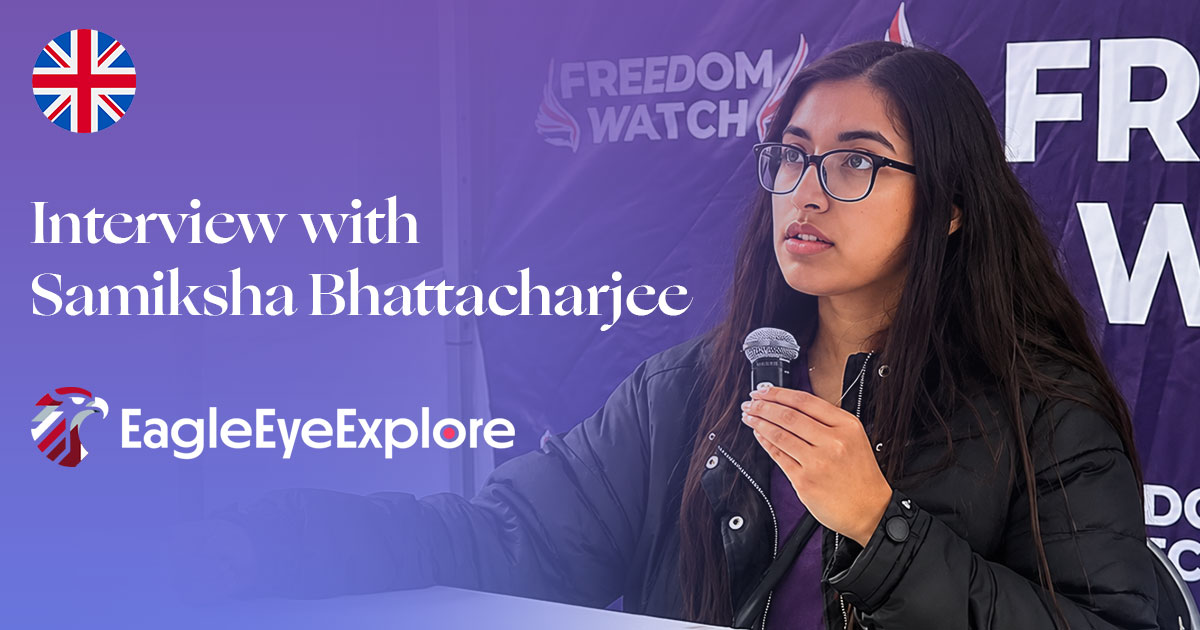
Samiksha Bhattacharjee is a British-Indian author, commentator and host of video and audio series ‘Samiksha’s State of the Debate’. Focusing on topics surrounding culture, economics, politics and freedom of speech, Samiksha places emphasis on covering such subject matter from the perspective of young people, herself being a student of History, Politics & Economics at the University College London in England, UK. As a self-professed classical liberal, Samiksha is also the President of the UCL Libertarian Society, where she openly advocates for freedom of speech, freedom of expression and individual rights. She is also a writer and has written and published a coming-of-age psychological thriller novel called Legal Crime, which she wrote when she was only 13-years-old.
Hello, Samiksha, and thank you so much for agreeing to be interviewed by us here at Eagle Eye Explore. Now, to begin with, something that we are seeing across the world in the political scene is the rapidly-growing involvement of young people in politics and current affairs. Especially in this day and age, it is not uncommon to even see teenagers becoming heavily involved in politics, whether it be simply following the news, listening to commentators or even joining youth branches of political parties and movements. As a young person and student yourself, why do you think that more young people than ever are becoming interested and involved in politics?
I think my generation is realising that politics is no longer something happening in a distant parliament building; it is actively encroaching on our daily lives and impacting us. From the hyper-politicisation of university lecture halls to the reality of economic stagnation and immigration in the UK, young people are feeling the direct consequences of bad policy. Furthermore, the internet and alternative media have completely shattered the monopoly of the old legacy press. A teenager or young adult today doesn’t have to wait for the evening news or morning newspaper to understand the world; they can listen to long-form podcasts anytime online, and engage in global debates in real-time on social media like X. The culture wars as well have made political debates a lot more accessible and simplistic, rather than dry economic debates, so it feels as though everyone can contribute an opinion. In short, young people are stepping up because they recognise that the future being decided right now is theirs.
You mentioned on your website that you yourself are a classical liberal and a libertarian. There are very many people, both young and old alike, who identify as classical liberals, but such a term is often confused with modern liberalism – specifically social liberalism. For those who may not be aware, what are the differences between classical liberalism and modern liberalism, in your eyes?
This is a crucial distinction that is too often lost in translation. In essence, classical liberalism is rooted in what we call negative liberty — it is about freedom from state coercion. It focuses on individual rights, strict limits on government power, free markets and absolute freedom of speech. The foundational belief is that the individual is sovereign and the state exists merely as a night-watchman to protect life, liberty and property. Modern liberalism, or social liberalism, has twisted this completely. It focuses on positive liberty, which views the state not as a potential threat to freedom, but as a tool for social and economic engineering. Modern liberals are perfectly willing to weaponise state power, expand bureaucracies and restrict individual liberties — such as free speech — in order to enforce their twisted version of social equity or protect groups from offence.
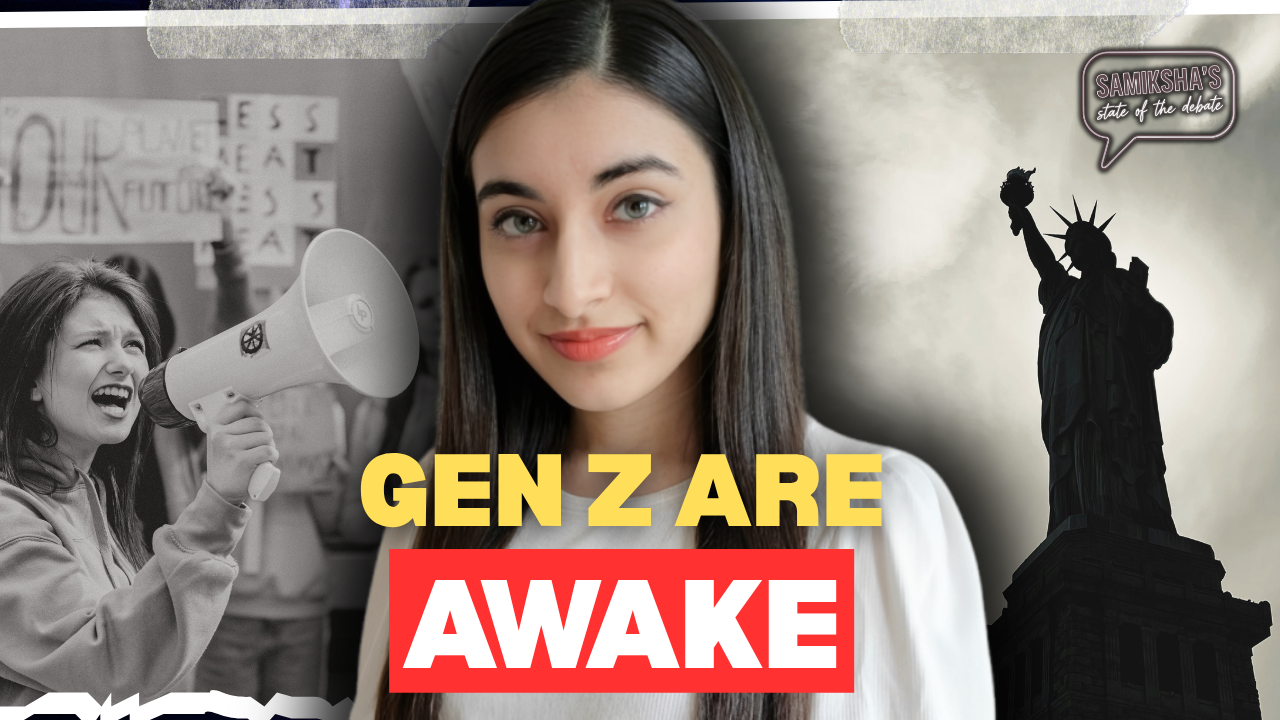
You have your own platform called Samiksha’s State of the Debate, where you talk extensively about politics, society and current affairs. Could you explain to us what State of the Debate is all about and what your aims are with it?
I’ve always been frustrated with the sanitised, superficial nature of mainstream political discourse. Too often, commentators talk over the heads of ordinary people using jargon, completely ignoring how those policies manifest in reality. My aim is to bridge that gap. I want to look at culture, economics and politics through a down-to-earth lens, explicitly bringing a youth perspective to the table that isn’t captured by progressive student unions. It’s about challenging the institutional orthodoxy and showing that independent, critical thinking isn’t dead among my generation. I also want to ensure people can relate to me, because I’m not a cardboard box!
As a free speech advocate and libertarian based in the UK, have you ever experienced censorship and others trying to “cancel” you, purely because of your views? This is a very common occurrence for libertarians and other right-leaning people in the Western world.
Oh, but I have been. Standing up for free speech at my university has essentially made me an outcast. Since I restarted the Libertarian Society at University College London, it feels as though I’ve become one of the most hated people on campus. I have lost the vast majority of my friends, my society’s own treasurer resigned and the Students’ Union went so far as to release a public statement implying they were “devastated” that we simply hosted a speaker who believes in the reality of biological sex. This is the reality of being a classical liberal on a modern campus. The union’s commitment to so-called “inclusion” explicitly excludes people like me. For this particular event, we needed security officers and close protection officers, and our speaker was being added to an online group chat where individuals we believe to be students were sending graphic, degrading and sexualised threats. This event did go ahead, and despite a loud street protest and hostile interruptions, it was a roaring success. Yet, the Union’s “Equity & Inclusion Officer” still issued a public apology to the trans and non-binary community, claiming she was “truly devastated” that the talk was allowed to happen. Behind the scenes, the internal executive discussion ran for over an hour, with the Union President openly admitting that the only thing stopping them from canceling us entirely was the law, specifically the Higher Education (Freedom of Speech) Act. When they couldn’t find a legal loophole to shut us down, the student press framed us as the villains, and the discussion turned to how our event could be a “catalyst” to change union rules so they could block similar ideas in the future. The student press have written repeated hit pieces about me and my views. Just recently, a group of us walked into a university-run bar to unwind after a completely peaceful, civil public assembly we held to discuss the collapse of the social contract and the rise of violent crime. Within minutes of sitting down, a student staff member recognised us, and the bar manager explicitly ordered our removal because our right-leaning political views made the staff “uncomfortable”. When we stood our ground and demanded to know what rules we had broken, they skipped dialogue entirely and called the Metropolitan Police to have us ejected for “wrong-think”. I’ve lost most of my friends…but as long as the alternative is a moral wasteland of conformity, self-censorship and fear, that is a price I am entirely willing to pay.
Another area of focus of yours is gender politics. In the West, gender politics have proven to be a highly controversial affair, and over the past decade or so especially, the LGBT community has become heavily involved in issues that otherwise would exclusively affect either men or women. Of course, one of the biggest controversies is the anti-transgender stance of J.K. Rowling, author of the Harry Potter series of books. As a free speech advocate and lover of debate, why do you think that the discord surrounding gender politics and the intervention of the LGBT community has become so toxic and even aggressive at times?
The discord has become aggressively toxic because the establishment attempted to outlaw polite debate on the matter. For years, ordinary citizens and intellectuals — most famously J.K. Rowling — were met with institutional bullying simply for stating objective, biological realities. When you tell the public that their eyes deceive them, and you penalise them for using basic language, you infuriate a lot of normal people. Furthermore, the toxicity stems from a fundamental shift in the movement itself. It transitioned from a campaign for equal legal rights and tolerance for individuals into an institutionalised ideology, demanding total compliance and the restructuring of public language, medicine and law. When a movement shifts from “live and let live” to enforcing ideological conformity, the pushback is entirely inevitable. Additionally, the movement itself is pushing for the sterilisation of our children! These are incredibly intense topics that hit home with a lot of people, so why would people not be angry?
Many conservative outlets and commentators have argued that one of the core issues surrounding the modern LGBT movement is its violation of women’s rights and women’s spaces in society. Do you yourself believe that this is the case?
100%! The moment you replace the objective, biological definition of a woman with some kind of a subjective, self-ID legal framework, the distinct legal protections for biological women evaporate. We see this directly in the encroachment on female single-sex spaces — such as domestic violence refuges, changing rooms and prisons — where vulnerable women have a fundamental right to privacy and safety. We see it in women’s sports, where years of hard work by female athletes are rendered meaningless by unfair biological competition. Protecting women’s spaces is an act of basic safety, reality and privacy that should never be sacrificed to satisfy trends and people trying to look politically correct.
Sticking to the subject matter that is identity politics, one of the most talked-about topics of recent years is the rapid rise of ethnic nationalism in the UK. While ethnic nationalism has been on the rise across continental Europe, with many people no longer finding it a taboo area of conversation, the UK has finally caught up with the conversation and has been witnessing an ever-growing number of ethnic nationalist political parties and movements. As somebody who is of an ethnic minority background living in the UK, how do you personally view the emergence of ethnic nationalism and nativism in the country today?
As someone from an “ethnic minority” background who isn’t a native Briton, I don’t tend to talk about immigration, but we have to be honest about demographics and stability. The emergence of these movements is a predictable, direct reaction to a political establishment that has treated the public with utter contempt for decades. When the state completely abdicates its primary duty (which is to secure the nation’s physical borders) and combines that with a relentless cultural push toward divisive multiculturalism, it creates a massive vacuum. For years, mainstream parties sliced society into competing minority identity groups, prioritising identity politics over shared civic values. It should surprise absolutely no one that a segment of the majority population eventually decided to pick up that exact same identity-politics playbook.
One of the most popular words being thrown around not only in Britain, but across Europe at the moment is the word Remigration. After decades of mass immigration into Europe and rising crime across the continent due to ever-increasing levels of both legal and illegal immigration, what are your thoughts surrounding the concept of remigration, and do you believe that it is a valid answer to an ongoing problem, which millions of Europeans are so concerned about?
The fact that the term “remigration” has broken out of fringe academic circles and entered mainstream European discourse is a testament to the utter failure of democratic accountability. For decades, millions of Europeans across the continent voted explicitly for controlled immigration, only to watch their governments oversee unprecedented levels of mass legal and illegal crossings. Preservation of heritage matters. A nation has a fundamental right to maintain its historic cultural and ethnic core. Many, including myself, would argue that for long-term social cohesion, a country like Britain should ideally maintain a strong native majority of at least 90%. Furthermore, we need a complete overhaul regarding who we grant citizenship to in the future. Citizenship shouldn’t be handed out like sweets without demanding assimilation. If you enter illegally, cannot speak English, fail to be a net contributor, commit crimes, or actively hate the country, you should be deported. Going forward, Britain must severely tighten future citizenship requirements to enforce this, while implementing mechanisms to denaturalise those who subvert the nation from within. The solution to forced multiculturalism is a strict return to national sovereignty, the rule of law and treating people as sovereign individuals under a shared cultural inheritance.
On your website, you outline one of your areas of focus, Politics vs. Reality, with the words, The widening gap between political rhetoric and lived experience. Following on from the questions about gender politics and ethnic nationalism in the UK, based on your own personal observations, just how significant are the differences between “political rhetoric” and “lived experiences” when entering into debates surrounding gender politics, LGBT matters and the clash between nationalism and multiculturalism?
The gap is wider than it has ever been. If you listen to the political rhetoric from the Westminster bubble, university administrations or HR departments, you are told a completely fabricated story. You are told that multiculturalism is an unalloyed success, that gender self-ID is entirely harmless, and that anyone worried about rapid demographic shifts or social cohesion is simply uneducated or malicious. But the lived experience of ordinary people tells a completely different story. In the realm of gender politics, the political elite and student unions repeat progressive mantras about “inclusion”. Yet, the lived experience is that women are watching their private spaces compromised, and female athletes are seeing years of hard work rendered meaningless by unfair biological competition. On campus, the rhetoric claims universities are bastions of free thought, but the lived experience is one of self-censorship, where students whisper their support in pubs, terrified that a graduate recruiter or a union official will see them step out of line. When it comes to the clash between nationalism and multiculturalism, the political class uses rhetoric that treats borders as meaningless. But on the ground, ordinary people live with the reality: the fracturing of local communities, the strain on infrastructure and the erosion of public safety. The political class lives in a world entirely insulated by wealth and status from the consequences of the theories they advocate for.
To close this interview, it would be very interesting to hear about your predictions for the future, as a young political commentator and analyst. What roles do you see the young people of today taking up in the world of tomorrow? In an age of so much uncertainty, change and outright danger, do you believe that your generation is destined for a future that is for the better or for the worse?
My generation has been handed a world defined by massive state debt, cultural demoralisation and unprecedented surveillance. There is a real danger that a large portion of my peers will succumb to the permanent childhood and state dependency that our institutional culture actively encourages, and the divide between young men and women means that many will never be able to get along and form families. However, I am fundamentally optimistic about a growing, resilient counter-culture. The outright danger of our times is forcing a minority of young people to completely abandon lazy apathy to politics. I see a rising generation of young commentators, entrepreneurs and independent thinkers who are completely realistic about the challenges ahead. We are not destined for a worse future unless we choose to accept it. The role of the young people of tomorrow is to reject the cultural orthodoxy, reclaim personal responsibility and rebuild a country that is genuinely free.