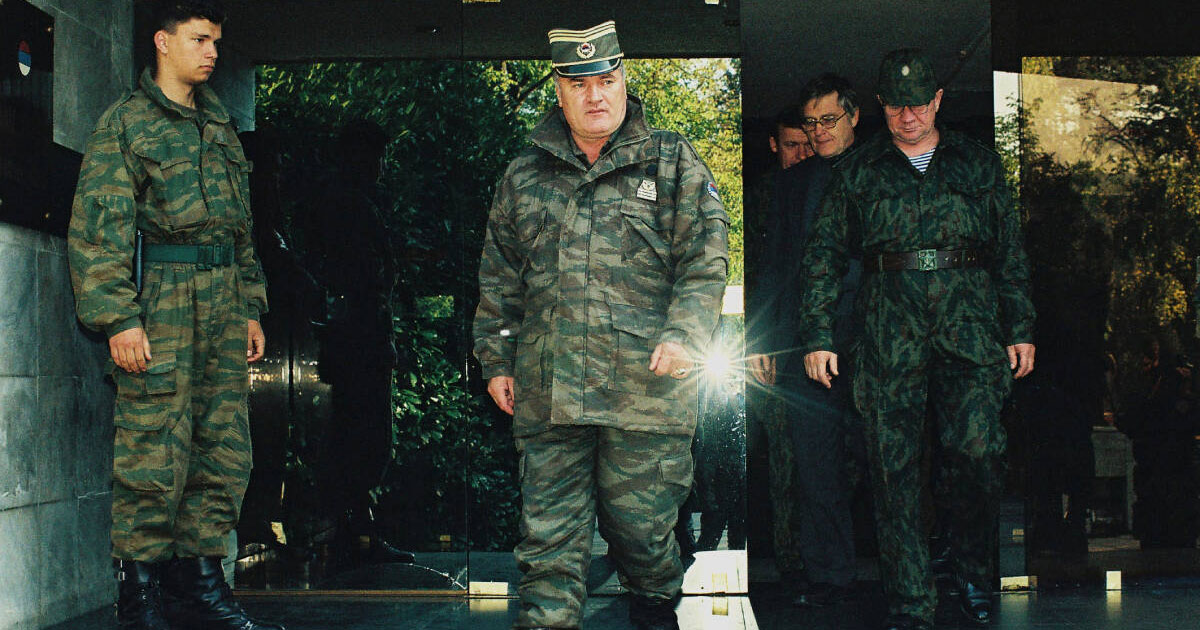
By showing massive expressions of the deepest respect for the founder and first commander of the Army of Republika Srpska – General Ratko Mladić – Serbs, in the words of Nikola Tanasić, gave “a moving example… of what they are capable of when they agree on something that matters to them.” Although it has become commonplace for Serbs to claim, thereby unconsciously adopting the negative stereotypes of their key geopolitical adversaries, that discord is the Serb’s normal condition, in the words of Sterija Popovic: “O wretched discord, daughter of the serpent of hell, where would you know how to live if Serbia did not exist.”
STILL CAPABLE OF UNITY
Bearing in mind the examples of mass popular veneration of the Belt of the Most Holy Theotokos and the funeral of General Ratko Mladić, Tanasić concludes that we as a people are still capable of unity, but only when we know what it is that we are uniting for. In both cases, a broad popular consensus was established on the spiritual-identity and symbolic level, while achieving such a consensus is not even on the horizon in the sphere of real politics.
If such a phenomenon were assessed from the perspective of the thought of a classical European thinker such as Julius Evola, we could conclude that these examples of the existence of Serbian spiritual unity are proof that the Serbs have not irreversibly sunk into the materialistic world of modernity. Consequently, the measure of preservation of the sanctified order of Tradition is the measure of the historical vitality of our national community and the strength of its collective SELF. Therefore, Tanasić is right to conclude that “there is no national unity without the Church,” because “the only functional and historically productive unity that Serbs currently possess, and on the foundation of which all tangible political results in this century stand – whether it is the survival of Serbs in Kosovo and Metohija, the defense of holy places in Montenegro, or symbolic opposition to the hysterical Russophobic policy of the West – has been achieved through the testimony of the Serbian faith and standing with the Serbian Church.”
WHAT THEY DID TO HIM IS INTENDED FOR THE PEOPLE
The Serbian Church correctly assessed that a popular myth had already been thoroughly woven around the name and deeds of the first commander of the Army of Republika Srpska, as well as around the name and deeds of the first president of Republika Srpska. For, in the words of priest Darko Ristov Đogo, “this people know very well that the General’s fate is their fate and that his name is their name, and that what they did to him is intended for them.” Hence the General and the Doctor long ago entered the gusle tradition, so that through the gusle they would remain permanently preserved in the collective memory of the people as the creators of the third Serbian state. When the General moved into eternity, the Serbian Church sanctified that popular myth in a manner appropriate to its teaching and canonical order, through the funeral service celebrated by the Serbian Patriarch, concelebrated by as many as eleven bishops and more than several dozen priests. Thus, once again, the unity of the epic and the liturgical was shown – the unity which, since Kosovo in 1389, has constituted the essence of the Serbian Covenant, and which is not essentially opposed to one another in the way the remarkable champion of the Serbian camp nation, Žarko Vidović, saw and interpreted them.
THE SANCTIFICATION OF COLLECTIVE MEMORY
The mass popular and church funeral of Ratko Mladić was an important contribution to the construction and sanctification of collective memory, not only of the General, but through the figure of the first commander, of the entire Army of Republika Srpska and the Defensive-Fatherland War, as the birthplace of Republika Srpska. Therefore, every attempt to deconstruct the sanctified popular myth of the General in the name of any ideology or an imposed Hague historical “truth” and “justice” would inevitably lead to the deconstruction of the authentic Serbian narrative about the Defensive-Fatherland War, as an epistemological preparation for and justification of the abolition of the state entity that this war brought into being. At the same time, the mass paying of respect to the deceased General represents, as Časlav Koprivica observes, an important contribution to the Serbian struggle “for our own memory – for the right to determine ourselves what we will remember and how we will remember it, for the right to memorial sovereignty,” without which there can be no state sovereignty either.

FROM THE SYMBOLIC TO THE POLITICAL LEVEL
Few states have a birthplace that is not war, just as there is no European nation for which war has not served as a connective tissue. And although, in the words of Darko Ristov Đogo, “there is no part of the Serbian Fatherland” that was not awakened by paying respect to the departed General, it could clearly be observed in those days that, precisely because of war, as the cement of European nations, there exists in Republika Srpska the broadest possible consensus on the historical role of Ratko Mladić and the officers and soldiers under his command. In a word, there is a widely accepted Serbian myth or story about the Defensive-Fatherland War.
The four-year bloody war made mass coexistence in Republika Srpska of the Serbian and Yugoslav, i.e. Second-Serbian or Western, view of the war for the Yugoslav inheritance impossible, regardless of the earlier spread and violent entrenchment of the key ideologemes of Titoism in the former SR Bosnia and Herzegovina. And it is precisely such coexistence of two diametrically opposed worldviews in Serbia and Montenegro that is the main obstacle to transferring rare, but moving, examples of mass national unity from the symbolic to the political level. For in a society of diametrically opposed viewpoints, one of which is in fact a convert-like adoption of the enemy’s viewpoint, it is impossible to define a minimum national programme around which Serbs could achieve, in the words of Nikola Tanasić, “functional and historically productive unity.”
A GUARANTEE OF PRESERVING THE COLONIAL DEAD END
Can one wage a struggle with a Serb anti-national activist who, according to Časlav Koprivica, “firmly does not [want to] think with his own head and feel with his own soul” and who “has agreed to be conditioned so as to become a priori ontologically incapable of doing so,” while his “dignity” rests on the fact that he is someone’s something – that is, a tool directed against his (former) community – for the cultural and political emancipation of that community and the sovereignty of its (or their) state? The General’s death, as in a mirror, revealed the depth of the epistemic and value divide which, as a colonial instrument, separates the societies of Serbia and Montenegro, preventing the homogenization of Serbdom as a prerequisite for our national liberation.
It is understood that the broadest national unity can be achieved only around national, rather than foreign, interests. Consequently, the struggle to expose and completely marginalize the foreign viewpoint, which has been internalized by converts as our own, is the most urgent task of Serbian politics. In contrast, a new social “agreement” based on the coexistence of two life-definingly opposed viewpoints would serve the further affirmation and legitimization of the foreign viewpoint as “our own” and would be a sure guarantee of preserving the present colonial dead end in which Serbia and Montenegro find themselves.
INSTEAD OF THE SERBIAN – COEXISTENCE OF THE NATIONAL AND FOREIGN VIEWPOINT
Like a gift from Heaven, the General’s death, on the eve of parliamentary elections in Serbia, revealed the full unnaturalness of coexistence under the same political roof of the Serbian and foreign, i.e. pro-Yugoslav, small-Serbian and/or Western, viewpoint. In this regard, the general trend of de-ideologization of the political scene in Serbia, equally characteristic of its government and opposition sides, serves to justify and maintain such an unnatural ideological coexistence as a key instrument for preserving the colonial status of the two historical Serbian states. After all, nothing but sheer personal interest can justify a common political front in which there is one person for whom Ratko Mladić is a hero and another for whom Mladić is a criminal. And such heterogeneous and unprincipled political fronts are lying in wait for Serbian voters at both ends of Serbia’s political spectrum.
At the beginning of the Yugoslav crisis of the 1990s, personal and group interests, along with external pressures and interventions, prevented us as a people from defining a unified political viewpoint, i.e. an ideological, value-based, geopolitical and geoeconomic minimum on which there would be no disagreement within Serbian society and among Serbian parties. Therefore, for decades we have been offered, instead of the Serbian, a coexistence of the national and the non-national, i.e. foreign, viewpoint, which is the ultimate proof of our national split, historiosophical disorientation and political de-sovereignization. The struggle for the public affirmation and expansion of a national consensus around the indisputability of the names and deeds of the heroic creators of the third Serbian state – Doctor Karadžić and General Mladić – is the best way out of such a humiliating status.