On 4 November 2025 the European Commission published its latest enlargement package — one report per country; the Serbian one is numbered SWD(2025) 755, the Bosnian SWD(2025) 751. These are working papers, not advice and not wishes.
The footnote on the first page of the Serbia report reads, word for word: the report “is based on input from a variety of sources, including contributions from the government of Serbia, EU Member States, European Parliament reports and information from various international and non-governmental organisations.” The same passage says the report incorporates “results of comparative assessments and indices produced by other stakeholders, in particular in the area of rule of law.”
So the Commission makes no secret that part of its evidence comes from outside. The question is who supplies it, and on whose money.
AN OPEN CALL
The material is not gathered in secret. Every year the EU Delegation in each country of the region publishes an open call for written assessments.
In Serbia it looks like this. The document is titled “Political, Economic Criteria and European Standards Consultations — call for written contributions to the Serbia 2026 Annual Report.” It was issued by the Delegation of the European Union to the Republic of Serbia. The period under assessment starts 1 September 2025, and the call specifies that what counts is “decisions actually taken, legislation adopted and degree of implementation.” The deadline is Thursday, 30 April 2026, close of business. The address is delegation-serbia-delegation@ec.europa.eu. The subject line is prescribed: “Serbia 2026 Report – (Name of your organisation) contribution.” The Delegation describes the submissions as “of the utmost importance for an accurate analysis and in-depth assessment.”
So called Kosovo runs the same procedure: the EU Office, headed by Aivo Orav, opened its call for the 2025 report with an 8 April deadline and the line “Your input is invaluable in shaping an accurate and comprehensive assessment.” In Albania, the 2022 report was preceded by two in-person consultations at Europe House on 11 and 14 April, with written contributions accepted until 15 April at a dedicated Delegation mailbox. The same calls went out for the Albanian reports of 2018 and 2021.
Georgia, where the procedure is identical, shows the full calendar: written contributions by 14 April 2026, preceded by cluster meetings — 30 March on the judiciary, fundamental rights and home affairs; 3 April on the green agenda, connectivity, agriculture and the internal market. One representative per organisation, working language English.
The Commission’s annual Rule of Law Report works the same way, only with published statistics. Since 2024 four candidate countries — Albania, Montenegro, North Macedonia and Serbia — have been covered alongside member states. Bosnia and Kosovo are not. The 2025 edition, out on 8 July, drew around 270 contributions and more than 650 meetings. The 2026 edition, out on 17 July, drew around 280 written contributions over December and January and more than 600 meetings with roughly 900 national authorities and other stakeholders, including journalists’ and judges’ associations. The named sources include the EU Agency for Fundamental Rights, the Justice Scoreboard, the Media Pluralism Monitor and Eurobarometer.
WHAT MAKES IT INTO THE REPORT
Direct attributions of the “according to organisation X” kind are almost absent from the 2025 Serbia report. The named sources are institutional: OSCE/ODIHR, GRECO, the European Court of Human Rights, the Venice Commission, the European Commission against Racism and Intolerance. Material from non-governmental organisations enters the text anonymously, through the phrase “civil society organisations.”
In one place, though, the provenance shows. On Serbia’s June 2025 local elections the report cites observers from domestic civil society organisations: a “climate of fear and repression,” marked by institutional pressure, violence and police presence. There was no international observation mission at those elections. The verdict of the Belgrade organisation CRTA was shorter: the elections were neither free nor fair.
The civil society section of the same report is a list of complaints collected from those same organisations. They “operate in a difficult environment and face increasing pressure and attacks.” Complaints were filed over spyware used against human rights defenders and journalists. Lawsuits against people who speak out in public are multiplying. A party in the ruling coalition tabled a draft law on agents of foreign influence, which never reached the floor. In February 2025 police searched the offices of four organisations at the request of the Special Anti-Corruption Department of the Belgrade Higher Public Prosecutor’s Office — the Commission notes this was the second time organisations had been publicly accused of money laundering, after the “List” case of July 2020, which has still produced no indictment. That same month 29 organisations announced they were leaving the government’s working groups; in January they had already frozen their membership of the government Council for cooperation with civil society.
WHO SENDS THE ASSESSMENTS
Behind the written submissions is not a scatter of small groups but a handful of durable structures that have been running for decades.
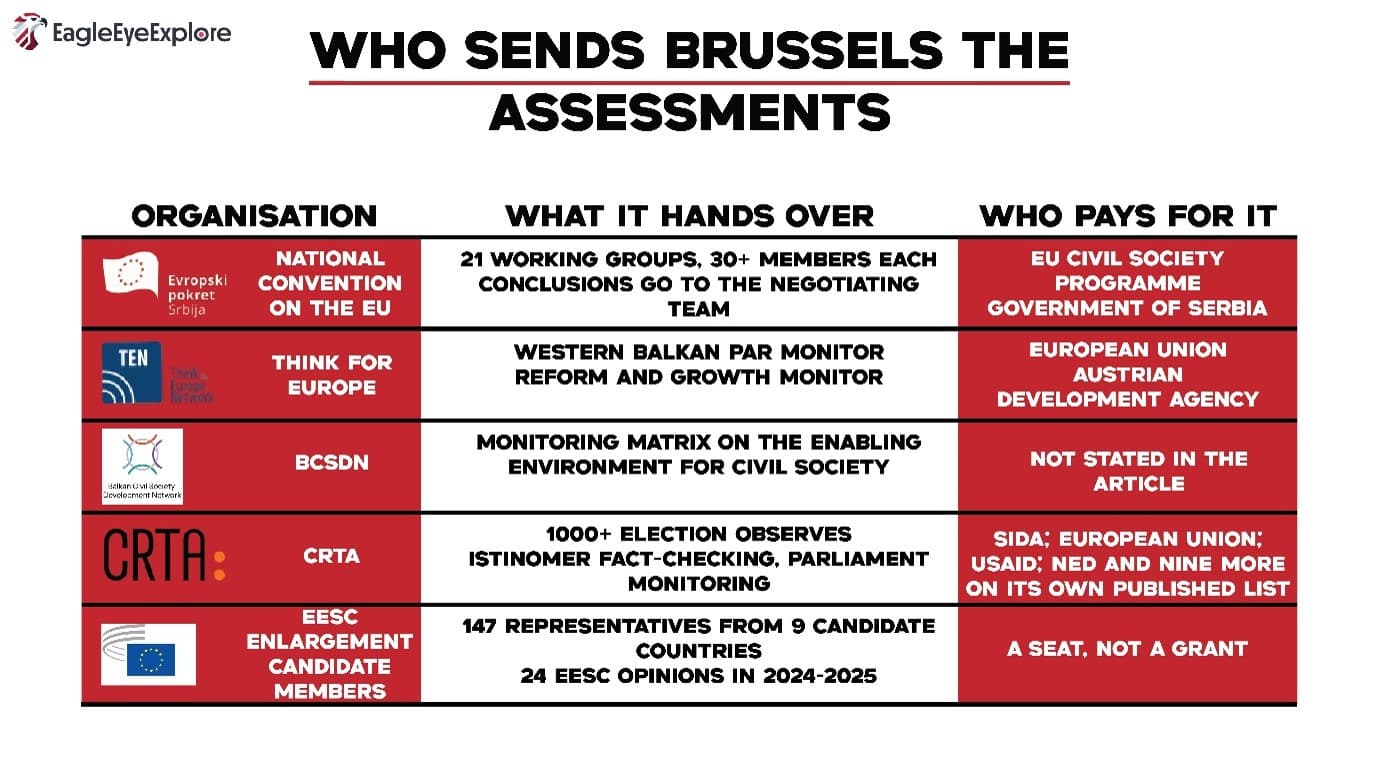
The National Convention on the European Union in Serbia has existed since 2006 and is modelled on a Slovak original. It has a presidency, a programme council and 21 working groups, each with at least thirty members drawn from state bodies, non-governmental organisations, professional associations and business. It is convened by the European Movement in Serbia. The money comes from the EU civil society support programme and the government’s Office for Cooperation with Civil Society. Its conclusions go to the negotiating team and to parliament’s European integration committee.
The Think for Europe Network brings together six policy institutes: CEP in Belgrade, EPI in Skopje, IDM in Tirana, Institute Alternative in Podgorica, the Group for Legal and Political Studies in Pristina, and the Foreign Policy Initiative in Sarajevo. From February 2023 to July 2026 they are running WeBER 3.0 — Western Balkan Enablers for Reforming Public Administrations. Belgrade’s CEP leads it; the EU-side partner is the Centre for Public Administration Research in Vienna. It is paid for by the European Union and the Austrian Development Agency. The product is the Western Balkan PAR Monitor: its own assessment of public administration reform in six countries, running in parallel to the official one. The previous version, WeBER 2.0, ran from December 2019 to June 2023 on EU money.
Separately, the same network runs the Western Balkans Reform and Growth Monitor, a three-year regional programme with EU financial support, led by EPI in Skopje. It tracks implementation of the national Reform Agendas under the Growth Plan. It has four strands: monitoring, national consultation mechanisms, re-granting, and strategic communication. Its stated purpose is to ensure that reforms financed through the EU’s six-billion-euro facility are “effective, inclusive, and transparent.” Put plainly: the EU pays a network based in Belgrade and Skopje to watch how countries earn EU money.
The Balkan Civil Society Development Network, based in Skopje, produces the Monitoring Matrix on the Enabling Environment for Civil Society Development, a regional report on the Western Balkans and Türkiye. It has been listed in the EU Transparency Register since 17 December 2009 under number 63794152825-82 as a lobbying organisation. Its declared spending on that activity: 900,000 euros in 2021, 700,000 in 2022, 600,000 in each of 2023 and 2024, and between 500,000 and 599,999 in 2025. Seven staff work on it full time.
Belgrade’s CRTA runs an election observation network of more than a thousand people, the Istinomer fact-checking service, parliamentary monitoring and an analytical service in Serbian and English. It publishes its own donor list: Sweden’s Sida, the European Union, USAID, the American National Endowment for Democracy, the Rockefeller Brothers Fund, the Sigrid Rausing Trust, Germany’s GIZ, the Friedrich Naumann Foundation, and the embassies of Canada, the Netherlands, Germany, the United Kingdom and France. Open Society Foundations is listed as a past partner. CRTA has testified before the European Parliament’s Subcommittee on Human Rights. There are seats reserved for such organisations in European bodies too. In September 2023 the European Economic and Social Committee introduced the status of Enlargement Candidate Member. Appointments were completed in February 2024: 147 civil society representatives from nine candidate countries, with fifteen more added for Kosovo. The title is honorary — no vote on amendments, no rapporteurships — but in 2024 and 2025 these people took part in drafting 24 committee opinions.
WHO PAYS FOR IT
The Instrument for Pre-Accession Assistance for 2021–2027 is worth 14.162 billion euros, of which 13.804 billion is operational. The previous cycle, 2014–2020, cost 10.683 billion. In the current cycle the window for rule of law, fundamental rights and democracy takes 15.13 per cent — 2.089 billion euros.
A separate line covers civil society in the Western Balkans and Türkiye: 337 million euros disbursed for 2014–2020 and 350.9 million allocated for 2021–2025. Inside that sum, grants through the European Endowment for Democracy come to 37.6 million, national resource centres to 12.6 million, the Western Balkans Fund to 11 million, and the TACSO technical assistance programme to 8 million.
What this looks like at the level of a single call is visible in the combined civil society and media programme for 2021–2023. The total is 14.4 million euros across twelve lots. Lot nine is called “CSO enabling environment” and carries one million. Lot eleven, “freedom of expression and media,” carries four million — the largest. A single grant runs from 700,000 to one million euros, with the EU covering between 51 and 90 per cent of eligible costs.
For Serbia there are figures from the EU Delegation itself. Over the past decade, 64 million euros went to civil society and media. Total EU grant assistance to Serbia over the same period was 2.9 billion. So between two and four per cent of European money goes to civil society and media; the rest goes to the state. Since 2020 the Delegation has awarded 114 grants to 143 organisations and more than 700 sub-grants across 29 districts and 102 municipalities; the European Endowment for Democracy handed out 160 sub-grants — 106 to media outlets and 54 to organisations. A separate call announced in June 2025, “Support for Human Rights, Democracy and Civil Society in Serbia,” was worth 7.55 million euros.
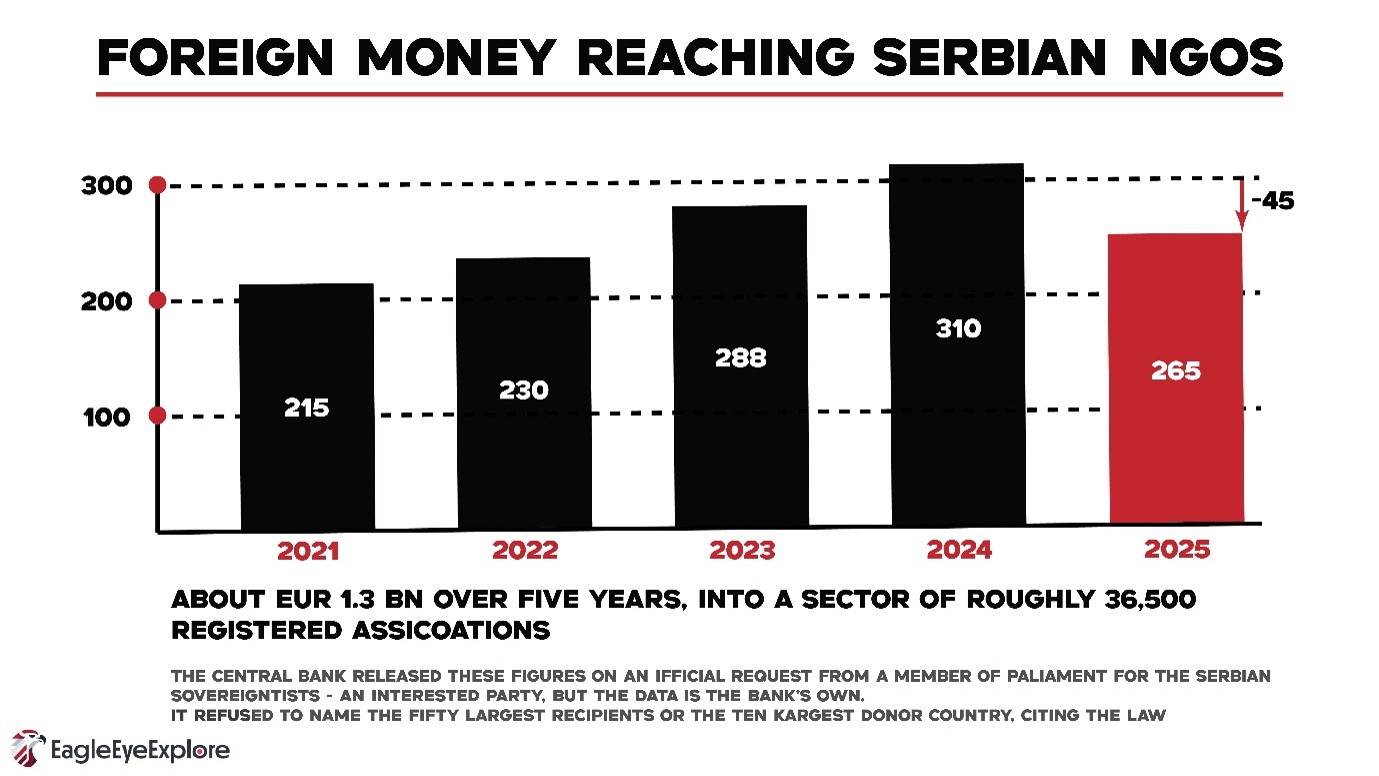
How much reaches Serbian non-governmental organisations from abroad in total is known from National Bank of Serbia figures released on official request and published by Politika on 30 July 2026: 215 million euros in 2021, 230 million in 2022, 288 million in 2023, 310 million in 2024 and 265 million in 2025. About 1.3 billion over five years. The central bank refused to name the fifty largest recipients or the ten largest donor countries, citing the law. The request came from Vukša Dragović of the Serbian Sovereigntists, so the figures were released by an interested party — but the data came from the central bank. There are roughly 36,500 registered associations in the country.
Until recently, non-European money was comparable in size. American development assistance to the Western Balkans over 2020–2024 came to 1.7 billion dollars. In Kosovo, Bosnia and Serbia together, projects worth more than 300 million were running in 2024. USAID alone spent 40,144,406 dollars in Serbia in 2024. Norway, through the SMART Balkans project run by organisations in Sarajevo, Tirana and Skopje, initially committed more than 17 million euros — cut to roughly 12 million by mid-2024; that money has funded more than 450 grants supporting over 600 organisations in six countries.
NGOs RATE THE CONDITIONS FOR NGOs
A separate strand is how the EU measures whether a country treats non-governmental organisations well. This is one of the membership criteria.
The rules are set out in the DG NEAR Guidelines for EU Support to Civil Society for 2021–2027. There are three strands — an enabling environment for organisations, their cooperation with public institutions, and their own capacity — and ten objectives with indicators beneath them. The assessment feeds into the fundamentals cluster, the one that opens first and closes last in accession talks.
Who takes the readings is clear from the second assessment against those guidelines, carried out by the EU TACSO 3 technical assistance project on the Commission’s behalf. The data collection method is a questionnaire sent to the civil society organisations themselves in Albania, Bosnia, Kosovo, Montenegro, North Macedonia, Serbia and Türkiye. It takes about thirty minutes, the questions are mostly closed, and the deadline was 11 February 2024. Its declared purpose is to provide “essential information on how civil society is changing in our region” for reporting on progress toward EU integration.
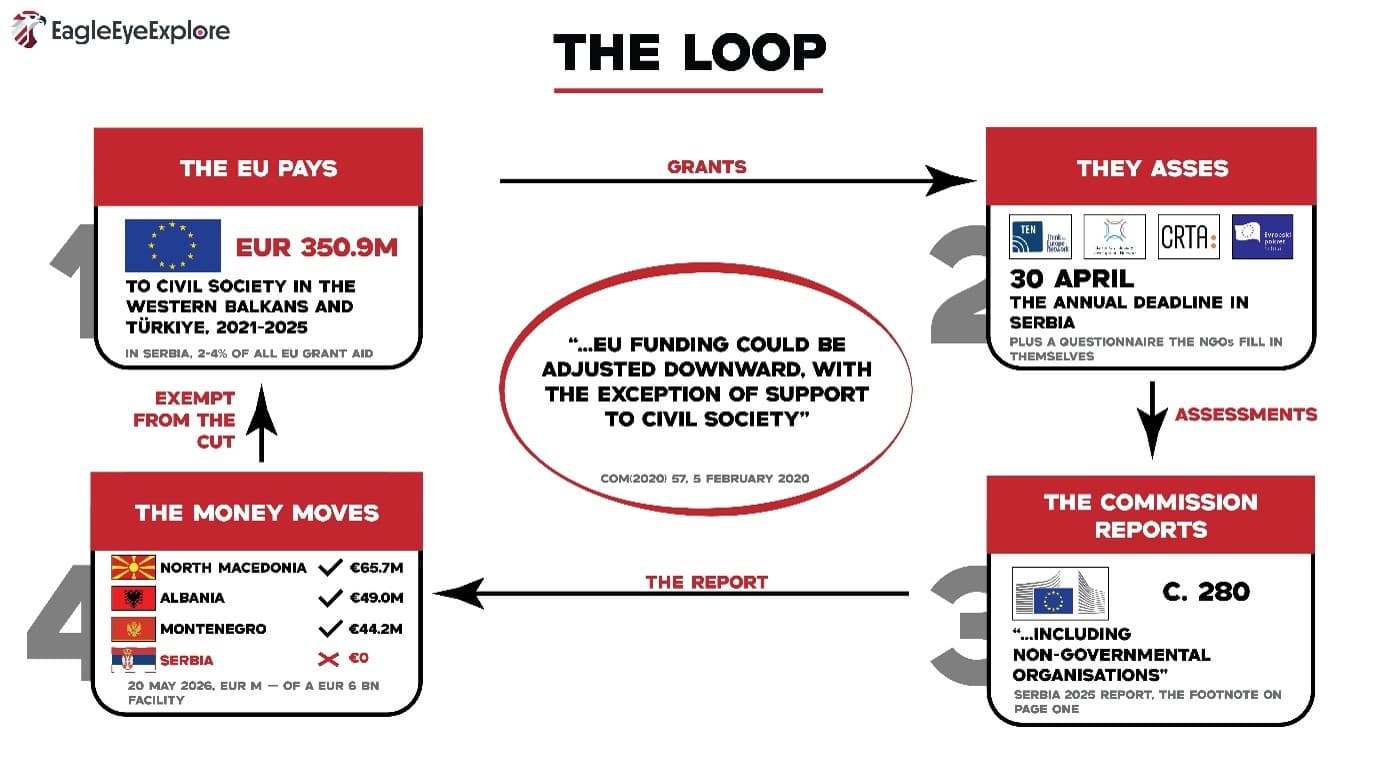
The result is a closed chain with four links. The EU allocates money to civil society. The organisations receiving it fill in a questionnaire on how well the state has created conditions for them. The results feed the country progress report. The report determines the next payment.
On top of that come the external indices the Commission’s methodology expressly permits. On 9 December 2025 the CIVICUS Monitor moved Serbia from the “obstructed” civic space category to “repressed,” the second worst of five. The monitor covers 198 countries and works with more than twenty civil society research partners. The same rating was reproduced in the joint submission by European networks to the 2026 Rule of Law Report.
That submission is telling in itself. It was prepared by a Civil Society Europe working group in May 2026 with the European Civic Forum, the Civil Liberties Union for Europe, the European Center for Not-for-Profit Law, the International Federation for Human Rights, ILGA-Europe and others. It contains nine recommendations addressed to the Commission. The second is to add a stand-alone chapter on civic space to the report. The eighth is to reinforce the link between country-specific recommendations and the allocation of financial support. The organisations that supply the assessments are asking for the money to be tied more tightly to those assessments.
HOW THE REPORT TURNS INTO MONEY
The link between assessment and money has stopped being theoretical.
The enlargement methodology adopted on 5 February 2020 introduced the clusters and the rule that “negotiations on the fundamentals will be opened first and closed last and progress on these will determine the overall pace of negotiations.” The same document lists three measures for cases of stagnation or backsliding. First, negotiations may be put on hold in specific areas or suspended entirely, and closed chapters reopened. Second: “The scope and intensity of EU funding could be adjusted downward, with the exception of support to civil society.” Third, the benefits of closer integration may be paused: access to EU programmes and unilateral trade concessions.
The one budget line shielded when a country is punished is the money for civil society. The organisations whose material builds the evidence for the punishment are protected from the punishment by a clause of their own.
The practical application is the Serbian case of 2026. The Reform and Growth Facility for the Western Balkans is worth six billion euros over 2024–2027 — two billion in grants and four in concessional loans. Payments come twice a year: the country submits a progress report, the Commission assesses whether individual reform steps have been met, and each step carries its own price. The pace is slow across the board: by 20 May 2026 the six countries had drawn 673.6 million euros, 12 per cent of what is planned by 2027, and had completed 90 of 731 reform steps.
On 28 January 2026 Serbia’s ruling coalition passed a package of judicial laws. On 25 February, at Germany’s request, EU ambassadors held an extraordinary debate: Nordic and Baltic states, the Netherlands and others declared serious concern, and some asked the Commission to consider suspending payments to Serbia if the Venice Commission’s opinion was ignored. On 17 April Enlargement Commissioner Marta Kos sent letters to every capital in the region. On 20 April it emerged that 710.6 million euros were at risk of never being paid — 11.84 per cent of total financing: Bosnia and Herzegovina 373.9 million, Serbia between 108.7 and 135.9 million, Kosovo 68.8 million, Albania 67.7 million, North Macedonia 49.2 million, Montenegro 15.1 million. The cut-off was the end of June 2026, after which the money is lost for good.
On 24 April the Venice Commission published an urgent opinion on the Serbian judicial laws with seven recommendations, noting that they had been adopted without due respect for transparency, inclusiveness and democratic debate. The opinion had been requested by the Speaker of the National Assembly, Ana Brnabić, herself. On 30 April, at the University of Fribourg, Marta Kos said it plainly: “For the time being, we have stopped all the payments from the Growth Plan because Serbia was backsliding in the judiciary, and as long as they do not repair this, they will not be able to receive EU financial support.”
On 20 May the Commission disbursed 158.9 million euros — 49 million to Albania, 44.2 million to Montenegro, 65.7 million to North Macedonia. Serbia received nothing; its second tranche of 163.1 million and third of 265 million stayed blocked. Its first release had come in January 2026, weeks before the judicial laws were passed; of the country’s 1.5 billion euro share for 2024–2027, nothing beyond that has been paid. By July 2026 Montenegro, Albania and North Macedonia were broadly on track, while Serbia, Kosovo and Bosnia were lagging.
Bosnia had been through a version of this earlier, on different grounds. On 28 September 2023 the EU stated that Republika Srpska’s draft law on a special registry for non-profit organisations “would directly contradict the repeated commitments of the Republika Srpska leadership to advance Bosnia and Herzegovina’s European integration,” and pointed out that it breached key priority 11 on civil society and key priority 12 on freedom of expression. Those are two of the fourteen conditions on which the opening of accession negotiations depended. The draft introduced a special registry for foreign-funded organisations, labelling of their materials, twice-yearly reporting, classification as agents of foreign influence, and the possibility of dissolution for non-compliance.
WHEN THE MONEY STOPPED
How much the whole construction rests on outside funding became visible in 2025.
After the US presidential order of 20 January 2025, Freedom House lost the funding for over 80 per cent of its programmes across 140-odd countries. On its Freedom on the Net project, the State Department had covered half the annual budget. Among the products halted was Nations in Transit — the annual democracy index covering 29 countries from Central Europe to Central Asia, in which one of the seven scored categories is precisely the state of civil society. The last edition appeared in 2024. There is none for 2025 or 2026.
In the region itself the losses ran to tens of millions. In Serbia up to 80 million dollars of civil society funding was frozen and the National Youth Council lost a third of its budget. In North Macedonia 22 projects worth roughly 72 million dollars were suspended, and at least ten organisations lost more than half their money.
The National Bank of Serbia figures show the same drop from the recipient’s side: 310 million euros of foreign funding in 2024 and 265 million in 2025. Forty-five million less in a year.
On 12 November 2025 the Commission answered with two documents at once. The EU Strategy for Civil Society declared the civic space of member states and enlargement countries a single whole — “a continuum and shared democratic space” — and the Commission undertook to “institutionalise and standardise in-country consultation of CSOs.” Candidate countries are to draw up a Roadmap on Functioning Democratic Institutions setting out concrete measures to improve conditions for these organisations. From 2026 a Civil Society Platform is being set up, with an annual summit held jointly with the Economic and Social Committee. There is money behind it: the CERV programme, worth more than 1.5 billion euros for 2021–2027, of which 77 per cent of awarded funds went to non-governmental organisations, and its successor AgoraEU at almost nine billion for 2028–2034. The second document of the same day was the European Democracy Shield, with a media resilience programme, a European network of fact-checkers and a centre for democratic resilience open to candidate countries.
THE COUNTER-MOVE
The response inside the countries is similar everywhere. In Republika Srpska a foreign agents bill was tabled in 2023. In Serbia in 2025 a party in the ruling coalition drafted a law on agents of foreign influence, which never reached the floor; in February that year prosecutors organised searches at four organisations, after which 29 of them walked out of the government’s working groups. Aleksandar Vučić put it this way: “Billions of euros were invested in bringing Serbia down, and they nearly succeeded.” The pro-government tabloid Informer was blunter: “Europe is financing the destruction of the state.”
The Commission’s 2025 communication recorded the opposite: “Restrictions on freedoms of association, assembly and expression have increased in some countries, such as in Serbia, Türkiye and Georgia.”
There is a second side to this picture. Civil society and media take between two and four per cent of EU grant assistance to Serbia; the bulk goes to the state, not to its critics. No rule obliges the Commission to accept the conclusions of non-governmental organisations: formally they are one source among several, alongside the country’s own government, the member states and the European Parliament, and direct citations of named organisations are almost absent from the reports. In the decisive episode of 2026 the legal assessment came from the Venice Commission, an intergovernmental body of the Council of Europe, and it was requested by the Speaker of the Serbian parliament. And the argument from the other side: when the state controls the statistics and most of the television, independent verification is impossible without externally funded organisations, and dropping that source leaves Brussels alone with government data.
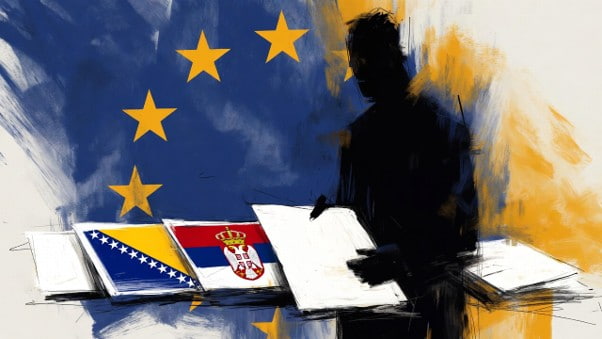
The mechanism, though, is unchanged. The European Union pays for the organisations’ work. The organisations send written assessments to the Delegation by a stated deadline. The report is assembled from those assessments. The report decides whether the country gets its next tranche. And when a country is punished by cutting its funding, one line stays untouched — the support to civil society the chain begins with.