A fact-checker in Podgorica, Sarajevo or Skopje has no powers of a state regulator. It cannot force a newsroom to take down an article or ban a user from posting on Facebook. But for several years, its verdict could trigger a mechanism that directly affected how widely a piece of content was distributed: after a review by one of Meta’s partners, the platform could attach a warning and reduce its reach.
That was what set modern fact-checking apart from ordinary journalistic criticism. The fact-checker did not block anything itself, but its assessment became a signal for the platform’s algorithm. Small non-governmental organisations thus acquired influence far beyond the size of their newsrooms. The final decision on what happened to flagged content, however, remained with Meta.
This model spread across the Western Balkans from the late 2010s. Local projects that had initially focused on checking politicians’ statements and media reports joined international networks, obtained certification and began working with major platforms. What had started as fact-checking gradually developed into a separate infrastructure.
WHO MAKES THE ASSESSMENT
The system operates on several levels. A local newsroom assesses a specific claim or publication. International networks such as IFCN and EFCSN set professional standards and certify organisations against them. The technology platform then decides what consequences, if any, should follow from a fact-checker’s verdict.
In practice, these roles are easy to conflate. To a user whose post receives a warning or loses reach, the local fact-checker can appear to be the source of the restriction. Formally, that is not the case: the newsroom provides the assessment, while the platform imposes any distribution limits. But it was precisely this link between editorial judgment and algorithmic moderation that made the system politically sensitive.
WHO FUNDS THE HUNT FOR DISINFORMATION
Across the Balkans, the model came to include Istinomer in Serbia, Raskrinkavanje in Bosnia and Montenegro, Truthmeter in North Macedonia, Faktoje in Albania and other projects. Many of these organisations also work in journalism, research, media literacy and advocacy, meaning they seek to influence public policy in the same field they monitor.
Fact-checking rarely survives as a self-sustaining commercial media business. Most organisations therefore rely on grants, international programmes and contracts with technology companies. In the Western Balkans, recurring sources of support have included USAID, the U.S. State Department, NED, the European Union, European governments, Open Society and Meta.
The clearest example is Montenegro’s Center for Democratic Transition, which runs Raskrinkavanje.me. CDT’s 2023 financial report lists funding from the U.S. Embassy for projects countering disinformation, grants from NED, support from the Rockefeller Brothers Fund, money from the Dutch government and financing from the European Commission.
A separate line in the report lists a €180,000 contract for checking misinformation on Facebook. At the same time, CDT received €172,885 from the European Commission for participation in the regional SEECheck network. The same organisation was therefore working with Meta, American and European donors while also running projects on foreign influence, elections and public policy.
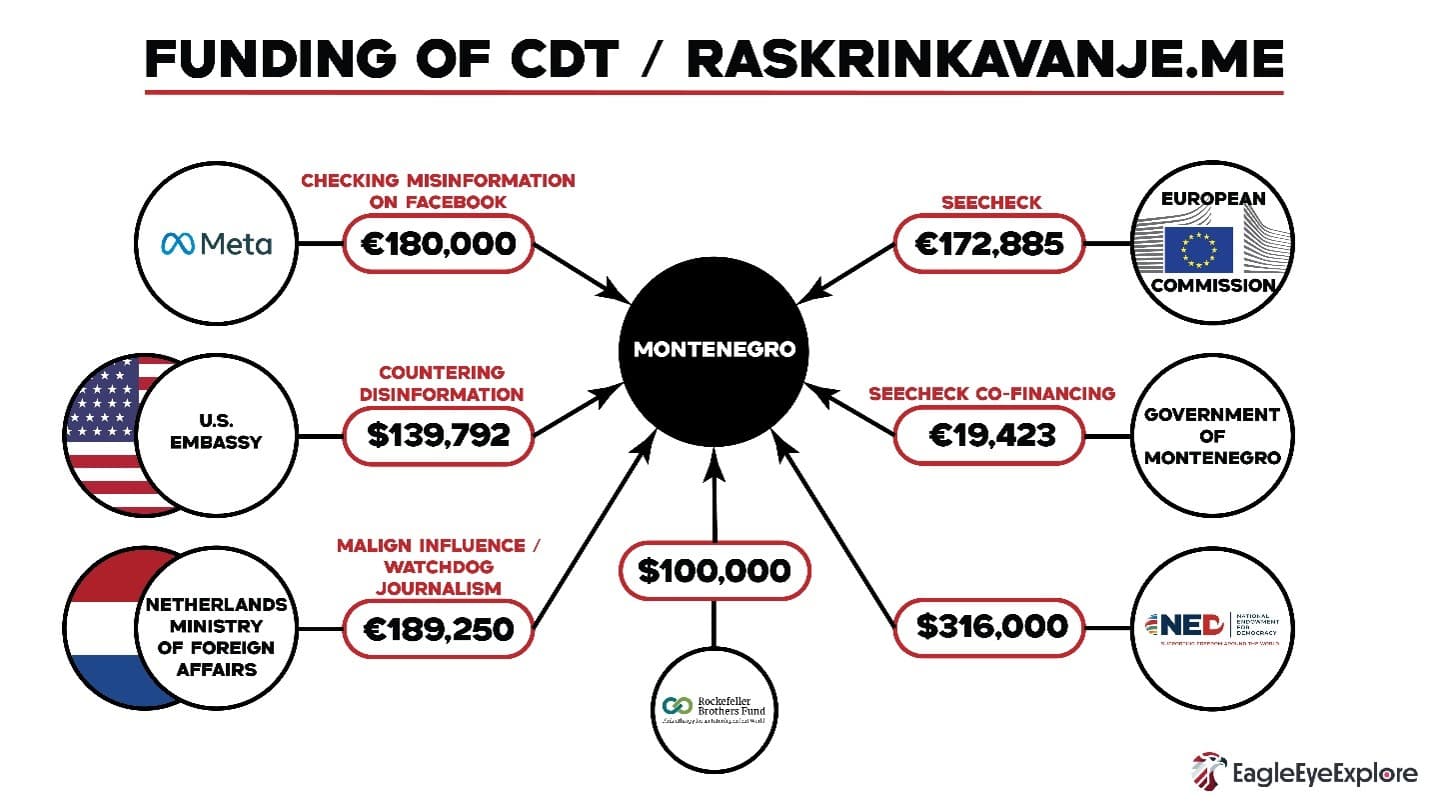
The existence of this funding does not mean that a donor determines the content of a specific fact-check. There is no evidence of such direct editorial control in the public documents reviewed. But the funding structure does show which institutions sustain the system and why transparency requirements for these organisations go beyond those of an ordinary newsroom.
FROM INDIVIDUAL NEWSROOMS TO NETWORKS
A similar model emerged in North Macedonia. Metamorphosis Foundation, which runs Truthmeter, began as a programme of Foundation Open Society – Macedonia before becoming an independent foundation. Over the years, its partners and donors have included the EU, USAID, NED, the governments of the United States, the Netherlands and Switzerland, Open Society, Meta and Google.
Metamorphosis is not limited to journalism. It works on fact-checking, media monitoring and research, participates in international professional networks and also advocates for government policy on disinformation. Its leadership has also been involved in the European Fact-Checking Standards Network.
This overlap of functions is not unique to North Macedonia. Albania’s Faktoje was launched with USAID support and later joined IFCN, EFCSN and regional anti-disinformation networks. Bosnian, Serbian, Croatian and Montenegrin projects also gradually became part of cross-border structures.
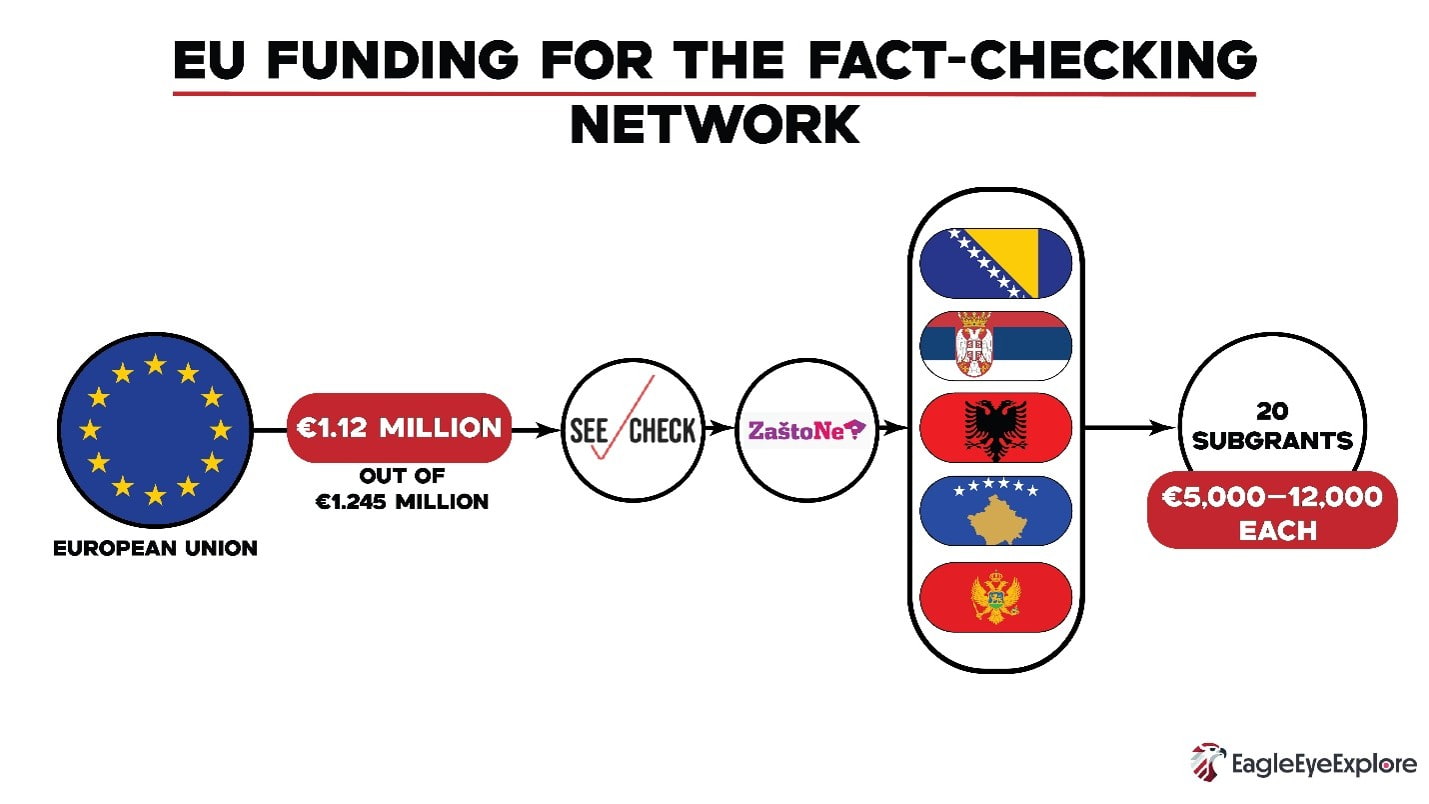
In 2020, several of these organisations created SEECheck. The network does more than publish joint fact-checks: it conducts research, trains journalists, promotes media literacy and prepares recommendations for public institutions. For 2023–2026, the European Union allocated €1.12 million to the SEECheck project, out of a total budget of roughly €1.245 million. The programme also includes subgrants for local media outlets and NGOs.
THE EUROPEAN INFRASTRUCTURE
For years, much of this infrastructure depended on American grants and Meta contracts. After cuts to parts of U.S. foreign assistance and Meta’s decision to move away from its traditional third-party fact-checking model, beginning in the United States, the stability of that system came into question.
At the same time, the EU has been steadily expanding its own infrastructure. It funds the European Digital Media Observatory, regional hubs, fact-checking networks and projects monitoring the information environment. In 2026, the European Commission signed another €5 million grant agreement to support independent fact-checking through EFCSN and its partners. More than 60% of the project funding is intended to go directly to fact-checking organisations.
This is especially significant for the Western Balkans. The countries of the region are not yet part of a single EU legal space, but their organisations are already embedded in European professional networks, receive European funding and participate in projects designed for cooperation with public institutions and platforms.
What is taking shape, then, is no longer a handful of newsrooms checking disputed claims. It is a permanent system made up of local organisations, international standards, shared databases, grant programmes, training schemes and channels of cooperation with public institutions.
WHERE THE DECISION ULTIMATELY SITS
There is no single body in the Balkans that decides what counts as disinformation across the region. A specific verdict is still made by a newsroom. An international network determines whether that organisation meets professional standards. The platform decides how to use the assessment. Donors finance the organisations and the infrastructure in which all of this takes place.
This division of responsibility allows each participant to say that the final decision lies elsewhere. A donor does not write the fact-check. An international network does not choose the post to be reviewed. A fact-checker does not control Facebook’s algorithm. The platform, in turn, points to assessments made by independent experts.
That is why the system cannot simply be reduced to censorship. But it is equally misleading to treat it as ordinary journalism. When a newsroom receives external funding, belongs to networks involved in setting standards, engages in advocacy and produces assessments that can affect the distribution of information on a platform, it becomes part of a broader infrastructure governing the information environment.
In the Balkans, this infrastructure has been taking shape for more than a decade. It began around individual NGOs and American grants, then expanded through partnerships with technology companies and regional networks. Today, the European Union is playing an increasingly important role in financing and institutionalising it.
The question, then, is no longer only who checks a particular claim. Just as important is who sets the rules, who pays for the system and who ultimately turns an editorial assessment into a decision capable of affecting how far information travels.