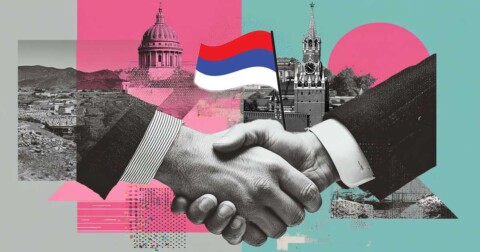
In recent days, the Serbian public has become familiar with the findings of the European Commission’s annual survey on Serbian citizens’ attitudes toward the country’s membership in the European Union.
Among other things, the public opinion survey shows that 28 percent of Serbian citizens have a “positive or very positive” image of the European Union, while 32 percent have a “negative or fairly negative” perception of it. The survey also indicates that, alongside the outspoken supporters and opponents of Serbia’s EU membership, there is a third—and in fact the largest—group, comprising 38 percent of respondents. These are the so-called “neutral” citizens, that is, people who do not have a clearly defined opinion of the European Union. When asked about the main benefits of EU membership, Serbian citizens most frequently cited open borders and the opportunity to travel (41 percent), followed by a better quality of life and higher living standards (32 percent), and financial assistance to Serbia from the European Union (31 percent). As for the perceived disadvantages of Serbia joining the EU, respondents were most concerned about the exploitation of natural resources (43 percent), the emigration of young people (35 percent), and the possibility that membership in the Union could undermine cooperation with Russia (33 percent). When it comes to areas in which the European Union should play a more significant role in Serbia, citizens most often pointed to economic development and trade, healthcare, and the fight against corruption and the better implementation of laws.
THE NEUTRAL VOTE COULD BE DECISIVE IN THE FUTURE
Commenting on the results of this year’s public opinion survey in the countries of the so-called Western Balkans and Turkey, Enlargement Commissioner Marta Kos paid special attention to the fact that “citizens across the enlargement partner countries clearly see what closer ties with the EU mean in practice – stronger peace and security, broader economic opportunities, and better prospects for the next generation.” Although, at least in Serbia’s case, it is difficult to find solid factual support for this conclusion in the results of the aforementioned survey, her words nevertheless clearly testify to the efforts of the Brussels administration to continue presenting the European Union to the citizens of the Western Balkans in an idealized manner as a haven of peace, security, and a high standard of living.
At the beginning of June, the results of a research project on Serbian citizens’ attitudes toward the European Union were also presented. The survey was conducted in January and February of this year by the agency Ninamedia on a representative sample of 1,000 respondents in Serbia excluding Kosovo and Metohija, on behalf of one of the leading NGO promoters of Serbia’s membership in the European Union and a member of the National Convention on the EU – the Centre for European Policy (CEP).
The results of this survey of Serbian public opinion regarding the country’s membership in the European Union also show that, alongside two large and numerically almost equal groups of explicit supporters and opponents of Serbia’s EU membership (39.8 percent versus 33.8 percent), there is a large group of respondents—more than one quarter, or 26.4 percent—who currently hold a neutral position toward Serbia’s accession to the Union. Their vote could prove decisive in the future if a referendum on Serbia’s membership in the European Union were to be held. Among respondents who stated that they would participate in such a referendum (85.3 percent of the sample), a plurality (41.6 percent) would vote in favor of membership, 32.4 percent would vote against it, while slightly more than one quarter (26 percent) currently do not know how they would vote.
PROPAGANDA STEREOTYPES DO NOT MATCH REALITY
For today’s “neutral” citizens to move into the camp of explicit opponents of Serbia’s membership in the European Union, and also for the current percentage of explicit supporters of EU membership to decline, it is necessary to confront the existing perception of the Union—constructed through positive propaganda stereotypes—with reality. Specifically, the public opinion survey conducted by the Centre for European Policy shows, on the one hand, that the number of Serbian citizens who believe that “the EU is more interested in pursuing its own political and economic interests in our region than in the state of democracy and the rule of law” has increased (41.6 percent), and that, accordingly, their standard of living will not improve if the country joins the Union (40.9 percent). On the other hand, the survey still records a relatively large number of citizens who believe that Serbia’s membership in the EU would automatically lead to an improvement in their living standards (30.5 percent). Regarding the question of the impact of Serbia’s membership in the European Union on individual living standards, the survey also records a large proportion of undecided respondents (28.5 percent).
When it comes to the macroeconomic benefits of Serbia’s membership in the European Union, the percentage of Serbian citizens who believe in a positive effect ranges, depending on the question, from 33.8 percent to 45.5 percent, while the share of those who do not foresee positive effects on Serbia’s economy from EU membership ranges between 25.7 percent and 34.2 percent. The proportion of citizens who are uncertain about the macroeconomic effects of Serbia’s membership in the European Union ranges, depending on the question, from 23 percent to 34.4 percent.
A UNION OF FEAR, NOT OF VALUES
The results of the aforementioned surveys on Serbian citizens’ attitudes toward the European Union indicate that today’s “neutral” or “undecided” citizens will most likely become the primary target of a new wave of exclusively geopolitically motivated pro-EU integration propaganda in the countries of the so-called Western Balkans, launched by Brussels at the summit in Tivat. This new campaign to popularize European integration in Serbia and throughout the Western Balkans will, in all likelihood, focus on spreading fears of the “Balkan powder keg” while simultaneously reinforcing the long-standing image of the European Union as a “safe house.” After all, the (mis)use of fear lies at the very foundations of the European Union, because, in the words of Adrian Severin, the Union was primarily created as a “Union of Fear” rather than a “Union of Values”; its foundational values emerged first from the fear of war and later from the fear of poverty and hunger.
The latest findings on Serbian citizens’ attitudes toward the European Union show that a significant number of our compatriots—roughly one-third—still perceive the Union as a peace project, despite the fact that the EU has undergone such a transformation that it can no longer be described primarily as a peace-oriented and civilian, that is, economic project. Although the Union’s departure from its original peace-oriented goals, which were also enshrined in the 2007 Treaty of Lisbon, became particularly visible during the war in Ukraine, well-informed observers of developments within the EU had long been drawing attention to the tendency toward its profound internal transformation.
ACCELERATED MILITARIZATION – WHAT REMAINS OF THE OLD EU?
As early as 2006, Radmila Nakarada, who can hardly be suspected of Euroscepticism, pointed out that “the EU has embarked on the creation of its own military force, on the gradual transformation of an economic-political union into a military defense alliance.” At the same time, she emphasized that “this does not mean that the EU has abandoned the civilian and preventive aspects of its conflict-resolution/crisis-management policy, but rather that the military/defense dimension is becoming more prominent and that the problem of establishing coherence between these two tracks, these two types of instruments, has emerged.” In this regard, the author noted that although the interest within the EU “in developing the civilian component has not disappeared,” it is impossible to dismiss “the concern that there is a real danger that, in the future, the military component will overpower the civilian aspects, and that instead of a civilian power, the EU will become a ‘normal’ superpower, intervening in all parts of the world where its security interests are threatened.”
Starting from the premise that the peace and social project constitute the differentia specifica of the European model of integration and development, Nakarada warned that abandoning the peace model would inevitably lead to a crisis of the EU’s social model as well. In her words, “today there are increasingly strong voices calling for the abandonment of the social model of capitalism in the name of economic efficiency and more successful adaptation to neoliberal global trends, increased competitiveness vis-à-vis the new economic giants, as well as voices seeking a more robust, harder Europe—a Europe as a military power.”
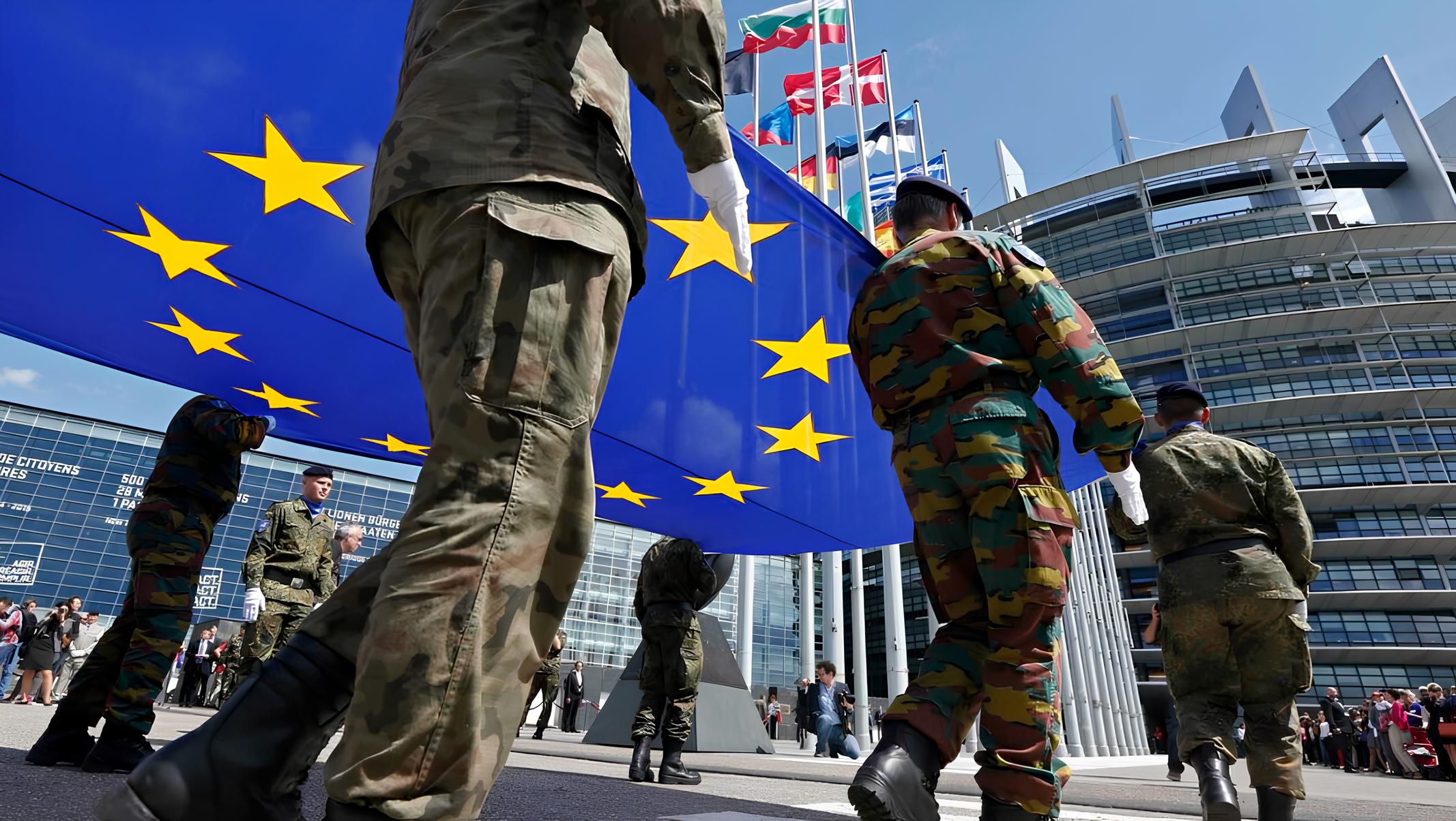
The earlier, gradual, and less visible militarization of the European Union, against which Nakarada warned, and whose roots can be traced back to the June 1999 decision of the EU Council to establish “rapid reaction forces,” reached its final culmination with the outbreak of the war in Ukraine. Today, it can be stated with certainty that the European Union is no longer primarily a peace project, nor consequently a socio-economic one, but rather a military and geopolitical project above all. Numerous facts and developments testify to the current accelerated militarization of the European Union, which stands in contrast to the commonly held perceptions of the EU among our Europhile idealists.