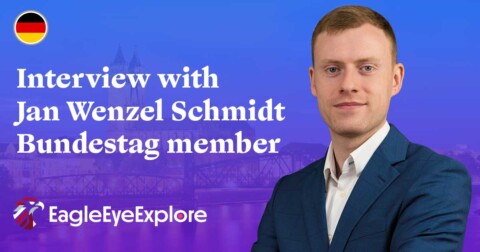
We advise future members of the European Union not to yield to pressure from the European Commission, not to give up their rights, and, above all, not to agree to the abolition of the veto. All states must have equal rights. If that is not the case, then such a system is unacceptable. We hope that, together with our allies across Europe, we will succeed in steering the European Union in an entirely new direction and bringing about a 180-degree political turnaround, so that it becomes a community that truly serves the interests of the peoples of Europe, says Tobias Teich, a member of the Alternative for Germany (AfD) in the German Bundestag, in an interview with EagleEyeExplore.
We spoke with him about whether Germany’s political landscape is undergoing an irreversible transformation, who bears responsibility for the state of the German economy, and whether the AfD, despite attempts to politically isolate it, can become the country’s leading political force and reshape Germany’s approach toward the European Union, Serbia, and the Western Balkans.
Mr. Teich, how do you explain the fact that the AfD enjoys 40 percent support in Saxony-Anhalt, while the CDU and SPD together barely reach that level? Is this a clear sign that the AfD’s sovereignist policies are gaining the support of dissatisfied German citizens?
Yes, it is a clear indication of profound changes on Germany’s political scene that have been unfolding for the past ten to fifteen years. Since the migration crisis of 2015, through the COVID-19 pandemic, and now the war in Ukraine, public trust in the traditional parties has been steadily declining.
At the same time, opinion polls show that older voters remain more inclined to support the established parties, while younger generations increasingly favor the AfD. Due to demographic changes, we believe this trend will become even more pronounced.
People are dissatisfied because they are facing a declining standard of living, problems within the healthcare and social welfare systems, and growing pressure on public finances. That is why we believe support for the AfD’s sovereignist policies will continue to grow.
Do you believe that the so-called “firewall” (Brandmauer), which prevents the AfD—the strongest party—from participating in government, is compatible with democratic principles? Shouldn’t the election winner have the right to take part in forming the government?
Absolutely. In our view, the so-called “firewall” is probably a unique phenomenon in the world.
Conflicts between governing parties and the opposition exist in many countries, but the way this policy of complete isolation of the AfD is being implemented in Germany is truly unprecedented.
On the one hand, we are told that even if the AfD receives 30 percent of the vote, it cannot govern on its own. On the other hand, we see the traditional parties becoming smaller, steadily losing their identities, and forming various coalitions solely to remain in power. This puts them in an increasingly difficult position because parties with fundamentally opposing political views end up governing together. As a result, their former political platforms effectively disappear.
The consequence is that even more citizens turn to the AfD because people realize that every effort is being made to prevent any genuine political alternative from emerging in Germany.
Many people are reminded of the system of the former East Germany (GDR), where there was effectively only one ruling political structure to which everyone had to conform.
I am convinced that the smaller parties of the old political establishment will disappear in the foreseeable future, and that the CDU, due to declining support and the natural passing of older generations, will eventually collapse as well, much like the Italian Christian Democrats did.
If the AfD achieves the result currently projected in the September elections in Saxony-Anhalt, do you see a possibility of finally breaking the political blockade and implementing AfD policies in the interests of German citizens?
That is the key question. The policy of the so-called “firewall” is already showing signs of weakening. In the European Parliament, we have already seen conservative and right-wing parties jointly support important decisions on migration and asylum, demonstrating that the firewall is not impenetrable.
Similar developments are already visible in states such as Saxony-Anhalt and Thuringia, where the AfD is very strong. Berlin will probably be the last to abandon this policy, but I am convinced that the elections in Saxony-Anhalt could mark the beginning of its end.
We believe that after those elections, the collapse of the so-called “firewall” will begin, forcing the old parties to accept the new political reality and acknowledge that their strategy of isolating the AfD was a mistake.
In your opinion, how much have economic factors—high energy prices, the industrial crisis, mass layoffs, and Germany’s economic decline—contributed to the AfD’s growing support?
They have had an enormous impact.
The migration crisis that began in 2015 was a severe blow, but at that time many citizens could still justify the situation because the German economy remained strong and the welfare state was still functioning relatively well.
However, after the coronavirus pandemic, and especially following the outbreak of the war in Ukraine in 2022, everything changed. The German economy is now in free fall.
Every statistical indicator points to a rapidly weakening economy. Every month we witness new layoffs. More and more medium-sized and even large companies are shutting their doors. Some automobile manufacturers are already planning to close entire factories in Germany. This means more unemployment, a weaker economy, and lower tax revenues for the state. That is the essence of the problem. The welfare state can only exist if there is a stable and successful economy capable of financing social benefits and servicing public debt. If that economic foundation collapses, there will no longer be enough money for anything. Spending cuts, reductions in benefits, and growing public dissatisfaction will inevitably follow. That is why I believe that the social and economic consequences of the crisis—even more than the migration crisis—will encourage people to support a political alternative.
How do you view the increasing number of physical attacks on AfD members, political pressure, and attempts to exclude your party from public debate? Is this a sign that the political establishment no longer has any convincing arguments against the AfD’s rise?
Absolutely. The increasing repression directed against the AfD and the campaigns conducted by the government, NGOs, and certain media outlets demonstrate that the political establishment is trying to stop political change in Germany. Their goal is to discourage us and exclude us from public life, but this strategy is producing exactly the opposite effect.
Over the past thirteen years, we have experienced cars being set on fire, attacks on party offices and campaign stands, physical assaults on our members, and even pressure from the private sector, including the closure of bank accounts belonging to some AfD representatives.
Nevertheless, we will not give up. The more visible these attacks and acts of intimidation become, the greater the solidarity we receive from ordinary citizens. Most people reject political violence, threats, and attempts to silence political opponents. Such actions do not weaken support for the AfD—they strengthen it.
You were one of the few politicians in Germany who publicly criticized the sanctions against Republika Srpska President Milorad Dodik and defended Republika Srpska. Time has shown that your position was justified, as the sanctions have since been lifted. What role did political determination and courage play in this? From a German perspective, how do you view the Balkans, and do you have a vision for future relations?
I would begin with the issue of Republika Srpska and Milorad Dodik. Personally, I believe that sanctions are generally a bad and ineffective instrument that fails to achieve its intended objectives. I place much greater faith in diplomacy, negotiations, and cooperation based on shared economic interests. Those who genuinely seek results are most likely to achieve them by offering cooperation from which both sides benefit.
That is why I have always advocated lifting the sanctions, and I welcome every decision in that direction. Lasting solutions can only be achieved through dialogue and negotiations conducted on an equal footing.
As for Christian Schmidt, I spoke with him just a few days ago in the German Bundestag. His departure as High Representative would be an important step toward allowing Bosnia and Herzegovina, and especially Republika Srpska, to regulate their own affairs more independently. From a German perspective, it is entirely understandable that no one wants a foreigner imposing laws, changing electoral rules, or making political decisions on their behalf. More than thirty years after the Dayton Agreement, I believe it is time to seriously reconsider that model and find a more sustainable solution that, while respecting all entities, would provide greater stability.
Regarding the Balkans, I do not believe Germany should act as a teacher or a tutor. It is far more important to build a partnership based on equality. We belong to the same Central European cultural space, share many values, a common history, and a similar understanding of the family. History teaches us that we should not stand against one another, but rather recognize what unites us and where we can cooperate.
In my opinion, Europe’s future no longer lies in the western part of the continent. Europe’s future lies in Central Europe. That is why it is important to develop regular political dialogue and cooperation with the countries of the Western Balkans so that, together, we can build a more stable and prosperous future.
The AfD advocates greater German sovereignty vis-à-vis Brussels. How does this approach shape your policy toward the Balkans, particularly Serbia and the issue of Kosovo?
Our position is completely clear. We are a party that advocates sovereignist policies.
We believe that the member states of the European Union must not be subordinated to the institutions in Brussels. We believe that national constitutions and national legislation take precedence over decisions made by the European Union, regardless of the fact that EU institutions claim otherwise.
The European Union is not a state. It has no people of its own. It has no constitution. It is based on two international treaties: the Maastricht Treaty and the Lisbon Treaty, but that does not mean it has become a state.
In our opinion, the European Union has long since departed from its original purpose.
It was meant to be an economic community that enabled its member states to achieve economic development, facilitate trade, promote the exchange of goods, and increase competitiveness.
We want to return the European Union to precisely those fundamental principles.
You previously stated that recognizing Kosovo was a major mistake and that such a policy caused serious injustice to Serbia. Do you believe that a sovereign Germany should return to respecting the principle of Serbia’s territorial integrity?
Thank you once again for this question. I overlooked it earlier.
It is perfectly clear that, regarding Serbia’s path toward the European Union, the EU insists on two things.
The first is that Serbia should, if possible, not exercise its right of veto, or at least obtain that right only at a later stage of membership. There is still no complete consensus within the European Commission on this issue.
The second, and far more important condition, is the recognition of Kosovo. The European Commission is effectively demanding that Serbia recognize Kosovo as a prerequisite for joining the European Union.
In our opinion, it is entirely understandable that Serbia does not wish to renounce part of its territory and wants to preserve its territorial integrity. I would also like to point out one important fact. This is not merely Serbia’s position. As far as I know, approximately one hundred countries have recognized Kosovo, while nearly the same number have not.
This means that Kosovo’s statehood remains disputed from the standpoint of international law and international practice. For that reason, we would continue to reject any policy that would force Serbia to recognize Kosovo in order to achieve other political objectives. That must never become a condition. As I have already said, the European Union should not interfere in the internal political affairs of its member states, let alone of countries that merely aspire to join it. That is not its fundamental purpose, and this is precisely the position of our parliamentary group. That is why we have previously initiated parliamentary motions, debates, and hearings on this issue in the Bundestag. We fully regard Serbia’s interests as legitimate and believe that it has every right to maintain its position without fearing political consequences.

How do you view the situation of the Serbs in Kosovo and Metohija, who face constant pressure and repression? What would be the AfD’s approach toward the Serbian community in Kosovo?
Political decisions, armed conflicts, and historical events create realities, but so does the passage of time if nothing is done. The best examples are South Tyrol and Northern Cyprus. In South Tyrol, after the First World War, systematic Italianization was carried out, including the prohibition of the German language, the imposition of Italian, and changes to the ethnic composition through organized settlement. In Northern Cyprus, decades of demographic change have created a new political reality.
Germany also has historical experience with ethnic Germans living outside the borders of the mother country, so we understand very well what happens when a state fails to care for its own people. That is why I believe time must not be allowed to work against the Serbs in Kosovo and Metohija. At the very least, the full protection of their rights must be guaranteed. Otherwise, demographic changes and the creation of new political realities will lead to a further decline in the Serbian population and an even more vulnerable position for the Serbian community.
If the AfD comes to power, would that mean establishing a relationship of equal partnership with Serbia and greater stability in the Balkans?
Absolutely. The AfD’s foreign policy is based on building partnerships among equals. Europe today faces serious political, economic, and demographic challenges, which is why I believe Central Europe will play an increasingly important role in the future.
We do not merely want a partnership with Serbia—we will actively work to build one. I believe in a policy of open dialogue, in which both sides clearly define their interests and build cooperation on the basis of mutual benefit. Regardless of the future of the European Union or Serbia’s status, there is considerable room for bilateral agreements that can stimulate economic development and strengthen relations between our two countries.
After numerous conversations in Belgrade, I am convinced that we have far more that unites us than divides us. Historical divisions must not be repeated. Serbia and Germany can achieve far more as partners working together to address the challenges of the modern era.
Serbs have experienced many important decisions being made in Brussels without direct consultation of the people. Do you believe this shared experience could lead to closer cooperation between sovereignist forces in Serbia and Germany?
Absolutely. First and foremost, I am a strong opponent of the way the European Union functions today. I believe that the European Union is making decisions that shape the long-term future of nations without ever asking citizens directly for their consent. Monetary union, Schengen, the Dublin Agreements, and the Common European Asylum System are just a few examples. Such issues should not be left exclusively to representative democracy—the people themselves must have the final say.
That is precisely why I see great potential for cooperation between Serbian and German sovereignist forces. History shows that systems which restrict political freedoms and distance citizens from decision-making do not endure for long. If dissatisfaction with the European Union’s current direction continues to grow, I am convinced that movements advocating sovereignty, democracy, and the preservation of national identity will continue to gain strength.
That is why I believe that Serbs and sovereignist forces in Germany stand on the same side when it comes to resisting these negative trends coming from Brussels. I am convinced that, through joint action, we will be able to change the current direction of the European Union and send a clear message to the institutions of the European Commission that the peoples of Europe want a different kind of policy.