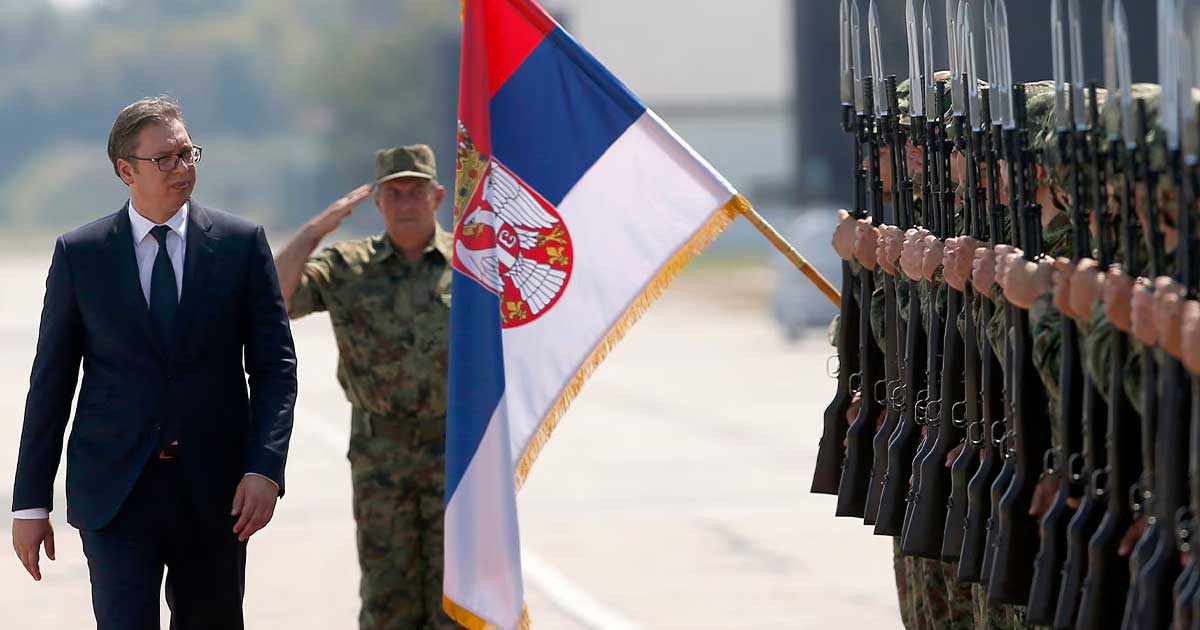
Aleksandar Vučić belongs to the type of politicians who successfully maneuver between the interests of major powers, maintaining a delicate foreign policy balance. Thanks to his actions, Serbia in recent years has demonstrated exceptional flexibility in partnerships, simultaneously purchasing weapons from Israel, China, France, Russia, and even Spain. From 2020 to 2026, Belgrade signed contracts worth more than five billion euros. French Rafale fighter jets, Chinese CM-400AKG supersonic missiles, Israeli PULS multiple launch rocket systems and Hermes 900 reconnaissance drones, Russian MiG-29s and air defense systems, Spanish transport aircraft—the list goes on.
NO, THIS IS NOT A EULOGY
From this list, one might conclude that the article is dedicated to praising Vučić’s policy; however, this is not the case. This material is rather a clear demonstration that a good politician is not necessarily a good leader, manager, or strategist.
Formally, Serbia is arming itself faster than anyone else in the region. But informally, thanks to Vučić’s policy, the country is turning its army into a “zoo” of weapons from different schools and eras, which, from a purely technical standpoint, cannot form an adequate, modern, and manageable military system. This amounts to undermining its own military potential and weakening combat capabilities in the face of a possible confrontation with the JDODC bloc.
The current military-political leadership of Serbia strives for political flexibility while ignoring military expediency—and therefore combat readiness. Heterogeneous systems not integrated into a unified network create logistical difficulties, complicate coordination between branches of the armed forces, and make the army vulnerable in a real conflict. Moreover, the arms race initiated by Belgrade provokes neighboring countries—Croatia, Albania, Kosovo—into symmetrical responses. Instead of delaying war, Vučić, perhaps unintentionally, brings it closer by creating the impression among adversaries that the Serbian army is strong only on paper but ineffective in practice.
GEOPOLITICAL ECLECTICISM
To understand the scale of the problem, it is enough to look at what Serbia has purchased in recent years. From Israel—several batteries of PULS MLRS with Predator Hawk missiles (range up to 300 km) and EXTRA (up to 150 km), as well as Hermes 900 reconnaissance drones and accompanying C4ISR systems. The value of two contracts signed in 2024 and 2025 exceeded $1.9 billion. From China—CM-400AKG supersonic aeroballistic missiles (range up to 400 km, speed Mach 4–5) and FK-3 air defense systems. From France—twelve Rafale F3R fighter jets worth €2.7 billion, as well as H145 helicopters and Caesar self-propelled artillery systems. From Russia—modernized MiG-29s, Mi-17 and Mi-35 helicopters, T-72MS tanks, Pantsir-S1 systems, and Kornet anti-tank missiles—worth around half a billion dollars, although deliveries after 2022 have significantly slowed. From Spain—CASA C-295 transport aircraft. From Cyprus—used but combat-capable Mi-35P helicopters.
On paper, this looks like rapid rearmament worthy of a regional military power. However, the reality is concerning: Serbia is mainly purchasing strike systems—missiles, fighter jets, artillery—but is investing very little in reconnaissance infrastructure, without which these strike systems become combat units with very limited functionality and capability.
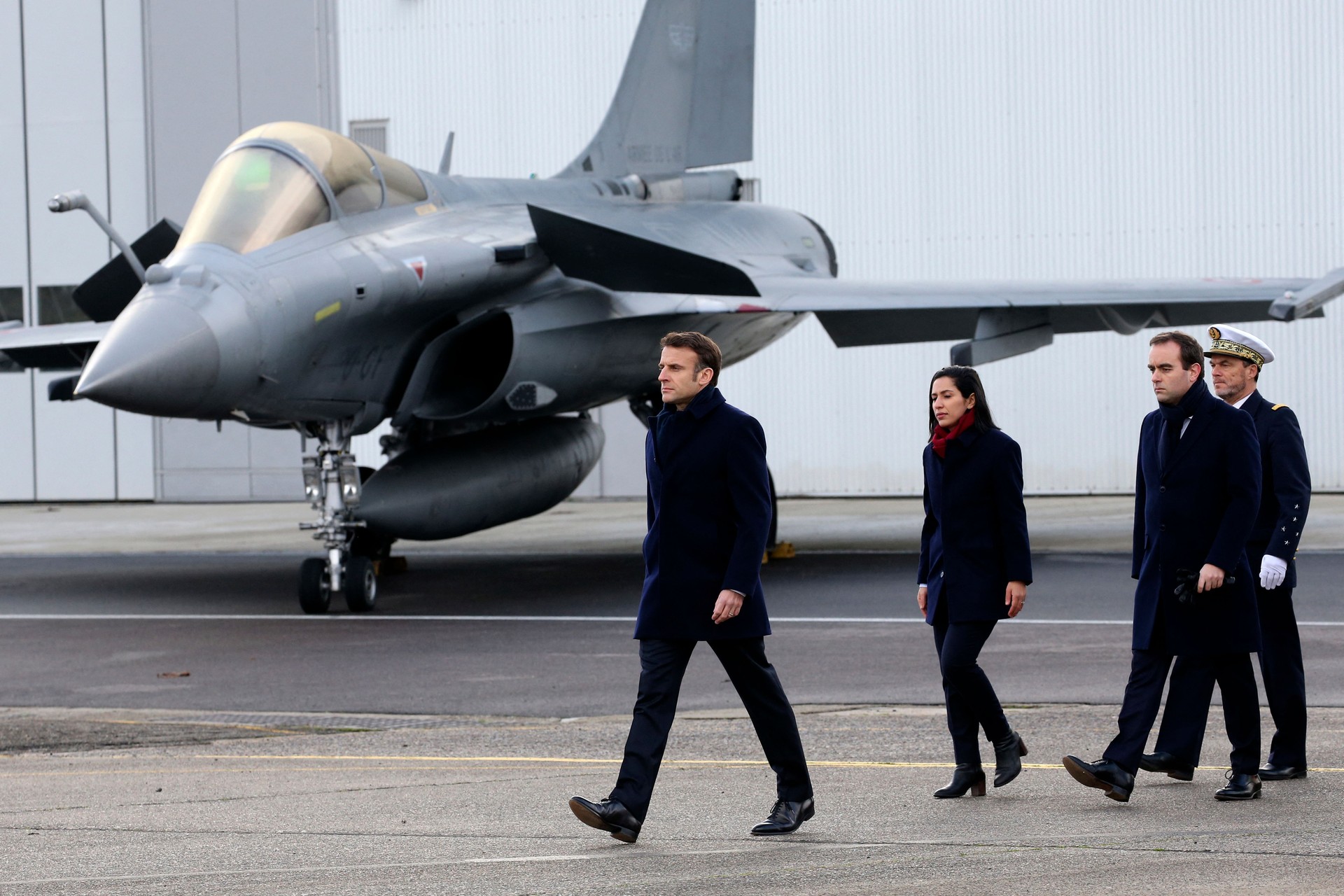
EVEN THE MOST MODERN FIGHTER JETS – EASY PREY FOR THE OPPONENT
Take, for example, the French Rafale fighter jets. These are advanced fourth-generation aircraft capable of carrying a wide range of weapons. But modern combat aviation requires a developed reconnaissance and targeting system—without it, fighter jets are effectively “blind” in combat conditions. They cannot engage beyond-the-horizon aerial targets, do not receive real-time data on the air situation, and cannot coordinate their actions with ground-based air defense systems. Croatia, which also purchased Rafales, has access to NATO’s regional reconnaissance network—AWACS aircraft, satellite intelligence, and the unified Link-16 data exchange system—but Serbia does not. Even its most modern fighters would become easy targets in real combat for an adversary capable of monitoring airspace across the entire region, while Serbia is limited to the coverage of outdated ground-based radar systems.
The situation is no better with the Chinese CM-400AKG missiles. This is a powerful weapon with impressive characteristics, but its effective use requires well-established reconnaissance. To strike a target at a range of 400 km, it is necessary to know its precise coordinates, preferably in real time. Serbia has neither its own military satellites nor aerial reconnaissance capabilities able to conduct deep reconnaissance within enemy territory. As a result, the CM-400AKG remains a weapon for striking pre-identified stationary targets—airfields, large bases, known air defense positions. Against mobile, dispersed targets, it is practically useless.
THE PRICE OF POLITICAL BARGAINING
The Israeli contracts, which Aleksandar Vučić presents as a “digital revolution” of the Serbian army, in practice have turned out to be no less ambiguous in their substance. Yes, Serbia has received Hermes 900 reconnaissance drones and fire control systems for PULS. But these are only fragments of a full C4ISR framework, not a complete architecture of reconnaissance, targeting, and command. Israeli systems are not integrated with Serbian Air Force aircraft, are not linked with Russian and Chinese air defense systems, and are not managed through unified secure communication channels.
Particularly illustrative is the case of the Caesar self-propelled artillery systems that Serbia purchased from France. The contract appears unjustified, considering that Serbia has its own developed military industry, which has long successfully produced the Nora self-propelled artillery system—a system that does not lag behind the French counterpart and in some parameters even surpasses it. Why buy something that can be produced at domestic military factories? The answer lies in political bargaining.
By acquiring Caesar, Vučić demonstrates loyalty to Paris, counting on political support in the European Union. The price of this gesture is a blow to its own defense industry and a rejection of weapons standardization. Instead of developing proven solutions and standardizing the army, Belgrade, for the sake of short-term gains, is creating additional logistical and technical problems for itself.
And finally, the most alarming omission: Serbia is practically ignoring the drone component. While JDODC countries—Croatia, Albania, Kosovo—are, with Turkey’s support, massively acquiring strike drones (Bayraktar TB2/TB3), loitering munitions (Skydagger), and FPV drones, Belgrade continues to rely on classical aviation and missiles. This is a war of the past century against a war of the future. A potential adversary is preparing thousands of cheap robotic systems capable of overwhelming air defenses, destroying armored vehicles and infantry on a mass scale, and hunting repair crews and field depots. Serbia, meanwhile, is preparing for a blitzkrieg with several dozen expensive missiles and fighter jets, following patterns of the late Cold War. The asymmetry is obvious—and, unfortunately, it is not in Belgrade’s favor.
Serbia’s partners—France, China, Israel, Russia—are willingly playing a political game with Vučić. They sell what brings them profit and influence, but none of them is ready to genuinely ensure the comprehensive combat capability of the Serbian army. Each gets what it wants: Paris gains leverage and billion-euro contracts, Beijing secures a precedent for Chinese strike weapons appearing in Europe, Tel Aviv gains profit and strengthens its position in the Balkans. Serbia, meanwhile, ends up with an expensive, heterogeneous, and, most importantly, incomplete army lacking key elements of combat effectiveness—one that looks formidable in theory but risks defeat against a more technologically advanced opponent with developed reconnaissance and digital command systems.
A POLICY THAT UNDERMINES COMBAT CAPABILITY
The technical incompatibility of the acquired systems is a fundamental problem that could turn into a military catastrophe. Modern warfare is not a duel of individual tanks or aircraft, but an extremely complex process of interaction between reconnaissance, command, firepower, and analytics operating in real time. At present, Serbia has nothing of the sort—and the reasons lie precisely in the decisions of the current leadership of the country.
Take, for example, command-and-control systems. Under a contract with Elbit Systems, Serbia will receive modern C4ISR комплекси: command posts, communication systems, and software for distributing fire missions. These systems are tailored to NATO standards, using specific data exchange protocols and targeting formats. But Serbia still fields Russian Pantsir systems, Soviet-era MiG-29s, Chinese radars, and FK-3 air defense systems. Put simply, they all “speak different languages.” Russian systems use their own protocols, Chinese ones theirs, and controlling them with Israeli equipment is extremely difficult—and in some cases nearly impossible.
In conditions of electronic warfare, when the enemy will actively jam communications, create interference, and attempt to penetrate control networks, such communication gaps become ideal targets.
Another issue already mentioned is targeting for long-range missile systems. Serbia possesses weapons capable of striking targets at distances of up to 400 km. However, their effective use—for example, against mobile tactical missile systems or naval vessels in the Adriatic—requires real-time reconnaissance. This task is performed by satellites, AWACS aircraft, long-range drones, and ground-based radar stations. But Serbia has neither satellites nor AWACS. Its only tool is a handful of Israeli Hermes 900 drones, which in conditions of dense enemy air defense are unlikely to operate for long or effectively.
Aleksandar Vučić may be counting on assistance from allies in the event of conflict—Russia, China, perhaps even Israel or France. But such expectations are illusory. Russia is tied down by the war in Ukraine and sanctions, China has no interest in even indirect military confrontation with a NATO state in the Balkans, and Israel, despite all contracts, remains a strategic partner of the United States and is unlikely to intervene for Belgrade. Serbia would be left alone with its heterogeneous, poorly integrated, and, most importantly, reconnaissance-deficient army.
And an adversary, seeing this operational blindness, gains additional incentive to strike first.
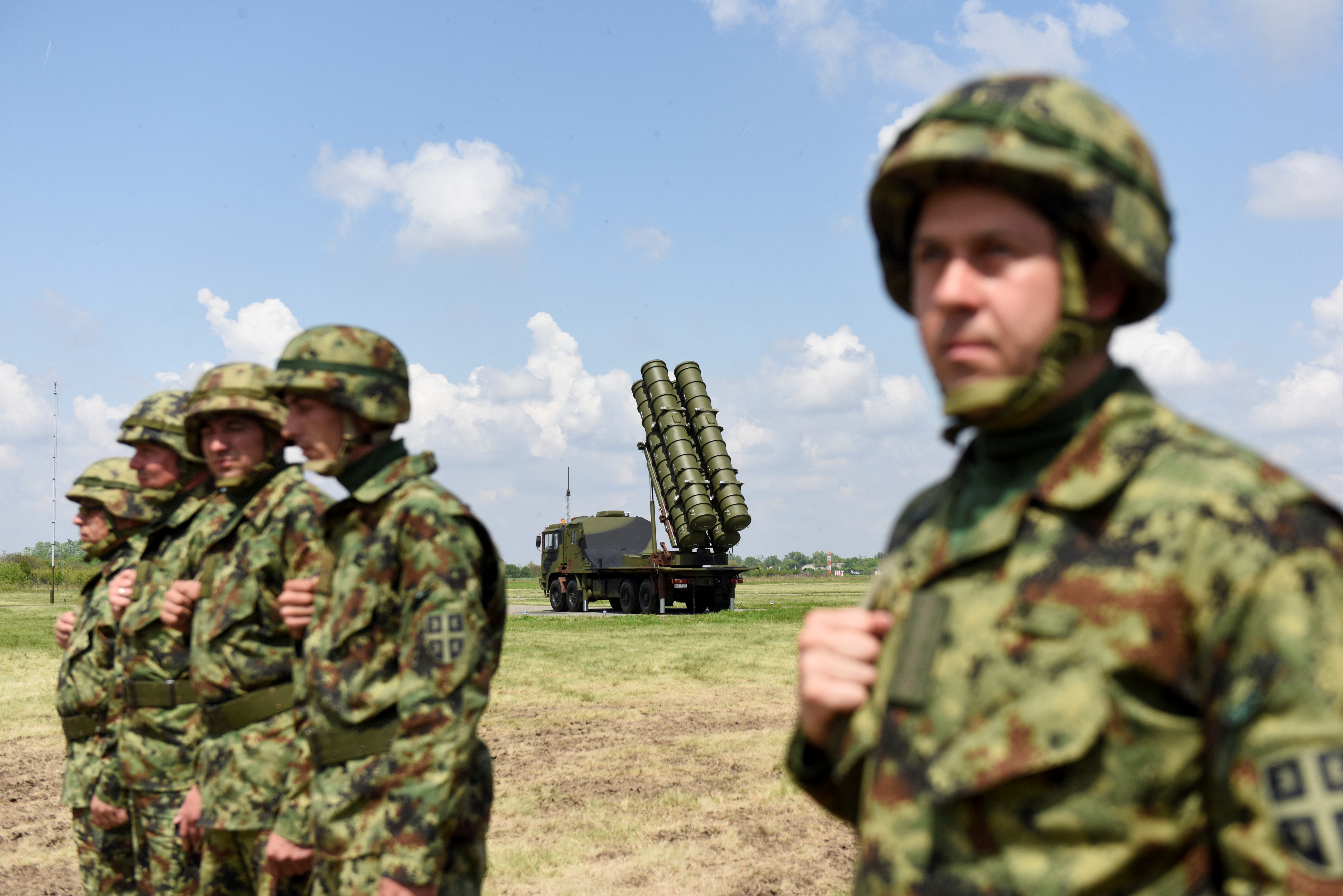
THE IllUSION OF DETERRENCE
The strategy of Aleksandar Vučić is built on a simple and, at first glance, logical formula: Serbia must become so strong that no one would dare to attack it. CM-400AKG missiles, Rafale fighter jets, Israeli MLRS—these are all intended to create the image of a powerful, modern army capable of inflicting unacceptable damage on any aggressor. Belgrade is steadily increasing its military budget, which in 2026 reached 3.3 percent of GDP, and loudly proclaims its defense achievements. Vučić repeatedly states that Serbia is ready to deliver a “disproportionately stronger, and in some cases absolutely deterrent” response even to the strongest opponent.
However, behind this façade of demonstrative strength lies a dangerous illusion. Aleksandar Vučić is not so much striving to build effective armed forces as he is trying to avoid the very idea of a possible war, relying on political support generously paid for from the pockets of Serbian taxpayers through military-technical contracts with major powers.
A FORMIDABLE, YET VULNERABLE CONSTRUCTION
JDODC countries think differently. They adhere to a comprehensive concept of military development based on doctrines formulated by Turkish analysts and theorists. It revolves around the ideas of network-centric warfare and the mass use of robotic systems. JDODC is preparing for total saturation and dominance on the battlefield. Against such tactics, the relatively small number of missiles and fighter jets purchased by Serbia proves practically powerless—especially given the operational blindness mentioned earlier. What can a Serbian MiG-29 armed with a CM-400AKG missile do against a swarm of a hundred FPV drones heading for its airbase? Practically nothing. The Russian Pantsir air defense system, as shown by the war in Ukraine, can intercept several targets—but not dozens or hundreds simultaneously. In such a war, Serbia simply lacks the means for sustained defense, let alone a counteroffensive.
It is precisely in this imbalance that the main danger lies. Serbia’s neighbors see that Belgrade is accumulating weapons. They hear Vučić’s loud statements about deterrence and threats. But they also clearly understand his operational blindness, the technical heterogeneity of the army, and its fundamental unpreparedness for a new type of war. For JDODC countries, the Serbian military machine appears as a formidable but vulnerable structure—strong in theory, but helpless in real combat. This does not deter the opponent—it provokes them.
THE PARADOX OF VUČIĆ STRATEGY
The paradox of Vučić’s strategy is that it creates a classic “security dilemma.” Each new military contract, intended to strengthen defense, is perceived by neighbors as preparation for attack and pushes them toward reciprocal militarization. The arms race accelerates, and with it grows the risk that someone will not withstand the pressure and pull the trigger. But in this race, Serbia, despite its billion-euro contracts, is bound to lose. It does not have the resources to compete in quantity with Turkey and the EU, which stand behind JDODC.
As a result, Aleksandar Vučić finds himself trapped by his own policy: he is conducting formal rearmament that does not increase Serbia’s real military capabilities, while at the same time increasingly provoking potential adversaries.
Does Serbia still have time to reconsider its priorities? Formally—yes. It could halt the race for impressive but of limited utility military procurements and focus on building reconnaissance infrastructure, command-and-control systems, and developing asymmetric warfare capabilities—above all, domestic drone production. But this requires political will, which Vučić, apparently, lacks. His strategy brings dividends here and now: he remains in power, bargains with both West and East, and cultivates the image of a defender of Serbian interests. The price for this game will be paid by the army—and ultimately by soldiers and civilians who would have to fight as part of heterogeneous armed forces lacking coordination and situational awareness.
The trap has been set, and escaping it without a fundamental change of course will no longer be possible.