From my childhood, I remember the rhyme in the title, whose exact meaning I still don’t quite know — except that it mocks those who give something to someone and then demand it back. The second, obviously derogatory part of the phrase, “slept with the chickens,” seems to have been added merely for the sake of rhyme.
It reminded me of the behavior of Denis Bećirović and Željko Komšić regarding Željka Cvijanović’s initiative for Bosnia and Herzegovina to nominate Donald Trump for the Nobel Peace Prize. At the first attempt by the Serbian member — or rather, the female member — of the tripartite Presidency to nominate the U.S. President, the “Bosniak-Bosnian tandem” did not even allow the proposal to be placed on the agenda, offering naïve technical excuses that the proposal was unprepared, that it wasn’t the right time, and so on.
THERE ARE SEVERAL REASONS
They simply failed to mention the essential reasons — and there are several. First, Trump came to power with strong, perhaps even decisive, support from American Jews, who naturally back Israel in every conflict in the Middle East. Second, he turned a new page in Bosnia and Herzegovina and betrayed their expectations that the U.S. would return to “unfinished business” in Bosnia. Third, Trump gave firm military support to Netanyahu’s response to Hamas’s rocket attack on Israel, thereby exceeding the limits of necessary self-defense in Gaza. Fourth, he proposed a business project to resettle Palestinians and turn the West Bank into an exclusive tourist zone. Fifth, his policy of expelling migrants from Islamic countries.
FEAR OR DISAPPOINTMENT IN THE U.S.?
In short, Bosniak representatives had several serious reasons to oppose Trump’s nomination for the Nobel Peace Prize, yet they did not cite a single one — instead, they hid behind naïve technical excuses. Why? Fear of the United States? Disappointment with the United States? — It’s probably a bit of both. But whenever Bosniak masses rise up in solidarity with their Muslim “brothers” anywhere in the world, and the authorities in Sarajevo, willingly or not, must cater to them, someone from the thin liberal urban political elite always appears to warn that it’s foolish to provoke a superpower. Then comes a “gentle” pivot — full of vows to democracy, civil rights, multicultural tolerance, and other empty rhetoric.
THE MAKE-UP EXAM
This time, they were conveniently handed a make-up exam: Trump successfully mediated the pacification of Hamas and halted Netanyahu’s invasion of Gaza, stopped the globally alarming missile exchange between Israel and Iran at its very outset, and prevented a conflict between India and Pakistan before it even began — and in all these threatening, ongoing, or emerging wars, Muslims were on the losing side. So, when the Serbian member of the BiH Presidency renewed her initiative to nominate Trump for the next Nobel Peace Prize, Bećirović and Komšić eagerly raised all four hands and feet in approval. Since Trump made peace with Hamas, that’s practically the same as reconciling with the Bosnian Muslim “brothers,” which, in their eyes, makes him instantly eligible for the Nobel Peace Prize.
Naively, they seem to believe that by doing so they have, at least belatedly, cleansed themselves in the eyes of Jews in the U.S., Europe, and especially in Israel — for whom awarding this year’s Nobel Peace Prize to Trump would serve as an indirect justification for exceeding the limits of necessary self-defense in Gaza. Their habitual reminder that Bosnia accepted the expelled Sephardic Jews from Spain during the Reconquista falls flat before the fact that it was the Ottoman sultan in Istanbul — not the local pasha in the province — who made that decision.

OUTBREAKS OF ANTISEMITISM IN THE BOSNIAK BASE
A stronger argument often cited is that during the war, Alija Izetbegović did indeed allow Sarajevo’s Jews to leave the city and guaranteed the protection of their abandoned property. However, that one-time, even commendable exception toward non-Muslims could not erase the general rule — especially in light of more recent evidence to the contrary. If the recent talks between the Bosniak Minister of Defense in the Council of Ministers of BiH and Iranian generals on military cooperation could be interpreted as a matter of national policy, the incidents involving the cancellation of hotel reservations for participants of the Conference of European Rabbis — followed by another incident in which Israeli passports were torn apart and thrown into the trash at a different hotel — testify to open outbreaks of antisemitism within the Bosniak base. The Serbs, Serbia, and Dodik never miss an opportunity to express solidarity with Israel. They are connected by the memory of Jasenovac — and by their shared troubles with Muslim neighbors.
With Trump’s arrival, the Bosniaks turned for support to Brussels — or rather, to Berlin and partly Paris — and to their protégé, the false High Representative, who firmly took control of the Bosniak judicial tools — the Prosecutor’s Office and the Court of BiH — in their campaign against President Dodik. The mentor was Biden’s ambassador Murphy, the middleman Schmidt, and the executor, Judge Sena Uzunović. When Trump withdrew Murphy, Schmidt found himself in a difficult position, but his homeland encouraged him to persist. In the end, when he realized that everyone was talking about the closure of the OHR, he handed the finale over to Uzunović. After all, he had already created the legal framework for her outside the Constitution and the law — and it was up to the Bosniak “heroine” Sena either to put Dodik behind bars or to push him to seek asylum in Russia. The Bosniak public fell into a frenzy of joy: “He’s finished! He’s finished!” screamed the first lines of media commentaries — followed by an eruption of unprecedented gloating.
IF NOT THE AMERICANS, THEN THE EUROPEANS
However, there was something deeply unusual about the entire situation. Dodik, on the one hand, enjoyed the unconditional support of Putin, and on the other, Trump not only swiftly recalled Murphy but also swept the State Department clean with an “iron broom,” driving out the neoliberal globalists who trace their lineage back to Madeleine Albright and Hillary Clinton. They had made his first term as difficult as they had made life for the Serbs over the past three decades. Trump did declare that the United States would no longer interfere in the internal affairs of other countries, and indeed, for almost a year now, Washington has not appointed a new ambassador to Sarajevo. But if the Russians aren’t going to interfere either — since, as he put it, they already “dwell in the hearts of the little Russians” — then perhaps someone else will. If not the Americans, then the Europeans; and if there’s no consensus within the EU, as Orbán and Fico keep disrupting it, then the Germans will take the lead, with British intelligence logistics and the quiet backing of the French. While Murphy, Schmidt, and Sena were acting swiftly on the ground, the Americans were gradually working on a plan to bypass them altogether.
A distant hint of this shift appeared when Interpol refused to issue a warrant for Dodik. True, there was no legal basis for it, but we’ve long since learned that legality is not always the deciding factor. Then came the 30th anniversary of the Dayton Agreement, at which Deputy Secretary of State Christopher Landau presented the new U.S. policy in Bosnia — one that defines “non-interference” as not excluding cooperation with all three sides in BiH that are ready to work on realistic, rational, and pragmatic solutions rather than on transcendent, abstract ideas. It was not difficult to see whom he viewed as a partner. Soon after, Landau invited Željka Cvijanović to Washington with a discreet proposal for Dodik — which she then carried to Moscow for consultations, and which he ultimately accepted. The essence of the arrangement lies in reciprocal, alternating concessions that would lead to a de-escalation of the crisis — a crisis generated more by Schmidt than by anyone else.
SEQUENCE OF DODIK’S MOVES AND THE LIFTING OF SANCTIONS
Dodik took the first step by accepting the Central Election Commission’s decision not to run in the upcoming early elections — a concession that isn’t particularly significant, since the position of president is largely ceremonial, while the true levers of power remain in the hands of the ruling party’s leader. In return, the United States lifted sanctions on the organizers of the Republic Day celebration. Indirectly, this also removed the stigma from Republika Srpska’s most important holiday — January 9th — a date that the Serbs reaffirmed through a referendum in defiance of the ruling of the Constitutional Court of BiH. Subsequently, the National Assembly of Republika Srpska (NSRS) annulled several of its own decisions that had been adopted as countermeasures to Schmidt’s unconstitutional and unlawful actions, thereby rendering them meaningless. In return, Washington lifted sanctions against Dodik, ministers in the RS government, and earlier, against chiefs of staff, protocol officials, and the director of RTRS. Clearly, these moves had been discreetly prepared for some time — but once they began, things moved swiftly and efficiently.
Meanwhile, Dodik arranged the placement of loyal personnel into the highest formal positions of authority: Savo Minić became Prime Minister, Željko Budimir was appointed Minister of Police, the party’s candidate for the early presidential elections is Siniša Karan, Ana Trišić Babić serves as Acting President, while Željka Cvijanović and Nenad Stevandić remain in their existing high-ranking roles.
THE BOSNIAKS REALIZE THEIR MISTAKE
The Bosniaks eventually realized their predicament and tried to extend the court’s ban preventing Dodik from holding public office for the next six years to include what is, in fact, his key political position — the head of his party. However, both Schmidt and the Central Election Commission ignored this later “interpretation” by Judge Sena. Thus, the Bosniaks finally understood that Dodik had once again outmaneuvered them — and precisely at the moment when they were convinced they had defeated him. Now, in their frustration, they vent their anger through the Court of Bosnia and Herzegovina, which doesn’t even exist in the BiH Constitution, spending their days drafting new indictments against Dodik — for which, of course, they’ll later collect court fees.
To avoid any impression that he acted behind Russia’s back, the Russian Ministry of Foreign Affairs (Lavrov, Zakharova, Kalabukhov) issued a statement confirming that for them, Milorad Dodik remains the President of Republika Srpska in full capacity — and that during his increasingly frequent visits, they continue to treat him as such. And Dodik himself, wanting to keep good relations with both sides, explained diplomatically: “I am still the president for those who consider me to be,” and “Russia is our strategic ally, while the U.S. is a credible partner.”
The Banja Luka protocol team found a wording that will be used in the coming period: “Elected President of the Republic.” Meanwhile, leading Bosniak politicians are trying to figure out where they went wrong.
HE WHO LAUGHS LAST, LAUGHS BEST
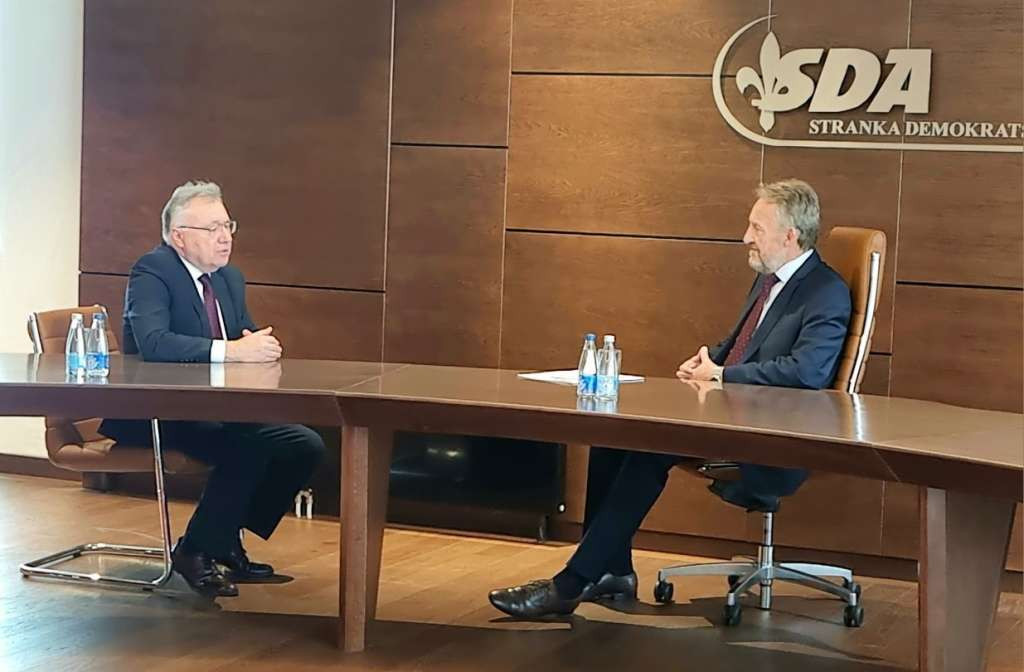
“We handed Russia over to Dodik, and now it’s hard to fix that — but we are ready for dialogue,” said Bakir Izetbegović during an audience with Ambassador Kalabukhov, whom he had previously refused to receive while serving in the BiH Presidency. But they also handed Trump over to him, lamented a Bosniak media commentator not long ago: “We laughed when Dodik celebrated Trump’s victory wearing a red cap. We mocked him when he hosted Rod Blagojevich and Rudy Giuliani in Banja Luka, just to remind the U.S. President that the Serbian diaspora had voted for him. And now, he who laughs last, laughs best.”
So, if with the votes of Bećirović and Komšić, give or take, Trump wins the Nobel Prize next year, it might count as a small plus for the Bosniaks. But if he doesn’t — then, as the old saying goes, they’ll be the ones who ‘took and gave, and slept with the chickens.’
RETURN TO THE ORIGINAL DAYTON, BUT WITHOUT SCHMIDT?
But then, as Merz recently said, “The Western Balkans belong to us…” Judging by the rest of the sentence — where he mentions “necessary reforms” — it seems he meant belonging to the EU, but in the end, that means the same thing: that the region belongs primarily to Germany. It seems more likely that Trump, both in the Western Balkans and in Ukraine, planned to reach an understanding with Putin independently of the EU — and that the United States, once again, intends to demonstrate how Brussels is incapable of solving problems in its own Balkan backyard.
How will the process of de-escalation in Bosnia and Herzegovina develop from here? What reciprocal moves will Trump/Landau and Dodik/Cvijanović take with Putin’s backing? Perhaps a return to the original Dayton Agreement — but certainly without Schmidt, possibly with a time-limited successor stripped of Bonn powers, whose role will be to turn off the lights at the OHR. Even the Chairman of the BiH Presidency, Željko Komšić, has said that Schmidt should leave — and it was no slip of the tongue.