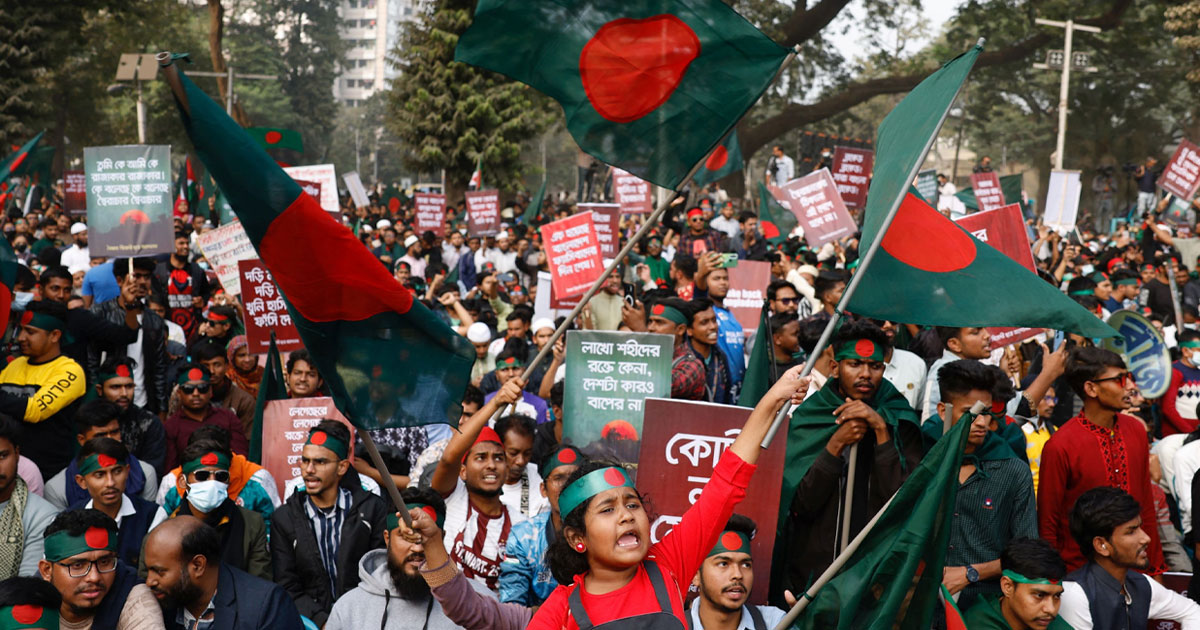
The immediate trigger for the student uprising in Bangladesh in late June and early July 2024 was a decision by the country’s High Court, issued on 5 June of that year, which reinstated the quota system for recruitment into the civil service. The system reserved thirty percent of “secure government jobs” for descendants of fighters from the 1971 war of independence.
In a country with a high youth unemployment rate such as Bangladesh, students viewed this as an unfair system protecting cadres of the ruling, pro-India Awami League. Protests were launched and demands were raised for reform of a system based on non-nepotistic selection of civil servants.
FACULTIES BLOCKED, STUDENTS TAKE TO THE STREETS
Rebel students, organized around the group “Students Against Discrimination,” blocked faculties and completely halted university activities. Barricades blocked entrances to key public colleges and universities in Dhaka and Chittagong. University administration and lectures were completely paralyzed, while the blockades quickly spread from campuses and faculties to major roads and railway lines.
There was no leadership of the protests in the classical sense. There was a system of coordinators and sub-coordinators. Decisions were made at online meetings and distributed through social media.
The authorities often acted nervously and imprudently. When six coordinators were detained and police released a video in which the detainees called for the protests to end, the remaining coordinators announced via social media that the statement had been made under pressure, and the protests continued. The arrest or detention of several coordinators did not automatically stop the protests, nor did it damage the organizational structure itself. There were several levels of leadership, so other coordinators took over communication and organization.
ABOUT 1,400 PEOPLE WERE KILLED
The students soon clashed with police and the youth wing of the Awami League, while the then-prime minister, Sheikh Hasina, did not spare them in her public characterizations, using expressions that very seriously suggested betrayal of the country and its interests.
Street clashes soon escalated, and the government subsequently imposed a curfew and restricted internet access.
According to an investigation by the UN Office of the High Commissioner for Human Rights, approximately 1,400 people may have been killed between 1 July and 15 August 2024, along with 44 police officers.
It is important, however, to emphasize that the figure of approximately 1,400 deaths refers to all deaths connected with the protests and violence during that period, not only people killed by police forces.
The United Nations documented numerous revenge killings that occurred after the government fell on 5 August, including, in addition to killings of police officers, numerous killings of members and supporters of the Awami League and other organizations.

TOWARD “FAIR” ELECTIONS WITH AN INTERIM GOVERNMENT
After Sheikh Hasina resigned and fled to India, an interim government of Bangladesh was formed, headed by Nobel laureate Muhammad Yunus as a morally unquestioned figure.
The July Revolution produced the July Charter, through which the rebellious students proclaimed what would prove to be merely an ostensible beginning of the struggle against corruption and for the liberation of allegedly captured institutions.
However, this period was in fact marked by a security vacuum accompanied by inter-ethnic tensions, deepening economic problems, and political friction over whether Sheikh Hasina’s Awami League should be banned from political activity.
Following reforms carried out by the interim government headed by Muhammad Yunus, the first “free parliamentary elections” in Bangladesh were held on 12 February of this year. In these elections, the pro-Western Bangladesh Nationalist Party (BNP), led by Tarique Rahman, achieved an overwhelmingly convincing victory—compared in the text to the electoral victories of North Korea’s Workers’ Party—while the Awami League of former prime minister Hasina was barred from participating. At the same time, a new Constitutional Charter of Bangladesh was adopted in a referendum.
WHO “LIT THE FIRE” FOR THE STUDENTS IN BANGLADESH?
After the street protests ended, the students formed their own National Citizens Party, or the “political wing” of their movement, counting on the financial and logistical support they had enjoyed up to that point.
In an attempt to achieve the strongest possible electoral result, they entered into a coalition with Jamaat-e-Islami and ultimately suffered a heavy debacle. Of the 300 seats in the Bangladesh parliament, the students won only six, while the BNP—which had been a minor political force before Sheikh Hasina’s fall—won as many as 212 seats.
At first glance, it is easy to conclude that during the “reform” year of 2025, while the country was governed by the interim administration of Nobel laureate Muhammad Yunus, the student leaders quickly became embroiled in public conflicts, while the student movement faced accusations of arrogance and taking justice into its own hands through street pressure and purges at universities.
There were even scandals involving extortion, in which individuals used the student movement as cover for criminal activities. These developments quickly compromised the initial aura of political innocence, exceptionalism, and unquestionable righteousness surrounding the student movement.
THE SCENARIO DID NOT ANTICIPATE THE STUDENTS ENTERING THE POLITICAL ARENA
All these facts are undisputed and did damage the image of the student political movement’s general moral untouchability in the Bangladeshi public, but the real reason for the rebellious students’ complete political debacle should be sought elsewhere.
From the beginning of the student uprising in Bangladesh, it was quite clear to the public—although perhaps not immediately easy to discern—that money and logistics for the protests were being provided by a network of NGOs, ANNI, coordinated by “Forum Asia,” an umbrella organization through which the U.S. National Endowment for Democracy (NED), USAID, the International Republican Institute (IRI), and the Open Society Foundations financed a broad network of NGOs in Bangladesh. Through the NGO sector on the ground, that network distributed the financial and other logistical support of the aforementioned American foundations to the Bangladeshi student movement, but only while the protests lasted.
When the protests ended and, during the “transitional period,” Nobel laureate Muhammad Yunus came to head the state, the NGO sector simply abandoned the students, whose role had thereby ended.
In the absence of financial and overall logistical support from the NGO sector, the student political organization ultimately suffered a debacle because it no longer had money and organizational logistics.
YUNUS’S FACE OF THE “TRANSITIONAL PERIOD”
Yunus himself received the Nobel Peace Prize in 2006 as the founder of a microcredit system developed in cooperation with Grameen Bank, “for efforts to create economic and social development from below.” The award was given for the development of a microcredit system, that is, small loans to poor people without conventional collateral.
The Nobel Committee assessed that economic and social development contributes to lasting peace, democracy, and human rights. Particular emphasis was placed on the role of microcredit in the economic empowerment of women, who constituted the majority of Grameen Bank’s clients.
But the matter becomes considerably more interesting when one sees that Yunus was, in fact, at the head of a series—or an entire system—of NGOs.
Here is why that matters.
PAIRS AND OTHER STORIES
Prominent Indian analyst Jaibal Naduvat notes in his study (“American Aid and Regime Change in Bangladesh,” 25 March 2025) that USAID alone, and just before the protests erupted, provided $270 million, with an additional $90 million in preparation, to influence political outcomes in India and Bangladesh.
Between the U.S. fiscal years 2020 and 2024, a total of $2.29 billion in aid flowed into Bangladesh’s NGO sector, of which $1.73 billion came from USAID alone.
This led to the creation of the PAIRS program, an IRI program which, as Naduvat states, was called the “Promoting Accountability, Inclusivity and Resiliency Support Program, Bangladesh,” according to a leaked report published by the U.S. news website The Grayzone in September 2024.
Naduvat states that this program provides a striking insight into a complex scheme that included training and financing various actors, from civil society groups and student activists to musical artists and even members of the LGBTQI+ community, in order to turn public opinion against Prime Minister Sheikh Hasina.
BNP IS UNABLE TO “SUCCESSFULLY MOBILIZE THE OPPOSITION,” BUT…
The report states that the opposition BNP was unable to “successfully mobilize the opposition,” but at the same time acknowledges that it remained “the most likely party that could bring about a change of government in the future.”
The document emphasizes a strategic focus on individuals who oppose the government, as well as what it calls “specific marginalized communities,” such as Biharis, other ethnic minorities, and the LGBTQI+ community. It states that these minorities could be used to advance the change agenda, claiming that they are “harder to suppress and can often reach wider audiences with their democratic and reform messages,” and that, given their social status, they are less exposed to the risk of attracting adverse government attention.
According to the report, preparatory work for the operation began with a baseline assessment conducted shortly after the 2018 elections. The initial phase included group and individual interviews with 304 “informants” in various districts of Bangladesh and the identification of 170 democratic activists who would cooperate with IRI on destabilizing Bangladeshi politics, Naduvat stated.
LAWYERS AND ARTISTS WERE GIVEN A PARTICULAR ROLE
Lawyers and artists, especially musical performers, played a particularly important role. Thus, lawyers who provided free services to protesting students were in fact recipients of IRI grants for so-called “advocacy activities,” such as lawyer Towfiq Ahmed.
Naduvat states that IRI awarded eleven grants for “advocacy activities” to artists, musicians, and arts organizations, resulting in the creation of 225 works of art addressing political and social issues.
Initially, 77 activists were trained, while 326 citizens were interviewed in order to formulate 43 “public policy” recommendations.
NOTHING WITHOUT MINORITIES AND THE MEDIA
In addition to PAIRS, there were subsequent programs at the same time. For example, there was another IRI project, between February 2021 and September 2022, for which NED provided $900,000, with the aim of “amplifying the voices of marginalized groups, particularly youth and women, in political debate and decision-making” and building the capacity of women political leaders, elected representatives, and political candidates to participate in elections and assume leadership positions at the subnational level,” Naduvat stated.
NED’s report for the previous year stated that the government in Bangladesh had been taken over by an interim administration headed by Nobel laureate Muhammad Yunus, tasked with stabilizing the country and launching long-awaited reforms aimed at accountable governance and free elections.
NED stated that its grantees acted as courageous and independent voices, helping to inform the public and protect democratic space. It highlighted Netra News, founded in exile with initial NED support, which used its ten-member team, including correspondents inside Bangladesh, to provide real-time independent reporting during a seven-day internet shutdown.
Their reporting broke the information blockade, providing key data to both the citizens of Bangladesh and the international public, while strengthening Ned’s core mission: to support the free flow of information in repressive environments,“ Ned said in its report.

USAID MONEY CONTINUED TO ARRIVE, BUT NO LONGER FOR THE REBEL STUDENTS
Several days after Bangladesh’s interim government took office, USAID signed a $200 million development agreement with it, described as support for advancing development, strengthening governance, expanding trade, and creating greater opportunities for the people of Bangladesh to build a brighter and more prosperous future, Naduvat observed, pointing in particular to violence suffered by Bangladesh’s Hindu community at the hands of supporters of the new government.
WHAT DID MIKE BENZ SAY?
Jaibal Naduvat also recalls a video from the X network, from February this year, which Elon Musk shared.
It was an interview with former U.S. official Mike Benz, who confirmed that dissatisfaction within the U.S. State Department with the outcome of Bangladesh’s 2018 elections, which returned Sheikh Hasina to power, prompted U.S. officials to consult with USAID and the NED-funded IRI on strategies to destabilize her government.
“Given the broad support her party enjoyed among voters, fomenting political unrest was considered the only viable path toward achieving regime change,” Naduvat states.
WHAT IS THE CONTEXT?
This therefore raises the question: what is the context of the events in Bangladesh? Did NED, USAID, IRI, and George Soros, who generously financed the NGO sector in Bangladesh, really care so much about the country’s youth and its future, or were there also interests at work that are more difficult for us to discern?
Sheikh Hasina was removed from power on 5 August 2024. There are two very rational explanations for her departure.
The first is obvious. The former prime minister’s government relied on India and New Delhi. Despite all its shortcomings, that government was moving toward the development of mutually beneficial good-neighbourly cooperation.
The Western centers of power behind NED, USAID, IRI, and the Open Society Foundations had ample reason to change that situation in their favor, especially after Bangladesh became a member of the BRICS New Development Bank five years ago. From then until the end of last year, the bank approved $450 million in more favorable loans for Bangladesh than it would otherwise have received in the West.
Although India opposed Bangladesh’s accelerated admission to BRICS, together with Pakistan, and given the actions taken by the United States against New Delhi this year—placing illegal groups composed of American and Ukrainian paramilitary and military structures into that country—it is clear that strengthening India–Bangladesh relations does not serve the interests of the aforementioned centers of power. Nor does it suit them to see India moving further away from the “Quad” and becoming increasingly integrated into BRICS, particularly as India is on an accelerated path toward resolving its disputes with China.
The second explanation concerns an alleged U.S. demand, according to Sheikh Hasina’s own claim, that the United States establish control over Saint Martin’s Island in the Bay of Bengal, where Washington planned to establish an air base to counter China.
Jaibal Naduvat states that the Americans believed Indian support had strengthened Sheikh Hasina’s government, making it “more authoritarian and corrupt” and thereby “eroding” Bangladesh’s “democratic framework.”
AMERICAN ENGAGEMENT AIMED AGAINST INDIA
“From their perspective, American engagement was a means of countering Indian influence, reducing the dominance of the Awami League, and opening greater political space for alternative voices—presented as an essential element of democratic governance. The motives behind the regime-change project could lie in all of these factors or in any one of them, in an intertwined mixture: geopolitics, driven by the strategic rivalry between the United States and China; the desire to ‘restore democracy’ by weakening what was seen as an ‘increasingly authoritarian regime supported by India’; or even the reaction of interest groups connected to ties between Bangladesh’s current interim leadership and influential circles in the United States,” Naduvat states.
The experience of Bangladesh shows us that the broader geopolitical and security context is crucial when interpreting what is happening around us.
“Implemented through seemingly benevolent interventions, a whole spectrum of influence operations evolved into the full construction of advocacy networks. Civil-society organizations, media and entertainment companies, as well as organizations at the local level, are simultaneously used to spread constructed narratives. Bangladesh is a cautionary example of how power is increasingly exercised through networks and narratives driven by particular agendas,” Naduvat states.
The activities of institutions such as USAID or NED which, as Naduvat emphasizes, promote global networks of political influence and manipulate the world order in ways that suit their exploitative worldviews, while hiding behind facades of aid and support, should be recognized and prevented.
“The danger they represent is real and tangible, even while their methods of operation remain opaque and unclear,” Naduvat warned.