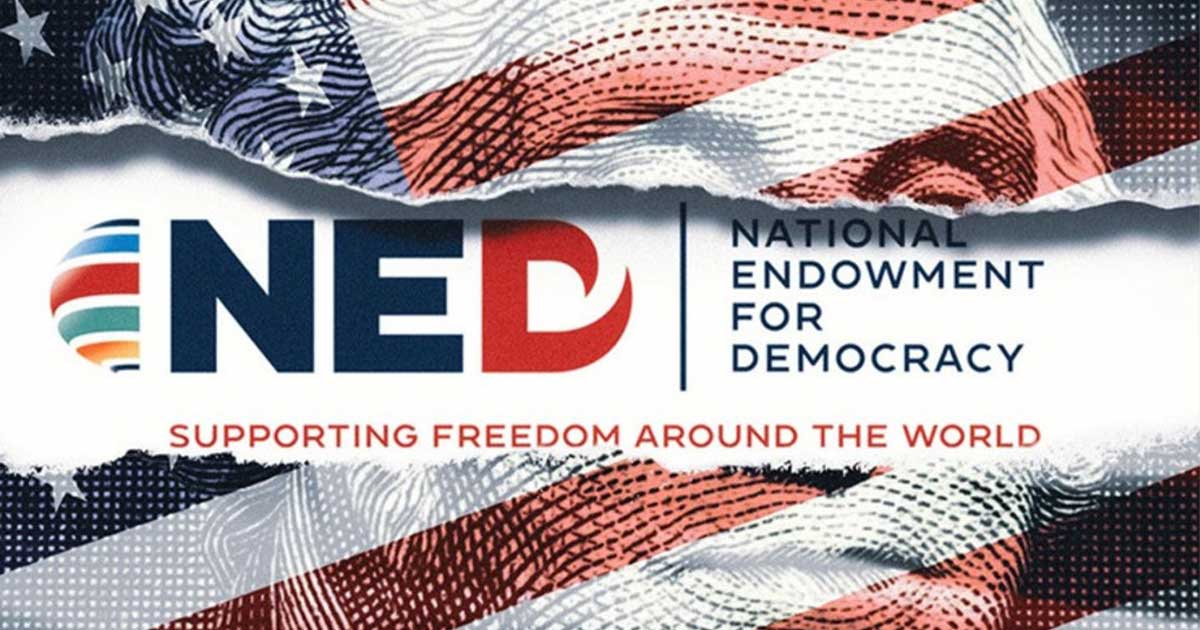
Despite announcements by U.S. President Donald Trump that he would eliminate state funding for the National Endowment for Democracy (NED), in fiscal year 2025 the organization allocated 271 million dollars for more than 1,550 projects aimed at achieving “democratic goals in over 90 countries.”
“THE ECONOMICAL NED”
In its report for fiscal year 2025, NED emphasizes that it “offers” an exceptionally cost-effective model. According to the organization’s data, with low administrative costs, smart use of new technologies, and a rationally organized structure, approximately 84 cents of every dollar entrusted to NED goes directly to grant allocations that support partners on the “front lines,” which, as also stated, ensures that the vast majority of resources are directed toward maximizing the impact of “those operating on the ground,” that is, NED’s political infantry.
“Our direct grants channel support to organizations at the local level, with 86 percent of awarded funds amounting to less than $150,000. These grants strengthen independent media, civic organizations, trade unions and business groups, religious leaders, human rights advocates, technology experts, and reformers working to strengthen democratic institutions, ensure economic opportunities, and protect fundamental freedoms in some of the most repressive environments in the world,” the report states.
EVERUTHING REMAINS WITHIN THE “BUSINESS PARTY”
NED itself points out that the organization, together with its four core institutes (the National Democratic Institute, the International Republican Institute, the Center for International Private Enterprise, and the Solidarity Center), “reflect the organized sectors of American political life.”
At the same time, this means that the aforementioned Democratic and Republican institutes are, in fact, engaged in the same mission, even when Donald Trump refers to his opponents in the United States as “human scum” or “enemies of the people.”
What is at stake, therefore, is a political family in the sense of the well-known remark attributed to Noam Chomsky, that in the United States there is essentially one party—the business party—with two factions, Democrats and Republicans, which differ to some extent but implement variations of the same policy.
“Together, this ‘NED family’ embodies the mandate of our founding legislation, the NED Act. Through these four core institutes and direct grant-making, NED mobilizes the key pillars of democracy—political parties, business, labor, free media, and civil society. This approach ensures that private American initiatives build relationships of trust with local actors, based on shared democratic values, so that support for democracy is locally driven rather than imposed from the outside,” the NED report for fiscal year 2025 states.

“THEY DO EVERUTHING OPENLY, SO IT DOESN´T LOOK SECRET…”
The much-maligned Ilija Čvorović, who in Dušan Kovačević’s famous work noticed that his tenant entered the French embassy with a bag and left without it—a key question that no one has yet answered when interpreting The Balkan Spy—would say that NED does everything openly, so it does not appear secret.
What is at play, of course, is a disguise: “shared democratic values.”
On the basis of these “shared democratic values,” “relationships of trust” are built with “local actors” (the NGO sector, “independent” media…), on behalf of the aforementioned private American initiatives, so that it only appears that “support for democracy” is a local (that is, domestic) issue, rather than a matter of American business and political interests.
After all, the leadership of NED does not even hide this. Credit should be given to them for their openness.
Here is a good example.
SUPPORT FOR DEMOCRACY AS A CHEAP METHOD…
The head of NED, Damon Wilson, at the beginning of February published an article in the magazine The National Interest titled: “How Democracy Promotion Supports Critical Mineral Resilience.”
Even the subtitle of the article: “Supporting freedom around the world is a key advantage for American companies and a challenge for Russia and China” clearly and explicitly indicates what is at stake.
In the mentioned article, without any hesitation, Damon Wilson openly states:
“For the United States, supporting democracy and self-governance abroad represents a practical and low-cost way to strengthen supply chain strategy and reduce risk.”
I SAY DEMOCRACY, BUT I MEAN CRITICAL MINERALS
Naturally, for the United States to make up for its lag in the production, processing, and overall availability of rare earth elements—an issue to which Donald Trump has devoted attention—Damon Wilson argues that NED is needed. What is required is someone who can, cheaply and efficiently, strengthen supply chains and reduce risks, while presenting all of this as an essential fight against corruption and for democracy, rule of law, and human and minority rights.
“This challenge is particularly pronounced because many minerals essential to U.S. energy systems, defense industries, and advanced technologies are mined and processed in countries where governance is weak and market oversight is limited. In such environments, even well-designed agreements can expose American companies to financial and operational risks if local enforcement fails,” Damon Wilson stated.
It follows that democracy, rule of law, and fair markets are conditions ensured by American control in the interest of American corporations, while everything else is reduced to mere corruption and chaos.
NED IS RECOMMENDED TO DONALD TRUMP
And here we come to the key argument that Wilson makes in explaining why NED is necessary—even for Donald Trump:
“China’s dominance in key stages of critical mineral processing underscores the stakes. U.S. reliance on imports of lithium, cobalt, graphite, and rare earth elements creates vulnerabilities that can be exploited by the Chinese Communist Party and other adversaries. Addressing these vulnerabilities requires attention not only to where minerals come from, but also to whether decisions on the ground are made according to transparent rules and reliable enforcement mechanisms, rather than under the influence of debt pressure or opaque financing. This concern has resonated at the highest levels of U.S. policymaking. Recent policy under the Donald Trump administration has emphasized diversifying supply chains, reducing dependence on rival states, and strengthening reliable sources for the United States. However, achieving these goals requires more than high-level agreements. It depends on whether countries have the capacity to enforce contracts, protect investments, and prevent strategic resources from falling into the hands of authoritarian regimes. It is precisely here that governance and economic freedoms determine whether American investments are protected or exposed to risk,” Damon Wilson stated.
But this is not the end of what is, admittedly, a candid admission on the subject of a seemingly orchestrated rule of law on one side, and a narrative of corruption on the other.
WE DO NOT MANAGE MINES, BUT…
“This is also an area where NED has a specific, complementary role. The National Endowment for Democracy does not negotiate contracts, nor does it manage mines. Instead, NED and its key institute, the Center for International Private Enterprise, support local civic leaders who strengthen the capacity to enforce the laws and rules that allow agreements to function in practice. These partners work with government officials, civil society organizations, journalists, economists, think tanks, and community leaders to monitor contracts, expose corruption, and improve transparency in critical mineral sectors. By embedding oversight at the local level, these efforts reduce risk for American companies and lessen the need for the United States to monitor implementation from afar,” Damon Wilson stated.
Fair enough. Let it not be said in the end that we did not know all this.