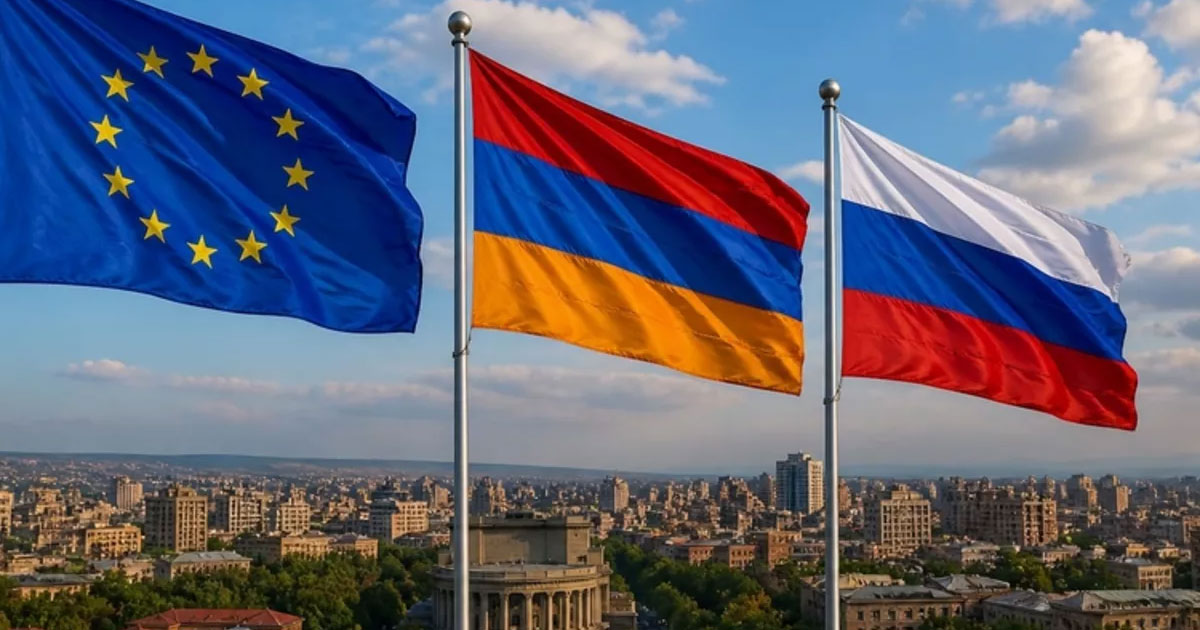
The 2026 parliamentary elections are the first in Armenia’s history in which the factor of “geopoliticization” has operated at full force. Since 2021, Moscow, Paris, and Washington have, in essence, never competed so actively for influence over Armenia. Five years ago, following the election campaign, Russia congratulated Nikol Pashinyan on his victory, while in his first address after the vote, the winner thanked Vladimir Putin and Mikhail Mishustin first, and only afterward Joe Biden and Emmanuel Macron.
THE CONSTITUTION ON PASHINYAN’S PATH
There was no longer the usual division of Armenian parties into pro-Western and pro-Russian: the former included only marginal political forces such as the “Republic” association, headed by Aram Sargsyan. The election campaign that has just ended was, above all, a test for the system that Nikol Pashinyan created in 2018. The then-journalist, opposition politician, parliamentarian, and organizer of mass protest actions did not present his rise to power merely as a “velvet revolution.” He presented himself as a politician who decisively and consistently dismantled the state that had been left to him by his predecessors. Eight years ago, Pashinyan took over institutions such as a parliament that was not under his control and in which his opponents from the Republican Party dominated, disloyal city administrations, local government bodies that retained a significant degree of autonomy; a judicial system that was not subordinate to the new government; as well as the authorities of unrecognized Nagorno-Karabakh, which had not accepted the “velvet revolution.”
The previous three-party structure of the National Assembly (a dominant pro-government force and two opposition associations) has been preserved. However, party-political representation has undergone certain changes. The ruling party won 3/5 of the parliamentary mandates, which enables it to form a government without resorting to coalition-building, complex negotiations, and coordination of ministerial positions with opponents. However, unlike the eighth convocation, the “Civil Contract” will not have a constitutional majority, which will not allow it to unilaterally amend the country’s Constitution. The idea of a referendum on amending the Constitution is not popular in society; however, since it possesses a constitutional majority, the authorities could organize one. However, under today’s conditions, constitutional reform is not exclusively an internal matter for the country. Azerbaijan has unequivocally identified it as a condition for signing a peace agreement between the two states: Yerevan must introduce amendments to the Basic Law and remove references to the Declaration of Independence of August 23, 1990, from it.
At the twilight of the USSR, the Armenian national-state project was based on the idea of unity, which implied the common self-determination of the Armenian SSR and the Nagorno-Karabakh Autonomous Oblast within the Azerbaijani SSR.
It should be noted that the significance of election campaigns has become much broader than it was previously. The 2026 campaign in Armenia is clear proof of this. At one point, a sharp domestic political struggle, the transformation of national-state identity, and the competition of various external actors for influence came together.
The parliamentary elections in Armenia cannot be assessed unambiguously, interpreting them in the context of the conflict between Russia and the EU, or as an isolated domestic political event in which the government and the opposition are entering a new phase of struggle.
In 2019, Pashinyan announced the beginning of the “second most important stage of the revolution,” which in fact meant a radical restructuring of the country’s judicial system. By the end of 2020, all Constitutional Court judges who were not loyal to the prime minister had resigned.
In the parliamentary elections that same year, Pashinyan secured a constitutional majority in the National Assembly and the possibility of forming a one-party government. In parliament itself, his “Civil Contract” faction successfully blocked all opposition initiatives.
Although the thawing of the Armenian-Azerbaijani conflict in 2020–2023 pushed the domestic political processes in the unrecognized Nagorno-Karabakh Republic into the background, it is worth emphasizing one important fact. Even before the “Autumn War” of 2020, Pashinyan had managed to establish his control in Stepanakert.

BREAKING THE TABOO — A CAMP FOR POLITICAL OPPONENTS
As part of his “revolutionary” domestic policy, Pashinyan broke an informal taboo that had existed in post-Soviet Armenia until 2018. He initiated criminal prosecutions against former leaders of the country, as well as leading politicians and representatives of big business. At various times, “cases” were opened against former presidents Robert Kocharyan and Serzh Sargsyan, as well as against Gagik Tsarukyan, leader of the “Prosperous Armenia” party. In 2025, with the help of administrative pressure and the “criminalization” of opponents, the prime minister managed to “clean up” such important municipalities as Gyumri (the second-largest city in Armenia and the “cradle of the Velvet Revolution”) and Etchmiadzin (the first capital of the Armenian Apostolic Church).
Thus, the “revolutionary government” entered the 2026 campaign with a noticeable advantage. The administrative pressure exerted during the elections demonstrated that it had no intention of giving up that advantage. Suffice it to say that the prime minister’s main opponent, Samvel Karapetyan, spent the entire election campaign under house arrest. According to data from the “Civil Contract” party, on the day of the vote itself, 200 people were arrested on suspicion of violating electoral legislation — an unprecedented measure in the entire electoral history of post-Soviet Armenia.
However, judging by everything, even after the end of the campaign, the authorities do not intend to stop at what they have achieved. During government question time, from the parliamentary rostrum, the prime minister publicly promised to destroy the threats which, according to him, have names: “Robert Kocharyan, the Kaluga oligarch (Samvel Karapetyan), and the pro-Belarusian oligarch (Gagik Tsarukyan). They must be destroyed in the camp. As long as I am prime minister, I will destroy them deliberately.”
THE “PROSPEROUS ARMENIA” CASE
In light of such statements, the Court of General Jurisdiction of the Avan and Nor Nork districts of Yerevan ordered the detention for two months of Gagik Tsarukyan, leader of the opposition “Prosperous Armenia” party. He is accused of fraud and money laundering on an especially large scale. According to the version of events presented by the Investigative Committee of Armenia, Gagik Tsarukyan, together with accomplices, organized a fraudulent scheme between 2022 and 2024 to import goods and fuel from Iran.
Tsarukyan was arrested on July 6 in Yerevan. On the same day, searches were carried out at his home and at dozens of companies owned by him. The criminal prosecution began shortly after the parliamentary elections in Armenia had concluded.
It was initially announced that “Prosperous Armenia” had passed the required 4 percent threshold to enter parliament in the June 7 elections. Later, the Central Electoral Commission presented revised figures — the party had received 3.996 percent of the vote. “Prosperous Armenia” stated that there had been inaccuracies in the vote-counting process and appealed to the Central Electoral Commission.
He also stated that only people who had received bribes had voted for the opposition political forces, while at the same time calling on his opponents to take to the streets and “carry out a revolution,” that is, to try to play the game with him on his favorite field.
Thus, the entire parliamentary opposition that exists today is effectively being viewed as a threat to Armenian statehood. There have been no such precedents in the history of post-Soviet Armenia. These initiatives can be seen as attempts to finally homogenize the republic’s domestic political space and, probably, after some time, initiate early parliamentary elections in which “Civil Contract” will obtain a constitutional majority and the right to disregard everyone else, changing the country’s Basic Law at its own discretion.
Attempts to intimidate potential opponents of the authorities cannot be ruled out either. Be that as it may, revolutionary expediency continues to determine the domestic political style of Pashinyan’s team.
URSULA VON DER LEYEN’S CONGRATULATORY MESSAGE: THE SPIRIT OF THE REVOLUTION — ALIVE AND WELL
Pashinyan is attempting not only to keep all branches of government under his control, but also to radically transform the national-state project, with the complete abandonment of the ideology of the unification of Artsakh and “Historical Armenia.”
Most likely, this is what Ursula von der Leyen had in mind. Congratulating Pashinyan on his election victory, she stated: “The spirit of the Velvet Revolution that you led in 2018 is alive and well.”
However, there are also certain inconsistencies with the revolutionary “spirit.” In 2018 and 2021, the elections for deputies to the National Assembly of the republic were snap elections. In the first case, they were held following the “Velvet Revolution” and, essentially, legitimized the rise to power of Nikol Pashinyan and his team, giving the revolutionary rhetoric and practice a “formal-legal gloss.”
In the second case, the snap elections were held following Armenia’s defeat in the Second Karabakh War and served as a kind of referendum on confidence in the government amid a national catastrophe.
But in 2026, the “party of power” is entering its third term, or ninth year, in office. A political monopoly has been established. In terms of the length of his time at the helm of the country, Pashinyan has already surpassed Levon Ter-Petrosyan.
If “Civil Contract” continues to function as the parliamentary majority party until 2031, the prime minister at that time will have been in power for 13 years and will have been able to “outlast” two presidents — Robert Kocharyan and Serzh Sargsyan — each of whom spent 10 years on the Armenian political Olympus.
The “spirit of the revolution,” therefore, will operate not so much in favor of change as in favor of extending the political monopoly of “Civil Contract.” All of the government’s efforts will de facto be subordinated to this supreme objective.

SPECIFICITY OF YEREVAN — NEITHER KYIV, NOR CHISINAU, NOR TBILISI
The course toward the political transformation of a divided, multicultural, or socially differentiated society into a unified political entity with common values, ideology, and identity was adopted by N. Pashinyan’s team even before the Second Karabakh War and the radical change in the military-political status quo in the South Caucasus.
However, external factors made it easier for the Armenian “revolutionary government” to accomplish this task.
While fully recognizing the validity of this version, we will point out a number of nuances that distinguish the Armenian situation from other post-Soviet examples.
“Ukrainization” — as a scenario of a complete break with Russia and sliding toward confrontation with it on the side of the West — has its own unique characteristics and cannot serve as a universal scheme for explaining the Armenian transformations.
The situation differed drastically from the situations in Ukraine, Moldova, and Georgia, where the political rivalry between conditionally “pro-Russian” and “pro-Western” politicians lasted for many years, encompassed more than one electoral cycle, and where each “nomination” had its own “permanent clients.” Viktor Yushchenko, Maia Sandu, and Mikheil Saakashvili, unlike Nikol Pashinyan, were not even hypothetically positioned as pro-Russian politicians.
In addition, neither Georgia, nor Ukraine, nor Moldova were part of the Eurasian integration projects under Moscow’s patronage (EAEU and CSTO). Even before the radical break with Russia, they attempted to create alternative associations (GUAM, and later the Organization for Democracy and Economic Development).
While Kyiv, Chisinau, and Tbilisi, attempting to distance themselves from Russia (long before the “five-day war” and the annexation of Crimea), chose a Euro-Atlantic direction, Yerevan was for a long time viewed as the “Kremlin’s forward fortress in the South Caucasus,” while its “complementarism” was perceived only as an addition to its alliance with Moscow.
Nevertheless, Armenia’s “turn” toward the West did not happen at a single moment.
(To be continued)