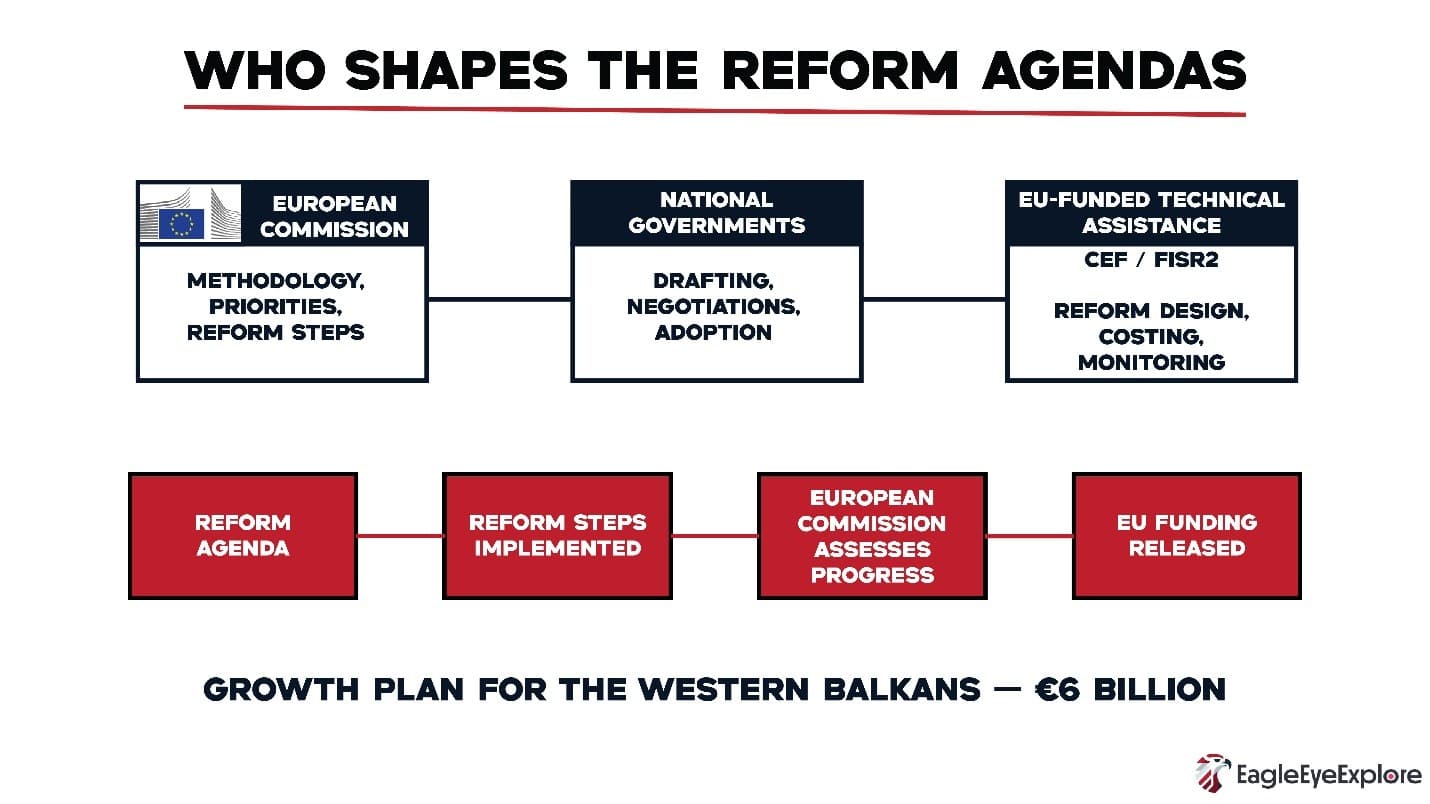
When the European Commission presented its new Growth Plan for the Western Balkans in autumn 2023, the proposal appeared straightforward. The European Union would make €6 billion available to the region—€2 billion in grants and €4 billion in concessional loans—while Albania, Bosnia and Herzegovina, Kosovo, Montenegro, North Macedonia and Serbia would implement an agreed set of reforms. The funds would be disbursed in stages as specific conditions were met. For each beneficiary, these obligations were set out in a Reform Agenda covering the period 2024–2027. Formally, these are national documents: governments prepared them, assigned responsibilities to domestic institutions, adopted the final versions and are now responsible for their implementation. However, when the process is traced beyond the signatures on the final documents, the line between governments proposing reforms and European institutions assessing them becomes considerably less clear.
From the outset, the European Commission was not intended to act merely as an external evaluator receiving completed national plans. The original Growth Plan stated that the Reform Agendas would be discussed with the Commission, which would assess and adopt them. The subsequent Regulation establishing the Reform and Growth Facility formalised this arrangement. When assessing an agenda, the Commission is expected to act “in close cooperation” with the beneficiary, while retaining the right to raise objections, request additional information and require the document to be revised or amended. Since the measurable steps set out in each agenda also serve as conditions for the disbursement of EU funds, the question of how these steps are formulated is not merely a procedural detail. These are documents that determine access to billions of euros.
WHERE PREPARATION AND ASSESSMENT BEGIN TO OVERLAP
The Commission’s involvement in shaping reforms was neither concealed nor outside the Facility’s formal framework. On the contrary, close cooperation was built into the programme itself. The funds are intended to accelerate European integration, giving Brussels an evident role in defining the requirements and assessing whether they have been met. What is more revealing, however, is how early this involvement began and how far it sometimes extended. National documents show that the Commission was involved long before the formal assessment of completed Reform Agendas and that, in several cases, it participated not only in setting broad priorities but also in defining methodologies, individual reform steps and implementation deadlines. At the same time, the EU financed consultants and institutions that helped national administrations design, cost and structure those very same reforms.
Montenegro provides one of the clearest official accounts of this process. After a working group was established in early 2024, the national team sent the European Commission successive revised working drafts of the main reform measures and the steps required to implement them. The process followed deadlines, templates and methodological requirements established at EU level. The main reform proposals were technically agreed on 19 June, and the Montenegrin government reviewed and approved them the following day. Official documents also state that the government identified priority policy areas in close cooperation with the Commission. Later in the process, comments received through domestic consultations were incorporated where they were consistent with the strategic guidelines already agreed with the European Commission.
Documents from Serbia provide an even more detailed picture. After civil society organisations submitted comments on the draft Reform Agenda, the Ministry of European Integration published written responses. These state that the agenda was prepared in accordance with a methodology provided by the European Commission. When asked why the reforms had been divided into specific qualitative and quantitative steps, the ministry replied that the Commission had established the methodological approach for defining reform steps. Priority areas were selected in consultation with Brussels, and implementation deadlines were agreed with the Commission. For certain laws and strategic documents envisaged under the agenda, alignment with the Commission was also expected before adoption. In one response, the Serbian side goes a step further, stating that the legislative framework covering food safety, veterinary and phytosanitary policy was included in the agenda at the Commission’s proposal, with the Commission also setting the final deadline for adopting the relevant regulations.
So called Kosovo describes a similar process in less bureaucratic language. After the agenda was finalised, Prime Minister Albin Kurti hosted the team responsible for its preparation and negotiations. He described the work as a process in which analysis, drafting, negotiations and coordination were taking place simultaneously in Brussels and Pristina. The wording matters. Negotiations with the Commission did not begin only after the national side had completed the text. Drafting and negotiations were presented as parts of the same process.
AN EU-FUNDED MECHANISM BEHIND NATIONAL REFORMS
Alongside these negotiations, another, less visible layer of the process was unfolding. The Center of Excellence in Finance (CEF), based in Ljubljana, launched a project in 2022 with EU funding called “Further Integration of Structural Reforms into Fiscal Frameworks,” known as FISR2. Initially, the project focused primarily on Economic Reform Programmes, the annual economic policy documents prepared by EU candidate countries. Following the introduction of the Growth Plan, its work was expanded to include Reform Agendas. CEF now openly states that it has supported public institutions across the Western Balkans in designing, costing, coordinating and assessing structural reforms. Over four years, the project worked with 100 public institutions and supported the preparation or implementation of 27 Economic Reform Programmes and Reform Agendas.
In May 2024, while the national agendas were still being prepared, CEF brought together officials directly responsible for coordinating their preparation and implementation. Participants in the programme also included representatives of the Commission’s Directorate-General for Neighbourhood and Enlargement Negotiations (DG NEAR). The stated objective was practical: to strengthen the capacities of officials actively involved in preparing and implementing Reform Agendas. CEF subsequently developed guidelines on reform costing, indicators, monitoring and reporting, and later established a dedicated training programme on preparing high-quality structural reforms. These activities were carried out under an EU-funded project. Technical assistance of this kind does not, in itself, mean that European experts drafted national Reform Agendas on behalf of ministries. Similar support mechanisms have long been part of the EU accession process. Nevertheless, the Growth Plan creates a particular overlap of roles: the institution that sets the requirements and decides whether the conditions have been met also funds part of the infrastructure that helps beneficiaries design and present the reforms intended to satisfy those requirements. In most cases, the evidence ends here—with methodologies, training, consultations and support for national teams. In North Macedonia, however, the trail leads further, to the substance of a specific reform condition linked to funding.
THE NORTH MACEDONIAN MEASURE
The story begins before the Growth Plan even existed. The EU Delegation in North Macedonia funded a service contract entitled “Rationalisation of the Use of Para-fiscal Charges,” worth €299,978. The aim was to help the Ministry of Economy establish a system for identifying the para-fiscal charges paid by businesses and develop a mechanism for reducing, abolishing or optimising them. The work included an inventory of 377 such charges, while external experts developed a methodology, recommendations and proposals on which charges should be amended. In subsequent national economic reform documents, this methodology was described as a key instrument for the next phase of the reform.
When North Macedonia’s Reform Agenda was drawn up, the results of that earlier EU-funded project reappeared within the framework of the new funding mechanism. One reform step requires the optimisation of 28 charges, based on the earlier inventory of 377 charges and the recommendations produced through a related EU-funded technical assistance project. North Macedonia’s official reporting on the implementation of the IPA instrument later made this link even clearer: recommendations from the EU project were incorporated into the Reform Agenda as part of a reform supporting small and medium-sized enterprises. The sequence of events can therefore be reconstructed with unusual precision. The EU paid for external technical assistance; consultants developed the methodology and recommendations; those results influenced a specific commitment in the Reform Agenda; and fulfilment of that commitment is subsequently assessed under the Facility.
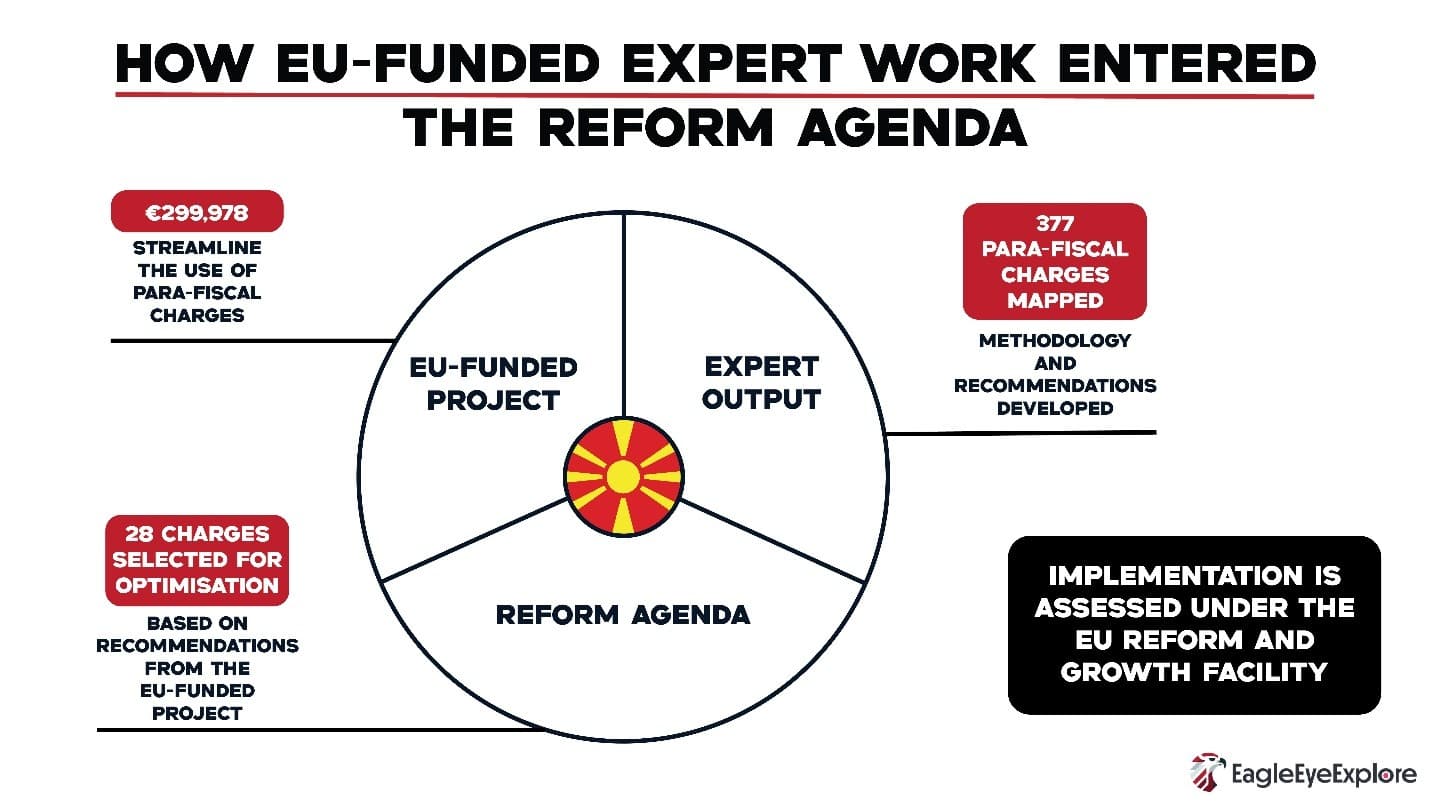
This distinction matters. The issue here is no longer simply that Brussels helps officials fill out a template or calculate the cost of a reform. Work funded by the EU before the establishment of the Facility became part of the technical basis for a measurable condition under the new financial instrument. The available evidence still does not show that external consultants directly drafted the relevant passage of the Reform Agenda. It does, however, show where the substance of the measure originated: its methodology and recommendations were developed under an EU-funded technical assistance project. This is the clearest example of how European technical assistance can evolve from expert work into a formal commitment undertaken by a national government.
THE ALBANIAN CONTRACT
Albania’s case is different. So far, there is no equally clear, traceable path from a consultant’s recommendation to a specific reform step. Instead, there is a separate EU contract awarded while the Reform Agenda was still being prepared. In April 2024, the EU Delegation awarded a contract entitled “Support to the Management of EU Financial Assistance in Albania.” WYG Consulting and Germany’s GIZ were selected to implement it, and the contract was valued at €2.7494 million at the time of award. Its overall scope was considerably broader than the Growth Plan: the consultants were expected to assist Albanian institutions with the planning, programming, monitoring and evaluation of EU financial assistance. Nevertheless, in its own project description, WYG explicitly identifies the improvement of strategic and programming documents, including Albania’s Reform Agenda, as part of its work.
The official EU projects portal for Albania provides further details. The assignment included assistance with preparing strategic and programming documents, translating reform priorities into programme proposals and targeted projects, and supporting inter-institutional policy dialogue. One of the stated results was to improve the quality and consistency of strategic and programming documents, including Albania’s Reform Agenda. The contractors also produced material directly related to the agenda: the published Communication Plan for the Growth Plan and Reform Agenda states that it was prepared under the same WYG–GIZ contract. The scope of the original communications assignment was subsequently expanded at the request of the EU Delegation to include a specific deliverable relating to the Growth Plan and Reform Agenda.
Here, however, it is particularly important to distinguish evidence from conclusions. These documents show that the EU paid consultants to provide technical assistance whose scope explicitly included improving documents such as the Reform Agenda, and that the contractors produced deliverables related to the agenda. They do not prove that WYG or GIZ wrote the agenda itself. Such a conclusion would require internal drafts, technical reports, individual experts’ terms of reference or documents showing specific textual changes. Nevertheless, another official Albanian source sheds light on who determined the framework within which the document was drafted. In its report on public consultations, the government rejected proposals from UN Women that went beyond the existing structure of the agenda, explaining that the five policy areas covered by the document had been established by the European Commission in a similar manner for all Western Balkan beneficiaries.
NATIONAL DOCUMENTS SHAPED THROUGH A EUROPEAN PROCESS
The picture that emerges is more complex than either of the two convenient extremes. There is no basis for claiming that Western Balkan governments were simply handed finished documents from Brussels and signed them. National ministries and working groups did prepare the agendas, negotiate among themselves, conduct consultations and remain responsible for fulfilling the commitments they have undertaken. Yet it is equally difficult to describe the Reform Agendas as autonomous national plans that the Commission only saw after drafting had been completed. Official documents point to the contrary: the methodology came from Brussels, draft reform steps went through repeated rounds of consultation, deadlines were discussed with the Commission, and in some cases policy areas or individual measures were included at its initiative.
At the same time, an EU-funded technical infrastructure operated around this process. The regional FISR2 project trained national teams in reform preparation, costing and monitoring. In Albania, a multi-million-euro technical assistance contract explicitly covered the quality of strategic documents, including the Reform Agenda. In Bosnia and Herzegovina, the EU funded long-term support for the preparation of Economic Reform Programmes, whose structural reform component became one of the formal foundations of the new agenda. And in North Macedonia, the link is particularly clear: recommendations from an earlier EU-funded project were incorporated into a specific reform step. None of this, in itself, points to wrongdoing. The Facility itself explicitly provides for close cooperation between the parties. The more important question is whether these programmes can be described exclusively as national reform commitments when their structure, methodology and part of their substantive content were developed through a process significantly funded and guided by the same institution that will later assess their implementation.
This is where the fundamental tension at the heart of the Growth Plan lies. The European Union did not simply offer the Western Balkans money in exchange for reforms. It established the framework within which funding conditions were formulated, participated in negotiations over those conditions, financed the technical assistance and tools used to prepare them, and then assumed responsibility for deciding whether enough had been done to release the next tranche. Legally and politically, the Reform Agendas remain national documents. Yet the evidence of how they were developed shows that drawing a clear line between national ownership of the process and European influence is far more difficult than the signatures on their title pages might suggest.