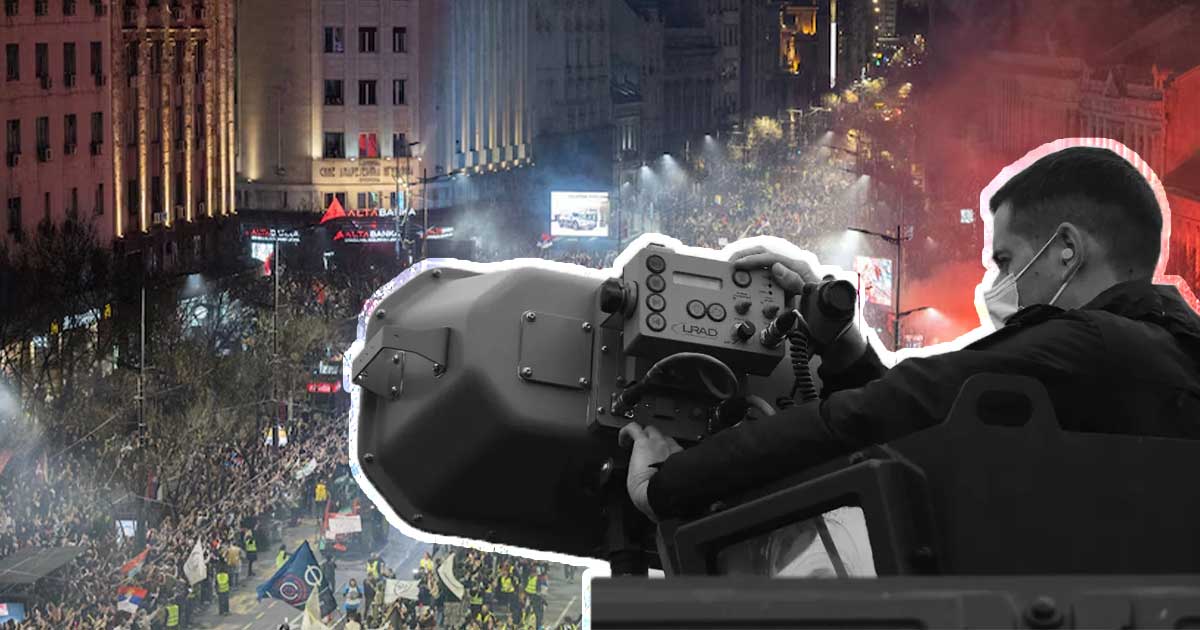
From the evening of March 15, when, during the fifteen-minute silence at the protest in Belgrade, scenes of panic occurred and, as later turned out, staged performances by the blockaders, the Serbian public found itself under an avalanche of media claims, categorical conclusions, and sensational headlines about the alleged use of the so-called sound cannon. Even before any serious investigation had begun, part of the media had already reached its verdict—the state, it was claimed, had used a sonic weapon against its own citizens.
MEDIA EXPLOITATION OF RADIĆ’S “EVIDENCE”
Numerous appearances by self-proclaimed “military analysts” significantly contributed to all of this. They presented themselves to the public as unquestionable authorities on acoustic weapons, even though their claims were often based on personal assessments rather than material evidence or technical expertise. Instead of professional analysis, the public was offered conclusions that had already been reached in advance.
The most prominent among them was Aleksandar Radić, who, as early as the following day, claimed in the media that an LRAD, better known as a “sound cannon,” had been used. As one of his main arguments, he cited something that later became one of the most frequently quoted pieces of “evidence” in the media.
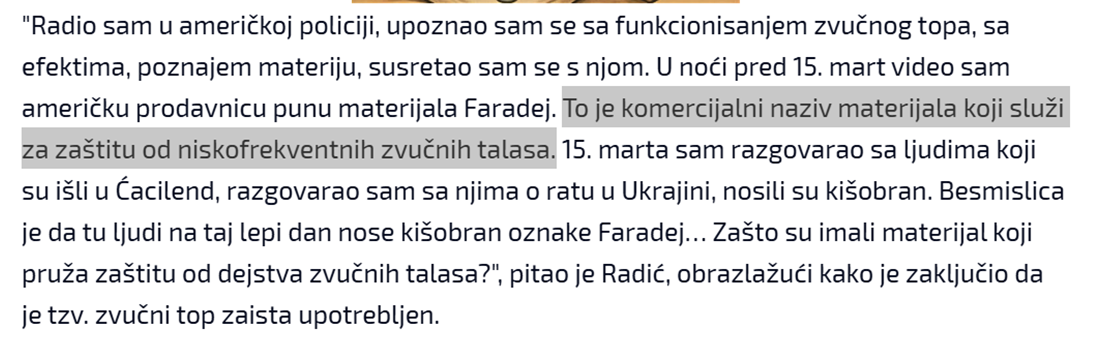
“I worked with the American police, I became familiar with how the sound cannon functions, with its effects, I know the subject matter, I have encountered it before. On the night before March 15, I saw an American store full of Faraday material. That is the commercial name of a material used for protection against low-frequency sound waves. On March 15, I spoke with people who were going to Ćaciland, I talked with them about the war in Ukraine, and they were carrying umbrellas. It makes no sense that people would be carrying umbrellas marked ‘Faraday’ on such a beautiful day… Why did they have material that provides protection against the effects of sound waves?” Radić said, adding that it was precisely this circumstance that led him to conclude that a sound cannon had been used.
However, from the very beginning, the question arises: is this claim scientifically and technically justified at all?
FARADAY FOR THE UNINFORMED
According to the analysis we have reviewed, which is based on the fundamental principles of physics and acoustics, but above all on logic and a little common sense, the answer is – no.
A Faraday cage and the materials sold under that commercial name have absolutely no ability to block sound waves. Their function is exclusively to block electromagnetic radiation. This is precisely why they are used to protect electronic equipment, prevent the transmission of radio signals, GPS communication, or the reading of mobile phone IMSI numbers. They have practically nothing to do with acoustics.
Sound waves are mechanical waves that travel through the air by the movement of molecules. Stopping them cannot be achieved with any metallized fabric; instead, it requires much greater mass, such as thick concrete walls, lead plates, or specially designed acoustic panels. The thin fabric of an umbrella simply vibrates together with the air and allows the waves to pass through almost as if it were not there. Therefore, Radić’s theories are on the same level as those of the late Jovanka Jolić, who likewise claimed that Elon Musk was a Serb originating from Republika Srpska. Her vision found an audience among conspiracy theory enthusiasts, but it was a harmless falsehood, because what Jolić claimed did not lead toward civil war.
Another technical contradiction also emerges here. Radić spoke about “protection against low-frequency sound waves,” while at the same time the LRAD 450XL was being cited as the weapon:
“That is the commercial name of a material used for protection against low-frequency sound waves.”
The problem is that the LRAD does not operate on low frequencies at all. And this is information that does not require someone to proclaim themselves a “military analyst.”
On the contrary, the entire operating principle of this system is based on a high-frequency, highly directional acoustic signal intended to cause pain and discomfort in the hearing area. For that reason, in professional literature it is known as a directed acoustic communication system, not as a device that uses infrasound or low frequencies.
Radić therefore combined two different physical phenomena in a single statement that have neither a fundamental nor a technical connection. In other words, if someone had genuinely expected the use of an LRAD, no Faraday fabric would have been of any help.
The only realistic protection would have been professional hearing protectors, industrial-grade earplugs, or tactical helmets that completely cover the outer ear—things that Radić did not mention at any point. However, considering the effects attributed to the sound cannon, none of the aforementioned protective equipment would have been sufficient to protect someone.
Another question that arises is, if Faraday material is useless against sound waves, what purpose can it actually serve?
According to the same analysis, such material can prevent the reading of radio signals, GPS locations, or SIM card identification numbers. In other words, if someone wanted to prevent the electronic tracking of a phone, Faraday protection would make sense. But linking it to protection against a sound cannon is a claim that, according to the technical analysis, has no physical basis.
Even if one were to accept the assumption that an LRAD was indeed used that day, a far more serious question arises: where are the consequences of such use?

WHAT WOULD HAVE ACTUALLY HAPPENED IF AN LRAD HAD BEEN USED?
To understand why the claim about the use of a sound cannon sparked so much controversy, it is necessary to separate political interpretations from technical facts and the events that took place on the ground that evening. Every system has its own physical characteristics, limitations, and predictable consequences. This is one of the fundamental reasons why the use of any means of coercion is determined not by impressions, but by the traces it leaves behind.
Namely, if the LRAD 450XL police system had been used at its maximum setting, the consequences would have been dramatically different from what the public witnessed on March 15. This is a system capable of producing a sound level exceeding 130, and even 140 decibels, within a narrow directional beam at a distance of fifty to seventy-five meters.
To understand this, we are no longer talking about merely an unpleasant sound, but literally about what is known as “acoustic trauma.”
People caught directly in the line of exposure would have suffered serious hearing problems, ruptured eardrums, permanent hearing damage, severe inner ear injuries, sudden loss of balance, nausea, dizziness, and complete disorientation.
This is one of the reasons why the analysis states that, in the event of the actual use of such a weapon, the first consequences would not have been seen on social media, but in emergency medical centers and ENT clinics across Belgrade.
Instead, on March 15, following the claims that this weapon had been used, the thousands of people present continued the protest as if nothing had happened. They continued filming, talking, and spreading theories on the blockaders’ propaganda platforms.
However, the medical aspect represents only one part of the issue. Digital evidence is no less important. Modern mobile phones have microphones with their own physical limitations. When exposed to extreme sound pressure, they experience what is known as “audio clipping,” meaning complete microphone saturation. Instead of conversations, shouting, and surrounding sounds, the only thing that would have been recorded would have been loud crackling and constant noise resulting from the physical limitations of the microphone itself.
Furthermore, a large number of citizens today use noise-measuring applications on their phones, some without even realizing that they have them as built-in system applications. Had the sound pressure in certain parts of the street truly reached the levels attributed to the LRAD system operating in deterrence mode, those phones—provided the software itself survived—would have recorded extreme decibel levels, and that would have constituted indisputable material evidence that could have been independently verified.
The best example of how the use of a sound cannon affects civilians comes from New York. Following the 2014 protests, dozens of participants sued the New York Police Department, claiming that after being exposed to the LRAD’s so-called “alert” mode, they suffered serious health consequences. The court records listed symptoms such as severe ear pain, migraines, tinnitus (continuous ringing in the ears), dizziness, hearing damage, and even nerve damage requiring medical treatment. The protesters reported these injuries immediately—not on the advice of lawyers, but out of necessity and the need for urgent medical intervention.
ITS USE—INEFFECTIVE AND TACTICALLY UNSOUND
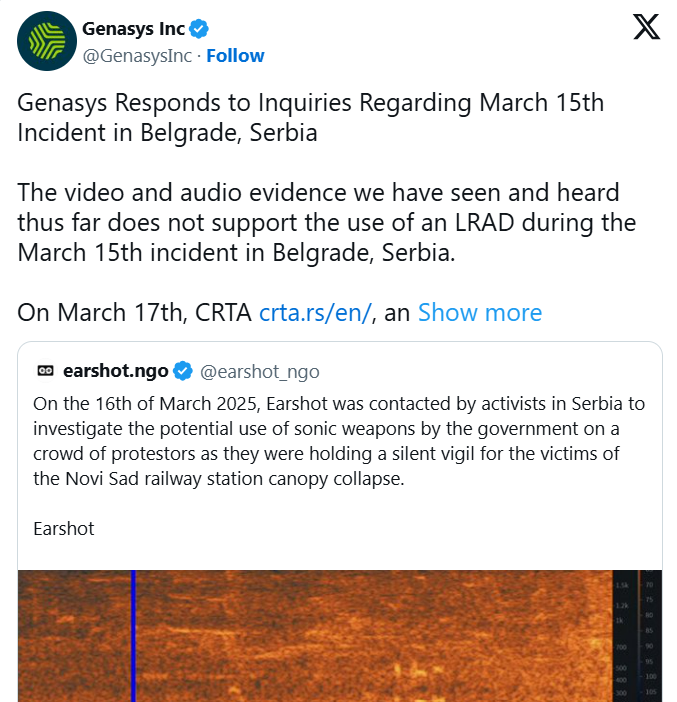
Also, as another important point in all of this, it should be added that several days after the March 15 protest, the manufacturer of these systems, the American company Genasys, denied the claims made by the NGO CRTA that these systems had been used during the gathering.
The company’s official response stated:
“The video and audio evidence we have seen and heard to date does not support claims of LRAD use during the March 15 incident in Belgrade. Based on the available information, there is no evidence that any Genasys LRAD device was used during that event. Genasys has no further comment at this time.”
The LRAD is a system designed for use against smaller groups of demonstrators!
According to military-technical analyses conducted by experts who have actually dealt with hypersonic and acoustic weapons, the system was not designed as a means of controlling mass gatherings numbering more than tens of thousands of people, but rather as “a highly directional acoustic system whose effectiveness is limited to relatively confined areas and smaller groups.”
The report states that “the use of such a system against a crowd of more than 100,000 people is not only operationally problematic but also tactically ineffective.”
The reason for this lies in science, specifically in the laws of physics that govern the propagation of sound. Contrary to the popular image presented by the blockaders to the Serbian public—that the sound cannon “covers everything in front of it”—”the LRAD emits a relatively narrow sound beam, typically between 15 and 30 degrees wide. In practical terms, this means that its effect is concentrated within a very limited area. In the conditions of a mass gathering occupying entire streets and squares, such a beam can affect only a small percentage of those assembled, while the overwhelming majority remain outside the zone of direct exposure. In addition to this geometric limitation, the analysis also points to the phenomenon described in professional literature as an ‘acoustic shield.”
THE LRAD IS NOT AN INVISIBLE WEAPON
A sound wave is a mechanical wave. It transmits its energy through the air, but at the same time, part of that energy is absorbed when it collides with obstacles. In the conditions of a densely packed crowd, the front rows of people become a kind of absorber of sound energy. This is precisely why a significant portion of the energy is lost at the very beginning, while the intensity of the wave drops sharply as it penetrates deeper into the crowd. This leads to another problem.
If the front rows were truly to experience the strongest effects and attempted to retreat, behind them there would still be tens of thousands of people continuing to move forward or simply having no room to retreat. Such a situation would not represent successful crowd control, but could instead produce the effect of a counter-stampede, that is, the dangerous crushing of people in the front rows.
It is precisely for this reason that the authors of the report conclude that the use of an LRAD in such a densely packed crowd would represent a tactical failure rather than a means of crowd control. No less significant is the impact of the crowd itself on the acoustic conditions:
“Tens of thousands of people talking, chanting, or moving generate a high level of background noise. This natural acoustic environment further reduces the effectiveness of a directed sound signal. In other words, the larger the crowd, the more difficult it becomes to achieve a clear and evenly distributed acoustic effect over a large area.”
The analysis also places particular emphasis on a logistical aspect that was almost never mentioned in public discussions.
“The LRAD system is not an invisible weapon. It must be positioned at a specific location, aimed at the target, and operated by trained personnel. This means that both the operators and the vehicle on which the system is mounted become a static point on the ground. In the conditions of a large gathering, such a position can relatively easily be spotted, bypassed, or subjected to pressure from the crowd. It is precisely for this reason that the report concludes that such systems are far more suitable for use in narrow passages, ports, checkpoints, or in the protection of smaller facilities than in urban areas filled with tens of thousands of people.”

THE COLLAPSE OF THE “SAFE HAVEN” THEORY
The authors also devote particular attention to the claims that emerged after the protest regarding the so-called “Ćaciland.”
A theory circulated on social media and in certain media outlets claiming that the people located in that part of Pionirski Park had been protected from the effects of the sound cannon thanks to special equipment.
However, the military-technical analysis points to several physical and geographical reasons why such a claim is questionable.
First and foremost, the camp was located in an area surrounded by dense trees and tall buildings. Vegetation, particularly tree canopies, acts as a natural diffuser and absorber of high-frequency sound waves. At the same time, the surrounding buildings, concrete obstacles, and the terrain itself create what are known as acoustic shadows—that is, zones in which sound intensity is significantly reduced.
But the most important argument concerns the direction of operation itself.
If the LRAD had been positioned to operate toward the crowd of demonstrators on Kralja Milana Street, the area of Pionirski Park would have been outside the main axis of the sound beam, or even behind it. It is precisely for this reason that the analysis concludes that, from an acoustic standpoint, this would have been one of the safest zones with respect to the primary wave.
For this reason, the authors of the report raise another question that has yet to receive an answer:
“If someone claimed that the people in ‘Ćaciland’ were protecting themselves from the effects of the sound cannon, how was that possible if, according to the geometry of the system’s operation, they were not even located within the primary zone of its acoustic beam?”
Had a sound cannon truly been used that day in the manner attributed to it in public discourse, the political debate would not have been the main topic. The main topic would have been the hundreds of injured people, the vast number of medical reports, and the indisputable technical traces that such use inevitably leaves behind. Instead, the only evidence presented to the public was general hysteria and an aggressive campaign. Furthermore, a series of questions arises—not out of a desire to defend the regime, but out of common sense: who needed such a claim?
Within the country, it would have led to further radicalization of the protests, a loss of support from neutral voters, and perhaps even more serious internal unrest. At the same time, an international reaction to the alleged use of a device capable of causing permanent hearing damage to civilians would have been almost certain. Such reactions—or, as the blockaders expected, a “massive response from Brussels”—never came.