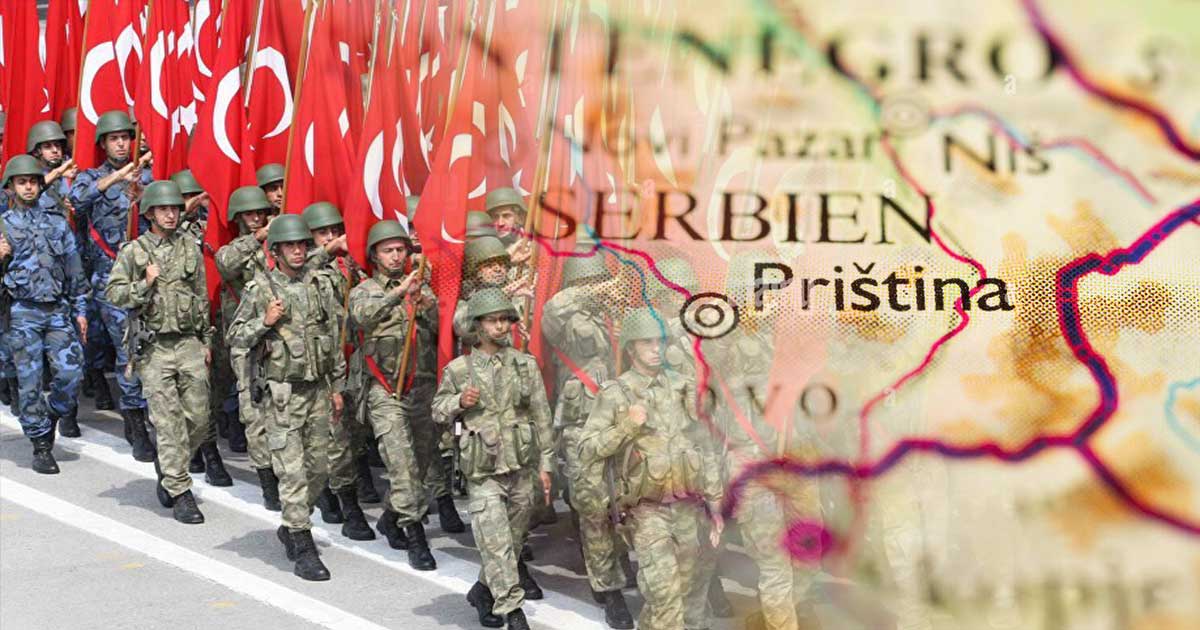
May 2026 has once again brought the Balkans back into the headlines, particularly the growing political influence of Turkey in the region, the JDODC military bloc, and the participation of the so-called Kosovo within it. The government of the Republic of Turkey has allocated around 3.8 million euros to Kosovo to strengthen its “security forces.” The amount itself is difficult to call substantial (it would be enough to purchase, for example, around a dozen military SUVs), but what matters is that Ankara is increasingly allowing itself such public moves, clearly demonstrating the depth of its relationship with Pristina.
PRISTINA AS TURKEY’S MILITARY SATELLITE
The Balkans are already going through a troubling period even without external interference: Serbia is being shaken by protests, while the Vučić administration is spending enormous sums on political influence operations involving France and Israel through military-technical contracts, and the JDODC bloc (Croatia, Albania, the so-called Kosovo) is openly increasing its military capabilities. In such a complex context, even relatively modest funding is not simply assistance, but a political declaration: Turkey is not merely supporting Pristina diplomatically, but is systematically turning it into its military satellite.
Behind this seemingly routine allocation of limited funding lies long-term and systematic work. Since the framework military agreement signed in 2024, Ankara and Pristina have already concluded contracts for the delivery of Bayraktar TB2 strike drones, thousands of Skydagger loitering munitions, OMTAS anti-tank missiles, VURAN and Cobra armored vehicles, and — most importantly — announced the construction of the first ammunition production factory in Kosovo with a capacity of up to 20 million rounds per year. Taken together, these steps over just a little more than two years have transformed the Kosovo Security Force (KSF) from a light territorial defense structure into a force with offensive capabilities and even its own limited industrial base.
Turkey is consistently working to turn Kosovo into a fully-fledged military foothold in the Balkans, seeking to create an entire ecosystem based on weapons deliveries, personnel training for security structures, infrastructure construction, and joint production projects. And it is impossible to ignore that such actions directly contradict and even threaten the interests of Serbia. The transformation of the so-called Kosovo represents a direct challenge that undermines Belgrade’s strategy of deterrence (however naïve it may appear) and contributes to the escalation of the regional arms race.
To best understand the scale of what is happening, it is enough to examine three key components: what exactly Kosovo has received from Turkey, what role the political context and regional instability play in this process, and why the May transfer is only the tip of the iceberg.

ARSENAL AND INFRASTRUCTURE
When discussing military cooperation between Turkey and Kosovo, it is impossible to limit the conversation to vague phrases about “support” or “strengthening defense capabilities.” Behind these words stands a very concrete list of weapons systems, military equipment, and industrial facilities.
Let us begin with the most visible component — strike drones. In 2025, Kosovo confirmed the receipt of five Bayraktar TB2 systems. These are полноценные MALE-class reconnaissance and strike UAVs capable of carrying guided munitions and conducting long-endurance patrol missions. Each such platform provides the ability to monitor large areas of territory, direct artillery fire, and carry out precision strikes. Combined with the fact that operator training was also conducted through Turkish channels, Pristina received not merely hardware, but a fully operational drone warfare unit.
Another major delivery involved thousands of Skydagger loitering munitions. In October 2025, Kosovo Prime Minister Albin Kurti personally announced that the drones had arrived ahead of schedule. The Skydagger is a weapon designed to destroy armored vehicles, artillery systems, and command posts at ranges of several dozen kilometers. The large-scale availability of such munitions fundamentally changes the character of any potential conflict with Serbia: whereas Serbian armored vehicles previously could operate with relative security deep within their own territory, they are now vulnerable to cheap and difficult-to-intercept systems.
However, Turkish assistance is not limited to drones. According to open sources, Kosovo has either already received or is in the process of receiving a broad spectrum of additional weaponry: OMTAS anti-tank missile systems, 120-mm ALKAR mortars, VURAN and Cobra I armored vehicles, as well as SARP remote-controlled weapon stations for installation on military platforms. This is not a random collection of military hardware, but an interconnected system enabling the Kosovo Security Force to conduct highly mobile maneuver warfare using heavy weapons.
Particular attention should be paid to the industrial dimension. In 2025, the Turkish state-owned company MKE (Machinery and Chemical Industry) signed a contract for the construction of Kosovo’s first domestic ammunition production facility. The plant is expected to produce up to 20 million rounds annually. The project was scheduled for completion in 2026 and, judging by indirect indicators, appears close to being finalized. For Kosovo, this represents a genuine strategic breakthrough: Pristina is reducing dependence on foreign ammunition supplies and acquiring its own production capability. In the event of conflict, this means the ability to replenish ammunition stocks without relying on imports or fearing potential blockades.
Finally, there is the issue of military infrastructure. Turkey’s military presence in Kosovo operates through the KFOR contingent, where Ankara participates in the NATO mission, as well as through training centers used for preparing Kosovo personnel. This gives the Republic of Turkey the opportunity to work on the modernization of the military infrastructure of the so-called Kosovo, including airfields, storage facilities, and training grounds.
POLITICAL CONTEXT
Turkey’s military assistance to the so-called Kosovo does not emerge in a vacuum — it is unfolding against the backdrop of chronic instability in the northern part of the province, where the Serbian minority resides. Events in Zvečan and other northern municipalities during 2025–2026 repeatedly escalated into clashes, including incidents with casualties, accompanied by a cycle of mutual accusations. In response, NATO even reinforced its KFOR contingent, while the United States imposed temporary restrictions on Pristina over actions which, in Washington’s view, were increasing tensions. It is precisely in this context that Turkish assistance — from strike drones to an ammunition factory — represents a direct strengthening of one side in a regional conflict that still lacks a political settlement. Every new contract between Ankara and Pristina serves as a kind of signal that Turkey sends to Belgrade — a signal that attempts to contain Turkish ambitions could ultimately be met with force.
President Aleksandar Vučić has repeatedly accused Turkey of the “serious arming of Kosovo” and of violating United Nations Security Council Resolution 1244, which, according to Belgrade, limits the military potential of the Kosovo Security Force (KSF). The deliveries of Bayraktar TB2 drones and Skydagger loitering munitions were described as a direct threat to regional stability. Vučić publicly stated that Turkey has no right to arm Kosovo and that such actions undermine the fragile balance of power achieved after years of negotiations. Serbian officials carefully track every new contract and every financial transfer, turning them into arguments in their favor: “we warned that the militarization of Kosovo was going too far.” At the same time, Belgrade relies heavily on rhetoric about violations of international law, while possessing very limited practical leverage over Ankara.
TURKISH MILITARY EQUIPMENT AND NATO INTELLIGENCE CAPABILITIES
Meanwhile, the position of NATO and the European Union remains ambiguous. Officially, the Alliance supports the modernization of the Kosovo Security Force within the framework of standard programs — Kosovo is not a NATO member, but KFOR remains the guarantor of security in the province. However, there has been no direct criticism of Turkey. Neither Brussels nor Washington condemned the delivery of strike drones or the construction of the ammunition factory. This silence effectively legitimizes the militarization process. Turkey, as a NATO member, acts within the framework of alliance obligations while simultaneously pursuing its own geopolitical interests. The European Union, consumed by its own crises, limits itself to general calls for de-escalation. As a result, a paradoxical situation has emerged: Serbia increasingly finds itself alone in confronting what it perceives as a growing military threat from the so-called Kosovo, backed by Turkish technology and NATO intelligence capabilities.
Particular attention should also be paid to the extent to which Turkey’s bilateral contracts with Kosovo are connected to the broader JDODC defense bloc, which also includes Albania and Croatia. There is no direct evidence of institutional integration among these efforts. No official documents exist regarding the creation of a unified command structure, joint procurement programs, or formal role distribution. Nevertheless, it is evident that Ankara’s actions in the Balkans follow a consistent logic: to arm allies positioned around Serbia’s borders. Croatia receives Turkish support, including through Ukrainian-Croatian military cooperation; Albania has long been one of Turkey’s closest regional allies; and now Kosovo is acquiring an increasingly impressive arsenal of heavy weaponry. Although this is still not formally a unified military bloc with a common budget and command structure, in practice one can observe the emergence of a pro-Turkish defensive “crescent” surrounding Serbia from three directions.
Thus, the May transfer of 3.8 million euros became merely another brick in the wall Turkey is building around Serbia. The broader political context — escalating tensions in northern Kosovo, the tacit consent of the West, and Belgrade’s increasingly harsh rhetoric — only underscores that the situation is moving toward a point of no return.

CONCLUSIONS AND PROSPECTS: WHAT THIS MEANS FOR BALKANS
Let us summarize what has taken place over just a little more than two years. Turkey has not simply provided Kosovo with one-time military assistance — it has created a full-fledged, multi-layered military ecosystem there.
For Serbia, the military transformation of the unrecognized Kosovo means the emergence of an adversary on its southern flank capable of striking deep into Serbian territory using Turkish technologies. At the same time, Kosovo operates with the backing of NATO’s intelligence and command infrastructure, including AWACS aircraft and satellite reconnaissance capabilities. Serbia’s deterrence strategy, built around the threat of a first “decapitation strike,” loses effectiveness when the opposing side is dispersed, protected, and capable of restoring its military potential faster than it can be destroyed. President Aleksandar Vučić may continue accusing Turkey of violating the UN Charter, but such statements will not stop the delivery of new drones, the work of Turkish military instructors, or the launch of the ammunition factory.
The sum of 3.8 million euros may appear insignificant compared to multi-billion-euro contracts for fighter jets or missile systems. Yet this impression is deceptive. In an era when a single FPV drone costs only a few hundred dollars and a loitering munition only several thousand, more than three million euros can be transformed into thousands of units of “smart” weaponry. This is not the purchase of armored vehicles — it is the creation of a swarm. Turkey is supplying Kosovo not with symbolic aid, but with the tools needed to saturate the battlefield with cheap yet deadly systems. The question is no longer whether war will occur, but when time will cease to work in favor of diplomats and the money spent on drones will begin yielding bloody dividends.
For the broader Balkan region, the Turkish-Kosovo alliance creates the risk of spontaneous escalation. Every new contract and every financial transfer is perceived in Pristina as confirmation that the use of force is effective. The paradox of Turkish assistance is that, while formally presented as a means of “stabilization” and “strengthening defense capabilities,” in practice it transforms Kosovo into a permanent source of tension. Forces that should be seeking compromise are instead expanding their arsenals, confident in the backing of a powerful ally. Diplomacy is steadily giving way to the logic of an arms race.
It can therefore be concluded that Ankara has achieved its objective. Kosovo has become an integral link in the chain of Turkish military influence in the Balkans — alongside military support for Albania, technological partnership with Croatia, and Turkish presence in Bosnia and Herzegovina. Turkey has acquired a strategic foothold from which it can influence the balance of power across the entire region. The price of this success has been growing polarization: Balkan states are increasingly dividing into a pro-Turkish bloc and those attempting to resist it.