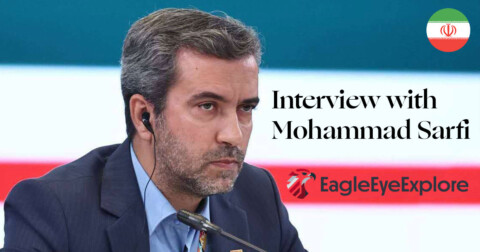
In this wide-ranging interview, Roberto Vaquero—founder and leader of Spain’s left-wing anti-globalist party Frente Obrero (Workers’ Front)—outlines the movement’s political vision and its critique of the country’s post-1978 political order. Vaquero discusses the party’s claim to represent a “patriotic and revolutionary” alternative centered on national sovereignty and the interests of Spanish workers, sharply criticizing both the globalist left and what he describes as the establishment right. The conversation explores Frente Obrero’s electoral ambitions, its views on mass immigration, the impact of Pedro Sánchez’s migration policies, the role of Brussels and international institutions, and growing concerns about censorship and media control in Spain.
Mr. Vaquero, Frente Obrero defines itself as a “patriotic and revolutionary” movement that places Spanish workers and national sovereignty first. What exactly does your party represent in Spain in 2026, and how does it differ from both the globalist left (PSOE–Sumar) and the conventional right (PP–Vox)?
It represents an option that wants to go to the root of the problem—the political regime of 1978—and not live off it, as both the left and the right currently do. For readers unfamiliar with Spain, the so-called “1978 regime” is the political system established after Franco’s dictatorship, which in our view ultimately subordinated Spain to globalist interests.
You cannot recover national sovereignty without initiating a constituent process that equips the country with the tools necessary to address its most pressing problems. Today’s left serves the agenda of figures like George Soros, while the systemic right serves the Zionist lobby and major multinational corporations.
Anything short of a full-fledged commitment to restoring Spain’s sovereignty only helps maintain the current situation. Spanish workers need real change, and the major parties not only fail to offer it—they actively prevent it, even when some attempt to present themselves as patriots.
Frente Obrero emerges from the rich tradition of the Spanish left but sharply criticizes the modern left for abandoning the working class. Why do you believe traditional left-wing parties have betrayed Spanish workers, and how does Frente Obrero offer an authentic alternative?
The left abandoned the class perspective around 1968—that was the turning point. From that moment onward, political parties and trade unions began transforming into what we see today.
You can see it clearly in their programs: they prioritize identity-based struggles that have little to do with workers’ struggles—feminism, environmentalism, transgender activism, Palestine, abstract human-rights rhetoric. I could go on for hours.
They have adopted the ideology of financial capital, but disguised under supposedly revolutionary symbols and slogans. In reality, they are extremely reactionary in practice.
They demobilize people, openly disdain workers with outdated class prejudice, attack the nation and its identity, and serve globalism. Frente Obrero emerged as a revolutionary, patriotic workers’ force—a necessary alternative for workers betrayed by this hegemonic, dysfunctional left.
Frente Obrero has gained visibility through street activism and participation in European elections but remains outside Parliament. Realistically, what are your chances of entering Congress in the next general election, and what level of support or alliances would be necessary?
We are still an embryonic, emerging movement. In the next general elections it is quite possible that we will become the largest extra-parliamentary force in Spain.
That said, politics in Spain changes rapidly. Who knows—we might surprise everyone.
Our strategy, however, focuses more on the European elections. In the national elections I am confident we will reach hundreds of thousands of votes, but Spain’s electoral system makes parliamentary representation difficult. The law is designed to prevent emerging parties like ours.
Regarding visibility, I want to emphasize that unlike many parties, whether on the left or the right, we are a grassroots movement. We have militants, not just passive members. That allows us to carry out activities others cannot achieve even with paid staff.

If Frente Obrero were to gain seats in Parliament, how would you use them to reshape Spanish politics—especially regarding national sovereignty, workers’ protection, and resistance to supranational pressure from Brussels? Could you imagine voting alongside Vox on issues like immigration?
Nothing will change under the current political system. For us, electoral and parliamentary struggle is mainly a thermometer—it shows our ability to reach people and gives us a platform to confront the system.
The real decisions in Spain are not made in Parliament. Just look at how the massive regularization of illegal immigrants was approved to understand that.
Parliament is a circus. That is Vox’s problem—it participates in it but does little beyond that. Without a real movement outside Parliament, nothing meaningful will be achieved.
As for voting alongside other parties, frankly we do not like any of them. We would vote case by case according to what we believe is best.
On immigration and sovereignty, our position is far tougher than Vox’s. The problem is not only illegal immigration—it is the massive scale of immigration and the growing Islamization.
Remigration policies must not apply only to illegal immigrants. Spain cannot sustain eleven million immigrants. Those who are unproductive, living off welfare, committing crimes, or refusing integration must leave as soon as possible—and we are not talking about a few hundred thousand.
There are more immigrants in Spain than the country can absorb. Good intentions and political correctness must not prevent immediate solutions.
Our culture, identity, and history are at risk. Meanwhile Vox is focused on making deals with the Popular Party. In my view, the difference between PSOE and PP is minimal. If Vox becomes a crutch for the PP, it becomes part of the problem—and in several regions that has already happened.
President Sánchez’s government has announced the accelerated legalization of more than 500,000 illegal migrants. As the leader of a party that claims to defend Spanish workers above all, how do you assess this amnesty and its likely consequences?
It is accelerating Spain toward the cliff.
The government is sending the message that if you break the rules, you will be rewarded. The pull effect will be devastating, and within a few years many will be able to apply for citizenship.
This is another issue that deeply concerns me. Someone who is born and raised elsewhere can arrive at age thirty and become Spanish after ten years if they avoid committing crimes. That reduces the Spanish identity to a bureaucratic document.
Mass immigration depresses wages, degrades neighborhoods, increases crime, and raises housing costs. But beyond that, there is also demographic replacement, which is undeniable.
You only need to walk through certain towns or districts to see areas where almost no Spaniards remain. Many newcomers do not integrate or respect local customs and serve the globalist objective of dissolving national identity.
The woke left talks about defending diversity, but Spain was already diverse long before mass immigration. Each region has its own traditions, cuisine, dances, legends, and even languages.
That is the culture we should defend—not one where Islam is imposed on us.
Many Spaniards fear the regularization may be less humanitarian policy than a calculated effort to import future voters. Do you believe Sánchez’s plan is part of a broader strategy to reshape Spain’s demographic and electoral landscape?
Honestly, I don’t think that’s the main reason.
Many of those who eventually gain citizenship will vote for their own parties or for groups that better reflect their cultural values.
The ideology of the PSOE is essentially the ideology of money—globalism. Islamic platforms might support them temporarily, but that alliance cannot last forever because, from their perspective, the PSOE represents moral decadence.
There is an international agenda, and it is not a conspiracy theory. The objectives of Agenda 2030 are public.
The PSOE simply carries out the wishes of its masters. It would give them too much credit to think they act independently. Their real bosses are supranational corporate interests. Sánchez is merely a puppet executing orders.
Sánchez has announced plans to ban social media access for minors under 16, criminalize “algorithmic manipulation,” and hold platform executives—including those from X—legally responsible for failing to remove illegal or “hate” content. Do you see these measures as legitimate protection or a dangerous expansion of power?
Protecting minors is necessary. The problem is that this measure hides broader intentions.
Sánchez faces heavy pressure due to corruption scandals and needs to control the narrative. He cannot do that without restricting social media and controlling what can or cannot be published.
The right-wing opposition has focused almost entirely on the minors issue, but the rest of Sánchez’s proposals are the truly dangerous ones. Their demagoguery makes them appear unserious, which ends up helping Sánchez politically.
Opposing an enemy requires precision and strategy, not emotional overreaction.
Considering that X (formerly Twitter) has become one of the few platforms where criticism of the government circulates relatively freely, do you believe Sánchez’s regulatory campaign specifically targets platforms that refuse to act as extensions of the state?
It is obvious that the measures target platforms where criticism of the government cannot be fully controlled.
What they want to do with Telegram seems even more serious than their offensive against X.
Public television already resembles the propaganda channels of authoritarian regimes. It is no longer mere bias—it is a complete falsification of reality.
I have never seen journalists and presenters behave with less professionalism. They are propagandists.
The attempts to control influencers through fines and court cases are also extremely serious, and society is not paying enough attention to them.
People talk about what Putin has done with Telegram and the creation of government-aligned social networks in Russia. But what Sánchez wants to impose in Spain is not very different.
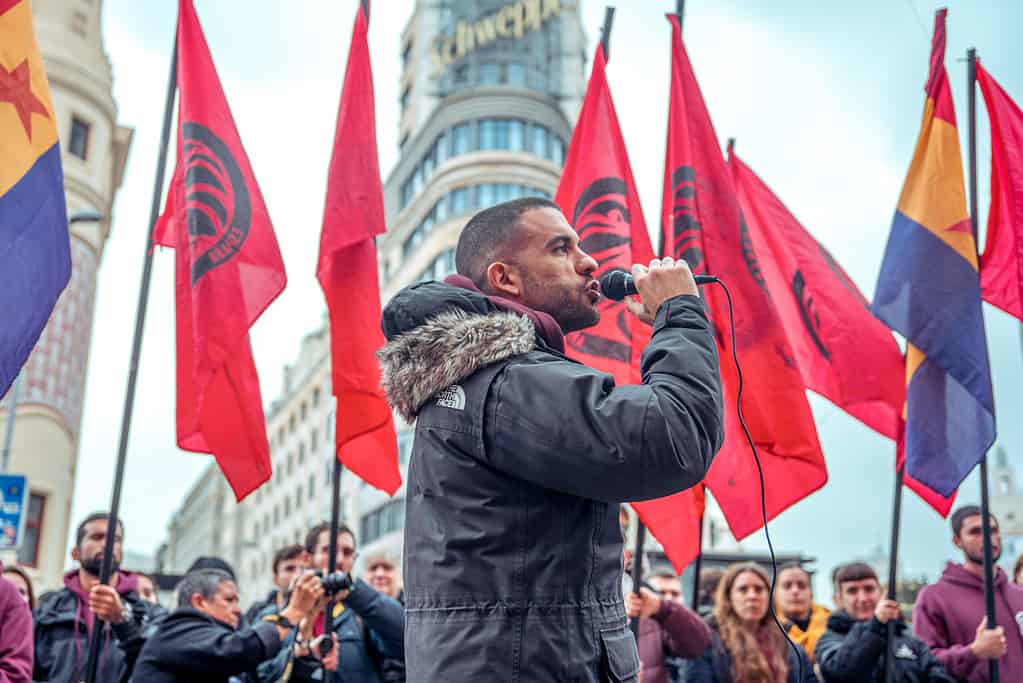
A former Podemos minister recently suggested that the Spanish left is actively replacing native Spaniards with immigrants to secure long-term electoral dominance. What is your reaction to that statement?
They have tried to portray it as a joke, but honestly Irene Montero is someone who usually reads prepared statements.
During a rally she spoke without advisers or notes and ended up saying what she really thinks.
They believe in a borderless world governed by globalist institutions and in the massive mixing of the world’s various ethnic groups so that humanity becomes homogenized and our unique identity markers are erased entirely.
So I doubt it was really a joke. I think she tried to imitate Jean-Luc Mélenchon, the leader of the radical left-globalist party La France Insoumise (LFI), who made similar remarks in Marseille.
That said, Montero’s lack of political skill exposed her. Personally, I believe that is what she actually thinks, even if she expressed it clumsily.
Looking at the combination of mass regularizations of illegal migrants from alien cultures, lax border policies, and increasing restrictions on free speech, do you believe the Spanish left is deliberately transforming the country’s demographic and cultural structure?
Yes—but it is not only the left doing it.
The Popular Party has also supported similar policies. Under former Prime Minister José María Aznar there were major immigration regularizations as well.
We should also remember that Spain’s business associations and the Catholic bishops’ conference support mass immigration policies.
In Spain, left and right shake hands when it comes to migration and globalist policies.
The only real solution, in my view, is a patriotic and revolutionary project—and that is precisely what we are trying to build.