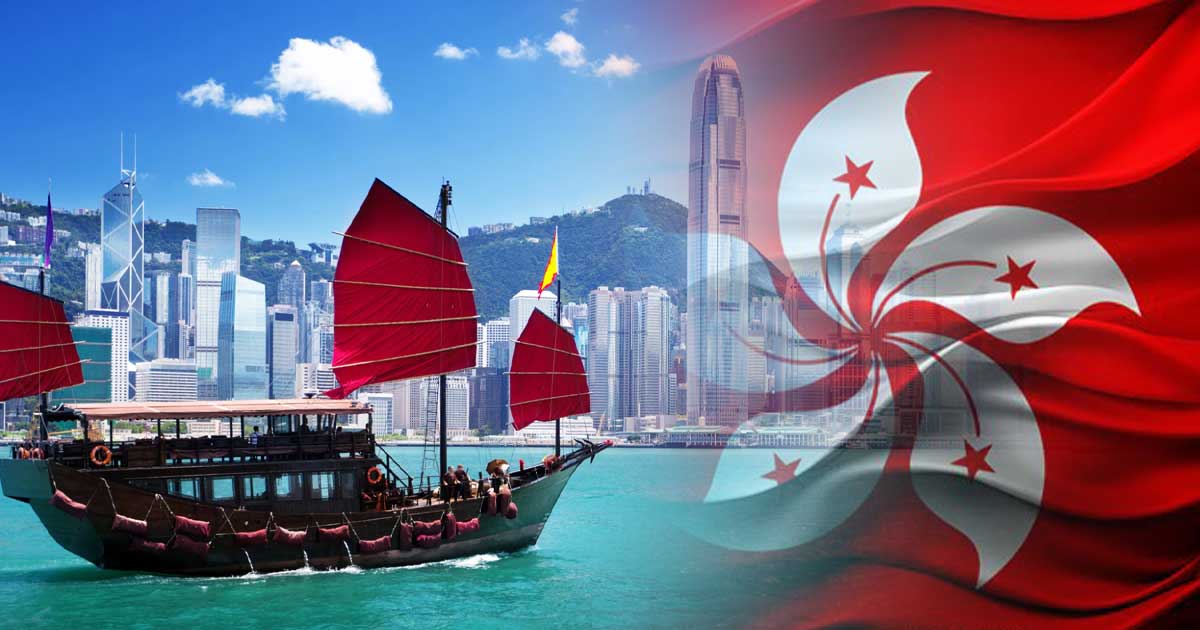
On Monday and Tuesday, China took two important steps that further consolidated its position regarding the “one country, two systems” policy, as well as its resilience against destructive foreign influence. On Monday, it was first announced that the High Court in Hong Kong had sentenced media magnate Jimmy Lai (78) to twenty years in prison for his involvement in organizing and inciting the violent protests of 2019, during which he called on foreign powers to impose sanctions on the People’s Republic of China and Hong Kong. Then, on Tuesday, a white paper dedicated to the issue of security in Hong Kong was published in Beijing. Through these two consecutive steps, China sent a more than clear message to the United States, the United Kingdom, and other Western powers that it will no longer allow Hong Kong to once again become its Achilles’ heel.
WHAT MADE HONG KONG APPEAR AS CHINA’S ACHILLES’ HEEL?
Over the past twelve years, Hong Kong has twice been the site of mass protests that China determined were linked to foreign centers of power. These were the protests of 2014 (the “Umbrella Revolution”) and those of 2019.
Formally triggered as opposition to the Extradition Law, which would have allowed the transfer of suspects to mainland China, the 2019 protests began in March, escalated in June, and lasted until early 2020, when they gradually subsided. The protests had no clear leader or visible organizational core. They followed the principle of “be water,” and their dramaturgy included high school students and university students taking to the streets, followed by their mothers supporting them. Lawyers, professors, and teachers then joined.
Although they lasted just under a year, the protests did not achieve their goals. Beijing, in cooperation with the local government in Hong Kong, was determined not to yield to pressure, especially after very concrete links were established between key protest participants and foreign power centers.
This became even more evident when the initial demand to withdraw the Extradition Law evolved into five demands. In addition to withdrawing the law, protesters demanded an “independent” investigation into police conduct, alleging excessive use of force. They also called for the release of arrested demonstrators — or rioters — the withdrawal of the official characterization of events as “riots,” since that designation carries harsher penalties, and finally, the introduction of universal suffrage in the election of the Chief Executive.
Although it was never officially stated, clear calls for the “democratization” of Hong Kong and its secession from the People’s Republic of China were heard during the demonstrations.

WHAT DOES THE WHITE PAPER SAY ABOUT THE 2019 PROTESTS?
“In 2019, external anti-China forces intensified their interference in Hong Kong affairs. After the Hong Kong Special Administrative Region government proposed amendments to the fugitive extradition ordinance, activists in Hong Kong, under the pretext of opposing these amendments, spread alarming claims throughout society, exploiting public concerns and limited understanding of the proposal. These activities ultimately led to prolonged unrest in 2019 and an attempted color revolution in Hong Kong. During that period, extreme violence and destructive incidents with separatist objectives were widespread, causing such damage to Hong Kong that it became almost unrecognizable. These events endangered China’s security and posed the greatest challenge to the implementation of the ‘one country, two systems’ principle since Hong Kong’s return,” the white paper states.
THE DEMONSTRATORS WERE IN FACT DEMANDING HONG KONG’S INDEPENDENCE…
The white paper on Hong Kong security further states that the 2019 demonstrators advocated Hong Kong’s independence, attempting to divide the country.
“…Anti-China activists in Hong Kong refused to recognize the legal authority of the Constitution over Hong Kong and rejected the overall jurisdiction of the central authorities, challenging and disrupting the constitutional order. They called for ‘national self-determination,’ ‘liberate Hong Kong, revolution of our times,’ and shouted slogans about ‘building a state by force’ and ‘writing a constitution on the streets.’ Through repeated separatist activities aimed at undermining national unity, they futilely sought to turn Hong Kong into a de facto independent or semi-independent political entity,” the white paper reads.
THEY BURNED NATIONAL FLAGS AND DESECRATED STATE SYMBOLS…
The white paper further states that demonstrators in 2019 engaged in what it literally describes as provocative public acts, including insulting and burning the national flag, and desecrating both the national emblem and the Hong Kong emblem.
“They broke into the offices of the central government in Hong Kong, besieged the headquarters of the Hong Kong Special Administrative Region government, and violently stormed the Legislative Council building, where they destroyed facilities and copies of the Basic Law. They unsuccessfully attempted to seize control of the Legislative Council by manipulating elections, intending to block government bills, paralyze Hong Kong’s governance, and provoke a constitutional crisis in order to ultimately undermine state authority,” the white paper states.
Citing specific examples of violence — such as throwing Molotov cocktails, damaging infrastructure, and vandalizing public property — the white paper adds that anti-China activists incited hatred and advocated violence through their media outlets, contributing to a decline in GDP and business activity in Hong Kong.
“THEY ATTACKED ANYONE WHO QUESTIONED THEM…”
“…They attacked anyone who questioned them, carried out unlawful detentions, group assaults, and beatings, and even doused victims with gasoline and set them on fire. They committed violence within communities and infringed upon residents’ rights to life and property. They disrupted fair and orderly electoral processes through coercion, intimidation, and attacks on candidates and voters, going so far as to publicly desecrate the family graves of a member of the Legislative Council. Moreover, they abused Legislative Council procedures and deliberately obstructed its normal functioning, preventing rational debate and the passage of key legislation vital to the economy and citizens’ livelihoods, thereby causing serious harm to public interests and welfare,” the white paper states.
The document further claims that demonstrators collaborated with hostile external forces and sought their intervention.
THEY CALLED FOR SANCTIONS AND FOREIGN SUPPORT
“Acting as political agents of foreign powers, they frequently traveled abroad to provide materials for shaping ‘Hong Kong-related issues,’ called for foreign sanctions against mainland China and Hong Kong, and even proposed sanction mechanisms, supplying targeted lists. They claimed that ‘we want foreign countries to exert influence on us,’ that they ‘desperately need help from foreign forces,’ and even pledged to fight for the United States,” the white paper states.
BEIJING QUICKLY RESTORED ORDER
The situation was ultimately resolved when it became clear that Hong Kong could not independently handle the problem at that time. The central government intervened. In 2020, Beijing implemented the National Security Law in Hong Kong, stipulating that anti-China forces that violate the “one country, two systems” principle and undermine Chinese sovereignty cannot participate in the electoral process.
This decision by Beijing, accepted in Hong Kong, was met with sharp criticism in the United States, the United Kingdom, and other Western powers. In 2021, electoral reforms were introduced defining the method of elections in the Hong Kong Special Administrative Region.
Article 23 of the Hong Kong Basic Law provides that the Hong Kong Special Administrative Region shall enact its own laws prohibiting treason, secession, sedition, subversion against the central government, or theft of state secrets.
PROTESTS HAD BEEN ORGANIZED EARLIER AS WELL
After Hong Kong’s return to China in 1997 as a Special Administrative Region, it was obliged to respect and protect the state system and adopt effective measures to safeguard China’s national security. The Constitution and the Basic Law provide clear constitutional guidance in this regard.
However, internal and external complications delayed the enactment of legislation under Article 23 for a long time after 1997. In September 2002, the Hong Kong local government initiated the legislative process envisioned by Article 23. To halt this legally mandated process, anti-China forces in Hong Kong and in Western countries sought to delay or obstruct it, exploiting public dissatisfaction with economic and social issues.
In 2003, protests erupted against the adoption of legislation regulating Hong Kong’s security. Several Legislative Council members who had initially supported the bill withdrew their support and called for postponement.
In September 2003, the Hong Kong government withdrew the draft legislation under Article 23 of the Basic Law, effectively postponing its adoption.
FOR YEARS, A PRETEXT FOR MASS PROTESTS WAS SOUGHT
This vacuum persisted for a long time, and forces seeking to destabilize China through actions in Hong Kong in 2012 denounced the national education initiative promoted by the Hong Kong government as “brainwashing.” They continuously attempted to launch mass protests, organizing gatherings, various rallies, joint petitions, and student strikes, eventually forcing the government to suspend national education guidelines.
In 2014, the “Occupy Central” movement was established in Hong Kong, organizing 79 days of protests (the “Umbrella Revolution”).
In February 2016, during routine action against illegal street vendors in Mong Kok, activists incited a large gathering that led to clashes with police, known as the Mong Kok riots, in which about 100 police officers were injured. In March of the same year, activists established the so-called Hong Kong National Party, openly advocating independence, “national” self-determination, and the creation of an “independent and free Republic of Hong Kong.”
Faced with these risks and challenges, the central government strongly supported the Chief Executive and the Hong Kong government in effectively preserving overall social stability, including lawful measures against the illegal “Occupy Central” movement, banning the Hong Kong National Party, and disqualifying Legislative Council members advocating independence.
NED AND COMPANY…
Let us momentarily set aside the documented claims of the Chinese government regarding foreign involvement in long-standing protests in Hong Kong.
The National Endowment for Democracy (NED) does not conceal its presence in Hong Kong and other potential “Achilles’ heels” of China, where it invests enormous sums of money.
While attending a 2019 gathering of representatives of the Dalai Lama’s administration in exile in Riga, the author of these lines was astonished by the overt presence of NED representatives, who were in fact the real organizers of the event. It was there that the author met NED’s founder, Carl Gershman, who was a special guest. NED firmly holds anti-China forces in Hong Kong in its grip, exerts pressure on China through the Dalai Lama’s people in exile, and supports Islamist separatism in Xinjiang.
NED reports state that it has been active in China and Hong Kong since 1984, including in the aforementioned regions and separatist and terrorist movements.
“Faced with the rapid erosion of the rule of law in Hong Kong and crimes against humanity in the Uyghur region, NED supports efforts to strengthen the capacity of civil society to act locally and internationally in advocating for persecuted groups,” reads one NED report.

IN 2024, NED INVESTED 9.9 MILLION DOLLARS IN ‘PROJECTS’ IN HONG KONG
In 2024 alone, just before the Donald Trump administration attempted to cut NED’s funding from the state budget, the organization financed sixty “projects” in China, investing 9.9 million dollars.
The Chinese government states in one report:
“The National Endowment for Democracy has long collaborated with those attempting to destabilize Hong Kong, providing them financial and public support. In 2020, under its Hong Kong-related program, NED launched several projects totaling more than 310,000 U.S. dollars to fund individuals seeking to destabilize Hong Kong.”
JIMMY LAI WAS SUPPOSED TO BE LIKE MARÍA CORINA MACHADO
“In 2023, NED cooperated with organizations such as Hong Kong Watch and Amnesty International, as well as anti-China legislators from the U.S., the U.K., and Germany, and nominated Jimmy Lai, one of the actors seeking to destabilize Hong Kong, for the 2023 Nobel Peace Prize,” the Chinese government report states.
Had everything gone according to NED’s plan, Jimmy Lai was supposed to become something like María Corina Machado, the Venezuelan Nobel Peace Prize laureate who presented her award (though probably not the monetary part) to Donald Trump.
This brings us to the essence: however much Trump may seek to curb NED for reasons of domestic U.S. politics — as a nest of individuals close to “woke” ideology and liberalism — the foundation and the U.S. presidency will for a long time remain on the same foreign policy line.
Beijing is clearly aware of this, and in that awareness lie the reasons for the firm message stated at the beginning of this text — that Hong Kong will no longer be China’s “Achilles’ heel,” and that in all aspects of China’s state structure there can be no place for those who oppose China and its institutions, no matter how much that may serve the interests of those who would like foreign investments, foreign companies, and foreign power centers — among others — to shape Chinese state policy into something it would no longer be.