Since the ProGlas initiative, on the eve of the new year 2025, presented its program of measures—Measures for the Day After—to be implemented by a so-called transitional or technical government, which, among other things, envisioned the “establishment of a prosecutorial police,” there has been increasing public discussion about the need for its introduction.
AN IDEA OLDER THAN THE PROTESTS
Thus, on March 24 of this year, during a sixteen-minute appearance on the primetime news program of N1 television, the president of the Association of Prosecutors of Serbia, Lidija Komlen Nikolić, gave a detailed explanation of the need to introduce a “prosecutorial” or “judicial police.” The president of the Association of Prosecutors of Serbia also spoke about the need for a “prosecutorial police” on June 11 in the Euronews daily news, this time together with former assistant chief of the Criminal Police Directorate, Dejan Radenković, who had once faced trial for corruption. The need to establish an “independent prosecutorial police,” as a “key measure in the fight against corruption,” was also explained several times in recent months by Nikola Jovanović, a former high official of the People’s Party and director of the Center for Local Self-Government.
Although this topic became a media highlight during the student/citizen protests—when most of the wider public encountered it for the first time—in certain professional and political circles the idea of introducing a judicial or prosecutorial police has been discussed for several years already.
At the end of November last year, the Center for Judicial Research (CEPRIS), with the support of the Belgrade Open School and the Government of Sweden, published a report titled “A Step Closer to Prosecutorial Police – A Comparative Analysis with Guidelines for Establishing a Prosecutorial Police in Serbia.” The authors, Radovan Lazić, prosecutor of the Appellate Court in Novi Sad and a member of the Board of the Association of Prosecutors of Serbia, and Bojana Savović, prosecutor of the Higher Court in Belgrade, both well-known to the wider public for their civic engagement, argued in detail for the introduction of a prosecutorial police.
Although they present various comparative-law models of subordinating parts of the police to the prosecution, which do not necessarily imply the formation of a separate prosecutorial police, Lazić and Savović conclude that “from the considerations presented, the most complete solution would be, following the example of Romania’s National Anticorruption Directorate or Switzerland’s judicial police, to establish a prosecutorial police within the public prosecutor’s office.” In addition, the authors also provide specific “guidelines for amending the normative framework for the creation of a prosecutorial police.”
PROSECUTORIAL POLICE IN THE PROGLAS PROGRAM
Given the close ties of certain founders of the ProGlas initiative with professional associations of prosecutors and judges, it is not at all surprising that the views on prosecutorial police expressed by the two well-known prosecutors were, only a month after the publication of the aforementioned study, almost literally adopted in the document of this initiative, which was pompously presented to the public as the program of a future so-called transitional government. Namely, the Measures for the Day After of the ProGlas initiative envisaged precisely that model of subordinating parts of the police to the prosecution advocated by Lazić and Savović, and which, in the document of this civic initiative, was described with wording taken directly from page twenty-eight of the prosecutors’ publication:
“Units of prosecutorial police will be established within public prosecutors’ offices, composed of various parts of the police, whose members, while working for the public prosecution, will be subordinated exclusively to the public prosecutor and physically located within the public prosecution, even though, organizationally, they would formally remain part of the Ministry of Internal Affairs. However, the minister and police commanders would have no authority over them.”
The only difference in the view of prosecutorial police between Lazić and Savović on the one hand, and ProGlas on the other, lies in the fact that Lazić and Savović believe that prosecutorial police should exist only within specialized prosecutor’s offices for organized crime and corruption, war crimes, and high-tech crime (thus opting for the model existing in Romania, where the prosecutorial police operates only within the National Anticorruption Directorate – DNA), and not within prosecutors’ offices of general jurisdiction. By contrast, ProGlas proposes its establishment in all prosecutors’ offices, as is the case in Italy and North Macedonia.
However, the ProGlas civic initiative is not the only political factor in Serbia advocating for the introduction of prosecutorial police. Its establishment has also been programmatically supported by Đilas’s Party of Freedom and Justice and Aleksić’s People’s Movement of Serbia, while in the past both Aleksandar Olenik and Nebojša Zelenović expressed support for its introduction during debates in the National Assembly of Serbia. Interestingly, as early as October 24, 2023, Zelenović linked the establishment of prosecutorial police to a potential opposition victory in the forthcoming parliamentary elections of December 2023, and the formation of a government that, over the next two years, would create conditions through various legislative measures for the “first” free early elections.
OBLIGATION FROM EU ACCESSION NEGOTIATIONS – CHAPTERS 23 AND 24
In the aforementioned publication by prosecutors Lazić and Savović on prosecutorial police, its introduction is rightly linked to the obligations that Serbia undertook in the process of accession to the European Union, specifically those outlined in the negotiation chapters that are opened first and closed last—in other words, the most important ones, Chapters 23 and 24. These obligations concern ensuring so-called operational independence of the police, which primarily implies weakening the powers of the Minister of Internal Affairs, as a political official, consequently strengthening the independence of police officers, as well as strengthening the powers of public prosecutors in relation to the police. The latter is justified by the fact that under the Criminal Procedure Code of 2013, the so-called prosecutorial investigation was introduced in Serbia. However, although by law the prosecutor formally directs the pre-investigation procedure, they do not possess effective authority over police officers, whose actions—or inaction—often determine the outcome of the pre-investigation, and therefore also the outcome of the trial.
In short, through accession negotiations, Serbia committed itself to ensuring the so-called operational independence of the police, and the European Commission regularly reminds the Serbian government of this unfulfilled obligation in its annual reports. Ensuring this operational independence of the police is essentially compatible with the demand for the introduction of prosecutorial police. More precisely, the establishment of a separate prosecutorial police—whether within all prosecutors’ offices or only within those of special jurisdiction—is the most radical model of removing an important part of police structures from the authority of the political executive power, i.e., the Minister of Internal Affairs, and subordinating it instead to the judicial branch of power, i.e., the prosecution service as an independent state body (Article 155 of the Constitution).
IT IS CLEAR TO VUČIĆ AS WELL
It was precisely this obligation of Serbia from the EU accession negotiations that Aleksandar Vučić reminded the public of in recent days: “We have taken powers away from the Ministry of Internal Affairs, in accordance with the agenda of the so-called European reforms, and given them to the prosecution, because they told us that is how it is done in developed European countries. Many did not say this because they wished Serbia well, but because it was always much easier to influence the smaller number of those who hold prosecutorial and judicial functions than those who do their jobs in the police.”
It is also clear to Vučić that the principle of the so-called operational independence of the police in fact paves the way for a significant reduction of the executive power in the field of security and, consequently, for the introduction of prosecutorial or judicial police. However, it is difficult to expect from Vučić, when it comes to obligations stemming from the process of European integration, anything more than this kind of verbalism, aimed primarily at mobilizing that part of his electorate which is already showing dissatisfaction with the prolonged erosion of the state and its authority.
After all, only a few days later Vučić sent a clear message—above all to Brussels—saying: “If you ask me, I can have thousands of objections to the EU regarding the territorial integrity of our country and some other issues. Nevertheless, as long as I am president, Serbia will remain firmly on the path toward the EU, dedicated and committed to that path, implementing and carrying out the necessary reforms.”
THE SEARCH FOR A SERBIAN LAURA KÖVESI
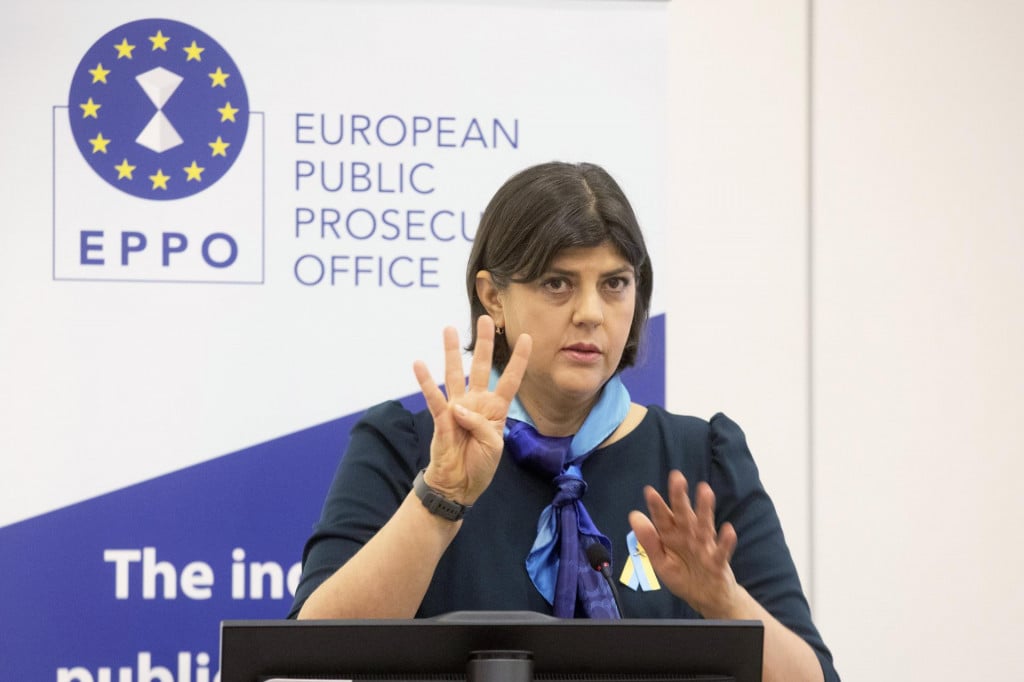
In the meantime, the Serbian public has been heavily “conditioned” by advocates of introducing prosecutorial police to adopt the thesis that the Romanian model of fighting corruption is a kind of panacea for eradicating this social evil. For this reason, for several years now, the former Romanian prosecutor of Hungarian origin, Laura Kövesi, has been systematically popularized in Serbian media (for example, an op-ed by Marinika Tepić in 2023). As part of this deliberately crafted imitation model, an ode was once written to this Romanian prosecutor—whose main task today, as the first Chief Prosecutor of the European Union, is to track down those circumventing sanctions imposed on Russia—by Predrag Milovanović, a member of the High Council of Prosecutors and of the Association of Prosecutors of Serbia. And when the student/citizen protests were already in full swing, the search began for candidates for a Serbian Laura Kövesi. Thus, at the beginning of August, the newspaper Danas published an article naming Mladen Nenadić, the Chief Prosecutor of the Office for Organized Crime, as the most serious candidate for a Serbian Laura Kövesi. Increasingly frequent—and for careful observers of our political everyday life, expected—references to the Macedonian example of the so-called technical government under the 2015 Pržino Agreement, as a good model for overcoming Serbia’s existing political crisis, also indicate that the prosecutorial police model existing in North Macedonia—with prosecutorial police operating within all prosecutors’ offices, not only within the specialized anti-corruption office—has not lost the race against the Romanian model, which implies one Laura Kövesi rather than several.
THE DISEASE IS IN A TERMINAL STAGE
What is problematic in the very concept of a prosecutorial or judicial police? On the one hand, we are all witnesses that systemic corruption of enormous proportions has existed in the country for decades. On the other hand, it is well known that a large number of Serbian citizens, regardless of their political orientation, voluntarily participate in various corrupt practices (especially in healthcare, state and local administration, the judiciary, and education), that very few people are willing to oppose concrete cases of corruption, and that well-known corrupt figures—if they are not positioned on one of the opposing poles of the Serbian political scene—generally do not encounter condemnation within the communities in which they live. All this shows that this social disease is in an advanced, terminal stage, and it is therefore illusory to expect that the application of a single legal measure will miraculously cure Serbian society of corruption.
Members of the Association of Prosecutors of Serbia routinely shift all blame for the poor functioning of the prosecution service and the large number of acquittals in criminal cases onto the police, that is, onto the problem of the lack of effective control of prosecutors over the work of police officers, while in prosecutorial police they see a magic wand for solving these problems. However, public opinion research shows that Serbian citizens generally have even less trust in the judiciary (courts and prosecution) than in the police, and that both segments of the state apparatus of coercion have, since 2022, been experiencing a clear trend of declining trust—something that must negatively affect the authority of the state.
THE CULPRIT FOR THE INEFFECTIVE FIGHT AGAINST CORRUPTION – THE JUDICIARY, NOT THE POLICE
The inefficiency in combating various forms of crime cannot be explained solely by the problems in the relationship between the prosecution and the police. After all, it is hard to believe that corrupt or politically motivated obstructions by the police during pre-investigation proceedings are the only reason why, in 2024, the number of old unresolved criminal cases increased in appellate, higher, and basic courts (by the end of 2024, there were 222 such cases in appellate courts, 30 of which were older than 10 years; 582 in higher courts, 96 of which were older than 10 years; and as many as 2,148 in basic courts). And it is hardly the police’s fault that an unacceptably large number of criminal proceedings are still being discontinued due to the statute of limitations.
If all or most of the key causes of inefficiency in our judicial system (prosecution + judiciary) stem from the prosecution’s lack of effective control over the police, then how can one explain the inefficiency of the judiciary in civil cases, where the police play no role whatsoever, and where inefficiency continues to increase year after year? Nor can it be attributed to the prosecution’s lack of control over the police that, in 2024, more than four billion dinars were paid out due to violations of the right to a trial within a reasonable time before our courts.
Moreover, an analysis of the largest corruption scandal in Serbia to date (the largest in terms of the number of defendants, and certainly the most damaging in its consequences for the state)—the “Index” affair—shows that it is primarily within the judiciary that one must look for the causes of the state’s ineffective fight against corruption.
Consequently, the assessments coming from certain leading members of the Association of Prosecutors of Serbia—that the introduction of prosecutorial police would quickly solve the problem of inefficiency in suppressing corruption in Serbia—are highly tendentious. Since these are individuals who certainly know the problems within the judicial system better than the author of these lines, their tendentiousness, which in public appearances takes on the contours of a political program, can only be explained by their socio-political ambitions and/or their advocacy of the corporate interests of the guild to which they belong.
After all, the prosecutors themselves do not hide the fact that their push for the introduction of prosecutorial police is merely a consistent continuation of the policy of strengthening the role and independence of the prosecution, which first found expression in the 2013 Criminal Procedure Code, and later in the 2022 amendments to the Constitution.
THE PERSECUTION OF TRUTH AS AN UNNECESSARY LUXURY
Namely, under the current Criminal Procedure Code (CPC), the so-called prosecutorial investigation was introduced (in fact, first by the Code of 2011), replacing the earlier judicial investigation (investigating judges). Accordingly, the court was given a passive, observational role in the evidence-gathering stage, whereby our traditional Euro-continental mixed (inquisitorial–accusatorial) criminal procedure was fully Americanized and, as a result, became adversarial. Assessing the solutions of the new CPC from the perspective of the role assigned to the court in the investigation, our most renowned expert in criminal procedure law, Milan Škulić, once concluded that “it is not impossible that this reflects an almost ideological fervor and blindness, according to which the role of the court in investigation must be reduced to the ‘bare minimum.’” The exclusion of the state court from the evidence-gathering stage was accompanied by the exclusion of the principle of material truth. In this regard, Škulić noted that “truth, as a kind of unnecessary luxury, was implicitly exiled” from criminal proceedings in the Republic of Serbia, which is also evident at the level of the Code’s language. The word truth appears only once— in the provision prescribing the obligation of witnesses to tell the truth. Thus, the criminal procedure in today’s Serbia, tailored to the Anglo-Saxon model of “courtroom quarrel” (altercation), has acquired the key characteristics of a Euro-continental civil lawsuit. Bearing this in mind, the author of these lines once concluded: “The problem is that, unlike a civil lawsuit, the subject of criminal proceedings is not a private dispute between parties but a criminal offense that harms the public interest and which is therefore prosecuted and punished in the public interest. Consequently, under the new CPC, the court (= the state) in Serbia has been placed in the absurd situation of enforcing the state’s right to punishment through its decision, but on the basis of evidence presented in a proceeding where, due to the dominance of the principle of party disposition, the subject matter of the dispute remained entirely outside the control of that very court.”
Thus, thanks to the reception of the Anglo-Saxon model of criminal procedure, what emerged was the model of the prosecutor as a “tyrant.” This was exactly how the prosecutor was described during the debates on the adoption of the French Code of Criminal Procedure of 1808, which decisively influenced the development of the European continental criminal procedure, when the prosecutor was assigned both the function of criminal prosecution and investigation. That model was then rejected on the grounds that “all citizens would shudder at the thought of a single state authority having the power both to accuse them and to gather the evidence that could justify its own accusation.”
One can only imagine the kind of fear Serbian citizens would feel before a prosecutor-tyrant who also has his own police—especially if the prosecutorial “broom” were to be guided, as in North Macedonia, by political motives.
THE MOTIVATION IS POLITICAL
The prosecution, which under the Criminal Procedure Code became the master of investigation, was made completely independent from the executive and legislative branches by the 2022 constitutional amendments. At the same time, the traditional monocratic model of prosecution organization was abolished, eliminating hierarchy within the prosecution service, so that individual prosecutors gained independence even from the Chief Prosecutor.
To a layperson, it might seem that such a reform is based on a legal concept, and that there is no real politics or ideology behind it. However, this concept of changing the position of the prosecution—both within judicial proceedings and within the framework of the system of government—is fundamentally driven by clear political motivation.
Reception of law has historically always been an important instrument of acculturation, by which a metropolis spread its cultural model to a colony. Thus, the well-known Russian proceduralist L. V. Golovko once concluded that the spread of the Anglo-Saxon model of prosecutorial investigation and adversarial criminal procedure on the European continent, including Serbia, has turned into a “factor of geopolitical influence.” What troubles Golovko, however, does not trouble Serbian prosecutor Predrag Milovanović. He points out that the Association of Prosecutors of Serbia had earlier put forward the “idea of prosecutorial police” but that “we received a general counterargument—that it does not fit our tradition.”
“For me, that is not, and I believe must never be, a sufficiently convincing argument,” concludes Prosecutor Milovanović.

A JUDICIAL POSITION FOR POLITICAL ACTIVISM
However, the political motivation behind reforming the procedural and constitutional status of the prosecution is not exhausted merely in the reception of law as an important factor of cultural wars. Behind such a reform program lies the Western, essentially left-liberal, idea of “judicial dictatorship”—something that, it seems, only Miša Đurković has written about in our context.
In his highly useful scholarly work, Đurković describes this phenomenon using the words of a well-known American judge, calling it an “American disease.” Its symptoms are the following: “In liberal-democratic states, judges over time began to seize the legislative function from legitimate, elected representatives of the people. Instead of striking down unconstitutional laws, they openly began to expand their jurisdiction and to themselves enact legal and social norms, even though they knew that these often had no basis in the constitution. Moreover, due to their ideological agenda, they use their privileged judicial position for political activism, believing it their right and duty to reform society, that is, to enact rules and norms at their own discretion, fully aware that they are unlawful and opposed by the overwhelming majority of citizens. In the past, judges were limited to applying the written constitution and preventing the adoption of unconstitutional laws and norms, safeguarding inherited morals, customs, and traditions. Today, however, judges believe that their task is precisely to change everything inherited, and to act as pseudo-legislators for that purpose.”
A JUDICIAL OLIGARCHY NETWORKED INTO A GLOBAL IDEOLOGICAL BROTHERHOOD
The same “American disease” is reflected in the constitutional amendments to Serbia’s Constitution of 2022, which made the judiciary (both prosecution and courts) completely separate and independent from the legislative branch—and through it, from the voters, who are the bearers of sovereignty in a democratically organized state. These solutions created the normative conditions for the holders of a fully independent judiciary to form a kind of judicial oligarchy which, in the words of Đurković, because of its strong international ties, possesses all the features of a global ideological and professional brotherhood.
Recognizing already at the beginning of the 19th century the real danger of establishing an all-powerful judiciary in the United States, one of the “Founding Fathers”, the Virginia lawyer and U.S. President Thomas Jefferson, warned that “it is good for the judiciary to be independent of the king or head of the executive, but independent of the will of the people—that is a wrong concept, at least in a republic.” Jefferson’s concern that a “judicial oligarchy” could be established in the United States stemmed from the realization that judges, too, are prone to ambition, partisan passions, and especially the passion for corporate privileges. In this context, he noted that among holders of judicial power the maxim prevails: “boni judicis est ampliare jurisdictionem” (a good judge is one who expands his jurisdiction).
BOTH THE SWORD AND THE PURSE
In the aforementioned work, Miša Đurković notes that another of the “Founding Fathers,” Alexander Hamilton, naively dismissed the possibility of judicial power interfering in legislation and politics, claiming “that the judiciary has neither the sword nor the purse, unlike Congress.” If, however, an independent prosecution, as the other branch of judicial power, were to gain its own police force—financed through special budget allocations—then the judiciary in Serbia would truly acquire both the sword and the purse, which according to Hamilton are the prerequisites for establishing oligarchic rule.
If an important part of the security sector—tracking and uncovering perpetrators of crimes—were entrusted to a prosecution independent from the national executive and legislative branches, but networked into a global professional-ideological brotherhood, this would lead to further, possibly decisive, disenfranchisement of the people as the bearers of sovereignty. For what would voters actually be deciding in elections if, outside the authority of the government chosen by a parliamentary majority, a significant portion of the security sector were handed over to the “independent” prosecution—under the pretext of ensuring greater operational independence of the police from the minister? And for a long time now, areas such as macroeconomics (the “independent” central bank) and numerous affairs delegated to a parallel system of executive power embodied in “independent” agencies, regulatory bodies, and commissioners, have also remained outside the authority of the government and, therefore, the reach of the voters.
Today, as Đurković observes in the same work, in a somewhat paradoxical way conservatives have become the last defenders of democracy against the attempts of left-liberal elites to disenfranchise the people and the nation-state, in order to establish a global oligarchy, of which judicial oligarchy is an important segment.
Corruption is, without doubt, an evil that destroys the state. But in fighting this evil, freedom and the will of the people must not be sacrificed.