Serbian historical experience testifies that, by definition, revolutionary waves have always been ridden by those who had undergone a vetting process by certain centers of power—proven to be useful and willing to betray national interests. In the Balkans, Georgia, Ukraine, Moldova, and other countries where great powers such as Russia and the United States clash in their struggle for dominance, the same organizations have always played a role—USAID, NED, NDI, the EU, as well as Western embassies and monarchies. The most notorious organization, which in recent months has been blamed for financing terrorism in the Middle East, fueling the war in Ukraine, attempting color revolutions in Georgia, Moldova, Belarus, and Serbia, spreading gender and woke ideologies, and even for the COVID-19 pandemic, was grandly shut down with the arrival of Donald Trump to power.
THE PLATFORM THAT CONTROLS WAR
It would be naïve to believe that with the dissolution of USAID, the United States has abandoned its ambitions of global influence. Traditional field operations, which required extensive manpower and enormous financial resources, have now been replaced by digital control and direct funding. Visible sponsors have been replaced by covert financial channels operating through institutions such as IRI, NDI, and NFT. But would any of this be possible without the most sophisticated tool of invisible influence—Palantir Technologies—as well as Elon Musk’s Starlink?
Palantir’s AI-driven tools and Gotham platform depend on a stable communication infrastructure. Starlink provides the Ukrainian military, media, and government with uninterrupted access to real-time data, even when all other infrastructure has been destroyed. Without this system, AI algorithms would be unable to function in real-time, and Palantir’s Gotham platform would lose its ability to “control” the war. From the very start of the conflict in Ukraine, the West has tested how technology can replace traditional hybrid warfare methods.
FOLLOWING THE CIA PLAYBOOK
After years of groundwork laid by USAID, the National Endowment for Democracy (NED), the International Republican Institute (IRI), the National Democratic Institute (NDI), and numerous other Western-backed foundations, Ukraine has undergone all phases of external influence. From the recruitment of NGO activists, who have for years cultivated the narrative that Russia is the primary obstacle to Ukraine’s independence, prosperity, democratic development, and human rights, to mass protests, color revolutions, and ultimately the conditions for civil war—this trajectory has been meticulously designed. However, the war has not brought Ukraine the promised future of prosperity and democracy. Instead, it has left the country with death, coercion, and massive debt to the very Western backers who engineered the conflict.
The first major phase of Ukraine’s color revolution process was completed in 2014, with a coup in Kyiv that set the stage for civil war and open confrontation with Russia. The West framed this conflict as a “fight for democracy” and a break from so-called Russian malign influence and Putin’s tyranny. In reality, it was yet another textbook example of CIA-backed hybrid warfare—media manipulation, political activism, violent protests, and the installation of compliant puppet governments.
THE FIRST AI WAR IN MILITARY HISTORY
The NATO proxy war against Russia in Ukraine is the first AI-driven war in military history. Ukraine has become the first country where Palantir has emerged as a key instrument of warfare, not only on the battlefield but, more importantly, in the information space. Palantir’s Gotham platform is now one of the primary “weapons” in the hands of Western entities operating through the Ukrainian regime, NATO, and U.S. intelligence agencies. This software does not merely analyze and predict Russian military movements, allowing Ukrainian forces to prepare defenses several steps ahead—it also actively shapes public narratives, controls media channels, and directs propaganda in real time.

Ukraine and the American software company Palantir Technologies signed an agreement in 2022 to support Ukraine’s defense and reconstruction during the Russian invasion.
“We are honored to continue developing a partnership with such a top-tier company. Palantir is already contributing to Ukraine’s victory by sharing its tools and intelligence data,” said Mykhailo Fedorov, Ukraine’s Vice Prime Minister for Digital Transformation, in March 2023.
Fedorov also highlighted that Palantir was one of the first Western industry partners to support Ukraine after Russian forces advanced into the country, emphasizing that the 2023 agreement was merely a continuation of years-long collaboration.1
PALANTIR – STANDING SHOULDER TO SHOULDER WITH THE MILITARY
This sentiment was echoed by Luis Mosley, Vice President of Palantir Technologies for Europe, who stated:
“Whether it’s helping the brave Ukrainian forces counter Putin’s aggression, supporting the relocation of their families, or aiding in the civil reconstruction of the country, Palantir stands shoulder to shoulder with Ukraine and its people.”
Earlier that year, Palantir spokesperson Alex Karp revealed that their software was being used to target Russian tanks and artillery. These were some of Karp’s most candid statements on how Palantir transitioned from supporting U.S. intelligence agencies to actively assisting Ukraine in war efforts.
Karp was also the first CEO of a global company to meet with Ukrainian President Volodymyr Zelensky after Russia’s invasion in February 2022, during which Palantir opened its office in Ukraine.2
UKRAINE IN THE WEB OF AI ALGORITHMS
Palantir is not alone. Western media has rightfully labeled the war in Ukraine as the first AI war. It is interesting to note that 243 AI companies are currently operating in Ukraine, with as many as 60 based in Kyiv. In August 2023, a joint UNIDO-CEPS report on AI competitiveness in Ukraine revealed that the defense sector ranks second in AI penetration and competitiveness. Some of the subcontractors working alongside Palantir Technologies include Clearview AI (a U.S. facial recognition company) and Mantis Analytics (a startup using AI to analyze disinformation). Their system collects data from social media, television, and radio channels in real time, identifying disinformation campaigns and forwarding them to relevant agencies for countermeasures. One such countermeasure is Osavul, a platform that employs AI for media monitoring, assessing the information environment, and detecting informational threats—a type of fact-checker and digital enforcer that simultaneously promotes false narratives while monopolizing the truth.
If the conflict in Ukraine is viewed outside the classic geopolitical framework and instead through the lens of technology and the global financial system, a clearer picture emerges of what is really happening in the country. Ukraine is not just a NATO battlefield against Russia; it is also the first country in history to serve as a near-complete testing ground for an experimental war, where AI algorithms play the leading role.
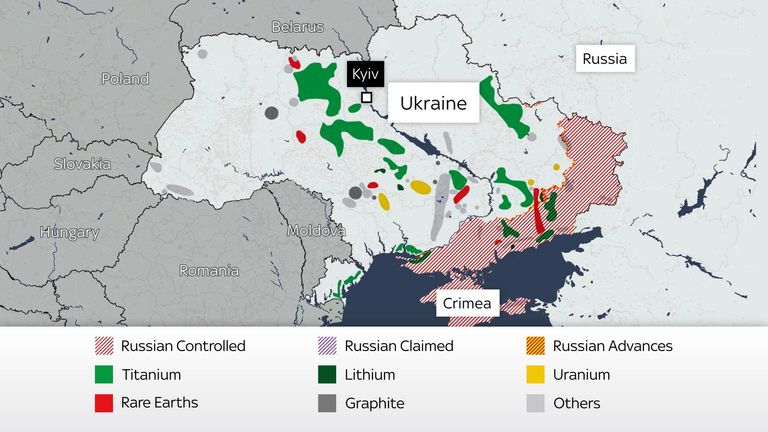
RUSSIA GETS THE LAND, AMERICA GETS THE MINERALS – GLORY TO UKRAINE
Although some still believe that Kyiv controls its own destiny and that Ukrainian soldiers are filling graves in defense against the “Russian aggressor,” the reality is entirely different. From the early steps of NGO involvement to protests, Maidan, and finally the Special Military Operation, from media propaganda to strategic planning and resource management, the war is being conducted through digital systems controlled by American corporations.
This explains the phrase that will forever define this conflict: “Russia gets the land, America gets the minerals, and glory to Ukraine.” In this context, recent information following meetings in Paris should be interpreted accordingly, as discussions increasingly point to Ukraine being forced to accept a so-called “peaceful resolution” of the war. Under this scenario, the eastern territories would go to Russia, while everything of strategic value—lithium, nickel, copper, titanium, and other rare mineral mines—would fall into the hands of American companies.
A HARSH LESSON
As one of the key players in this technological war, Elon Musk has demonstrated just how dependent Ukraine is on his Starlink. His threats to withdraw support if events do not unfold in line with U.S. interests—which fully align with his personal interests—were never meant as a warning to Kyiv, which has long understood that it remains nothing more than a puppet of Western corporations. Instead, they were a performance aimed at the suffering Ukrainian people, some of whom still believe they are sacrificing their lives for a sovereignty that this very regime and the West have completely stripped away. This scenario is nothing new in American geostrategic maneuvers—wars have long ceased to be fought to conquer territories. Instead, they are waged to control resources. Whoever controls the resources controls the regimes, and in turn, the territories. The fate of Ukraine could easily be repeated in any country naive enough to believe that Western “values” are anything more than a mask for neocolonial exploitation. However, this is not the only trap. In Serbia, there are many more. One of them is reverse psychology—the illusion of protecting against exploitation, the fight against corruption, and the false promise of a return to communism. If one lesson is to be learned from this conflict, it is harsh but simple—those who believe in change coming solely from within, without real external power to back them, are destined to become nothing more than collateral damage in someone else’s game.