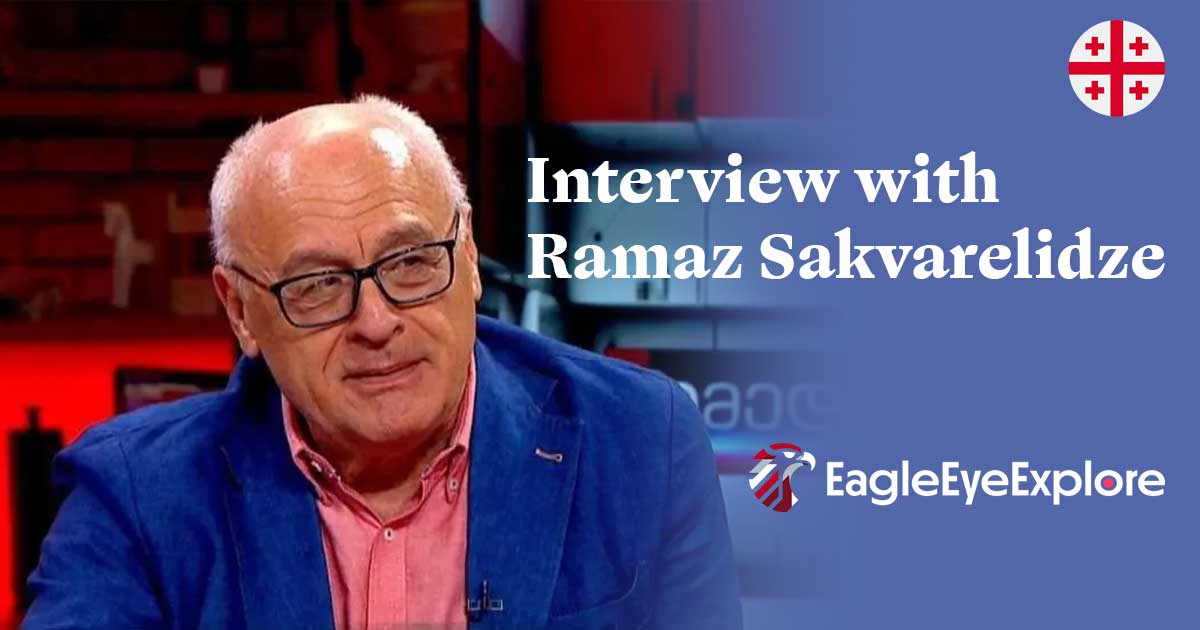
I first heard about Ramaz Sakvarelidze and his political analyses—which, incidentally, come from the perspective of a Doctor of Psychology—from a Georgian colleague. In an interview Sakvarelidze gave last year to the PolitRus portal, he remarked that a growing perception had emerged in Georgia that the European Union is not a friend, but rather a strict schoolteacher wielding a pointer, ready to strike students across the knuckles whenever something displeases it. It was as though he were describing Serbia.
There is also his observation that Georgian society is not a unified entity, but is politically divided into supporters of the ruling Georgian Dream party, supporters of the so-called “Nationalists,” and a third category consisting of those who support neither side.
Ramaz Sakvarelidze also notes that foreign interference in Georgia’s internal affairs clearly benefits the opposition. In his view, the opposition cannot defeat Georgian Dream through elections or by securing broader public support, and therefore considers external pressure to be justified—a position characteristic of those aligned with the broader “National Movement.”
There is also the question of relations with the United States, specifically Sakvarelidze’s observation that the pressure on Georgia which had existed previously came to an end with Joseph Biden’s departure from the White House.
Even this brief overview of Sakvarelidze’s public appearances makes it clear that Georgia shares much with Serbia—above all, the complexity of existing on the periphery of the European Union.
Serbia and Georgia have, to some extent, been following a similar “European path,” if I may put it that way. Both countries refused to blindly follow the European Union’s foreign policy agenda, namely the path of direct confrontation with Russia, and both have faced street protests as a result. Georgia even temporarily suspended its “European path.” At least in Serbia, the European Union has, for decades, been branded in the public imagination almost as successfully as Coca-Cola. For many people, the European Union exists beyond any form of critical examination; it is treated as a kind of political axiom—a truth that neither needs to be questioned nor proven. In the minds of part of the public, it remains an economic, social, and political paradise capable of “civilizing” us. Is there life outside the European Union for the peoples living on its periphery?
I liked the comparison with Coca-Cola. Cynics say that Coca-Cola is not particularly good for your health. Your description of the Serbian political marketplace of that deceptive beverage perfectly corresponds to the situation in Georgia. I would add one observation regarding this kind of Western “civilizing mission”—it is not a spontaneous phenomenon. The history of the theory of color revolutions begins with Gene Sharp, who still has many followers today. Their manuals state that in countries where the West intends to change the government, continuous propaganda portraying the West as the highest standard of a good life must be maintained. It is something akin to a personality cult in politics. Such a cult is desirable for every politician. The West has created a cult of the West for precisely the same purpose. This cult is a political weapon aimed primarily at those countries that are strategically important to the West. In fact, we should be pleased—if the cult of the West is being intensively promoted, it means that our countries are important to the West.
Serbia is not tied to Russia through statehood. We were never part of the Russian Empire or the Soviet Union, but Russia was a significant—indeed, the most significant—supporter of our ancestors in their struggle for liberation from the Ottoman Empire, and later during the First and Second World Wars. This means that the perception of Russia in Serbia has always remained relevant, strong, and dynamic. On the other hand, the European Union is once again trying to force us into adopting a rigid political and economic stance against Russia. How can nations such as the Serbs and the Georgians function on the geopolitical fault line between Russia and the European Union?
The confrontation between these powers, and the vast field of ruins created by the collision of states, imposes a policy that seems unrealistic for small countries—let us build an independent state. We can secure the safety of our small states by making different great powers interested in our security and thereby encouraging them to protect us, much as was once the case with Switzerland.
When Georgia announced in the autumn of 2024 that it was freezing its “European path,” Brussels responded by declaring through the European Parliament that it was concerned about the rights of “pro-European Georgians,” while the election results in your country were simply labeled as “electoral fraud.” It has become a habit of the European Union to automatically declare election results unfavorable to its interests as irregular and stolen. Not to mention the recent electoral experiences in Romania and Moldova. Did Georgia’s decision to suspend its “European path” create problems within the country itself?
If Coca-Cola were banned in Georgia, it would provoke far greater public dissatisfaction than the deterioration of relations with the European Union. The European Union makes no secret of the fact that it wants to restore to power in Georgia the group led by Mikheil Saakashvili—a group that left bloody scars in the memory of the Georgian people. Because of its support for that group, the European Union itself is losing popularity among the majority of the population.
One thing that stands out is the fact that Georgia applied for European Union membership in the spring of 2022 and was granted candidate status the very next year. If Georgia’s “European path” began around 2014, Serbia’s began in 2000, and we have not progressed very far, while our neighbors, for example Bulgaria and Romania, despite having weaker economic and overall conditions, were admitted very quickly. Could Georgia have been among those fast-tracked countries simply because of its immediate proximity to Russia?
Ukraine and those who have supported it wanted us to join the war against Russia. After the 1990s, we fought Russia several times and lost 20 percent of our territory. We no longer want that. But had we fallen for the provocation, they would probably have opened the doors to us as well, just as they did for Ukraine and Moldova.
China is becoming an increasingly important factor in both Serbia and Georgia. What role does China play in Georgia?
In Georgia, there are great hopes for relations with that great—and, most importantly, peace-loving—country. The only problem for Georgia is the uncertainty surrounding relations between China and the United States, because both are important partner countries for us. As far as stability is concerned, great hopes are placed in China as a country that is more interested in a peaceful economy than in war. On the other hand, Russia took away 20 percent of our territory and stationed its military bases there. Since the 2008 war, we have had neither diplomatic nor other relations with Russia. With China, the situation is the opposite.
Despite the absence of formal diplomatic relations, Georgia’s economic cooperation with Russia has grown noticeably. Can economic cooperation become the foundation for a process that may one day steer relations between the two countries in a constructive direction?
It would be interesting to hear what you base your claim on that cooperation with Russia is expanding. Abkhazia and South Ossetia remain under Russian occupation, and many Georgians display Ukrainian flags on their balconies precisely because of that. The peaceful resolution of the problem of Russian occupation is a complex issue for Georgia. Your question is, of course, logical. Conflict resolution textbooks have always maintained that economic cooperation helps overcome conflicts, but I doubt that psychological methods can make people forget and forgive the recent occupation of their territory and the blood that was shed. There is a difference between conflict and crime, and the latter is not easily forgotten. The Georgian authorities have repeatedly stated that discussions about improving bilateral relations are possible only after the withdrawal of the occupying forces from Georgia.
To what extent are the United States present in Georgia, and how do you assess Georgian-American relations?
Those relations are being rebuilt. During Joseph Biden’s presidency, they were undermined by ultra-liberal forces that are now concentrated within European institutions. Incidentally, Ronald Reagan once said that in the future fascism would return in the form of liberalism. The bridge between the United States and Georgia, which the liberals destroyed, is now being rebuilt.
The President of our country, Aleksandar Vučić, recently visited Georgia. It appears that the two countries are moving toward closer cooperation. To what extent are Georgians familiar with Serbia, and what do they actually know about it?
In Georgia, Serbia is seen as a country that shares a common destiny with us. From the problem of separatism to the struggle for the right to pursue an independent and just policy, we share the same fate. That is why I am convinced that our countries will build a genuine friendship with tremendous potential for the future.