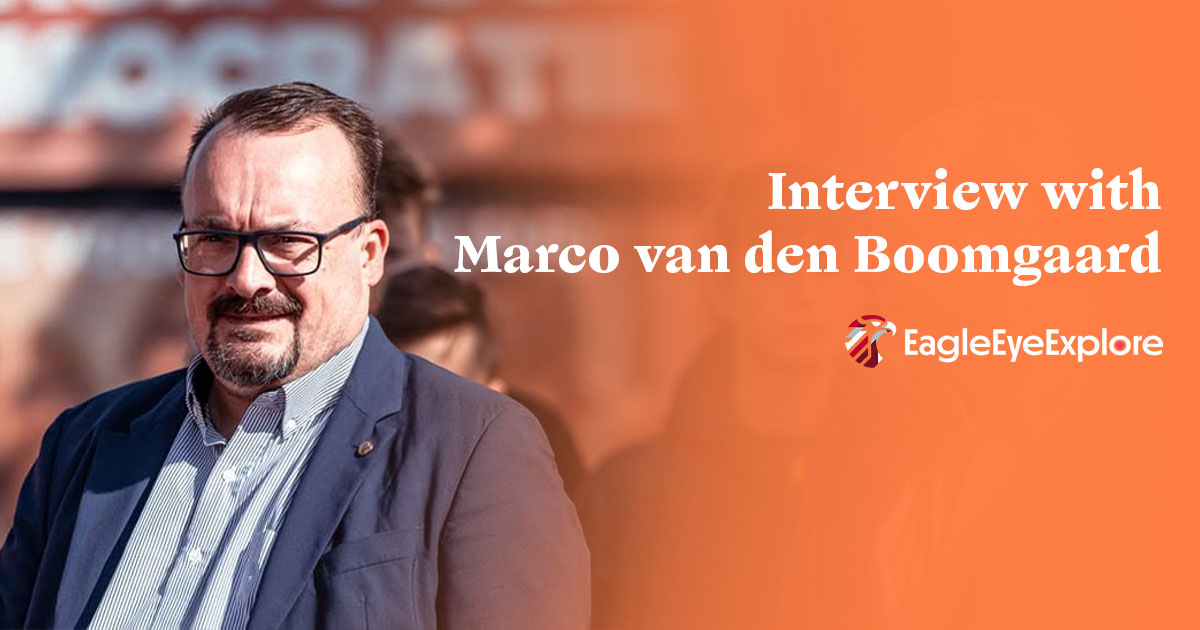
The most fruitful transatlantic relationship is one in which Americans and Europeans exchange experiences while recognizing that policy solutions must be adapted to national circumstances. ICLC’s position between these two worlds provides an opportunity to connect policymakers, entrepreneurs, civic leaders and future leaders on both sides of the Atlantic. And since ICLC’s network also extends to Latin America and other regions, I see something broader taking shape: not merely an American-European dialogue, but an international network in which sovereign states and conservative leaders can learn from one another, Marco van den Boomgaard, ICLC’s Regional Director for Europe, told our portal in an interview.
The International Conservative Leadership Council is a relatively new organisation and presents itself not as a political party or electoral campaign, but as a platform for ideas, leadership and international collaboration. What gap in the conservative movement did its founders see, and why did you decide to take on the leadership of its European branch?
The gap ICLC identified is not necessarily a shortage of conservative parties, politicians or ideas. There are many of them. The problem is that they often operate within their own national, political or institutional environments.
ICLC was created to provide an international infrastructure through which conservative leaders, policymakers, entrepreneurs, academics, civic organisations and others can exchange knowledge and build relationships across borders.
That distinction is important. We are not trying to become another political party, nor are we trying to dictate a single political programme to different countries. ICLC describes its mission as building a durable network that can survive individual elections and political cycles.
That was one of the reasons I accepted the responsibility of becoming Regional Director for Europe. Europe contains many strong conservative movements, but cooperation between them can still be fragmented. My role is to help create connections: between countries, between generations and also between Europe and conservative networks elsewhere in the world.
For me, international cooperation and national sovereignty are not contradictions. Genuine international cooperation should take place between confident sovereign nations rather than requiring them to surrender their identity or democratic authority.
ICLC speaks of freedom, national sovereignty, free markets and traditional values, and of leaders who think in generations rather than election cycles. How do you translate those principles into concrete work in Europe, and what distinguishes ICLC from the many think tanks and networks already active on the continent?
The first difference is that ICLC is intended to be a network of people rather than simply a producer of reports.
Research and policy analysis matter, but relationships matter as well. ICLC brings together political leaders, entrepreneurs, policy specialists, faith leaders and civic representatives. Its activities include forums, leadership events, policy discussions, training and international networking.
In Europe, I see several areas where those principles translate into practical discussion: national sovereignty and subsidiarity, freedom of expression, economic competitiveness, entrepreneurship, energy security, demographic developments, family policy and the preservation of cultural identity.
Family is particularly important. In September, I participated with Scarlett Karoleva, ICLC Deputy Director of Women’s Leadership, in an ICLC Europe discussion entitled “Identity & Family: The Roots of Who We Are.” That illustrates the type of conversation we want to develop: not only reacting to tomorrow’s political headline, but discussing what kind of society we want to leave to the next generation.
The Guatemala City Declaration also provides an indication of ICLC’s institutional philosophy. It combines national sovereignty with international cooperation and specifically states that cooperation should not mean standardising national agendas. That principle is highly relevant for Europe.
Europe does not need every conservative to think identically. It needs the ability to cooperate where fundamental principles overlap.

Who are ICLC’s key partners and allies in Europe today, whether parties, foundations or civic organisations?
Europe is still a developing part of the ICLC network, so I think we should be precise about this.
ICLC already has a growing international structure and publicly identifies activity across more than ten countries, while newer ICLC material refers to a network covering more than fourteen nations on four continents, including Spain and Italy.
But I would distinguish between formal institutional partnerships and the broader relationships we are developing with politicians, civic organisations, conservative networks, academics and other individuals.
My task as Regional Director is precisely to expand that European network.
I do not believe ICLC should simply collect logos from political parties and call that cooperation. We want substantive relationships. We are interested in people and organisations that share sufficient common ground on sovereignty, liberty, free enterprise, democratic accountability, family and the rule of law.
Europe will therefore be an important growth area for ICLC in the coming years.
How important is the Central European experience as a model for the network?
Central Europe is an important case study because countries in that region have had particularly intense debates about sovereignty, national identity, family policy, migration, energy and the division of authority between national governments and European institutions.
But I would not argue that one country’s political model can simply be exported to another.
Hungary is not the Netherlands. Poland is not Spain. Italy is not Romania. Each country has its own history, constitution, political culture and electorate.
The lesson I take from Central Europe is therefore less about copying individual policies and more about political confidence: governments and political movements asking what serves their own citizens, culture and long-term national interests.
That fits closely with ICLC’s emphasis on sovereignty. International cooperation should strengthen nations rather than erase the differences between them.
Conservative forces in Europe are stronger than ever, yet often divided across groups and national agendas. How realistic is it to build a genuinely connected European conservative ecosystem, and what role can ICLC play in bridging those differences?
It is realistic if we stop confusing cooperation with uniformity.
European conservatives disagree on important questions. There are different views about economics, foreign policy, European integration, defence and the appropriate relationship between national governments and EU institutions.
Those disagreements will not disappear, and they do not need to.
A functioning conservative ecosystem can instead identify areas of common interest: national sovereignty, democratic accountability, secure borders, economic competitiveness, freedom of expression, support for families and the principle that political decisions should be taken as close to citizens as reasonably possible.
ICLC can provide a neutral meeting place within that broader conservative family. It can connect politicians with entrepreneurs, academics, civic leaders and international partners without requiring everyone to belong to the same parliamentary group or political party.
The objective should not be to create one European conservative party. It should be to create stronger channels of communication between people who may belong to different political traditions but recognise common challenges.
ICLC is headquartered in Florida, which gives it a natural connection to the American conservative movement. What can European and American conservatives learn from each other, and how do you see that transatlantic partnership developing in the coming years?
There is enormous potential in that relationship.
American conservatives have considerable experience in building political and civic infrastructure outside government: grassroots organisations, leadership programmes, think tanks, donor networks, media platforms and policy organisations.
Europe has something different to contribute. We have centuries of national history, different constitutional traditions and direct experience of trying to combine cooperation between countries with the preservation of distinct national identities.
Neither side should simply copy the other.
The most productive transatlantic relationship is one in which Americans and Europeans exchange experience while recognising that political solutions have to fit national circumstances.
ICLC’s position between these worlds creates an opportunity to connect policymakers, entrepreneurs, civic leaders and future leaders from both sides of the Atlantic.
And because ICLC’s network also extends into Latin America and other regions, I see something broader emerging: not simply an American-European dialogue, but an international network in which sovereign nations and conservative leaders can learn from one another.

If conservatives had a decisive say in the EU institutions, which issues would they approach differently: migration and border control, energy and farming policy, regulatory burdens on small businesses, or the balance of power between Brussels and national capitals?
These issues are interconnected, but from the perspective I bring to ICLC Europe, the fundamental question is subsidiarity: which decisions genuinely need to be taken at European level, and which should remain with democratically elected national governments?
On migration, conservative parties generally place greater emphasis on control of external borders, enforcement of immigration rules and national authority over admission.
On energy and agriculture, the debate is about balancing environmental objectives against affordability, energy security, food production and the economic position of farmers.
For businesses, particularly SMEs, regulatory complexity matters because every additional administrative obligation consumes money and time that smaller companies cannot absorb as easily as multinational corporations.
And underlying all of those questions is sovereignty.
European cooperation can be valuable in trade, security, infrastructure, research and other cross-border challenges. But cooperation does not automatically require centralisation.
My preferred principle is therefore straightforward: Europe should cooperate where cooperation creates clear added value, while leaving decisions at national or local level wherever possible.
That is much closer to a Europe of strong nations cooperating voluntarily than to the idea of an increasingly centralised European state.
Many young Europeans feel the pressure of housing shortages, rising costs and a politics that ignores them. Do you see a growing openness among young people to conservative ideas, and, given your background as a Forum voor Democratie councillor in Zoetermeer and in international conservative politics, how do you read the current Dutch political landscape and the place of conservatives within it?
Young people are facing very concrete problems, and housing is perhaps the clearest Dutch example.
The Netherlands has a substantial housing shortage, and a growing proportion of young adults remain at home with their parents. For many younger people, questions about housing, disposable income, employment and their prospects of starting a family are therefore not theoretical political discussions. They affect everyday life.
That creates space for every political movement, including conservatives, to demonstrate whether its ideas can provide credible answers.
We should also be careful about assuming that an entire generation thinks in one political direction. Young Europeans are diverse. Some are progressive, some conservative, and many do not fit neatly into either category.
What I do see is a willingness among some younger people to question established political assumptions and to discuss subjects such as national identity, migration, freedom of expression, housing, family formation and the future of Europe.
The Dutch political landscape reflects a wider fragmentation. In the 2025 parliamentary election, Forum voor Democratie won seven seats, while JA21 won nine and the PVV twenty-six. Those results show that several different parties now compete for voters on the Dutch right rather than there being one single conservative bloc.
My experience in local politics in Zoetermeer also taught me something important: ultimately politics becomes very practical. People want a safe neighbourhood, an affordable home, accessible roads, functioning public services and a government that listens to them.
International politics should never make us forget that.
That is also how I see ICLC. The organisation can discuss large ideas — sovereignty, freedom, family, prosperity and the future of Western civilisation — but those ideas only become meaningful when they translate into institutions and policies that affect people’s everyday lives.
For me, the future of European conservatism therefore depends on three things: developing a new generation of leaders, building serious international relationships, and remaining connected to the practical concerns of ordinary citizens.
We do not need every conservative in Europe to agree on everything.
We do need them to be able to talk to each other, learn from each other and cooperate where their principles and interests genuinely meet.