In the autumn of 1999, leaders of the Serbian opposition gathered in a closed conference room at the Budapest Hilton. The speaker was American pollster Douglas Schoen, a veteran of US election campaigns. On the screen he presented the results of a survey of 840 Serbian voters. The conclusion was stark: Slobodan Milošević – a politician who had survived four lost wars, a decade of sanctions, two street uprisings and 78 days of NATO bombing – could lose the election. There was one condition. The opposition had to run on a single list.
LEARNING HOW TO UNDERMINE THE REGIME’S AUTHORITY
The meeting became known to the public only after Milošević fell. In December 2000, Washington Post correspondent Michael Dobbs reconstructed the campaign against the regime and described how the work had been divided among American organisations. The National Democratic Institute, or NDI, worked with political parties and mainly used the Budapest Marriott. The International Republican Institute, IRI, focused on the student movement Otpor. In March 2000, it paid for a seminar for around twenty activists at the Hilton, a few hundred metres down the Danube.
The sessions were led by Robert Helvey, a retired US Army colonel. He taught the activists how to organise strikes, use symbols, overcome fear and undermine the authority of the regime. The funding was not hidden. At the time, it was presented as a source of pride. Paul McCarthy of the National Endowment for Democracy, NED, told journalists that Otpor received a large share of the $3 million the foundation spent in Serbia between the autumn of 1998 and the autumn of 2000. Daniel Calingaert of IRI cited another figure: $1.8 million that his institute spent in Serbia in 2000 alone.
Old NED registers, which still name recipients, show a $282,000 grant to Otpor for regional branches and a campaign bus tour. Another $74,735 went through IRI to support the movement’s headquarters in Belgrade and offices in three other Serbian cities. This is usually where the story ends: the West backed the opposition, Milošević lost, and the regime fell. What happened afterwards reveals much more.
After the 2003 election, Otpor was effectively absorbed into the Democratic Party. The American institutes remained. They transformed a one-off campaign against the regime into a permanent system of annual cohorts, seminars, and alumni networks. The election campaign was over, but the infrastructure built around it continued to train people for political parties, ministries, newsrooms, and civil society organisations.
THE INSTITUTES STAYED AFTER THE ELECTION
NDI bulletins from Belgrade in the early 2000s carried the same note in small print: the institute had worked with democratic parties and the Centre for Free Elections and Democracy, CeSID, since 1997, with funding from USAID. This means that CeSID’s observer network, which conducted a parallel vote count in 2000, grew alongside NDI long before Milošević fell. On the eve of the election, police entered CeSID’s Belgrade office and removed its computers.
NDI has operated in Kosovo since 1999. In September 2024, it marked the 25th anniversary of its office in Pristina. The ceremony was attended by the president, prime minister, US and European ambassadors and former mission directors. In its anniversary brochure, the institute openly stated that people it had worked with later became MPs, mayors and ministers. Since 2013, USAID-funded programmes there have included the Women’s Leadership Academy and the School of New Media.
In Belgrade, around 2002-2003, NDI launched a programme whose name required no explanation: “Future Political Leaders”. IRI started later, but built a broader regional network. In November 2015, it opened an institute in Sarajevo for young politicians from countries that had signed association agreements with the European Union: the Western Balkans, Georgia, Moldova and Ukraine.
From 2018, the Advanced Leadership in Politics programme operated in Bosnia and Herzegovina, Montenegro and Serbia, later adding North Macedonia. At the end of 2022, IRI brought together sixty young “agents of change” from Bosnia, Kosovo and Serbia. Its partners included the Ana and Vlade Divac Foundation in Belgrade, the Belgrade Centre for Security Policy, the Faculty of Political Science at the University of Sarajevo and the Kosovo Centre for Security Studies.
The organisations changed, programme names became more neutral, and the language more cautious. The basic method did not. Find ambitious young people, train them, connect them to one another and bring them into an international network. What began as mobilisation against a single regime became long-term work with the pool of political talent in several countries.
SONJA LICHT’S LEGACY
From 1991 to 2003, the Serbian branch of George Soros’s foundation was led by Sonja Licht. Her background included the Faculty of Philosophy, dissident circles from the late 1960s and participation in founding around a dozen non-governmental organisations. For twelve years, she distributed funds that sustained a large part of the independent media and civil-society sector in Serbia, Montenegro and Kosovo.
From July 1999, while the seminars in Budapest were being organised, Licht also chaired a working group of the Bratislava Process. Supported by the Slovak Ministry of Foreign Affairs and the EastWest Institute, the platform had an explicit purpose: strengthening Serbia’s democratic opposition. In 2003, as Soros began winding down parts of his Balkan operations, Licht left the foundation and established the Belgrade Fund for Political Excellence, BFPE.
The new organisation became a school for young politicians, civil servants, journalists and public figures. That same year it joined the Council of Europe’s network of Schools of Political Studies. There is no document showing that the Soros foundation formally handed its programme over to the Council of Europe, and claiming otherwise would go beyond the evidence. What the institutional history does show is continuity of purpose under a new funding structure. A private American foundation was followed by a European intergovernmental institution.
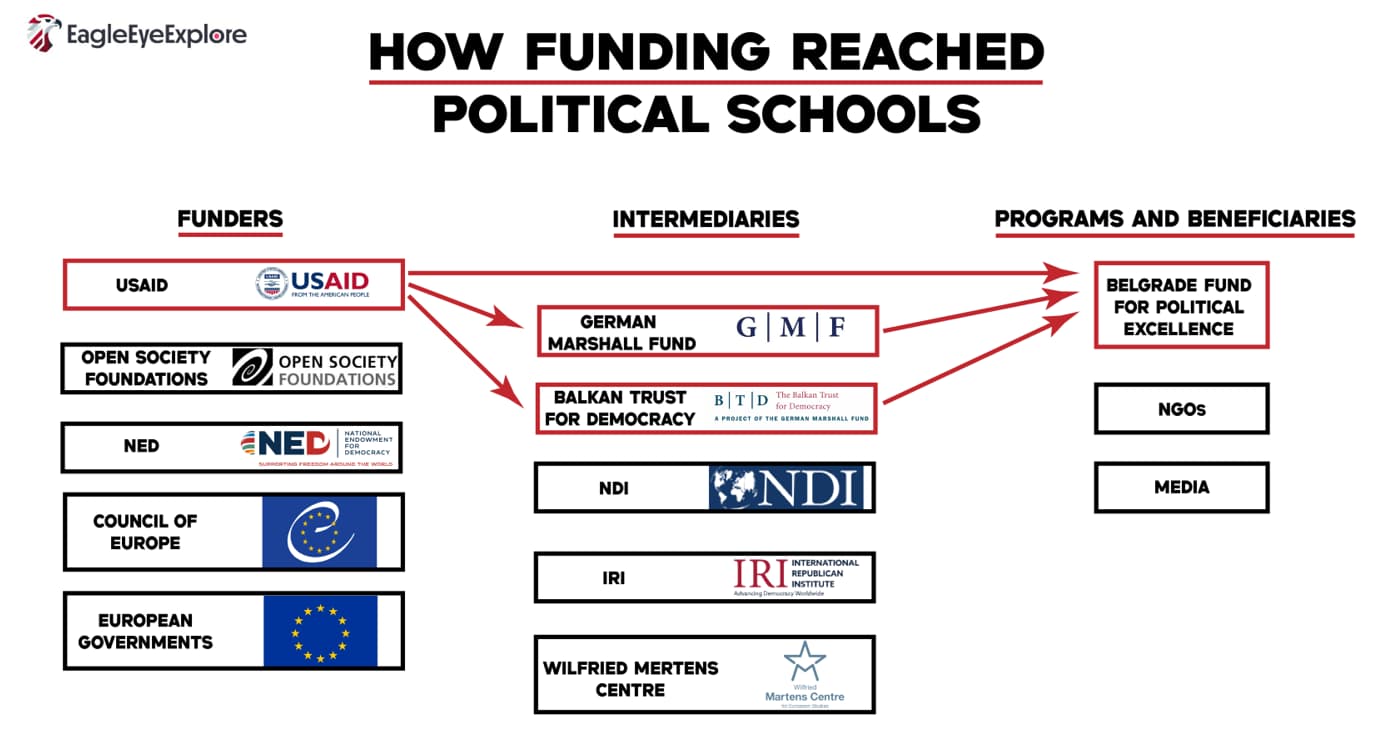
BFPE publicly listed its partners: the Council of Europe, the British and Canadian embassies, the European Fund for the Balkans, USAID and the Wilfried Martens Centre, the political foundation of the European People’s Party, the largest party family in the European Union. Its National Security Academy was run in cooperation with the Berlin office of the German Marshall Fund and the George C. Marshall European Center for Security Studies.
The project was supported by the Balkan Trust for Democracy, established in Belgrade in the spring of 2003, the same year as Sonja Licht’s school. The fund was founded by the German Marshall Fund, USAID and the Charles Stewart Mott Foundation. At launch, the partners announced a $25 million fund, with about $2 million a year intended for civic groups, NGOs, local authorities and media across South-Eastern Europe.
As more donors joined, different sources estimated the fund’s total size at between $30 million and $36 million. US government money could therefore reach BFPE-related projects through several channels: directly through USAID-supported projects, through the Balkan Trust for Democracy, and through joint programmes with the German Marshall Fund.
HOW THE NEXT GENERATION IS SELECTED
The Council of Europe network now includes twenty-one Schools of Political Studies across Eastern and South-Eastern Europe, the Caucasus and parts of the southern Mediterranean. In the Balkans, the network largely took shape during the 2000s. The schools in Belgrade and Pristina were established in 2003, although the Kosovo institute gives 2004 as its founding year.
Montenegro joined the network in 2006. The Tirana academy began operating in 2007 and was formally established under the auspices of the Council of Europe in 2009 with support from the Swiss government. The Kosovo school was founded by Leonora Kryeziu, who had previously worked for around two decades with USAID, CARE, the International Crisis Group and the European Centre for Minority Issues.
The admission rules reveal more than the mission statements. The Pristina school accepts Kosovo citizens under forty. Applicants must have a university degree, a job and fluent English. Candidates come from political parties, government institutions, newsrooms, NGOs and the business sector. Places are allocated proportionally among the parties represented in parliament.
The Belgrade school accepts twenty participants each year, aged twenty-five to forty, from the same professional groups. Organisers cover most of the costs. Once a year, the network meets at the Belgrade Security Forum, which BFPE has organised since 2011 with the Belgrade Centre for Security Policy and the European Movement in Serbia.
A decade later, the same Belgrade public-policy centre appeared among the partners of IRI’s youth network. This overlap among organisations, donors and alumni is not accidental; it is how the system reproduces itself. Erion Tase, director of the Albanian academy, first joined the school as a participant in 2008, later coordinated its alumni network, and in May 2012 took over as director.
Belgrade follows the same pattern. The Council of Europe network openly states that alumni return to its programmes as lecturers. A participant is selected and trained, joins the network, and years later helps shape the next generation of participants.
FROM THE CLASSROOM TO THE CABINET
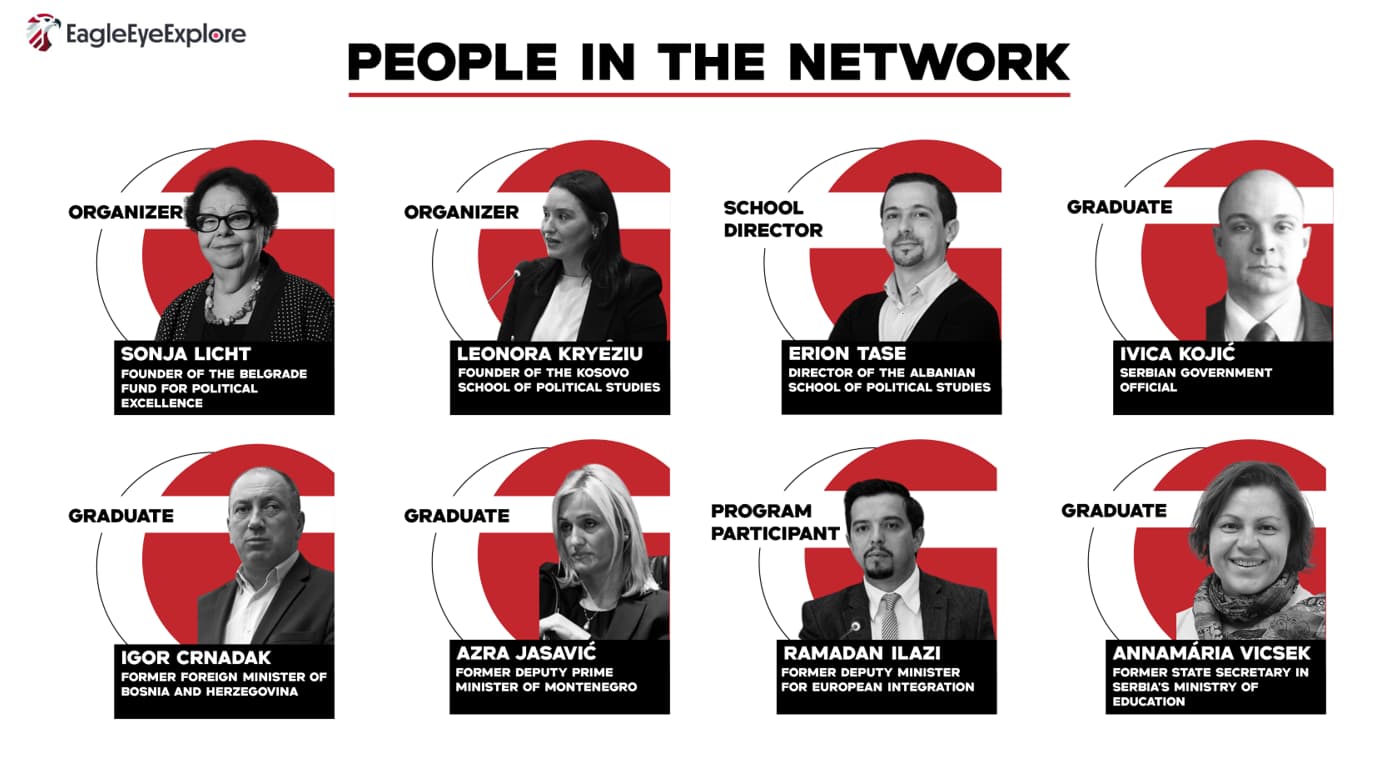
The Council of Europe itself publishes lists of successful alumni. This is not a leak of information or an exposé; it is the network’s official showcase. Ivica Kojić, a participant in the Serbian class of 2007, later became chief of staff to Serbia’s prime minister. Igor Crnadak, from the 2010 class, became Bosnia and Herzegovina’s foreign minister.
Azra Jasavić, a 2012 participant, was deputy prime minister of Montenegro. Driton Kuçi, from the same class, was Macedonia’s economy minister. Ramadan Ilazi, a 2008 participant, became Kosovo’s deputy minister for European integration. Annamária Vicsek, from the 2014 class, was a state secretary at Serbia’s Ministry of Education.
As for the Belgrade school, the Council of Europe is more general: its alumni have served as MPs, ministers, deputy ministers, state secretaries, mayors, party officials and editors. Sometimes the transition from a training programme to public office is visible at the graduation ceremony itself.
At the Tirana academy’s graduation ceremony in late 2019, certificates were presented by Albanian parliament deputy speaker Vasilika Hysi, Swiss ambassador Adrian Maître and the head of the Council of Europe office, Jutta Gützkow. The graduating class was represented by the deputy mayor of Durrës and an adviser to the justice minister. Hysi invited the graduates to work with parliamentary committees and on the European integration agenda.
The American institutes publish fewer names, but individual biographies reveal the same flow between programmes and politics. Lana Prlić, then deputy secretary-general of Bosnia and Herzegovina’s Social Democratic Party, took part in IRI programmes and spoke at the opening of its Sarajevo institute in 2015.
The clearest example comes from neighbouring Bulgaria. Daniel Mitov ran NDI programmes in Iraq from 2010 to 2012. From August 2014 to January 2017, he served as Bulgaria’s foreign minister in two governments. He then returned to NDI, where he worked as its Russia mission director until 2020.
One biography does not establish a rule, and no identical Balkan case was found. But Mitov’s career shows that the door between a Western political institute and a ministerial office can open in both directions.
MONEY FOR THE PARTY NETWORK
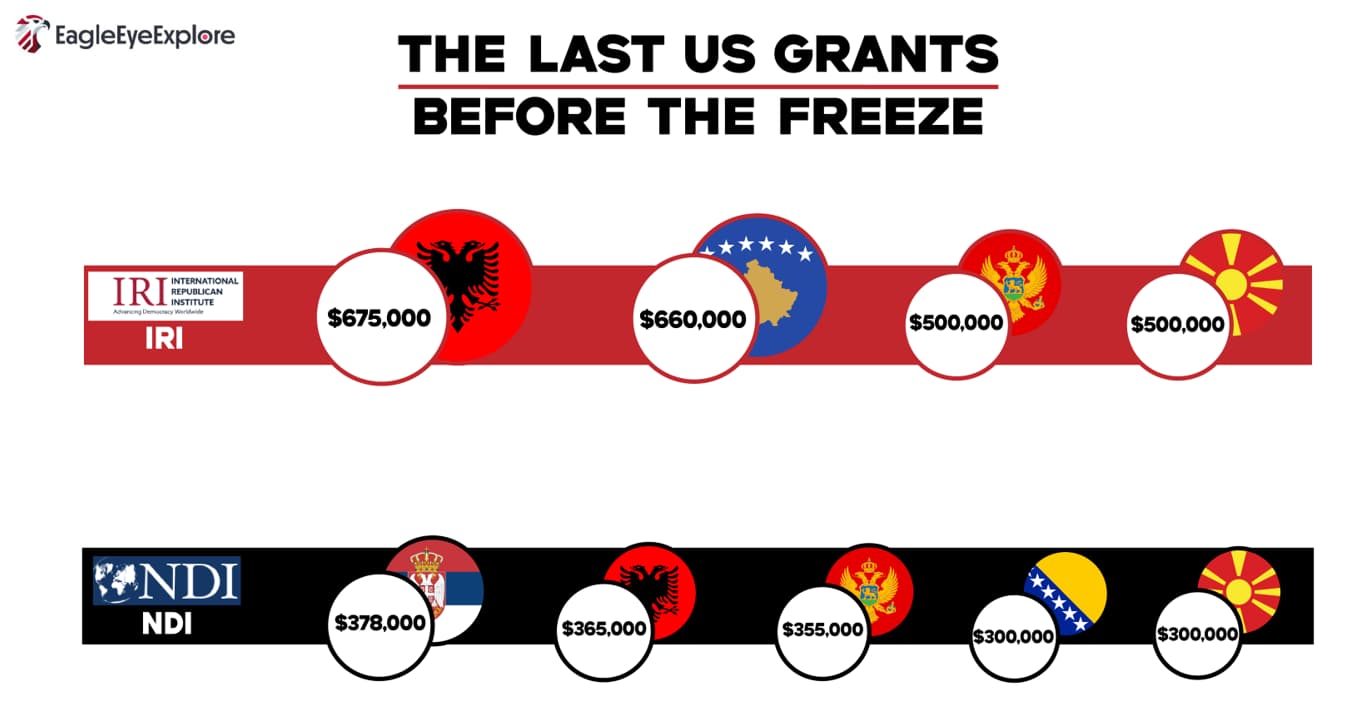
The cost of this system can be traced to the dollar. NED’s register for fiscal year 2024, updated on 15 January 2025, lists the final awards made shortly before the freeze on US foreign assistance. IRI received $675,000 for work with political parties in Albania, $660,000 in Kosovo and $500,000 each in Montenegro and North Macedonia.
NDI received $378,000 for Serbia, $365,000 for Albania, $355,000 for Montenegro and $300,000 each for Bosnia and Herzegovina and North Macedonia. Regional programmes were larger still: $1.2 million to IRI for strengthening parties and regional security in Central and Eastern Europe, and $905,000 to NDI for political participation and leadership.
A separate $600,000 line covered the programme “Promoting Political Party Integrity”. Behind that title was NDI’s work with 250 representatives of 45 political parties in ten countries, focused on internal reform, party finance and promoting women into leadership positions.
The register was public. To grasp the scale of the programme, it was enough simply to read it in full. Then the rules changed. NED first suspended publication of recipient lists, and in April 2025 published them again in a new format. The names of local organisations disappeared, replaced by descriptions such as “an organisation will train journalists” and the amount of the grant.
Only the four core American institutes were generally named. NED said the change was intended to protect partners. It cited criminal proceedings against grantees in Hong Kong, Taliban efforts to identify people linked to US programmes in Afghanistan, and US intelligence warnings before the Russian invasion of Ukraine about possible kill lists.
Those arguments cannot simply be dismissed. Nevertheless, the practical result is clear: it is no longer possible to use the public register to determine which Balkan organisations received American funding.
WASHINGTON TURNS OFF THE FUNDING
At the end of January 2025, Donald Trump ordered an almost total freeze on US foreign assistance. In February, the administration’s cost-cutting operation, associated with Elon Musk, blocked transfers from the US Treasury to NED, including funds that Congress had already approved.
At an April hearing before a House Appropriations subcommittee, IRI president Dan Twining described the consequences: 92 of 95 programmes had been suspended, all 64 overseas offices had been closed, and up to 85 per cent of staff had been laid off. NDI president Tamara Cofman Wittes said the institute had terminated 93 of 97 grant agreements, closed three-quarters of its offices and dismissed around a thousand employees.
The State Department partially restored funding in March, and NED said it had begun stabilising operations. But a structure built since 1983 could not be reassembled in a matter of weeks. This was no longer a temporary delay in transfers. It was the collapse of an infrastructure that had supported offices, staff and partner organisations for decades.
The damage was quickly counted on the ground. In North Macedonia, BIRN reported that $72 million across 22 projects had been put at risk. The country also took part in six regional Balkan programmes worth around $140 million in total.
In Kosovo, 18 projects worth around $162 million were suspended, according to the Pristina-based GAP Institute. Since 1999, the United States had provided Kosovo with about $2 billion, more than half of it through USAID.
THE SCHOOL FINDS NEW BACKERS
In January 2026, the Belgrade Fund for Political Excellence announced a new intake. The conditions had barely changed: twenty places, applicants aged twenty-five to forty, and participants from politics, public administration, media, academia and business. The programme offered three national seminars during the year, with organisers covering most of the costs.
Graduates would join the alumni network and gain access to partner schools in the Council of Europe system. A year earlier, the American part of this structure – active in the Balkans since 1997 – had largely ceased to exist. USAID disappeared from the list of principal funders.
What remained were the Council of Europe, contributions from individual member states, Swiss funding in Tirana, and the political foundation of the European People’s Party. The architecture was poorer, but it had not disappeared. Other funders had taken the place of the American one.
The new intake opened as scheduled. A system built on external money proved easier to decapitate from Washington than to dismantle from Belgrade – and easier to transfer to a new funder than to close.