
In international public discourse concerning the armed conflict in Ukraine, a highly simplified and mistaken understanding has become firmly established regarding one of the most important elements of conducting military operations – military communications. It is believed that the key successes of the Ukrainian army in controlling units and unmanned aircraft have been achieved exclusively through access to the American Starlink satellite constellation. This interpretation distorts the real picture of what is happening and prevents other countries from drawing objective military lessons from the Ukrainian experience. The actual situation is more complex. Ukraine is systematically and deliberately implementing a strategy of duplicating and providing backup communications channels, seeking to reduce dependence on imported technologies that may at any moment be restricted or switched off for political reasons. Starlink is only one element of this architecture, albeit an important one, but not the only one. In parallel, Kyiv is building ground infrastructure intended to handle tasks for which a satellite channel is either too expensive, vulnerable, or unsuitable because of terrain conditions and the electronic-warfare environment.
One of the most striking examples of such infrastructure is the network developed under the operational name “BakhmutTelecom.”
CIVILIAN COVER FOR A MILITARY OPERATOR
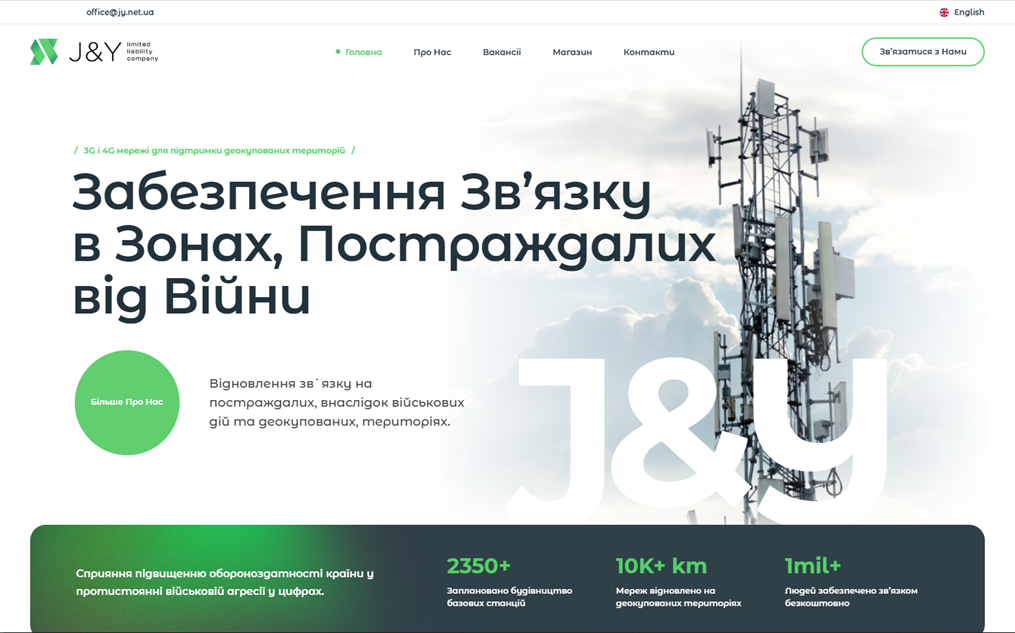
Formally, “BakhmutTelecom” is not a structure of the Ministry of Defence of Ukraine. The network operates through the legal framework of J&Y LLC, which publicly presents itself as an operator whose job is “restoring communications in territories affected by hostilities.” This wording provides cover in the form of humanitarian or infrastructure activity, while the company’s actual role goes far beyond the restoration of civilian communications.
The company’s registration date is noteworthy – 6 October 2020. According to available data, mass deployment of a network of towers along the line of contact began only in 2023. Almost three years elapsed between those two dates. This time gap is essential: it indicates that the company did not emerge as a spontaneous response to a change in the operational situation, nor as an improvisation under conditions of an already-started conflict, but as a pre-prepared legal and organisational shell for future military communications infrastructure.
The company’s legal address is Zaporizhzhia, a major industrial centre in close proximity to the combat zone. The employment section lists openings for technical personnel and installers in Kyiv, Zaporizhzhia, Kharkiv and Kramatorsk – cities distributed along the entire front line. This indicates that the company is actively expanding the network in directions along the front, rather than limiting itself to rear areas. A KVED code for the construction of electricity-supply and telecommunications facilities is also registered – legally authorising the extensive earthworks necessary for laying fibre-optic lines underground between the towers.
Accordingly, the organisational framework of “BakhmutTelecom” is not a wartime improvisation, but a pre-planned structure created for long-term operation under conditions of conflict.
NETWORK ARCHITECTURE
The architecture of “BakhmutTelecom” differs fundamentally from conventional notions of a mobile telephone network. It combines elements of traditional cellular infrastructure, optical backbone lines and specialised solutions intended to provide communications under combat conditions.
The foundation of the ground network is a system of approximately 2,500 towers, 36 or 50 metres high, deployed in three echelons along the entire line of contact. The towers are interconnected in two ways: by underground fibre-optic lines where this could be achieved, and by microwave radio relay links. This combination makes it possible to preserve network connectivity even if one of the channels is damaged.
Nokia and Ericsson solutions are used as telecommunications equipment, and the network operates on 3G and 4G standards. This is a fundamental choice: these standards provide stable communications even under active electronic warfare because they use coding and spectrum-spreading methods that are more resistant to interference than simpler systems.
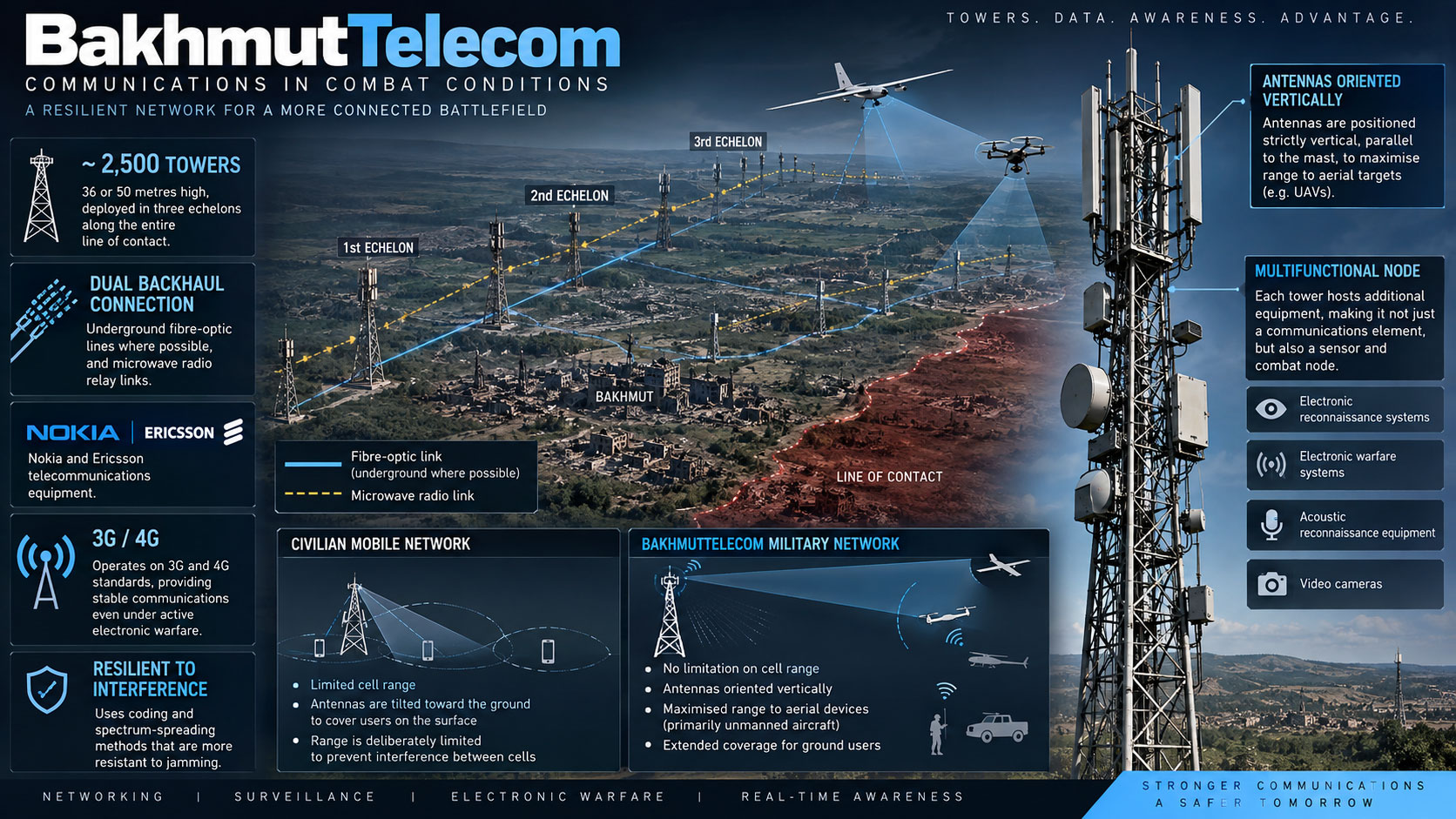
One of the most noticeable differences between “BakhmutTelecom” and civilian networks is the absence of a limitation on cell range. In ordinary mobile networks, the range of a base station is deliberately limited in order to prevent interference between cells. In the military network, this limitation has been removed. Moreover, the antennas on the towers are oriented strictly vertically, parallel to the mast, rather than tilted toward the ground as in civilian networks. This configuration makes it possible to maximise the communications range to user devices located at altitude – primarily unmanned aircraft.
Another distinctive feature is the maximum use of tower masts for mounting additional equipment: electronic reconnaissance systems, electronic warfare systems, acoustic reconnaissance equipment and video cameras. Thus, each tower is not merely a communications element, but also a multifunctional sensor and combat node.
WHAT DOES THIS MEAN IN PRACTICE
The functional purpose of “BakhmutTelecom” goes beyond providing voice communications or data transmission for individual units. The network serves as a transport medium through which heterogeneous systems – sensors, unmanned aircraft, electronic warfare systems – are brought together into a single command-and-control architecture.
First and foremost, the network provides connectivity for distributed acoustic sensors of the Zvook and SkyFortress systems. These systems form a network of tens of thousands of small acoustic sensors deployed along the front line and in the forward area. Their task is to detect and determine the direction of flight of unmanned aircraft and missiles based on the characteristic sound of their engines. Each sensor sends data to a processing centre, where it is compared and analysed. Without a stable and inexpensive communications channel, such a network would be impossible to operate, because the sensors are distributed over a large area and cannot be connected by wired lines.
The second function is to provide encrypted communications and data transmission for units of the Armed Forces of Ukraine and the National Guard. The network is used as a primary or backup channel for tactical communications, the transmission of coordination information, messages and video data. Under conditions of active electronic warfare, the existence of a backup channel independent of satellite systems becomes critically important.
The third function is the control of unmanned and robotic systems. The network provides control of FPV drones, ground robotic systems and strike aircraft UAVs at distances of at least 70 kilometres from the line of contact. This means that an operator located in the rear can control a drone at a considerable distance from the front line. Control through a cellular network provides not only command transmission but also reception of high-quality video. Directly connected to this is the task of moving UAV operators to the rear, thereby reducing their vulnerability and increasing the overall resilience of the system.
The network’s capabilities are determined by its architectural characteristics. The cellular channel can be used both as a primary channel and as a backup alongside Starlink or MESH modems. This flexibility makes it possible to preserve control even if one of the channels fails or is suppressed. In addition, the network is integrated into the DELTA, Grafit, Ground Control, Sky Map and other situational-awareness systems – it becomes an element of the unified information space in which Ukrainian formations operate.
WHY IS THIS INTERESTING FOR SMALL STATES?
The experience of “BakhmutTelecom” is worth attention. It demonstrates a model that could be relevant for states with limited resources and small territories – including Balkan states.
Serbia, for example, is several times smaller than Ukraine in area, while the distances between key operational directions are measured in tens rather than hundreds of kilometres. Covering a network of comparable functionality would therefore require many fewer towers, and consequently lower capital costs, fewer personnel and less time for deployment. What took three years to build in Ukraine under conditions of active hostilities could be implemented faster and more cheaply in peacetime and across a smaller area.
Another aspect is of fundamental importance: “BakhmutTelecom” is built from mass-produced, readily available components. User devices – modems, routers, video-processing boards – are manufactured in series, are inexpensive and do not require a specialised industrial base. This means that even a country without a developed microelectronics industry can deploy a similar network by relying on standard equipment procurement and its own engineering capabilities.
Finally, “BakhmutTelecom” demonstrates that independence from a single communications channel is not an abstract value, but a practical necessity. Satellite systems may be restricted or switched off for political reasons; conventional analogue and MESH channels prove expensive and vulnerable. A ground-based military cellular network, built as a duplicated and backup layer, is capable of providing resilient command and control even under the most adverse conditions.
WHAT LIES BEHIND THIS EXPERIENCE?
The analysis makes it possible to draw several conclusions that are significant beyond the Ukrainian theatre of military operations.
First, “BakhmutTelecom” is not an auxiliary or secondary structure. It is not a “backup” channel in case Starlink fails, nor a local initiative of individual units. The network constitutes the foundation of tactical command and control – infrastructure through which connectivity to distributed sensors, control of unmanned and robotic systems, coordination of unit actions and the operation of electronic warfare systems are provided. In terms of importance, it is comparable to Starlink, and in a range of scenarios – for example, operations in border areas where a satellite channel is limited or unavailable – it becomes the primary means of controlling troops and robotic equipment.
Second, this system is not simply a collection of towers. Its resilience is determined not by the number of masts, but by the existence of critical nodes without which the network loses connectivity: traffic aggregation points, underground optical backbones, switching centres and connections to external operators. Individual towers are only edge elements, whose replacement does not require significant effort or time. Destroying an antenna or mast by itself does not produce a systemic effect – it merely reduces coverage density over a limited area.
Third, the experience of “BakhmutTelecom” shows that in modern warfare, the key resource becomes not so much an individual platform as connectivity. The ability to integrate distributed systems – sensors, drones, electronic warfare assets, command posts – into a single, controllable architecture proves more important than the characteristics of individual weapons systems. It is precisely this connectivity, rather than the number of tanks or aircraft, that determines the resilience of an army under conditions of intense combat operations.
For the small states of the Balkan Peninsula – and above all for Serbia – the Ukrainian experience is interesting not as a ready-made recipe, but as an illustration of a possible path. A path that does not require enormous budgets or imported masterpieces of the defence industry, but rather systems thinking, engineering discipline and a willingness to invest in infrastructure.