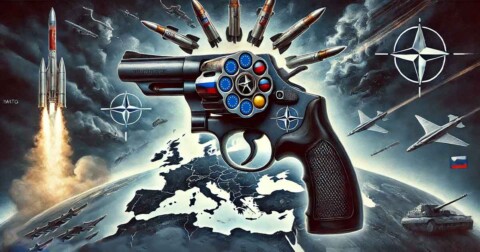
Examining the issue of JDODC’s expansion extends far beyond the realm of purely academic or journalistic interest. For Serbia, which would be directly affected by this process, the scenario of Bulgaria and Slovenia joining the Turkish-backed military bloc would represent not merely a change in the diplomatic landscape, but a fundamental shift in the regional security architecture itself.
IN A STRATEGIC SEMICIRCLE OF POTENTIAL ADVERSARIES
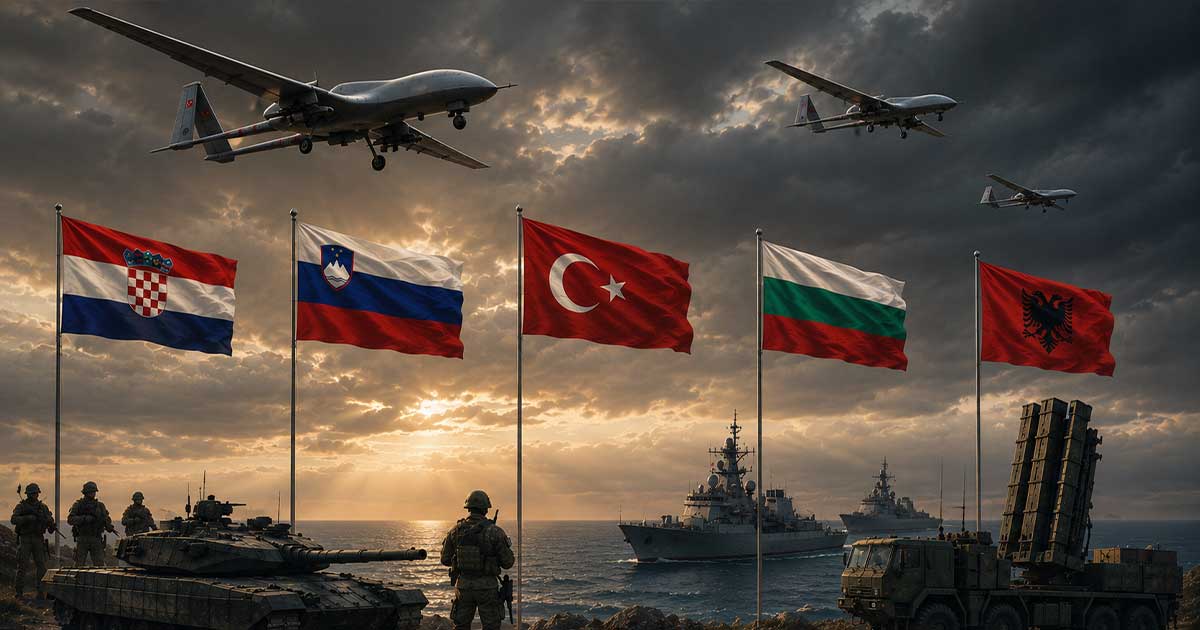
As noted in our publication’s previous article in this series, discussions regarding the alliance’s expansion are taking place within leading analytical and policy institutions, supported by both strategic assessments and political statements. Should this scenario materialize, Serbia would find itself within a strategic semicircle of potential adversaries.
To the south would be self proclaimed Kosovo and Albania, already equipped with strike-capable unmanned systems and integrated into Turkey’s military-technical cooperation network. To the west stands Croatia, serving as a technological integrator and operating modern Rafale fighter aircraft. To the northwest, Slovenia would provide the bloc with access to Central Europe and additional political influence within the European Union. To the east, Bulgaria would give the alliance direct access to the Black Sea and NATO’s eastern flank.
As a result, Serbia would find itself surrounded by five coordinated states sharing a common military doctrine, integrated intelligence infrastructure, and interconnected logistical networks.
Such a configuration would create an entirely new strategic reality in the Balkans.
Instead of preparing to respond to the potential actions of isolated national armed forces, Belgrade would face the challenge of responding simultaneously across multiple operational theaters. The length of the borders requiring protection would increase, while logistical routes would become vulnerable from a greater number of directions. At the same time, the military capabilities of JDODC member states—including the mass production of unmanned systems and the development of network-centric command methods—are evolving faster than Serbia’s armed forces can adapt. Serbia’s military, unfortunately, continues to rely largely on a traditional organizational structure and expensive but weakly integrated procurement from multiple foreign suppliers.
EASTERN SERBIA – A POTENTIAL BATTLEFIELD
If JDODC were expanded to include Bulgaria and Slovenia, Serbia’s military-geographical position would change far more significantly than might initially appear. The issue is not simply an increase in the number of potential adversaries, but a transformation of the entire operational environment in which the Serbian Armed Forces would be required to operate.
First, the total length of Serbia’s borders with alliance member states would increase. At present, Serbia shares borders with Croatia to the west and Kosovo to the south (while Albania, although not sharing a land border with Serbia, lies in immediate proximity). Bulgaria’s accession would add an eastern sector—approximately 300 kilometers of border running through eastern Serbia. Slovenia’s accession would introduce a new strategic concern in the northwest, where Serbia’s borders with Hungary and Romania (neither of which are JDODC members) would effectively lie between two alliance members—Slovenia and Bulgaria.
Consequently, Serbia would find itself strategically constrained by five coordinated states surrounding it from three directions.
This would create entirely new pressure points. Eastern Serbia—in particular the areas around Zaječar, Pirot, and Niš—has traditionally been regarded by the Serbian Armed Forces as a relatively secure sector, with primary military attention focused on the southern and western fronts. The addition of Bulgaria as a member of JDODC would transform these eastern regions into a potential theater of military operations requiring the deployment of additional personnel and equipment.
This, in turn, would complicate both logistics and defense planning, since resources previously concentrated on one or two operational directions would now need to be distributed across a much broader defensive arc.
Pressure on Serbia’s defense industry would also intensify. As JDODC coordinates procurement and defense-industrial development among five countries, Serbia would no longer be competing with individual states but rather with a coordinated bloc capable of negotiating joint procurement contracts, standardizing technical requirements, and sharing industrial production capacity.
This challenge is particularly evident amid the technological revolution driven by the large-scale deployment of unmanned systems, where the combined industrial resources of five allied countries could achieve production volumes and modernization rates far beyond what Serbia could realistically accomplish on its own.
Finally, the logistics of national defense itself would become considerably more complex. Defending extended borders across multiple operational directions would require the dispersion of military forces, reducing defensive density and increasing response times to emerging threats.
In circumstances where a potential adversary possesses superior intelligence capabilities—supported by satellite reconnaissance and electronic intelligence available through NATO and Turkey—even a temporary weakening of one sector could be rapidly identified and exploited.
Looking ahead, Serbia will need either to develop new methods of compensating for its numerical and geographical disadvantages or fundamentally reconsider its defense doctrine by placing greater emphasis on asymmetric capabilities, domestic defense production, and highly mobile forces capable of operating independently of static front lines.
IS SERBIA PREPARED FOR A NEW FORM OF WARFARE?
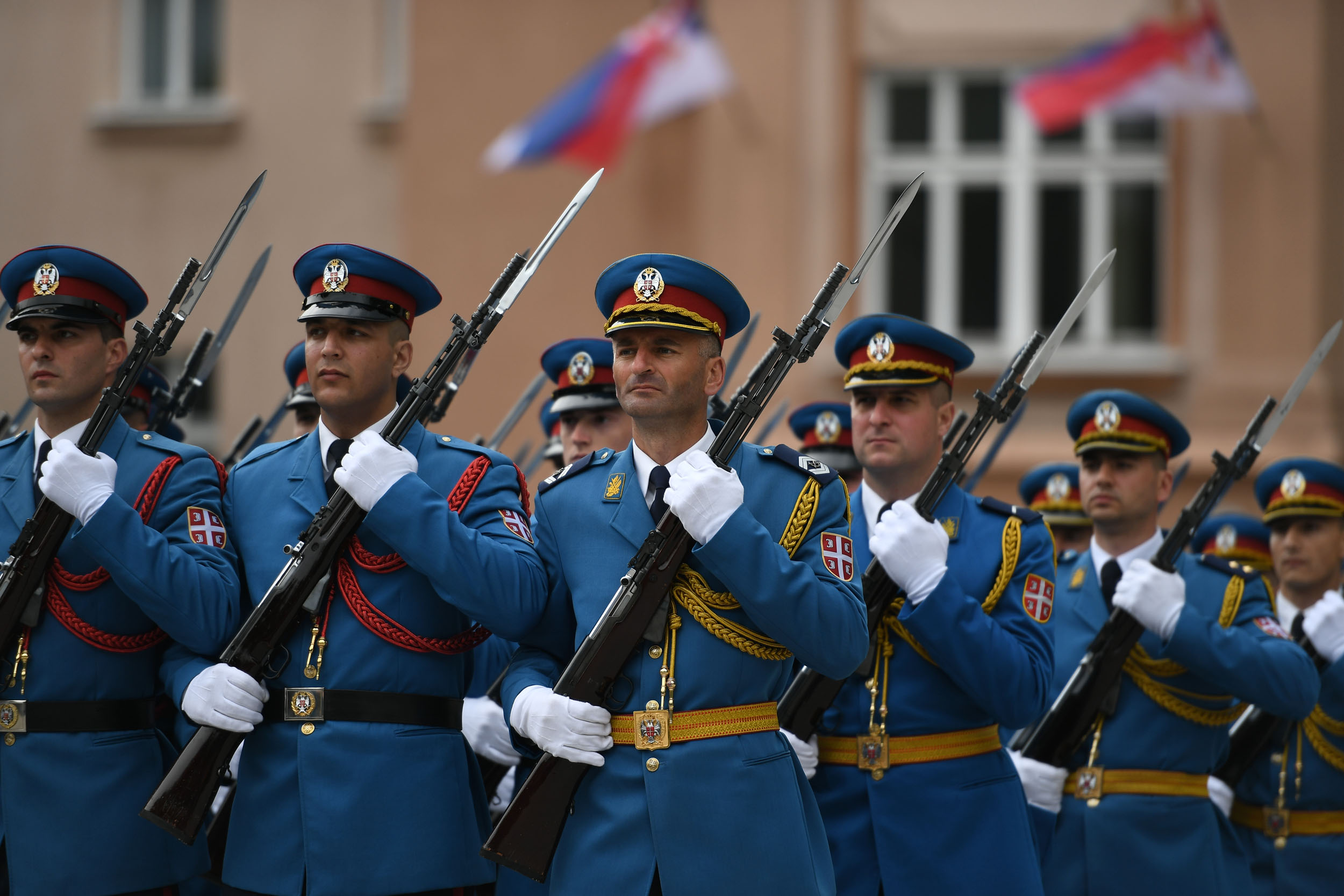
In the event of a potential JDODC expansion, vulnerabilities within the Serbian Armed Forces that may previously have been viewed as theoretical or localized become systemic challenges. The issue is not a lack of weaponry as such, but rather a fundamental mismatch between Serbia’s current model of military development and the model of warfare for which its potential adversaries—and their sponsors—are preparing.
The first major challenge concerns weapons interoperability. Over the past several years, Serbia has actively procured military systems from a wide range of suppliers: French Rafale fighter aircraft, Chinese CM-400AKG supersonic missiles, Israeli PULS multiple-launch rocket systems and Hermes 900 reconnaissance drones, Russian MiG-29 fighters, modernized T-72MS tanks, and Pantsir-S1 air defense systems. Each of these platforms is highly effective within its respective role, yet they rely on different data exchange protocols, communication standards, and targeting formats.
A potential adversary, by contrast, is building its military around unified command-and-control protocols derived from NATO standards and Turkish technological developments. This enables JDODC member states to operate with a significantly higher degree of coordination, while Serbian units risk being unable to exchange operational information efficiently among themselves.
A second—and even more serious—challenge is Serbia’s lack of a strategic-level intelligence infrastructure. Serbia possesses neither military satellites nor airborne early warning and control (AWACS) aircraft, nor an extensive network of ground stations capable of providing continuous surveillance deep inside an adversary’s territory. Consequently, Serbian strike systems—whether Rafale fighters, CM-400AKG missiles, or modern artillery—would depend primarily on delayed intelligence from ground forces during combat operations.
Croatia, Bulgaria, and other JDODC members, on the other hand, have access to satellite, electronic, and airborne intelligence through their alliance commitments with NATO and Turkey. This enables them to maintain comprehensive situational awareness and act proactively, whereas Serbian forces would often be forced to respond only after threats had already materialized.
Finally, perhaps the most concerning issue is Serbia’s limited preparedness for a new form of warfare based on the mass deployment of inexpensive unmanned systems. Drawing on lessons from Ukraine and Turkish technologies, JDODC is steadily expanding its production of loitering munitions, FPV drones, and reconnaissance UAVs. These systems, costing thousands—or in some cases merely hundreds—of dollars, are capable of striking logistics hubs, artillery positions, and armored columns at ranges of up to 100–150 kilometers.
Serbia, by contrast, continues to rely primarily on conventional surface-to-air missile systems, where each interceptor missile costs hundreds of thousands of dollars. Against mass drone attacks, such an approach is not only operationally inefficient but also economically unsustainable. Even successful interceptions would rapidly deplete expensive missile inventories, while the opposing side could continue producing drones on an industrial scale.
The experience of the war in Ukraine has demonstrated that one of the most effective responses to this challenge is the development of dedicated drone-based interception systems. Serbia, however, has yet to show clear signs of moving decisively in that direction.
VUČIĆ POLITICAL DEADLOCK
A hypothetical JDODC expansion to include Bulgaria and Slovenia would have not only military but also profound political implications—potentially even more significant for Serbia than the tactical challenges on the battlefield.
If Bulgaria and Slovenia—both members of the European Union and NATO—were to join the Turkish-backed military bloc, it would effectively mean that Brussels and Washington had accepted JDODC as a legitimate instrument of regional security. Even if these countries acted strictly within their alliance commitments, their participation in a bloc perceived in Belgrade as being directed against Serbia would create a difficult political precedent.
For decades, Serbia has pursued a policy of balancing between East and West. Under this scenario, however, that multi-vector strategy would risk becoming increasingly unsustainable. Bulgaria and Slovenia are not merely neighboring countries; they are also members of the very institutions that Serbia seeks either to join or to develop closer relations with. Their participation in an alliance viewed in Belgrade as having an anti-Serbian orientation would significantly reduce Serbia’s ability to appeal to European institutions as neutral arbiters.
In this context, Serbia’s multi-billion-dollar defense contracts with France, China, and Israel may prove to be less instruments of strategic partnership than an illusion of security. French Rafale fighters, Chinese missile systems, and Israeli unmanned aircraft cannot compensate for the absence of political backing during a major crisis.
Experience suggests that even the most sophisticated weapons cannot replace alliance commitments or an integrated security architecture. Paris, Beijing, and Tel Aviv each pursue their own commercial and geopolitical interests through arms sales to Belgrade. In the event of a serious regional crisis, however, they would be unlikely to provide Serbia with military or diplomatic support comparable to that enjoyed by JDODC members through NATO and Turkey’s collective security framework.
As a result, President Aleksandar Vučić, whose strategy for many years has combined diplomatic balancing with military deterrence through expensive arms acquisitions, could face an increasingly difficult strategic dilemma. The expansion of JDODC exposes a fundamental contradiction in this approach: political flexibility cannot indefinitely compensate for military shortcomings, and arms contracts do not create political alliances.
If such a scenario were to materialize, Belgrade would face a difficult choice. It could fundamentally revise its strategic course by seeking new forms of cooperation, reassessing its defense priorities, and perhaps making significant political compromises. Alternatively, Serbia could gradually find itself becoming what some analysts describe as a “Balkan Armenia”—a country possessing a formally capable military that nevertheless proves strategically ineffective, isolated, and lacking reliable allies.
The tragedy of such a scenario would not lie in deliberate hostile intent alone, but in the cumulative consequences of systemic strategic decisions made long before the full extent of the emerging security challenge became apparent.
LESSONS FROM ASYMETRIC WARFARE
Amid growing pressure from an expanding JDODC, Serbia inevitably faces the challenge of developing an asymmetric response capable of compensating for its numerical and geographical disadvantages while addressing the systemic vulnerabilities of its current defense model. The experience of Ukraine, together with the work of Western defense startups such as the German company Helsing (which we recently covered), provides concrete guidance for such a reassessment of defense priorities.
One of the key priorities should be the development of domestic production of unmanned systems, including strike drones, reconnaissance UAVs, and specialized FPV interceptor drones for air defense. The Ukrainian experience has clearly demonstrated that the mass deployment of inexpensive but effective robotic systems can not only counter similar enemy capabilities but also create an entirely new category of threats for which conventional armed forces are often unprepared.
Unlike expensive imported systems, domestically manufactured drones can be rapidly adapted to changing battlefield tactics, quickly modified, and produced at the scale required by operational demands.
A second crucial element is the decentralization of defense production. The example of the Hornet loitering munition—an American-Ukrainian system assembled largely from commercially available components—demonstrates that effective next-generation weapons do not necessarily require massive factories or highly classified research facilities. Instead, a network of smaller manufacturers operating according to common standards and open technical documentation can achieve similar results.
Such a production model is considerably more resilient against attacks on industrial infrastructure and allows manufacturing to be restored rapidly even during wartime. For Serbia, which already possesses a well-developed defense industry but has not yet fully utilized it for the production of modern robotic systems, this approach offers significant opportunities without requiring massive financial investments.
A third priority should be investment in electronic warfare and digital integration. The experience of Helsing and other Western defense startups suggests that the decisive factor in the effectiveness of modern weapons is often not the hardware itself but the software that integrates otherwise separate systems into a unified command-and-control and data-sharing network.
Even a limited domestic equivalent of platforms such as Altra or MDOcore, adapted to Serbia’s existing military infrastructure, could significantly improve coordination among units and reduce response times to emerging threats. Such an approach would not require copying expensive Western technologies; rather, it could rely on open-source solutions and modular architectures that allow capabilities to be expanded gradually over time.
Finally, the deployment of a national network for detecting small aerial targets is critically important. Without short-range radar systems and acoustic sensors, even the most advanced air-defense systems become ineffective against large-scale drone attacks.
The experience of Ukraine has shown that a distributed sensor network integrated with mobile interception teams can successfully counter even mass assaults by loitering munitions. Such a solution is significantly less expensive than purchasing additional surface-to-air missile systems while offering substantially greater effectiveness under the conditions of modern drone warfare.
It is important to emphasize that none of these priorities require resources comparable to the billions of dollars spent on fighter aircraft or advanced missile systems. The issue is not one of dramatically increasing defense spending but rather reallocating priorities—shifting away from prestige acquisitions toward practical capabilities that have already proven themselves in actual combat.
Such a transformation requires less additional funding than political determination: the willingness to acknowledge that future wars will not resemble those of the past, and that investing in expensive symbols of military prestige from previous generations may ultimately prove disastrous.

TIME IS RUUNING OUT
The potential expansion of JDODC through the inclusion of Bulgaria and Slovenia is not merely a hypothetical threat that might materialize sometime in the distant future. It is a tangible strategic challenge that is already reshaping the military and political landscape of the Balkan Peninsula.
Serbia still has time to reassess its defense priorities and adapt to this changing environment. However, this window of opportunity will not remain open indefinitely. Every new procurement contract for expensive but poorly integrated military systems, and every additional year spent preserving an outdated force structure, brings Serbia closer to the point at which meaningful adaptation may no longer be possible without severe costs.
The current strategy—a combination of diplomatic balancing, deterrence through costly arms purchases, and reliance on eventual diplomatic intervention—risks leading to a strategic dead end, the consequences of which have already become evident in several recent conflicts.
The only realistic path forward may be an asymmetric strategy centered on the mass production of unmanned systems, the expansion of electronic warfare capabilities, the creation of a decentralized defense-industrial base, and the implementation of a minimum level of digital integration capable of linking otherwise separate military assets into a unified command network.
Such an approach does not require resources comparable to multi-billion-dollar fighter aircraft or missile procurement programs. It requires something different: a willingness to recognize that the wars of the future will not resemble those of the past, and that prioritizing high-profile procurement projects over practical battlefield capabilities could prove to be a costly strategic mistake.
Ultimately, however, implementing such a transformation requires political will. Without it, even the most well-founded recommendations will remain little more than theoretical exercises, while Serbia risks repeating the experience of Armenia in 2020, where technological shortcomings and strategic miscalculations contributed to a rapid military defeat.
The difference is that Belgrade still has a unique opportunity to learn from the experiences of others—an opportunity that history shows is not always taken.
The question is whether Serbia will prove to be the exception.