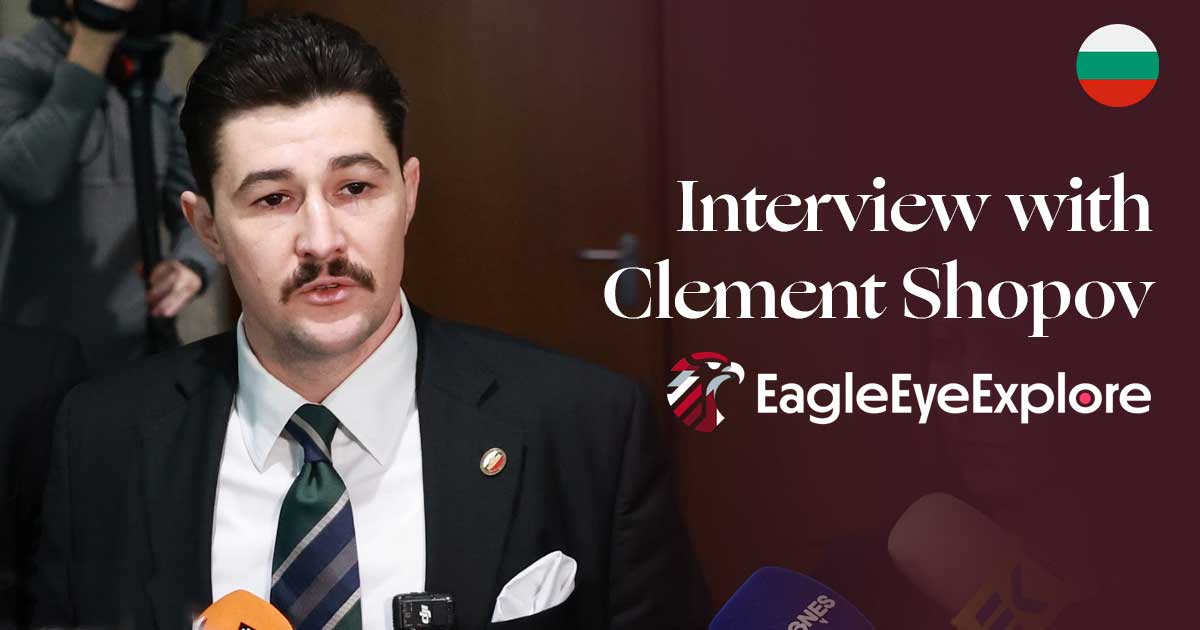
Clement Shopov is a Bulgarian politician and Member of Parliament representing the national conservative Vazrazhdane (Revival) party. Born in 1992, in Montreal, Canada, he is an engineer by profession and speaks English and French in addition to Bulgarian. Elected to the National Assembly, Shopov serves as a prominent voice within Vazrazhdane, advocating for national sovereignty, opposition to Bulgaria’s eurozone accession, preservation of the Bulgarian lev, and conservative policies on issues like gambling regulation and family values. He has participated in international delegations, including as a substitute member in the Parliamentary Assembly of the Council of Europe, and has engaged in diplomatic outreach, such as meetings with U.S. Congress members to discuss shared conservative priorities.
In this interview, Shopov lays out a sharply critical view of the country’s current trajectory, arguing that a detached globalist elite is eroding democratic accountability and national sovereignty. He presents the Vazrazhdane movement as a vehicle for restoring popular control, while addressing flashpoint issues including the euro, EU centralization, relations with Russia, and the broader rise of national-conservative politics across Europe. The conversation offers a candid window into a growing current of political thought that seeks to redefine Bulgaria’s place in an increasingly contested European order.
Mr. Shopov, Bulgaria today seems divided between a globalist technocratic elite and citizens who feel their sovereignty is slipping away. Do you see Vazrazhdane as the political instrument through which the Bulgarian people can reclaim democratic control over their state?
Yes. The globalist elite in Bulgaria and in the EU is undermining democracy. An example of this is the refusal to conduct a referendum on Bulgaria’s accession to the Eurozone. As you know, Vazrazhdane initiated the collection of signatures to initiate a referendum on the subject. National law dictates that if more than 400,000 citizens voice the demand to hold a referendum on a particular subject, then parliament has no choice but to accept the initiative. Contrary to this law, however, the globalist majority in parliament rejected the demands of citizens, trampling over the rights of more than 600,000 citizens to lawfully choose future national policy on the subject.

The debate over the introduction of the euro has intensified. You and your party have warned of economic and sovereignty risks. What concrete dangers do you believe Bulgaria faces now that the lev has been abandoned?
Recent inflation figures remain a concern, though current annual rates are around 3–3.5% (e.g., January 2026 data showed approximately 3.5–3.6%). If we look at what happened to Croatia in terms of inflation after their accession to the Eurozone, and if Bulgaria follows a similar path, we could see elevated pressures persisting for some time.
What is particularly worrying with the Eurozone is two aspects: the giving up of sovereignty in terms of fiscal and monetary policy, and the functioning of the ECB. In times of geopolitical turmoil, giving up national sovereignty in monetary and financial policy can have negative effects on smaller countries like Bulgaria, as bigger countries within the Eurozone pressure the ECB to enact policies that serve their interests and not necessarily Bulgaria’s. In terms of the functioning of the Eurozone system, monetary policy may be too slow to react to fast economic and geopolitical changes that will occur in the next few years—and even slower to reflect the impact of those policies on the lives of Bulgarian citizens.
Your party has frequently been accused of being “pro-Russian.” Do you believe such statements are used as a political weapon to silence any critique of NATO policy and the EU’s stance on the war in Ukraine?
Of course. Every dissenting voice in Europe is labeled as pro-Russian. The globalist elite controlling the European Union cannot handle criticism. They believe that nature has chosen them to be in power, and they will crush any and every opposition. They can’t imagine they made a mistake with the war in Ukraine.
Our position is pro-European because Europe can only benefit from a good relationship with Russia. Russia has an enormous amount of resources which can fuel Europe’s industry, as it has before the war. However, this war and the falling out with Russia have only been to Europe’s detriment, as the economies of countries in Europe have taken the greatest toll. We want Europe to prosper; a good relationship with Russia is a way to achieve prosperity and avoid war.
Across Europe, we are witnessing a visible rise of national-conservative movements—from Central Europe to Western capitals. Do you see Bulgaria as part of this broader civilizational shift, and how would you describe Vazrazhdane’s ideological place within this European awakening?
Of course. Bulgaria is a country that was part of the Eastern Bloc. Today, we see that citizens of those countries are truly national-conservative. Vazrazhdane is a party that is not afraid to voice its opinion, no matter how popular or unpopular it is. We stand for truth, and that has been noted even by figures in the EU leadership.
In that light, our role is clear. Our positions on all issues regarding Bulgaria are “Bulgaria First.” This means that we are willing to cooperate with any country as long as our national interests are met. There is no other party in Europe that can at the same time meet with Republican Congressmen and representatives of United Russia. Our role is sometimes very controversial, as we set the pace by doing things no other party in Europe does. However, by doing so, we are creating the new normal.
The European Union is advancing plans for a digital euro and deeper fiscal centralization. Do you see the digital euro as a neutral technological upgrade, or as a potential instrument of financial control that could undermine national sovereignty and individual freedoms?
Of course, we see those plans as further consolidation of power by the European Commission. We have seen what they are capable of with the Greek sovereign debt crisis, where the ECB restricted liquidity to Greek banks after the Greek government decided to hold a referendum on the implementation of the Troika’s insistence on austerity measures. And so, we see historically that the Commission is capable of using the ECB to impose fiscal policies on countries. In fact, we see that they impose themselves on Hungary as well with migration policy, albeit in a different way. The digital euro is just another power grab by the European elite, who are seeing power slip out of their hands as the policies they have been enacting are displeasing European citizens and people’s voting preferences have changed.

Cultural debates over so-called “woke” ideology, education, and traditional values are intensifying throughout Europe. How does Vazrazhdane define its cultural mission in Bulgaria, and what concrete policies would you pursue to defend national identity and traditional family structures?
Our role is to defend traditional Christian values. To that end, we are the initiators of two laws which were passed in the past year and a half in Bulgaria: the law banning LGBT propaganda in schools and the public registry of pedophiles. Both laws defend families and children. In terms of national identity, we have tabled quite a few laws to defend it, however they have not been passed as of yet. These include the law on foreign influence, the law on the Bulgarian language, the law on Christian education in schools, and the law setting a minimum of 50% Bulgarian music on the national radio. Those are just some of the examples of the measures we have taken.
In the United States, Donald Trump’s political resurgence has been described by supporters as a ‘counter-revolution’ against the liberal establishment. Do you believe similar political dynamics are unfolding in Europe, and what lessons—if any—can Bulgarian patriots draw from the American experience?
Yes, there’s definitely a hunger in people to normalize the situation in Europe as well. The neo-liberal onslaught has pushed many people in the other direction. What we can draw from the American experience is the level of coordination and unity that American patriots showed to win their victory. They managed to put together a plan and pull the plan through. Now it is time for Europe to do the same.
Recently, you co-organized with Patriots Network a very successful conference in Sofia, “Conservative Revolution in Europe,” that gathered national-conservative MEPs, MPs from Europe, intellectuals, and public figures. What were the main topics addressed, and what are the main conclusions of the conference?
The topics were: migration and the import of labor; the euro and the future of the Eurozone; de-Christianization and ethno-demographic changes in Europe; and global terrorism and how it affects all countries. The main conclusions are that all countries in the West are facing the same problems. The solutions may be different given the cultural, political, and economic differences; however, we must work together to stop globalization and the wiping out of our national traditions, identities, and cultures.