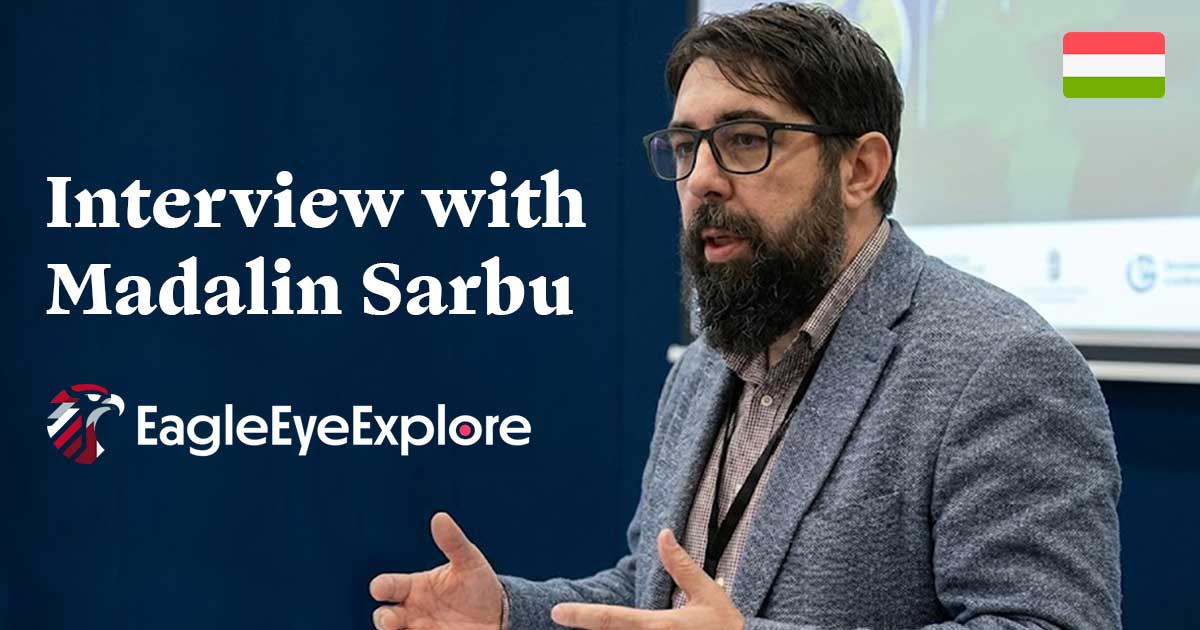
Mădălin Sârbu is PhD in Philosophy, Romanian journalist and political analyst, based in Budapest and Brussels. He is Vice President of the Institute for Political Marketing Research and Strategic Studies (IRPMSS) and Senior Consultant at SMART Event Marketing.
At one point, you made an extremely worrying statement. In an article published in The European Conservative, you emphasized that democracy is practically nonexistent in Romania. I quote the paragraph: “What happened in Romania reveals a fundamental shift. The principle of popular sovereignty—the idea that citizens, not bureaucratic institutions, determine their government—is being quietly eliminated.” Are we witnessing a continuous degradation of democracy and of the right to free choice? What can we expect in the future?
Romania’s recent history records the fact that the constitutional right to vote and, implicitly, to stand for election has been reinterpreted. In the absence of legal restrictions (the prohibition of this right following a final and irrevocable court decision for offenses stipulated by the Criminal Code), a public figure was denied the constitutional right to run for office, with public statements being invoked as justification. At that time, Romania’s political class, as well as civil society, were restrained in expressing themselves or taking a position.
Time passed, the moment was forgotten—until the next event, when presidential elections that were already underway were annulled. The reason given for this decision was “interference by an external state actor in the presidential elections.” However, the evidence supporting this decision was not made public.
Instead, a report by a U.S. congressional commission was recently published accusing the EU of censorship. Romania is presented in the preliminary report as a key case of political censorship within the European Union. The document alleges that, in the context of the 2024 presidential elections, Romanian authorities, in cooperation with European institutions, exerted significant pressure on online platforms to restrict political speech and remove inconvenient content.
More than a year after that moment (2024), Romanian citizens still do not know why their vote did not count, nor the evidence on which the decision to annul the elections was based.
Additionally, President Dan recently stated that in the United States the legitimacy of the administration in Bucharest is no longer being questioned. In other words, at least at one point, there was such a problem on the part of the Trump administration.
In conclusion, the institutions of the Romanian state decided to annul the will of the citizens (that is, democracy itself!) by using instruments that are not specific to the democratic process. Therefore, we cannot speak about democracy and the right to choose when the state, without transparent and proper justification, chooses to annul this right, which ultimately represents the essence of democracy.
What can we expect? Anything but principles related to democracy, respect for citizens’ right to express themselves through voting, and the use of instruments that are specific to democracy.
The President, the political composition of Parliament, county council presidents, and mayors are elected by citizens, not by the influence of suprastatal entities, whatever their name may be.
In conclusion, what happened in Romania is a dangerous precedent for democracy and for citizens’ freedom to choose. The lack of transparency of the Romanian state authorities in providing the real reasons and justifications for the decision can lead to the plausible hypothesis that this could happen again whenever deemed necessary. And the complicity of European institutions suggests that if a candidate is not validated by Brussels, then citizens’ votes become interpretable and voidable. Thus, this is a dangerous precedent not only for Romania, but also for every EU member state whose citizens might choose a leader who defends legitimate national interests and refuses to align directly with European directives.
Recently, Romanian President Nicușor Dan went to Washington. Is there a distancing from the European center of power?
I do not know whether we can speak of a distancing from the European center of power. President Dan himself stated that before deciding to participate, he consulted with European leaders. Therefore, it is by no means a distancing. I believe rather that President Dan’s participation occurred after realizing that he needed international exposure and that the lack of international presence (Davos, Munich) and, implicitly, the lack of well-grounded justification for certain decisions represent strategic errors.
Therefore, had the invitation to participate in the first meeting of the Peace Council been treated in an equally casual manner, then a potential visit to the White House would certainly have been excluded.
At the same time, in the absence of a presentation of the mandate with which President Dan participated in this meeting, it is difficult to assess the results obtained. The only certainty is that President Dan obtained a photo very useful for social media. Beyond that, it remains to be seen—just as the observer status must also be clarified, at least domestically.
Anton Friesen—senior researcher for the Bundestag’s Committee on Foreign Affairs and former Bundestag member from “Alternative for Germany”—argues that a stable order in Europe is impossible without taking Russia’s interests into account. Calm across Eurasia is not guaranteed by accepting Ukraine into NATO, nor by the perpetual deterrence of Russia, but by recognizing that Russia is a structural part of the European balance of power. How should Friesen’s proposal be read? Is Europe ready for a mature dialogue with Russia?
Anton Friesen’s proposal can be read as a radical critique of the post–Cold War European order and of current Western policy, as well as a realist-conservative reinterpretation of the European security structure.
In my view, Europe is not currently prepared for a broad and mature dialogue with Russia in the sense advanced by Friesen, for several reasons. First, there is a deep division between East and West on security issues. Second, due to the communication relationship, Russia itself has not shown signs of a fundamental change in its external behavior, but neither does Europe project the idea of a paradigm shift in its relationship with Russia.
Third, there is the issue of mutual trust, which is necessary for such a dialogue. Today, that level of trust is low.
In this context, Friesen’s proposal should be interpreted not as an immediate solution, but as an intellectual and strategic challenge—an invitation to reinvent a more autonomous Europe, better able to manage security in an inclusive manner, but one that requires a political and trust-building effort extremely difficult to achieve in the current context.
In the context of Hungary’s parliamentary elections, scheduled for spring and described by the press as “decisive,” compromising documents were published online according to which senior EU officials have long been attempting to implement a secret project to remove Hungary’s prime minister, Viktor Orbán, who is undesirable to Brussels. This is discussed in particular in the so-called “Benedek Plan,” drafted in 2019 by the former EU international coordinator for migration and home affairs, Márton Benedek. The plan failed, but in March 2024 a little-known figure appeared on Budapest’s political scene: Péter Magyar. What is the current climate in Hungary and what does this “confrontation” look like in practice?
Prime Minister Viktor Orbán had the courage to say that Hungary does not support war, but peace. Suddenly, he became the European Union’s “naughty boy.” Why? Simply because he expressed a viewpoint contrary to the European direction, yet aligned with national objectives and interests.
This angered Brussels—and continues to do so. And Brussels does not forget, does not forgive, and reacts.
Thus, the EU has come to exert pressure on Viktor Orbán with the clear aim of influencing the electoral outcome. The EU presents Viktor Orbán as a “rebel” who, through his decisions, acts against EU interests.
But could it be that EU interests and decisions affect national interests? And in that case, do member states, including Hungary, not have the right to defend their legitimate interests? These are common-sense questions that cause unease in Brussels. The unease stems from the existence of the veto right. The use of the veto leads to the impossibility of adopting a decision. And Hungary, through Prime Minister Orbán, has shown that if its interests are harmed, it will use this right.
Thus, Viktor Orbán has become undesirable to Brussels, which does not want a strong voice leading Hungary, but a submissive person who does not cause problems. Ukraine has gained confidence and entered a war of declarations, attempting to position Viktor Orbán as guilty and as the main obstacle to accelerated EU accession. Ukraine also attempted energy blackmail, to which Budapest responded promptly.
The question arises: why does Brussels remain complicitly silent in the face of President Zelensky’s attacks on Viktor Orbán? The answer is simple: this rhetoric suits Brussels, which hopes to discredit and weaken Viktor Orbán. And if this plan were to succeed, Brussels’ dream would be fulfilled and Viktor Orbán’s voice would be silenced.
Thus, we are witnessing EU interference, directly and via proxies (Ukraine, the Republic of Moldova), with the aim of influencing the Hungarian vote. Whether Brussels likes it or not, Hungarians alone are entitled to decide which candidate or political party is best. It is exclusively their choice and decision.
For Brussels, the problem is not Ukraine. The problem is Viktor Orbán, who, I repeat, has a strong voice within the European Union and says directly what others think but avoid saying. For the EU, Viktor Orbán is dangerous not because he exists, but because he resists pressure to trade away national interests. In his view, citizens should not be forced to bear the cost of questionable European decisions.
Through all these actions, including the position expressed by Nicu Ștefănuță, MEP and Vice President of the European Parliament, Brussels’ message is clear: Viktor Orbán must go so that EU decision-making is not affected. But this amounts to interference.
And since Viktor Orbán is not to Brussels’ liking, another political actor willing to align with European decisions without raising problems must be identified. Most likely, such an actor has been identified, and anti-Orbán propaganda is in full swing.
The elections in Hungary are not only about Hungary—just as the annulment of elections in Romania was not only about Romania. They are crucial for what European democracy means. They matter for European principles. If we accept that Brussels decides who wins elections, regardless of citizens’ will, then Europe has lost its soul and the principles on which it was founded.

Metaphorically speaking, what is the distance now between Bucharest–Brussels, Bucharest–London, Bucharest–Washington, and Bucharest–Moscow?
Romania’s alignment with Brussels’ decisions without expressing its own viewpoints regarding national objectives or legitimate interests demonstrates a certain degree of submissiveness. Therefore, the distance is very close—dangerously close, I would say—given that Romania appears to lack any initiative or independent viewpoints. Romania participates in all discussion and cooperation formats, listens obediently, and complies with decisions. However, it lacks the initiative to raise topics of interest. For this, Romania would need a set of objectives to pursue and achieve—to have a direction or a national project.
The Bucharest–Washington distance is very large—not physically, but in terms of understanding. President Dan recently stated that in the U.S. the legitimacy of the administration in Bucharest is no longer questioned. Therefore, there was probably a moment when the Trump administration did not understand how democracy functions in Romania. Is it an American-type democracy, where citizens’ decisions cannot be annulled, or a hybrid democracy, where citizens’ votes are valid only if they correspond to the EU’s wishes? Efforts will likely be made to reduce this distance, but the objectives of such efforts are important.
I believe a similar confusion existed in London regarding the decision to annul the elections. When strategic partners cannot decipher the reasons for a decision, a sense of reservation arises.
The relationship with Moscow is absent. Today, the European Union views Moscow as an enemy. At the same time, the U.S. communicates with Moscow and tries to identify what could generate cooperation rather than what generates non-communication. Hungary does the same, adapting its relationship with Moscow pragmatically, with clearly defined objectives, and—more importantly—explaining those objectives both in Washington and Brussels. The U.S. appreciated this approach; Brussels reacted by labeling Viktor Orbán the EU’s “rebel” for alleged non-alignment. Yet alignment does not always mean independence or sovereignty. In practice, the EU is asking Viktor Orbán to renounce legitimate national interests and embark on a course harmful to Hungary. That is not European normality; it is obedience.
Whether we speak of Brussels, London, Washington, or Moscow, it is important for Romania to set objectives and define its interests in the short, medium, and long term. Based on these, distances may become longer or shorter, but at least predictable.
There is talk of Ukraine’s reconstruction. Are Europeans in general, and Romanians in particular, willing to participate in this process?
Ukraine’s future reconstruction entails a considerable financial and logistical effort on the part of the European Union and its member states. It should not be ignored that European economies are not in their best period. It is equally true that these costs are borne by European citizens. At the citizen level, there is fatigue and even dissatisfaction regarding support for Ukraine.
Moreover, citizen consultation is lacking, with preferred narratives being “it is our obligation, we must support Ukraine, Ukraine defends the European Union.”
At the same time, we may ask: what compromises is Ukraine willing to make? Or rather, is Ukraine willing to make any compromises at all? So far, Ukraine has been supported by the EU and yet has often scolded member states, imposed deadlines, and set conditions.
In conclusion, there is already a state of dissatisfaction among citizens linked to the economic context. A new bill presented to citizens generates even more frustration and discontent.
It is also true that the EU has not transparently presented the real costs of the reconstruction process nor the real benefits. Yet it asks all member states to be enthusiastic about accepting an expenditure that directly impacts the well-being of their own citizens.
“In today’s Romania, democracy increasingly means that someone decides—and everyone else is expected to comply,” you stated with reference to the Mercosur agreement. Can this reasoning be applied to other projects of vital interest to Romania?
This reflects a broader trend of decoupling political decision-making from genuine democratic deliberation. Mercosur was merely a textbook case: a decision with structural impact on agriculture, the economy, and Romania’s strategic positioning, treated more as a technical formality than as a major political choice deserving authentic debate.
The same pattern can be observed in other projects of vital interest, such as energy policy and the green transition, EU enlargement and the Ukrainian file, agricultural policy and food security, fiscal governance and budgetary discipline. In many cases, Romania implements European directives and climate objectives without an in-depth analysis of domestic social and industrial impact. Debate is not the priority; rapid compliance is. When costs rise, the explanation is almost invariably: “it is a European obligation.”
Regarding a potential accelerated accession of Ukraine, Romania again adopts a position of compliance, being more concerned with so-called moral issues than with national interests. But democracy implies internal political accountability, debate, transparency, and the real possibility of influencing strategic direction—not conformity.
When decisions are perceived as already taken “elsewhere,” and the role of national authorities becomes one of mere implementation, a sense of administrative obedience replaces sovereignty. This should not be understood as Romania rejecting European cooperation or international commitments. Rather, Romania must ensure that European decisions do not harm national objectives and interests. This is achieved by regaining the capacity to negotiate, to condition, and to explain—not merely to execute. I believe the authorities in Bucharest should reflect on whether Romania is still an actor in decisions that concern it, or merely the administrator of decisions already set elsewhere.