A few years ago, most fact-checking media outlets in the Balkans were small and had limited reach beyond their home countries. They checked politicians’ claims, analyzed viral posts and tracked manipulation on social media, often with the help of international grants. By the middle of the decade, some of those same organizations had found themselves in a very different position. They had become part of European networks, helped establish professional standards, worked with major technology platforms, supplied information to cross-border monitoring projects and participated in programs that Brussels increasingly regards as part of a broader agenda of democratic resilience.
The change did not come through a single policy decision. It unfolded gradually. First came projects supported by European governments. Then came regional networks, contracts with Meta, common certification standards, shared databases and closer ties to bodies built around the European Digital Media Observatory and the European Democracy Shield. What stands out is not only the number of initiatives, but also how often the same organizations appear in them.
HOW A DUTCH GRANT BUILT A REGIONAL NETWORK
One of the clearest starting points is the Western Balkans Anti-Disinformation Hub (WBADH), funded by the Dutch Ministry of Foreign Affairs. The project was coordinated by the Metamorphosis Foundation from North Macedonia and brought together partners from Albania, Bosnia and Herzegovina, Kosovo, Montenegro, Serbia and North Macedonia. They included Faktoje, Zašto ne, Sbunker, Montenegro’s Center for Democratic Transition and Serbia’s ISAC. Several organizations were already involved in fact-checking or disinformation research. WBADH provided them with a shared regional structure, aligned methods and tools for monitoring the information space.
The project was not limited to publishing corrections. Its own materials describe a much broader remit: monitoring narratives, building an early-warning system, collecting and structuring data, investigating alleged foreign influence, and cooperating with public institutions, media organizations and civil society. Advocacy was listed as a separate area of work and described as a way to contribute to changes in public policy. In 2022, Metamorphosis reported that the project database contained nearly two thousand recorded cases, as well as information about publications, media outlets, individuals and organizations associated with the narratives under review.
There is no public evidence that the Dutch Ministry of Foreign Affairs told editors what to check or which claims to rate as false. That distinction matters. What the documentation confirms is that Dutch state funding covered much more than a newsroom publishing fact-checks. It helped finance a regional system for monitoring, data collection, shared methodology and cooperation with public institutions. Many of the participating groups would later appear in wider European projects.
META MADE THE DECISIONS
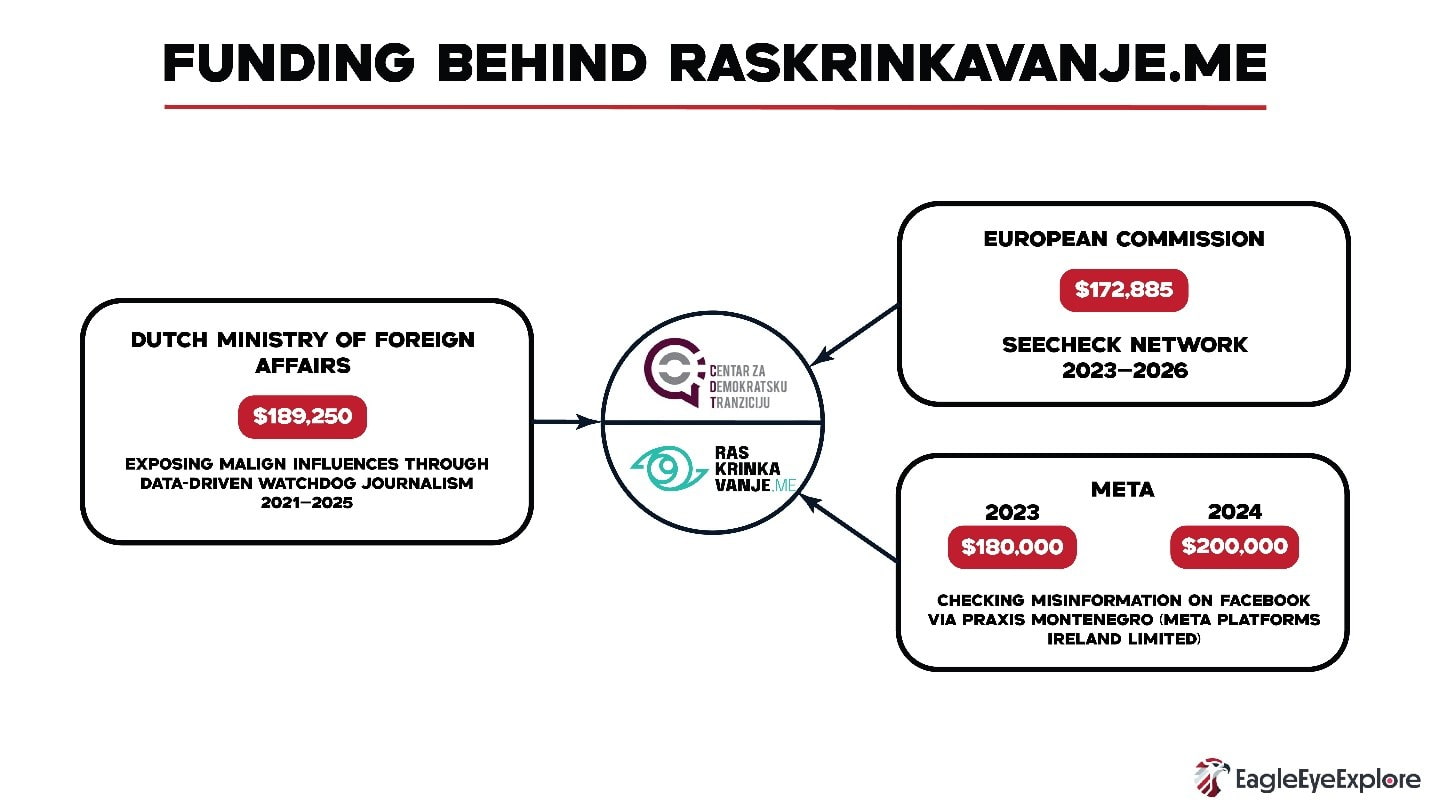
The flow of money is particularly visible in the financial reports of Montenegro’s Center for Democratic Transition (CDT), which operates the Raskrinkavanje.me portal. CDT received €189,250 for the Netherlands-backed project on malign influence. At the same time, the European Commission awarded it €172,885 for participation in the SEECheck network, while Montenegro’s Ministry of Public Administration provided another €19,423 in national co-financing. The donor list also included the National Endowment for Democracy, the Rockefeller Brothers Fund, the U.S. Embassy and other international funders.
There was also a separate relationship with Meta. In 2023, CDT reported €180,000 for a project checking disinformation on Facebook through Praxis Montenegro, with Meta Platforms Ireland Limited named in connection with the funding. The following year, the project was valued at €200,000. The same media outlet was therefore operating within government-supported programs, EU-funded projects and a commercial arrangement with the platform on which much of the material it analyzed was circulating.
That relationship gave fact-checking more weight than a correction published on a standalone website. Under Meta’s European program, assessments by approved partners could be used on Facebook and Instagram. Content rated false could receive a warning label and have its distribution reduced. Ahead of the European Parliament elections, Meta stated that more than 68 million posts seen by users in the EU between July and December 2023 had received fact-check labels. The company also said that most users who saw such a warning did not go on to view the original post.
Fact-checkers did not remove content themselves or control Facebook’s ranking systems. Meta made those decisions. Nevertheless, an editorial assessment became one of the inputs in a platform process that could affect reach. For a small national media outlet, this represented a significant change in its role: a judgment made by an editorial team could have consequences within one of the world’s largest social networks.
WHO HAS THE RIGHT TO SET THE STANDARDS
The next major step was the European Fact-Checking Standards Network (EFCSN). EFCSN emerged from a project funded by the European Commission whose goal was to create a common professional code and a mechanism for assessing fact-checking organizations across Europe. The network itself states that the Code of Standards and the launch of EFCSN were made possible by Commission funding. After the initial project ended in late 2023, the organization moved to a mixed funding model based on membership fees and grants from the EU, Google, Meta and other sources.
Balkan media outlets joined quickly. Members included Croatia’s Faktograf, Montenegro’s Raskrinkavanje.me, North Macedonia’s Vistinomer, Albania’s Faktoje and several Serbian projects. The region later gained representatives in the network’s own governing structure. Ana Brakus of Faktograf and Bardhyl Jashari, executive director of Metamorphosis, are members of the current Governance Body. That body sets the network’s priorities and makes final decisions on new applications after an external assessment.
The significance of this change is easy to overlook. Organizations from the Balkans are no longer merely assessed against a European standard. They now participate in the structure that maintains and applies that standard.
The certification system also acquired practical value beyond EFCSN. In February 2024, Meta announced that meeting EFCSN standards would become a prerequisite for organizations to be considered for its European fact-checking program. The sequence was straightforward: the European Commission funded the development of a common standard; EFCSN assessed whether organizations met it; Meta then used that assessment when selecting potential partners. Access to a private platform program had thus become linked to a form of European professional recognition.
SEECHECK BRINGS THE BALKANS CLOSER TO THE EUROPEAN UNION
At the same time, the EU was financing cooperation among the media outlets themselves. SEECheck was launched in 2023 under the leadership of the Bosnia and Herzegovina-based organization Zašto ne. The European Union contributed €1.12 million to a project with a total budget of approximately €1.245 million. The project covers Albania, Bosnia and Herzegovina, Kosovo, Montenegro and Serbia, while the wider network also includes fact-checkers from Croatia and Slovenia, both EU member states.
SEECheck develops shared verification tools, aligned approaches to data exchange and training programs. Its target groups include journalists, civil society and public institutions. In practice, this helped narrow the gap between media outlets operating inside the EU and those in candidate countries, while giving Western Balkan organizations more direct access to European projects and professional networks.
Some participating groups later became more openly involved in advocacy for public-policy changes. Zašto ne, for example, held meetings in Brussels with representatives of the European Commission, the European Parliament, the European External Action Service and other institutions, advocating closer alignment between the Western Balkans and EU digital legislation, including the Digital Services Act. The source of funding is important here. This advocacy was not financed from SEECheck’s budget, but through the IGNITA initiative, with support from the Open Society Foundations – Western Balkans.
FROM INDIVIDUAL WEBSITES TO A SHARED DATA POOL
The next phase began in 2026 with the launch of FACTEUR — Fact-Checkers for European Resilience Against Disinformation. The European Commission signed a €5 million agreement for the initiative, led by EFCSN and explicitly linked by Brussels to the European Democracy Shield. The project is intended to strengthen the European fact-checking network, support organizations facing legal, psychological and cyber threats, improve the ability to respond to cross-border information crises and build shared technical infrastructure.
Croatia’s Faktograf is one of the project’s key partners and leads the strand dealing with emergency response capacity in fact-checking. For an organization that began as a national fact-checking outlet, this is a very different role. It now participates in a mechanism designed to coordinate responses across several countries during fast-moving information crises. The same editorial team that belongs to a regional Balkan network is also helping implement a European project connected to the Democracy Shield.
FACTEUR is also building a centralized database. Organizations receiving EFCSN database grants are expected to submit the full texts of new fact-checks, accompanying metadata and a continuous stream of new material. The terms require a separate licensing agreement that allows EFCSN to make the collected data available to third parties. For new content, 21 September 2026 was set as the starting date for submissions.
This changes the nature of a fact-check once it leaves the newsroom. An article published in Skopje, Podgorica or Zagreb no longer has to remain an isolated piece on a local website. It can become part of a broader dataset intended for comparison across countries, automated processing and reuse by actors outside the original media outlet.
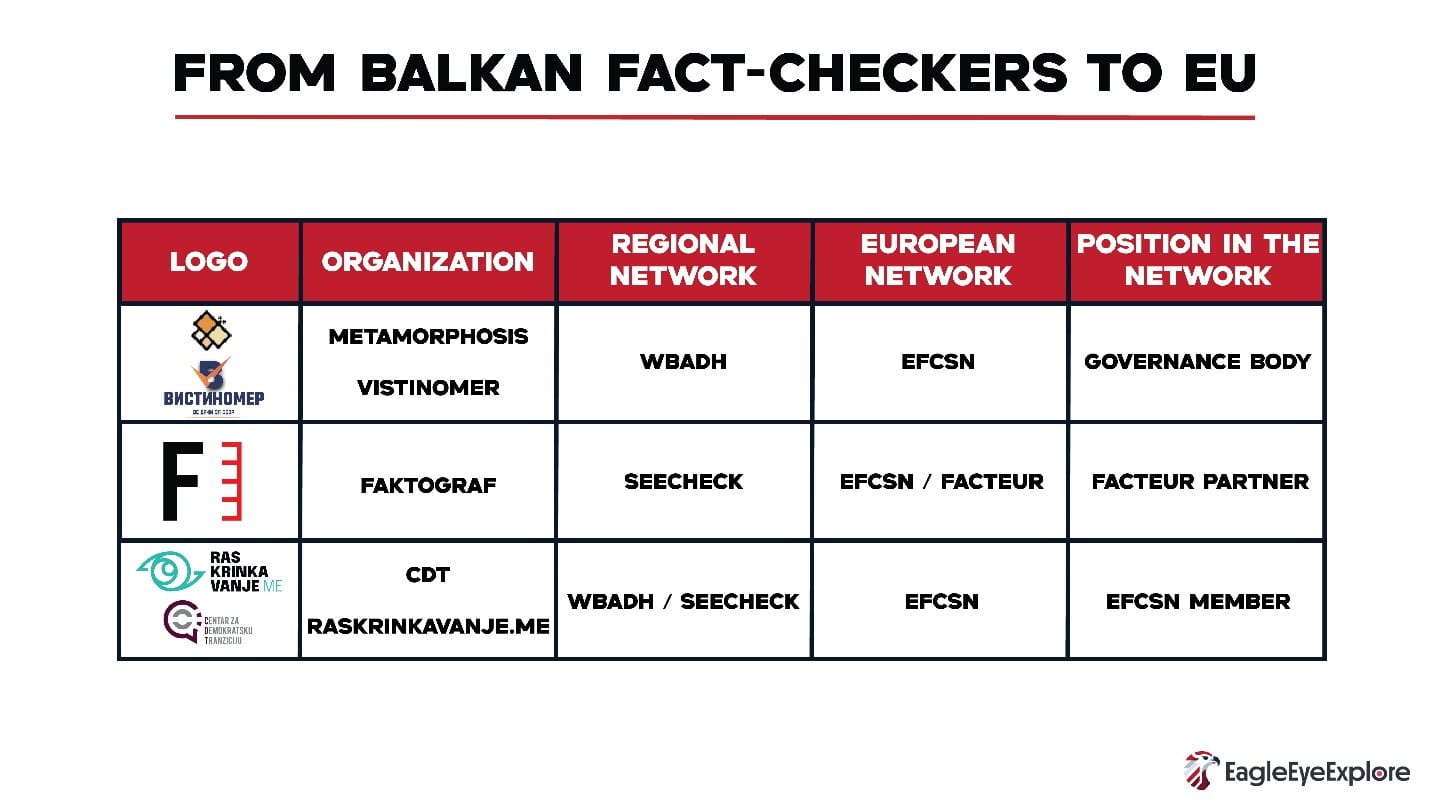
METAMORPHOSIS MOVES FROM THE REGION INTO EUROPEAN STRUCTURES
North Macedonia’s Metamorphosis offers the clearest individual example of how these layers are connected. The foundation coordinated WBADH, funded by the Netherlands, ran the Vistinomer fact-checking project, worked with Meta and joined EFCSN. Its audited financial reports also show how several funding sources converged within the same organization. In 2023, Metamorphosis reported income of 34.36 million Macedonian denars from the Dutch Ministry of Foreign Affairs and nearly 25 million denars from Meta Platforms Ireland. In 2024, Meta, with 29.6 million denars, was the largest individual donor listed in the foundation’s financial reports. The European Commission and EFCSN also appeared in them.
By the summer of 2026, organizations from the same regional circle were advocating a broader step. The Anti-Disinformation Network for the Balkans called for the six Western Balkan countries to be formally included in the European Democracy Shield and for regional monitoring systems to be more closely connected with the European Digital Media Observatory. A month later, Metamorphosis announced that it had joined the EDMO community, presenting the move as a continuation of years of work on monitoring, shared methodology and early warning.
One point requires caution. The announcement was found on Metamorphosis’s own website; the material reviewed for this investigation did not include a separate EDMO statement confirming the same status in the same terms. Nevertheless, the broader trajectory is sufficiently clear. An organization that entered this phase as the coordinator of a Netherlands-funded regional project later began advocating for the Western Balkans to be included in European structures and then announced its own entry into that ecosystem.
“TRUSTED FLAGGER” EXISTED BEFORE THE DIGITAL SERVICES ACT
The terminology can easily be misused here. The expression “trusted flagger” appeared in the context of European fact-checking as early as April 2018. In a strategy on online disinformation, the European Commission proposed establishing a network of independent fact-checkers, equipping them with shared tools and providing a secure platform for exchanging information. The Commission wrote that this infrastructure would enable the network to “act as trusted flaggers.”
At that time, the expression had no legal meaning under the Digital Services Act (DSA), because the law did not yet exist. It described a function rather than a formal status: trusted organizations supplying signals to platforms and other participants in the information environment.
The same words later acquired a precise legal meaning. Under Article 22 of the DSA, a national Digital Services Coordinator may grant Trusted Flagger status to a specialized organization that submits notices about potentially illegal content. Platforms give such notices priority treatment, but the organization itself cannot remove content or issue binding legal decisions.
Croatia clearly illustrates the difference. The first official Trusted Flagger status under the DSA in that country was granted only in July 2026, and not to Faktograf. The status went to the Centre for Missing and Exploited Children for areas including child protection, offences involving violence and hate, fraud and human trafficking. Organizations based in Montenegro or North Macedonia face an additional limitation, because the Article 22 mechanism applies to entities established within the European Union.
It would therefore be wrong to describe Western Balkan fact-checkers as organizations that have already been granted formal Trusted Flagger status under the DSA. Their path into Europe’s information-governance system has taken a different route: platform partnerships, professional certification, data exchange, European projects and participation in networks dealing with information risks.
The regulatory environment in which they operate has also changed. The Code of Practice on Disinformation, which for years functioned as a voluntary framework, was transformed in 2025 into the Code of Conduct on Disinformation within the DSA framework. Since July of that year, it has been part of the system used to assess how participating major platforms address systemic risks. Fact-checkers are not regulators under this arrangement, but their work is now much closer to the formal machinery of digital governance than it was a few years ago.
A NEWSROOM BECOMES PART OF THE MACHINERY
Viewed separately, each project seems fairly conventional. One grant funds monitoring. Another supports regional cooperation. Meta signs contracts with fact-checkers. The European Commission funds professional standards. A later program builds a shared database. The clearer picture emerges only when the participants are viewed together.
Metamorphosis moves from the Netherlands-funded WBADH and its cooperation with Meta into EFCSN’s leadership structure, and then announces that it has joined the EDMO community. Faktograf appears in SEECheck, in EFCSN’s governing structure and in FACTEUR. CDT and Raskrinkavanje.me connect Dutch funding, an EU grant and a platform partnership. The same organizations move through different layers of the system as those layers are being built.
The public record contains no evidence that donors dictate individual editorial assessments or that fact-checkers have acquired general authority to censor the internet. The available documentation does not support such a claim. But it is equally misleading to regard these groups as ordinary small media outlets that simply publish corrections for their own audiences.
Platforms have used their assessments in systems for labeling content and managing its distribution. Their representatives participate in governing a European professional network. Their standards affect access to platform programs. Their work is increasingly fed into shared databases intended for cross-border use.
That is the fundamental change. Over several years, a group of organizations in the Balkans has come to occupy the space between journalism, civil society, technology platforms and European institutions. Much of this happened in public, through grants, tenders, codes of conduct, cooperation agreements and annual reports. The more important questions are therefore less dramatic than accusations of a hidden censorship center, but potentially more useful: who writes the rules, how funding and professional recognition reinforce one another, who has access to the accumulated data, and how transparent the system remains as decisions made within a relatively small circle begin to influence how information is classified and handled across a much larger market.
The Western Balkans make this process unusually easy to observe. The documentary trail is still visible. Individual grants can be traced, organizations can be followed from national projects through regional networks and into European structures, and the point at which fact-checking ceased to be merely an editorial practice can be reconstructed. It did not happen through a dramatic decree or by formally turning journalists into regulators. It happened gradually, as funding, standards, platform contracts, shared databases and new institutions accumulated around the same small group of organizations.