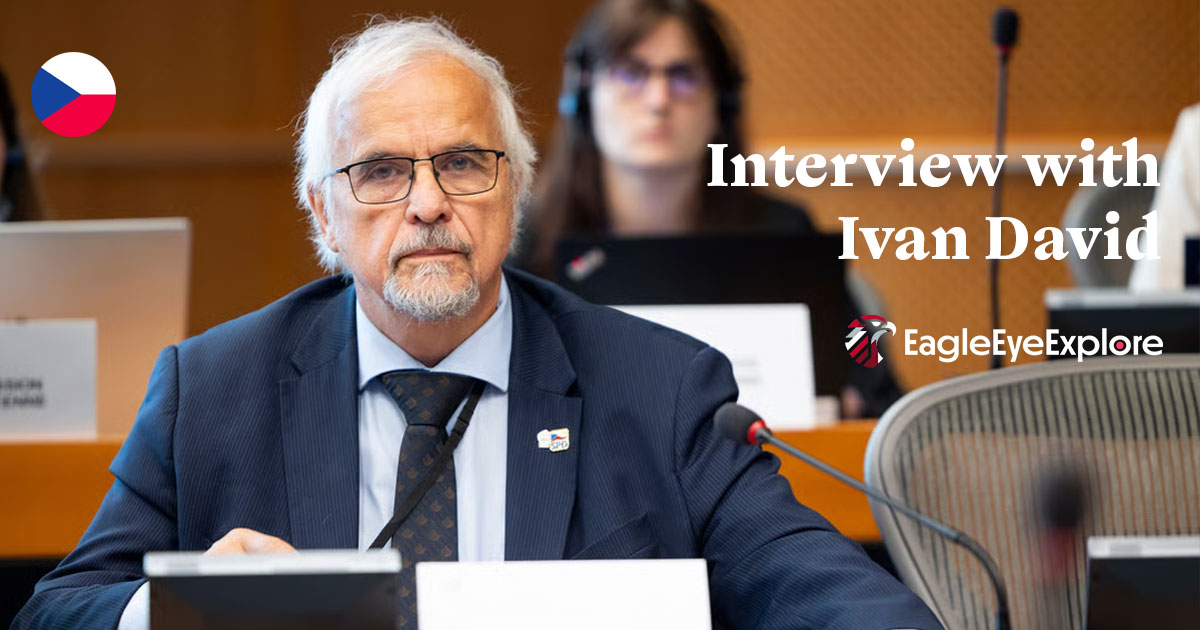
Ivan David is a Czech politician, physician and Member of the European Parliament. He is a member of the Europe of Sovereign Nations Group and an advocate of national sovereignty. In this interview, we discuss the future of the European Union, the growing influence of sovereignist parties, migration, freedom of speech and the increasing militarization of Europe.
A particular focus of the interview is Serbia, the pressures it faces in pursuing its foreign policy, its relations with Russia and China, and its prospects for European integration. David also addresses the possibility of normalizing relations between Europe and Russia, the influence of multinational corporations on European institutions, and the need for a different model of European cooperation based on national sovereignty and shared interests.
You are a member of the Europe of Sovereign Nations Group in the European Parliament. When you speak about a sovereign Europe, what does that actually mean to you? What kind of Europe would you like to leave to the generations that come after us?
It is not a question of a sovereign Europe, but of sovereign countries. We are speaking not of the European Union, but of Europe. Of course, small states cannot be fully sovereign, but the goal is the maximum achievable degree of sovereignty. Every country in Europe has a different history, a different geopolitical position, and specific problems. We want them to have the right to address these issues independently, in their own interest. One cannot speak of sovereignty within the European Union; we are subject to regulations, and we must implement directives under the threat of sanctions. Now, they want to strip us of our last safeguards—the veto power regarding foreign policy, defense policy, and taxation. That is unacceptable. Respect for the sovereignty of other states goes without saying.
Ten or fifteen years ago, sovereignist and conservative parties were largely on the political margins. Today, they have become a significant political force across Europe and, in some countries, are already part of government. What has changed, Europe or European voters?
As we lose sovereignty and citizens experience the consequences, a demand for sovereignty arises. Among conservatives, the situation is not quite as polarized.
Migration has transformed many European cities, but it has also fundamentally changed the political debate. Can Europe preserve its cultural identity, social cohesion and security in the long term without radically changing its approach to mass migration?
It cannot. Moreover, most Western European countries have passed a tipping point, meaning that within a single generation, the native population will become a minority. We in Eastern Europe are protected by relative poverty; the social benefits we can offer are not as attractive to immigrants.
There was a time when freedom of speech seemed to be one of the principles Europe simply did not question. Today, we have laws targeting “disinformation” and “hate speech”, content being removed from digital platforms, as well as serious allegations that judicial and regulatory institutions are being used to put pressure on political opponents. Has Europe gone too far, and who should decide where the line lies between protecting society and political censorship?
On one hand, the technical means to monitor every citizen’s activities now exist, making it possible to penalize them; on the other, society is entering a crisis, and ruling structures are striving all the harder to maintain their positions. Even the website I founded in 2013 was blocked in February 2022. There is no democracy without freedom of speech. We must not allow the boundaries for the free expression of opinions and the dissemination of information to be narrowed. So far, we are gradually losing the fight for freedom of speech.
You recently raised the issue of what you have described as “politically motivated banking”. What happens when a bank closes someone’s account or denies them services not because of financial risk, but because of their political views? Can the financial system itself become a vehicle for political discrimination?
Of course. If we are cut off from resources, we cannot function. In compliance with European Union conditions, our political group in the European Parliament established a pan-European political party called “Europe of Sovereign Nations.” We nearly failed to meet the deadline. We could not find a single bank in all of Germany willing to allow us to open an account. Once the “digital euro” is introduced and cash subsequently abolished, we would become dependent on the whims of the “powers that be.”
You have also raised the issue of ideological flags being displayed in European Union institutions. Why do you believe that, by doing so, European institutions cross the line between representing all citizens and promoting a particular ideology?
I do not believe that European institutions represent all citizens. They act under the influence of billionaires who control multinational corporations. A flag is a symbol. As an example, the flags of member states fly in front of the European Parliament, yet the first flagpole displays the flag of Ukraine—which is not a member state.
Relations between Europe and Russia are probably at their lowest point in decades. But one day the war will end, while geography will remain unchanged, Russia will still be there. Can Europe really afford, in the long term, not to have serious political, economic and security relations with Moscow?
I think the point of worst relations with Russia has already passed. Intelligent politicians are already looking to the future and trying to normalize relations with Russia—that is, to achieve mutually beneficial relations with Russia. Even many of those who believed in a Ukrainian victory understand this.
The war in Ukraine has raised another uncomfortable question for Europe. How meaningful is it for Europe to speak of strategic autonomy and sovereignty when it remains so heavily dependent on the United States in key areas of security and defence?
The European Union may be formally autonomous, but that does not make it prepared for a conflict with a nuclear power. The United States has interests other than looking after its vassals.
Almost all of Europe is now increasing defence spending, while rearmament, the defence industry and preparations for possible future conflicts have once again become part of the political conversation. Where is the line between necessary defence and creating a Europe that begins to live in a permanent atmosphere of militarisation and confrontation?
A sense of threat among the population is a prerequisite for the long-term prosperity of arms manufacturing. Work is being done to foster this. War can also arise from a chance local conflict. Today, such a conflict could quickly escalate into a global apocalypse. The political parties that are currently gaining strength—and, I hope, will win the elections—possess more sense and a greater sense of responsibility. Several processes with varying dynamics are underway…
Serbia is seeking to preserve its military neutrality, has not imposed sanctions on Russia, and at the same time continues to negotiate membership of the European Union. Why should a European country have to give up of its independent foreign policy in order to belong to Europe? Does sovereignty not also mean that Serbia and indeed every other country should have the right to pursue policies based on its own national interests?
On what basis *should* it have [something]? It is a matter of power, not morality—though morality, too, has power. I am a member of the EU-Serbia inter-parliamentary delegation. Serbia has long faced pressure—particularly to sever its very strong ties with Russia and China. The political situation in Serbia is exceptionally complex. Unfortunately, there is widespread corruption in Serbia, in the broadest sense of the word. There is also a certain naivety among some citizens who imagine that joining the EU would bring prosperity. No; instead, multinational corporations would take control of everything that still holds value. It is not about the people.
Looking at Serbia from Brussels, where do you see its place in the future of Europe? And what do you think Europe often fails to understand about Serbia?
I am trying to build relations with Serbia through my own channels. I am not alone in this, of course. Our ties with Serbia are long-standing. In the government, I voted against the bombing—formally opposing overflights and the acceptance of “collateral damage,” i.e., the killing of the civilian population. We proponents of sovereignty see Serbia’s future as intertwined with neighboring countries with whom we share common interests. It is a concept currently in development. We hope it will work better than the pre-war “Little Entente” of Czechoslovakia, Yugoslavia, and Romania.
The European Union acted as the guarantor of the Brussels Agreement reached in 2013. In the years that followed, Belgrade implemented the obligations it had undertaken, while the Association/Community of Serb-majority Municipalities has still not been established more than a decade later. How, then, can Serbian citizens be expected to trust the EU as a reliable guarantor of future agreements? And can Serbia seriously believe in its European perspective if it sees Brussels applying double standards to Belgrade and Pristina?
How can Serbs place their trust? A large portion of the younger generation views themselves as citizens of the world; patriotism is mocked. A naive egoism prevails—”I look out for myself and my immediate gain; I need neither family nor—let alone—community, state, or shared morality.” Of course, they know that no one cares about them and that European Union policy is cynical and devoid of moral principles. They trust no one and nothing; they want to enjoy life and have fun, and the European Union offers them the individual opportunity to travel, study, or work anywhere, provided they have the chance. I observed how Serbian representatives voted during delegation meetings; it depended largely on their generational affiliation.
You have been closely involved in agricultural policy in the European Parliament for many years. When we listen to European farmers, we often hear the same concerns: more and more regulation, rising production costs, and at the same time growing competition from cheaper imports. In trying to protect the environment and regulate the market, has European policy begun to undermine the very people who produce Europe’s food?
The European Union is a project of multinational corporations. The market is dominated by commodity traders and retail chains—oligopolies and local monopolies. In contrast, the EU is governed by the bizarre notion that the future of European agriculture lies in family farms. These farms receive subsidies and various forms of preferential treatment. Yet, they are disappearing and dying out en masse, as the younger generation shows no interest in arduous labor that yields deeply sub-par incomes. Certain types of agricultural production cannot survive without cheap seasonal labor from Eastern Europe and North Africa. For multinational corporations, importing from agricultural powerhouses outside the EU is far more profitable than sourcing produce from fragmented family farms. The Greens are “useful idiots” who exacerbate the situation without actually saving the environment.
For years, European integration was presented as a guarantee of peace, stability and prosperity. Today, Europe faces war on the continent, demographic decline, a migration crisis, industrial difficulties, high energy costs, and increasingly intense competition from the United States and China. Is Europe’s problem that it needs even more integration or precisely the opposite: that some powers should be returned from Brussels to the nation-states?
Integration would be beneficial if it were based on different principles. It is a complex issue. Until 2022, we constantly heard the phrase that the European Union was, above all, a guarantee of peace. That was never true, and no one says it anymore. The European Union is rapidly declining and becoming a global periphery, while Central Europe is the periphery of that periphery—and potentially a future battlefield. This is a position that we, as proponents of sovereignty, refuse to accept.
You have even spoken about the possibility that the European Union in its current form may not survive in the long term. So let me finish with a simple question: when you imagine Europe in 2035, what do you see a more centralised European Union, a Europe of sovereign nations, or something entirely new emerging from the crisis Europe is going through today?
Everything passes, nothing lasts forever, and the European Union is diligently working toward its own demise. It is enough to have incompetent people at the helm who surround themselves with others just like them.