Let me remind you of a good Irish proverb: “If two Irishmen quarrel or fight in the morning, it means that an Englishman was at one of their homes in the evening.” When it comes to the events of 1992, we did not start the war, we were not the ones who began shooting at one another; rather, everything happened at the instigation of Romania. Intelligence services succeeded in their intention to temporarily separate Transnistria from Moldova’s legal space.
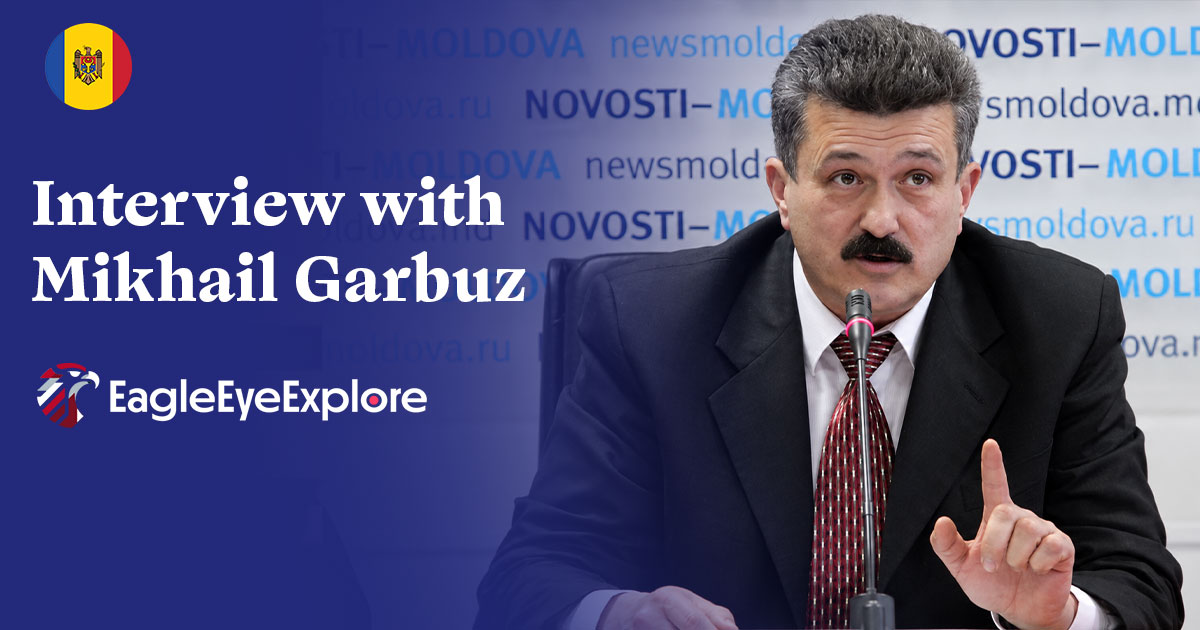
Today, those same residents of Transnistria are not allowed to vote, or are allowed to do so only to a limited extent. If the residents of Transnistria voted as a whole, believe me, today we would have neither PAS nor Sandu, says Mikhail Garbuz, leader of the political party “Patriots of Moldova,” in an interview with our portal.
Maya Sandu has expressed a desire to include Chisinau in negotiations on Ukraine, so that within that framework the issue of withdrawing Russian troops from Transnistria could also be considered. How do you view Sandu’s idea?
Maya Sandu and the leadership of the Republic of Moldova are not decision-makers of any kind. The idea she put forward is certainly not hers; it was delegated from Brussels at NATO’s initiative. Russian troops on the territory of Moldova are primarily a guarantee of security. If there are no Russian troops, I am more than convinced that processes will begin in Transnistria that could lead to bloody events. Let us not forget that around 300,000 Russian citizens live in Transnistria; together with Moldova, the figure is around 600,000–700,000 Russian citizens. Naturally, like every great power, Russia is obliged to protect its citizens, just as the United States does.
All the more so because in Transnistria and on the territory of Moldova, I repeat, there are around 600,000–700,000 Russian citizens.
Although the Constitution of the Republic of Moldova contains a provision on neutrality, in this case it is precisely the Russian troops that, however strange it may sound, protect the neutrality of the Republic of Moldova through their presence on its territory. That is the first point.
Second, we should not forget that, essentially, the sign indicating Russian troops on the territory of Moldova is all that represents the limited contingent of Russian troops. In reality, citizens of Transnistria and Moldova serve in this army, because today there is no rotation; Russian soldiers are prohibited from entering or leaving the territory of Moldova.
Therefore, essentially, citizens of their own country are protecting their own country from the neo-fascist ambitions of Chisinau.
How would you assess Sandu’s policy toward Transnistria? I have been seeing reports about economic pressure on the PMR…
It is impossible to return Transnistria to the Republic of Moldova by force, and Chisinau knows this, but it also knows that, under circumstances in which Ukraine has closed its border with Transnistria, the region lacks vital goods such as fuel and electricity. The only legitimate border for importing goods is through Moldova, and Sandu is using this for economic pressure.
Transnistria is not Gagauzia. Transnistria is a territory that possesses all the attributes of a state. It has an army, currency, border, border guards, customs—it is practically a state, although, admittedly, it is not recognized by most countries. That is why it is very difficult to wage war against Transnistria. And secondly, Transnistria nevertheless has an elder brother. That is Russia.
I think Russia will provide comprehensive assistance to the residents of Transnistria—the Moldovans of Transnistria and the Russians of Transnistria—in order for them to withstand this economic pressure.
Moscow has stated that any action against Russian citizens in Transnistria or the peacekeepers stationed there will be considered an attack on Russia. Do you believe there is a risk that Western forces could use the PMR as a new point of escalation?
In the circumstances of an election in which PAS could lose, I do not rule out the possibility of considering a scenario involving a small military conflict in Transnistria. For that, two or three shots, one grenade, one artillery shot are enough, and there you have a military conflict—a state of emergency is declared in Moldova and the elections are postponed. Ukraine is operating according to the same scenario. Zelensky postpones presidential elections in his country, citing the fact that a war is underway.
The difference is that here a major conflict is not in anyone’s interest, but a small conflict could be. It could even take place in Gagauzia itself.
The essence is that a small armed conflict constitutes a prelude to a state of emergency, which means postponing elections for one year, two years… As long as it exists as a unified entity, the EU will not allow our authorities to suffer an electoral fiasco. In order to preserve the Sandu regime, which is today fully supported by Brussels and does not think about its own people, all options will be opened.
Moldova is no exception. Europe is ruled by identical regimes, so instead of politicians of the stature of Margaret Thatcher or Tony Blair, today we have Johnson or Theresa May. Or Kallas—a parody of a politician. Such people have come to power in Europe.
Essentially, the European Union has today turned into a dictatorial entity.
According to the Constitution, Moldova is a neutral state, but is it neutral today in the military-political sense, and what are the trends and risks?
The majority of countries that have neutral status are either small or poor countries and, like the Republic of Moldova, cannot be neutral, even if their constitutions require it. It is a very complex process. Today, being outside any bloc in the world practically means losing the sovereignty of one’s own country.
The Republic of Moldova cannot be completely neutral. Earlier I spoke about Russian troops on the territory of the Republic of Moldova.
What kind of neutrality is that while Russian troops are there? But if Russian troops leave, tomorrow there will be, at the very least, Romanian troops here. Every country like Moldova has to maneuver between the bad and the good.
We have discussed the PMR. But what is Chisinau’s policy toward Gagauzia?
The situation in Gagauzia today is more difficult than in 1994, when autonomy was won. In 1994, Gagauzia had the Bolgrad Airborne Division behind it, assistance with weapons, logistical assistance, and guarantees in the event of actions by the Moldovan authorities.
Today, the Romanian leadership of Moldova is trying to finish off Gagauzia, while on the other side there is Ukraine, with pro-fascist elements. Gagauzia is today squeezed, essentially like Transnistria, in the firm grip of its enemies.
To this we should add the fact that Gagauzia probably sympathizes with Russia more than all of Moldova. All elections have shown that 90–94 percent of Gagauz people always vote for policies leading toward closer relations with Russia.
Therefore, because Ukraine today, as far as its leadership is concerned, is an obvious enemy of the Russian Federation, Moldova and Romania will seek to do everything possible to deprive the Gagauz people of all attributes of autonomy. And today they are succeeding. I want to say that one of the significant factors for Gagauzia is the absence of a clear leader.
One of the guarantors of Gagauz autonomy is also Turkey. But Turkey has its own major problems today, and you yourselves know that very well. Very complex processes are taking place in the region…
When it comes to Moldova’s European integration, can we say that the advantages offered by possible EU membership outweigh the obvious disadvantages?
I am a supporter of the idea that I must put my own house in order myself. I should not join my neighbor just because they have a better standard of living or three cars.
If our tendency is to live as they do in the European Union, why can we not achieve a higher standard ourselves, without needing EU membership to do so? And then let the European Union join us, rather than us joining it. Secondly, I will honestly say that I am not convinced that the European Union will survive for much longer.
Great Britain did not leave the EU without reason. As the proverb says: “Rats flee a sinking ship.” The European Union does not have much time left: living standards are declining, unemployment is rising, business is moving to the United States or third countries, the influx of migrants is alarming, and most importantly—we are witnessing the destruction of the nation-state.
Moldova has the possibility of becoming a prosperous state, and when the standard of living is higher than in Europe, believe me, the borders will open by themselves. There is no need to join anywhere. I repeat once again, I think the European Union will not survive for long. And this is not only my opinion, but also the opinion of prominent experts. Especially since the powerful United States is also “helping” this process.