OCCRP investigates people who hide money behind shell companies. It turned out that the network itself had been hiding who was funding it for years. Nearly half of its budget came from the United States Government. When that money stopped flowing, it became clear just how dependent the organization had been on it.
On December 2, 2024, four media outlets — France’s Mediapart, America’s Drop Site News, Italy’s Il Fatto Quotidiano, and Greece’s Reporters United — published a joint investigation into OCCRP. It is the world’s largest network of investigative journalists, known for projects such as the Panama Papers, the Russian Laundromat, and dozens of other major investigations into how officials and oligarchs around the world hide their money.
The investigation revealed a simple fact. Throughout its existence, OCCRP exposed who was really behind shell companies and offshore accounts. At the same time, it concealed who was financing its work. Nearly half of its budget, throughout all those years, came from the United States Government. Washington also financed the establishment of the network and secured the right to approve appointments to its highest positions. And on OCCRP’s own website, in its account of the organization’s founding, a United Nations grant was listed as its initial source of funding.
THE IDEA CAME FROM THE STATE DEPARTMENT
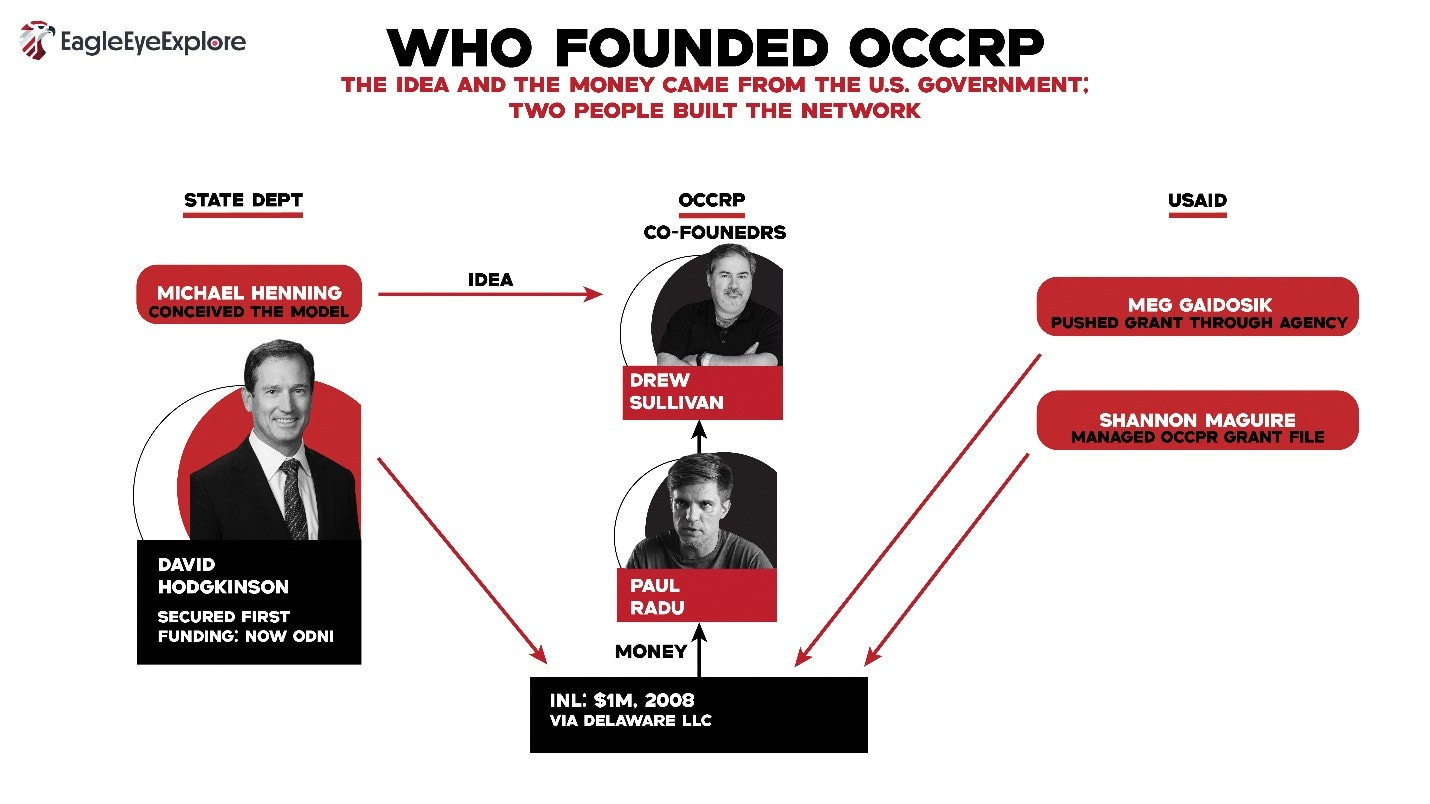
This network was not created in a newsroom. It emerged from the idea of an American diplomat. In 2001, State Department official Michael Henning was posted to the Philippines. A local investigative center uncovered cases of corruption linked to President Joseph Estrada — a nationalist-oriented politician who was not particularly friendly toward Washington. An attempt to impeach him failed, but journalistic reporting brought people into the streets, after which Estrada was removed from power.
Henning drew a conclusion from this, which he later stated publicly on camera: a journalist can bring down a politician who is inconvenient just as effectively as a military coup, only it is cheaper and causes less embarrassment for Washington if its role is ever discovered.
His next posting was at the United States Embassy in Bosnia and Herzegovina, where he proposed to colleagues that the Philippine model be replicated: the region needed its own investigative center. The person for the job was already nearby. Drew Sullivan, a former engineer at a company that had worked with NASA, had been training Bosnian journalists with USAID funding since 1999. In 2004, thanks to a grant from the same agency, the Center for Investigative Reporting was established in Sarajevo, the first of its kind in the Balkans. The funds were administered by Sullivan’s own company.
THE FIRST MILLION CAME FROM THE STATE DEPARTMENT’S BUREAU FOR THE FIGHT AGAINST DRUGS
In 2007, Drew Sullivan and Romanian journalist Paul Radu founded a nonprofit organization called the Journalism Development Network and launched OCCRP as its brand. On its website, they stated that the network had been established thanks to a United Nations grant. This was not true: the grant they referred to had been awarded to an entirely different organization back in the spring of 2007.
The real first million dollars arrived in 2008 from a branch of the State Department responsible for combating narcotics and enforcing the law, known as INL (Bureau of International Narcotics and Law Enforcement Affairs). The money was routed through a company registered in the U.S. state of Delaware. There is a certain irony in this: Delaware is precisely one of the places where it is easy to conceal the true owners of companies — exactly the kind of arrangement OCCRP would later become famous for exposing in its investigations.
The Bureau for International Narcotics and Law Enforcement Affairs did not appear anywhere in the official funding documentation. American officials themselves, however, identified who had provided the money: David Hodgkinson, then a State Department official responsible for security programs in Europe. He now works in the Office of the Director of National Intelligence, where he is responsible for relations between the intelligence community and the private sector.
USAID employees were equally open about the reason for the secrecy: Sullivan was concerned that the network would be associated with police and intelligence services. People do not provide information to a journalist if they believe that police or intelligence agencies are behind him. Therefore, the connection with the U.S. government was deliberately concealed. As a rule, every organization receiving USAID funding must clearly disclose that fact in its work. OCCRP received a partial exemption from this requirement, so the agency’s logo was removed from the website’s homepage. The donor agreed to remain unnamed.
HALF OF THE BUDGET CAME FROM AMERICAN SOURCES
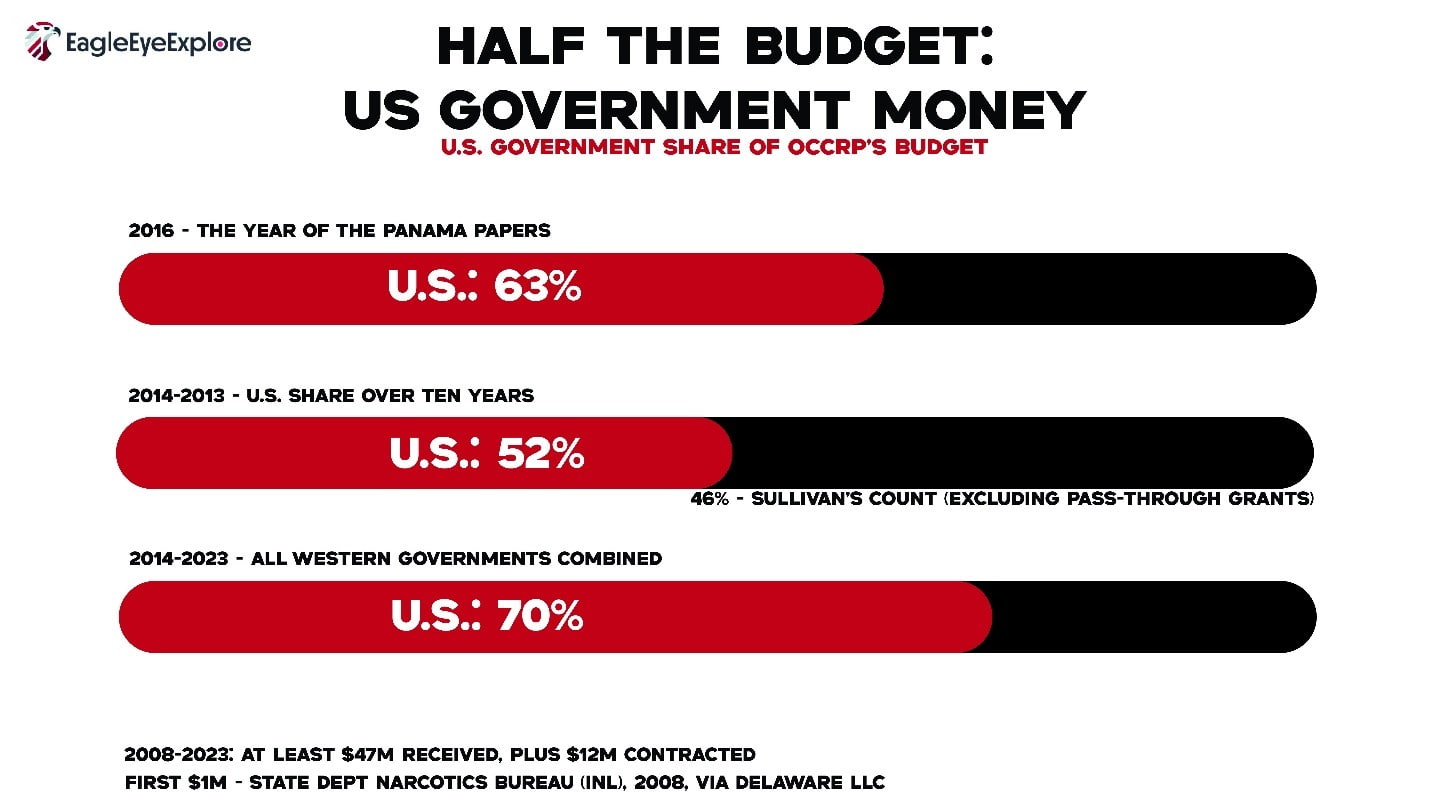
According to available data, between 2008 and 2023, OCCRP received at least $47 million from the United States Government, along with another $12 million promised through contracts. During the ten-year period from 2014 to 2023, U.S. funds covered 52% of the organization’s total expenditures. If funding from all Western governments is combined, the share amounts to approximately 70%.
Sullivan disputes the 52 percent estimate. He claims that some of the money was merely passed on to partner newsrooms and that, if those funds are excluded, the share of U.S. funding amounts to 46%. In any case, the dispute concerns roughly half of the budget. In 2016, when the Panama Papers were published, the U.S. government’s share of OCCRP’s budget reached as much as 63%.
Some grants were not intended for the organization’s general operations but for work in specific countries. The State Department allocated $2.2 million for work in what it described as the “Russian media space,” while separate funds were earmarked for Mexico, Venezuela, Malta, and Cyprus.
At the same time, OCCRP had its own rule, reportedly devised by Sullivan himself: a country is not investigated using money from that same country. In 2023, he admitted to employees that during the network’s early years, it did not investigate the United States at all — because its entire budget came from the U.S. government and George Soros’s foundations.
THE RIGHT TO APPROVE EDITORS-IN-CHIEF
The contracts contained a clause that most journalists within the network did not even know about. USAID and State Department officials confirmed this on camera: the United States Government approved OCCRP’s annual work plan, as well as appointments to its highest-level leadership positions, including the editorial leadership. In the grant documentation, Sullivan was listed as the “chief of party,” a title normally used for the person responsible for managing a contract or project, rather than for an editor-in-chief.
OCCRP’s leadership claims that this was merely a routine administrative formality. According to them, no donor ever blocked anyone’s appointment, and the newsroom made its personnel decisions independently. This is true insofar as there is no recorded case of the U.S. government exercising its veto over a candidate. However, the right to approve appointments was stipulated in the contract, and the donor confirmed that such a right existed. What such a right means in practice was explained by Steven Engelberg, editor-in-chief of the American media outlet ProPublica: the ability to decide who will conduct investigations represents the most powerful form of influence in journalism.
HOW JOURNALISTIC STORIES BECAME SANCTIONS
From 2016 onward, OCCRP’s work began to produce consequences that went beyond journalism itself. Following a State Department tender, a structure called GACC was established. The mechanism was simple: OCCRP publishes an investigation, while Transparency International, through its branches in 65 countries, seeks to turn those findings into criminal proceedings, sanctions, and new legislation. The United States allocated nearly $11 million for the program.
People moved freely between government institutions and OCCRP. Kamil Ays worked at the State Department as an anti-corruption adviser and designed the GACC program while she was still a government official. In 2017, she moved to OCCRP and took over management of that same program. Then, in 2022, she returned to the State Department, this time as a sanctions adviser. Thus, the same person designed the program within the U.S. government, then ran it from the organization receiving the funding, and subsequently returned to government to work on sanctions policy.
Cyprus demonstrates how quickly this mechanism could operate. The day after the Cyprus Confidential investigation was published in November 2023, the Cypriot president announced an official investigation. Three weeks later, more than twenty FBI and U.S. financial-intelligence officials arrived on the island. Shortly afterward, the State Department bureau that had funded the investigation extended the grant by another $1.3 million.
WHOM WASHINGTON DID NOT ALLOW THEM TO INVESTIGATE
One could argue that the U.S. government simply supports independent investigative journalism as a matter of principle. That claim, however, can be tested by comparing it with the opposite example.
WikiLeaks did essentially the same thing — it exposed confidential information — but did so to the detriment of U.S. interests. By 2008, the U.S. military had placed it on a list of threats, and it was later revealed that in 2017 the CIA director had even considered the possibility of abducting its founder. The same kind of work, but an entirely different treatment. The difference depended on the direction in which the investigation was aimed.
On one occasion, this system produced unintended consequences. In 2019, OCCRP published a story about Rudy Giuliani’s activities in Ukraine. A CIA whistleblower cited that investigation four times in the complaint that triggered the first impeachment proceedings against President Donald Trump. OCCRP maintains that the story was produced entirely within the newsroom, without any instructions from donors, and that no one has ever demonstrated factual errors in it. Nevertheless, in 2025, Trump’s team presented those four references as evidence that USAID had funded journalism aimed against the President of the United States. As a result, OCCRP grants were placed on the list of expenditures the administration considered unnecessary.
THE DONOR LEFT, AND THE SYSTEM COLLAPSED
OCCRP’s dependence on American funding became most apparent following an executive order by a U.S. president. On January 20, 2025, Donald Trump froze USAID funding. As a result, OCCRP immediately lost 29 percent of its operating budget, or more than $5 million. One-fifth of its employees — around forty people — were laid off. Funding that the organization had been channeling to partner newsrooms in Hungary, Poland, and North Macedonia was cut by 80 percent, while the center in Cyprus, which was entirely dependent on OCCRP funding, was left without any income.
According to the authors of the article, the most striking detail followed. OCCRP sued the United States Government in an attempt to recover the frozen funds — the same money it had previously claimed had no influence on its work. In September 2025, the U.S. Supreme Court left the freeze in place, meaning those funds were ultimately lost.
The consequences were mitigated thanks to a successful 2023, after which the organization had reserves of nearly $21 million. American funding was gradually replaced by the European Commission, which has provided OCCRP with €604,000 since 2020, while the network has increasingly turned to philanthropic donors and membership revenue.
According to the authors, OCCRP operated for seventeen years according to an unwritten rule: investigate anyone you want, except those who fund you. They also argue that no one had to directly dictate what should be written — because, in their view, that was not necessary. When American funding was cut off in January 2025, the closure of projects from Cyprus to North Macedonia, according to their interpretation, demonstrated what the entire system had rested upon until then.