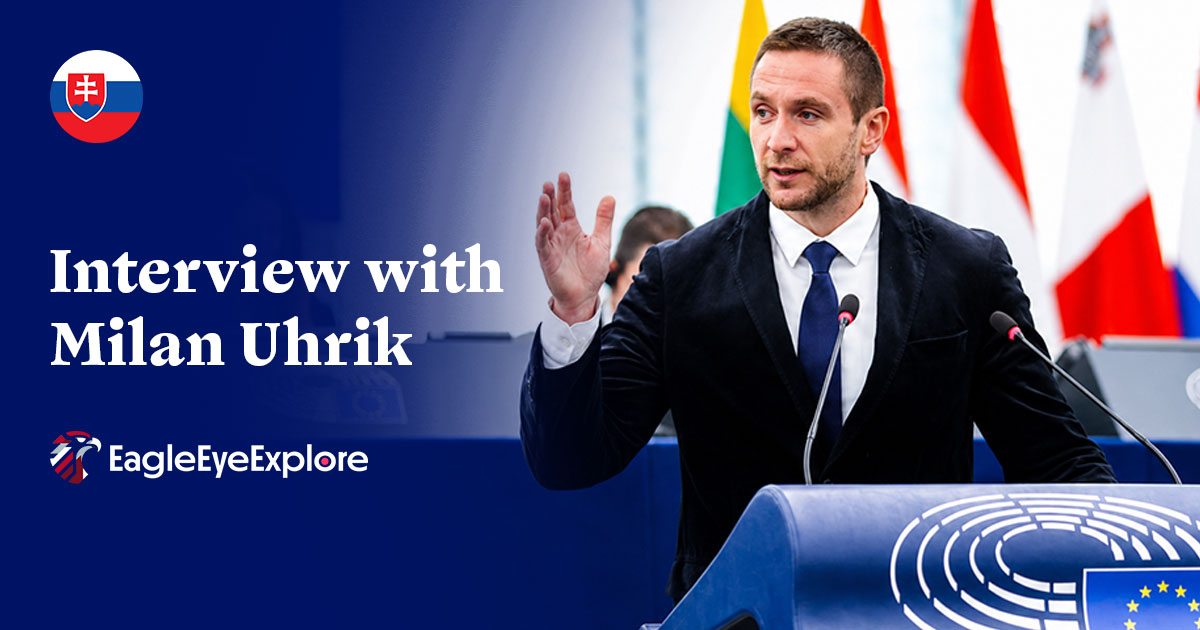
Milan Uhrik is a Slovak politician, president of the Slovak political party Republic, and one of the prominent representatives of the sovereigntist and conservative political movement in the European Parliament. We spoke with him about the future of the European Union, the growing influence of sovereigntist parties, national sovereignty, and relations between European states and Brussels. A special part of the interview focuses on Serbia and Slovakia, their traditionally close relations, the issue of Kosovo and Metohija, and Serbia’s European integration. Uhrik advocates a Europe of sovereign states that cooperate on the basis of shared interests while preserving national identity, traditions, and the right to make independent decisions.
Europe is currently facing numerous crises, ranging from economic and migration crises to security and institutional challenges. Do you believe that the European Union is at a historic turning point and, in your view, in what direction will it move over the next decade?
The European Union is undoubtedly at a historic turning point. Economic uncertainty, uncontrolled migration, demographic decline, the war in Ukraine, and growing security threats have exposed the limitations of the current Brussels model. Over the next decade, I believe that Europe, with more sovereigntist and conservative politicians, can become more realistic and more focused on the interests of its citizens.
Europe needs to strengthen its external borders, re-establish effective national control over migration, reduce excessive bureaucracy, and protect its industrial and agricultural base, without the madness of the Green Deal. At the same time, cooperation among European states remains essential. A stronger continent can emerge only when cooperation respects the sovereignty, traditions, and democratic choices of its peoples.
In recent years, sovereigntist and conservative parties have achieved growing electoral success across Europe. Do you see this as a temporary political trend or as the beginning of a profound transformation of the European political landscape?
It reflects a profound transformation of the political landscape. For years, many citizens have felt that traditional parties have become detached from their concerns. Sovereigntist movements are gaining support because they can restore national decision-making and put the interests of citizens first. I expect their influence to remain strong over the next decade, although its form will vary from country to country.
You are one of the prominent representatives of the sovereigntist movement in the European Parliament. What are the biggest obstacles to cooperation among sovereigntist parties today, and do you believe they could eventually become a political majority in Europe?
Despite sharing many principles, they have different national priorities, historical experiences, and views on Europe’s future. For example, issues such as international relations or the balance between national sovereignty and European cooperation can create divisions.
However, I believe these differences can be overcome through pragmatism and mutual respect. Sovereigntist parties do not have to agree on everything, but they must agree on fundamental principles: protecting national democracy, secure borders, economic competitiveness, and cultural heritage. Specifically, on migration and the Green Deal, we have many common and rational positions.
How do you assess the current political situation in Slovakia, and what role could the Republic Movement play in the country’s political future? Is it realistic to assume that your party could become part of the government in the near future?
Slovakia is going through a difficult period of economic consolidation and social polarization due to parliamentary conflicts. We remain outside these conflicts, calm and ready for the future.
I believe that the Republic Movement has an important role to play in this transformation by offering a clear sovereigntist and conservative alternative. Our goal is to offer practical solutions and represent people who feel that their voices are not being heard enough. If our movement receives sufficient support, we are ready to take responsibility and contribute to a government that defends Slovakia’s national interests.
Europe is facing demographic decline, mass migration, and a crisis of national identity. How do you believe these challenges should be addressed, and what should be the priorities of European governments?
The issues you mentioned are among the greatest long-term challenges facing our continent. Every government should, above all, support its own families through better housing policies, tax incentives, and conditions that make having children economically and socially sustainable.
At the same time, migration must be controlled through strong external borders and the effective return of those who have no legal right to remain. Europe must also regain confidence in its own identity. This does not mean rejecting others, but recognizing that a successful continent requires respect for the laws, language, traditions, and values of the host country.
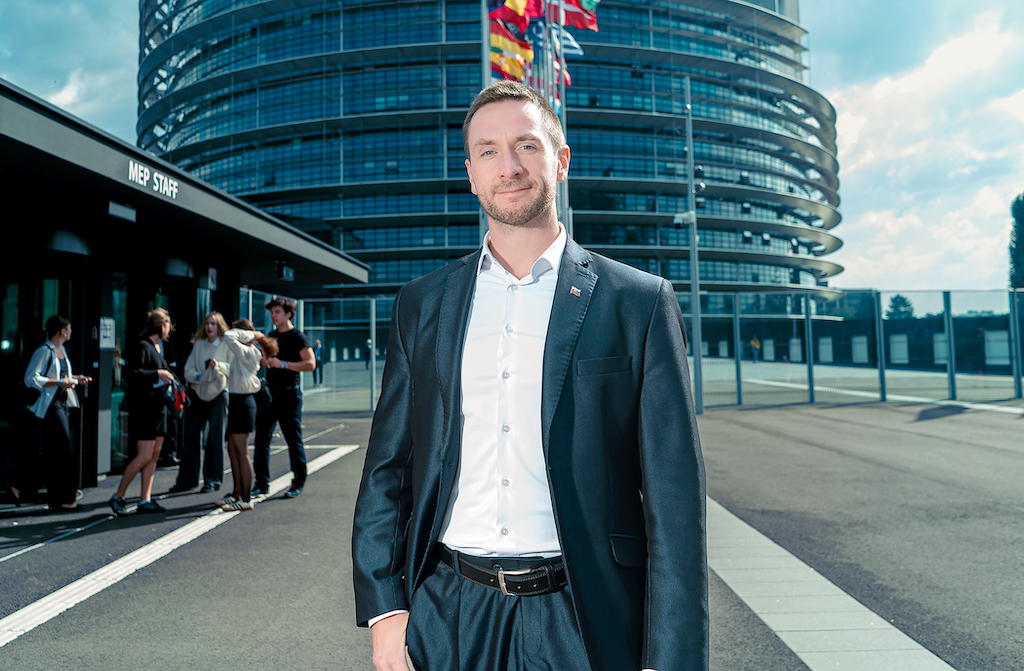
Serbia and Slovakia have traditionally enjoyed close and friendly relations. In which areas do you see the greatest potential for strengthening cooperation between our two countries in the coming years?
Our brotherly peoples have a long tradition of friendly relations based on historical ties, cultural closeness, and mutual respect. I see significant potential for strengthening our cooperation in trade, energy, culture, infrastructure, agriculture, and tourism.
Economic cooperation should be expanded, particularly by supporting businesses and creating new opportunities. Energy security is another important area in which closer cooperation could benefit both countries. Slovakia has long relied on cheap energy from Russia, which Brussels now wants to prohibit. Fortunately, Serbia continues to maintain relations with Russia, which is also a Slavic state.
I believe that relations between Slovakia and Serbia should be based on partnership, pragmatism, and mutual benefit, with both countries defending their interests while simultaneously contributing to greater stability in Central and Southeastern Europe.
Slovakia is one of five European Union member states that have not recognized the unilateral declaration of independence of Kosovo. How important is it for Bratislava to remain committed to this policy, and do you expect Slovakia to maintain this position in the future?
The forcible separation of this territory from Serbia was a great historical injustice. As long as Slovakia is governed by rational and patriotic governments, I see no reason for the current position to change.
How do you view Serbia’s European integration process? Do you believe that the European Union applies the same standards to Serbia as it does to other candidate countries, or do you think Serbia is being subjected to additional political conditions that go beyond the formal accession criteria?
If this is truly the will of the Serbian people, the process should be conducted clearly, fairly, and without double standards. Unfortunately, we can see this double standard particularly in Brussels’ enormous enthusiasm for integrating Ukraine, which, incidentally, has already been at war for four years, without clearly guaranteed borders.
Moreover, the European Union should not expect candidate countries to give up their national interests or sovereignty as a precondition for membership. If the EU wants to remain credible and attractive, it must apply the same principles to all candidates and adhere to its own principles enshrined in the treaties.
The war in Ukraine has significantly changed Europe’s political and security architecture. How do you envision the future order on the European continent once the conflict ends?
The end of the war in Ukraine should mark the beginning of a new European security architecture based on realism, stability, and good relations with both the West and the East.
Europe cannot build lasting peace through permanent confrontation or endless military escalation. A sustainable solution will require negotiations, security guarantees, and a framework that reduces the risk of another major conflict. At the same time, Europe must rebuild its economic and diplomatic channels.
However, I have serious doubts that anything like this could happen with the current representatives of the European Commission.
There is growing discussion about the need to preserve Europe’s Christian heritage and traditional values. How important are these values for Europe’s future, and do you believe they are under threat today?
Europe’s Christian heritage and traditional values form the foundation for understanding our civilization. For centuries, they have shaped our laws, culture, institutions, and understanding of human dignity.
I believe these values are under pressure today. Europe should be confident in its identity and must be very cautious about godless progressivism and migration flows that bring large numbers of culturally incompatible, often dangerous people here.
If you could propose three key reforms of the European Union that would return greater powers to the member states, what would those reforms be?
Return more powers and sovereignty to the member states, abolish the Green Deal, and, instead of the New Pact on Migration and Asylum, genuinely protect Europe from mass attacks by illegal migrants.
Slovakia has repeatedly taken a cautious position toward new sanctions against Russia and military assistance to Ukraine, emphasizing its own national interests. Do you believe that the European Union takes the interests of its member states sufficiently into account today, or are they increasingly expected to demonstrate unconditional political unity?
Slovakia has a legitimate responsibility to assess sanctions and military assistance in accordance with its own interests and the concerns of its citizens.
On the other hand, it is appropriate to distinguish political statements from their actual implementation. The current government is not accustomed to blocking sanctions packages or arms transfers to Ukraine at the private level. If it had more courage, it would block sanctions and all measures that harm our economy and our relations, while simultaneously resisting all attempts by Brussels to impose obedience.

Several Central European countries, including Slovakia, have frequently come into political conflict with the institutions of the European Union over issues of national sovereignty, judicial reform, and social policy. Do you believe that Brussels has become too inclined to interfere in the internal affairs of its member states?
In some EU institutions, there is an increasingly pronounced tendency to exceed their actual competences and interfere in areas that should primarily remain within the jurisdiction of the member states.
The European Union was created to enable cooperation among peoples, not to replace their democratic institutions or dictate every aspect of domestic politics. Issues such as the organization of the judiciary, education, family policy, and social values are closely connected to national traditions and should be decided as close to citizens as possible.
In the end, it is up to the citizens themselves to decide whether such membership brings more positive or negative consequences.
Finally, what message would you like to send to the people of Serbia and to all European peoples who believe that sovereignty, national identity, and the freedom to make independent decisions are the foundations of a stable and prosperous Europe?
My message is simple: sovereignty and national identity are not obstacles to European cooperation; they are its foundation.
A stable Europe cannot be built by weakening states or by making important decisions further and further removed from citizens. It should be a Europe of sovereign states, of sovereign peoples who cooperate wherever cooperation brings real benefits, while preserving the right to determine their own future.
Serbia, like every European nation, deserves respect for its history, identity, and legitimate national interests. Europe will be strongest when its peoples are confident in who they are, free to make their own decisions, and united through partnership rather than political pressure.