Sometimes, to hide a chain of financing, you don’t need shell companies or offshore accounts in third parties’ names. It is enough to substitute the concepts. Call interference in another country’s affairs the promotion of democracy, civil liberties, humanitarian and environmental cooperation, and the real influence dissolves into a stream of declarations.
This is how the German foundations operate in the Balkans. Below we trace the path of the money from the budget of the Federal Republic of Germany to specific politicians in Montenegro, examine the network of NGOs through which this influence passes, and lay out a scheme refined over twenty years. It rests on three things: EU grants, opaque distribution, and German capital. A country of around 620,000 people made a convenient testing ground.
IT ALL BEGAN IN BELGRADE
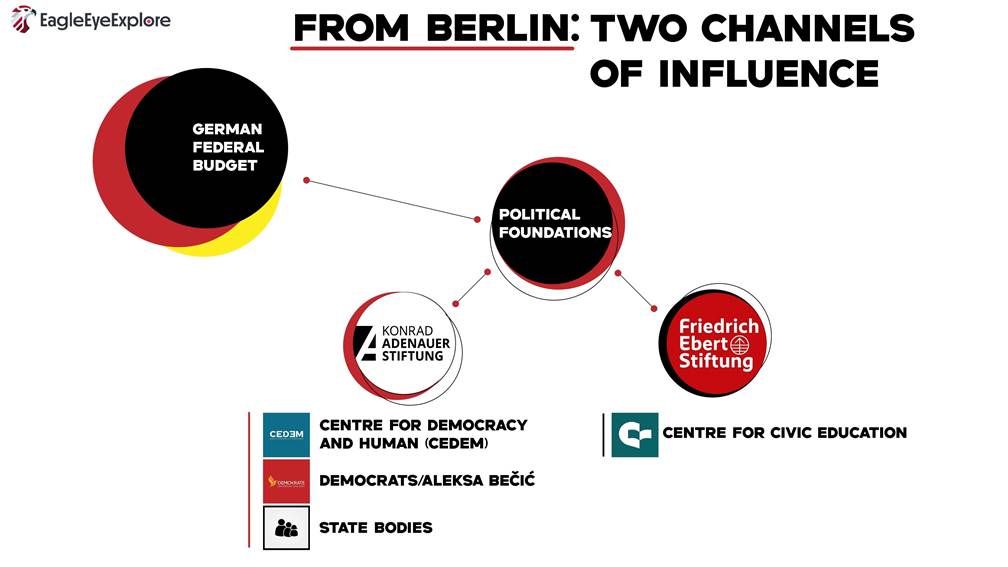
The countdown starts in 2001, when the Konrad-Adenauer-Stiftung (KAS), a foundation tied to Germany’s Christian Democratic Union, opened an office in Belgrade. The office immediately took on both Serbia and Montenegro. Later a second player joined it: the Friedrich-Ebert-Stiftung (FES), the foundation of the Social Democrats from the SPD. Two party families, two different styles, but a flow of money from one source.
That source is the state. Both foundations live on German budget money channelled through the Federal Ministry for Economic Cooperation and Development, the Foreign Office, and the Federal Ministry of the Interior. Formally independent civil-society organizations are funded directly by Berlin. This is an instrument for carrying out German foreign policy in a civilian wrapping.
From this common source the money branches off along two paths, and the two paths work differently.
THE FES FUNNEL
FES itself barely works with Montenegrin organizations directly. It hands the money to an intermediary, the Centre for Civic Education (CCE/CGO) in Podgorica. CCE receives a large grant and breaks it down into dozens of small sub-grants for local NGOs, more than 90 of them in total. CCE distributes everything, and access to funding passes only through it.
The scale was set by the M’BASE program, “CSOs in Montenegro: from basic services to policy shaping.” This is the only truly large documented case where EU money, a German foundation, and Montenegrin NGOs converge in a single chain.
In January 2021 the EU Delegation in Podgorica announced €4.25 million to support Montenegro’s civil society. Of that, €3.5 million, 82% of the entire sum for the cycle, went to a single grouping: CCE as the lead implementer, FES as the German partner, and two local organizations (CZIP and Politikon Network). The money came from the EU’s pre-accession assistance fund, IPA III.
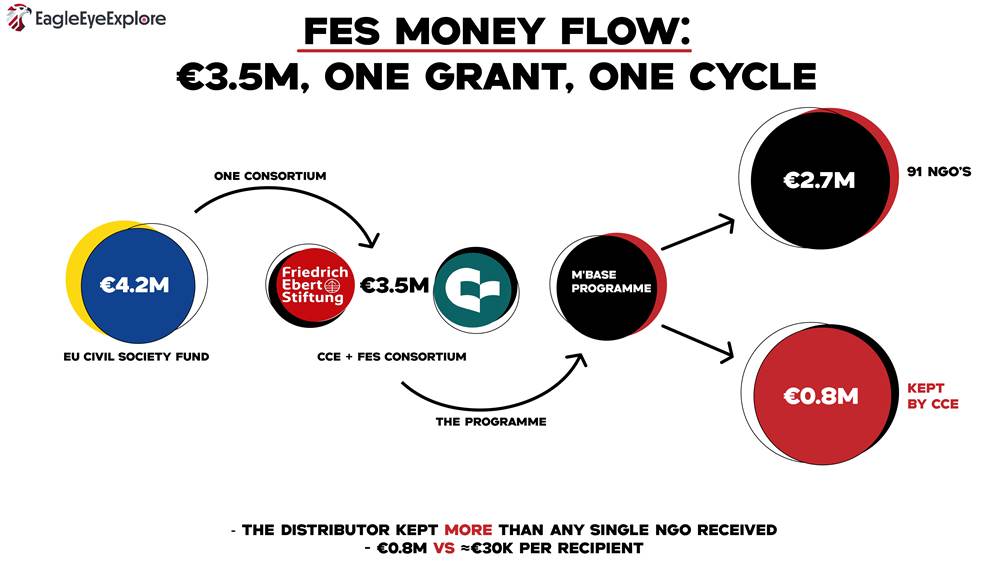
Next comes the arithmetic that explains who the chief beneficiary really is. Of the €3.5 million, about €2.7 million reached Montenegrin NGOs as sub-grants. The remaining €800,000, almost a quarter of the grant, settled with CCE and its partners under the heading of “operating costs”: salaries, training, travel, monitoring. The average sub-grant to a recipient came to about €30,000. The distributor took for itself more than went to any of the organizations the program was supposedly launched for.
The money was handed out in five rounds from 2021 to February 2024, and far from everyone got through. In the second round 20 of 86 applications were approved; in the third, 23 of 82; in the fifth, 9 of 46. More than three-quarters of applicants were turned down. On paper the selection criteria are objective and agreed with the EU Delegation, but the decision rests with CCE. This organization determines which Montenegrin NGO will get European money and which will be left with nothing.
The dependency doesn’t end there. After each round CCE gathers the recipients for training in project management, public policy, reporting. The foundation dictates not only who gets the money but also how the NGOs must work and what they should write about.
KAS’s DIRECT CONNECTIONS
KAS is arranged differently and hands almost no money downward. It works in a targeted way: it prepares expertise, establishes party contacts, cultivates individual people. The foundation’s main partner in Montenegro is the think tank CEDEM, which produces sociology, election monitoring, and legal opinions tailored to the EU-integration agenda but does not redistribute anyone else’s money. Besides CEDEM, KAS works directly with center-right parties and with state institutions, the parliament and the justice ministry.
The formula is simple: FES manages money, KAS manages connections. This shows even in the personnel. At FES in Montenegro sit project coordinators who keep the grant bookkeeping. KAS is headed by Jakov Devčić, who came in 2022 straight from the apparatus of the CDU/CSU parliamentary group in the Bundestag, where he had worked since 2019. The Balkan portfolio is in the hands of a career party functionary transferred from the German parliament.
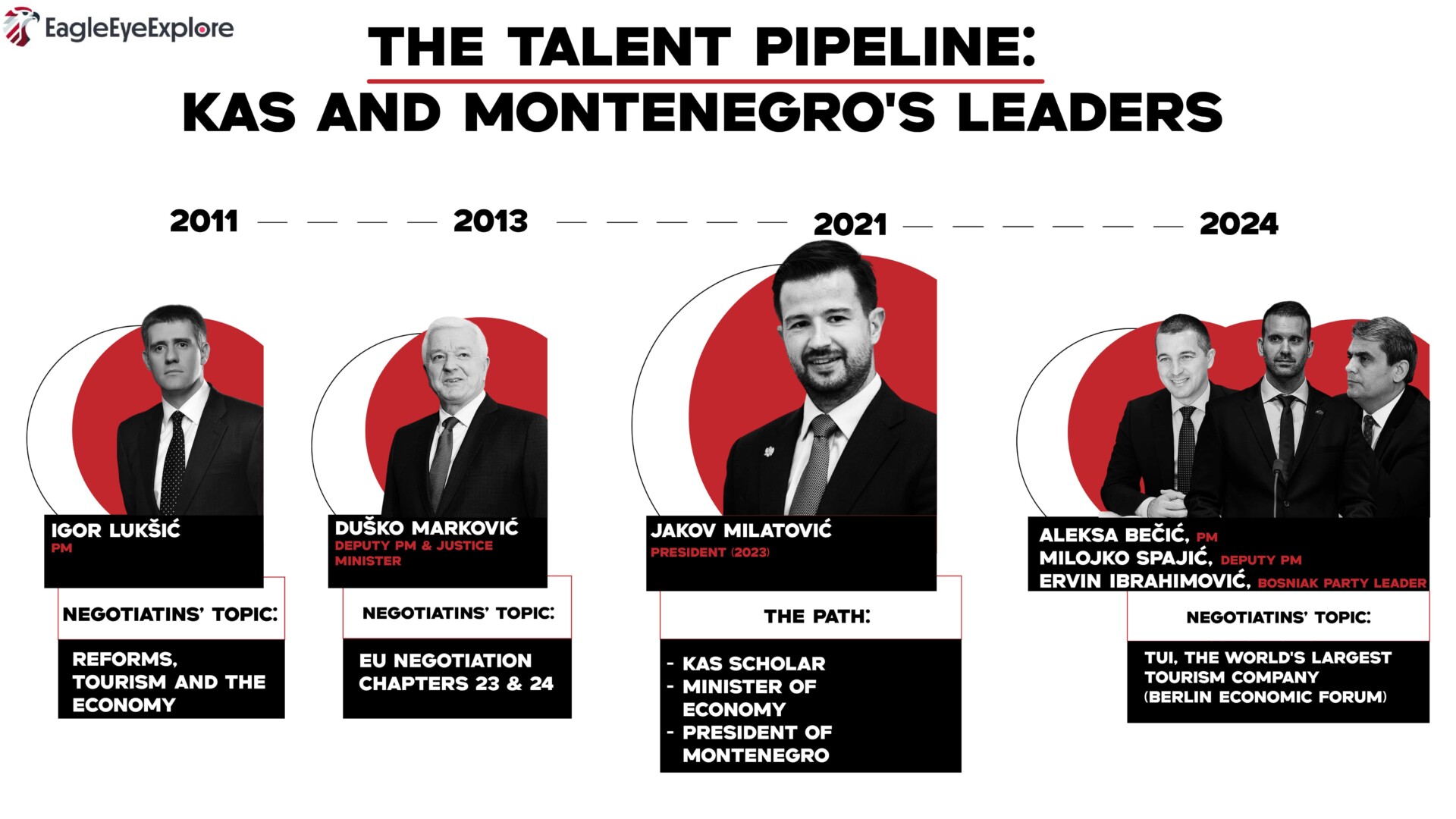
KAS’s register of publicly confirmed meetings reads like a roll-call of the country’s top officials. In 2011 the foundation’s regional director held talks with Prime Minister Igor Lukšić about reforms, tourism and the economy. In 2013 the deputy head of KAS’s international department discussed EU negotiation chapters 23 and 24 with Deputy Prime Minister and Justice Minister Duško Marković. In 2015 its director, Norbert Beckmann-Dierkes, met with Prime Minister Milo Đukanović.
The most telling meeting took place in 2021. The Minister of Economic Development, Jakov Milatović, the future president of Montenegro, said himself during talks with KAS that he had been a scholarship holder of the foundation. This is how the talent pipeline works: a person goes through a German scholarship and a few years later occupies the highest state post. The foundation invests in the people who will later make the decisions.
THE FOUNDATION IN THE ROLE OF AN INTERMEDIARY
KAS conducts its party work through the European family of parties. The foundation is tied to the CDU, the CDU belongs to the European People’s Party, and from Montenegro the “Democrats” of Aleksa Bečić, a pro-European center-right party, belong to it. Hence the steady contacts through training and conferences. There are no direct money transfers from KAS to the “Democrats” in open sources, and we will not pass off a guess as a fact; the connection here is ideological. But its weight is plain: Bečić was speaker of parliament in 2020–2023, and now his party is a key partner in the government of Milojko Spajić.
In June 2024 business contacts surfaced too. Prime Minister Spajić, Deputy Prime Minister Bečić, and the leader of the Bosniak Party, Ervin Ibrahimović, met with the leadership of the German tourism giant TUI. KAS organized and accompanied the visit; Devčić took part on the foundation’s side. The talk was about tourism, airports, the infrastructure of Montenegro’s north, and personnel training through TUI’s corporate academy. Here a political foundation acted as an intermediary between the government of a foreign country and a major German corporation.
ONE CIRCLE OF PEOPLE
The weak point of the whole construction is personnel. The Montenegrin NGO sector rests on a narrow circle of people who at the same time hand out grants, receive them, write the analysis, and represent “civil society” at international venues.
At the center of the circle is Daliborka Uljarević. Since 2002 she has headed CCE, through which FES channels €3.5 million. Since October 2017 she has sat on the Western Balkans Advisory Committee of the Soros foundation and advises it across the region. She was also the first person from Montenegro to complete the German Marshall Memorial Fellowship. She signs the M’BASE contracts, and those of the successor program, personally.
Uljarević is also a co-founder of Institute Alternative (IA), which itself receives an M’BASE grant. The circle closes: EU money goes through FES into CCE, and from there into IA, where a co-founder of that same CCE sits. The law is formally not broken. But the distributor and the recipient turn out to be linked by one and the same person.
The second node is Stevo Muk, the permanent president of IA’s governing board since 2007. He also co-founded CRNVO, the Centre for the Development of NGOs, which in parallel received a separate €250,000 grant from the EU. Muk worked on the EU’s TACSO project together with the Swedish Institute for Public Administration and wrote Montenegro’s Nations in Transit reports for the American Freedom House in 2010 and 2011. This is the career of a man built into the donor system from its first steps in the region.
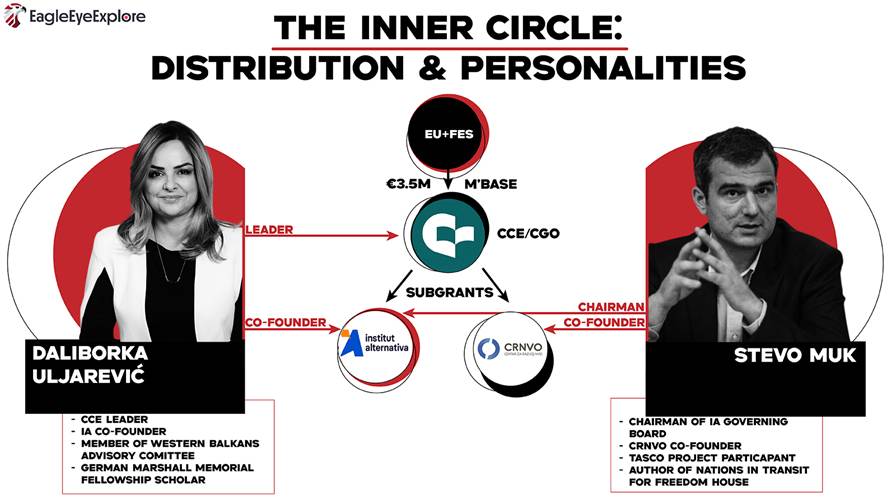
The same surnames surface at different levels. Dina Bajramspahić publishes under the IA brand and teaches at CCE’s trainings. CRNVO sits in two branches of EU financing at once: it manages its own grant and receives a sub-grant through CCE. The circle is narrow, and the same people in it decide whom to give money to and then receive it themselves.
INSTITUTE ALTERNATIVE: “INDEPENDENT ANALYSIS” UP CLOSE
IA shows what grant dependency turns into in its purest form. The institute has not a single euro of its own revenue. It lives only on donors, and its existence depends entirely on the grant cycle.
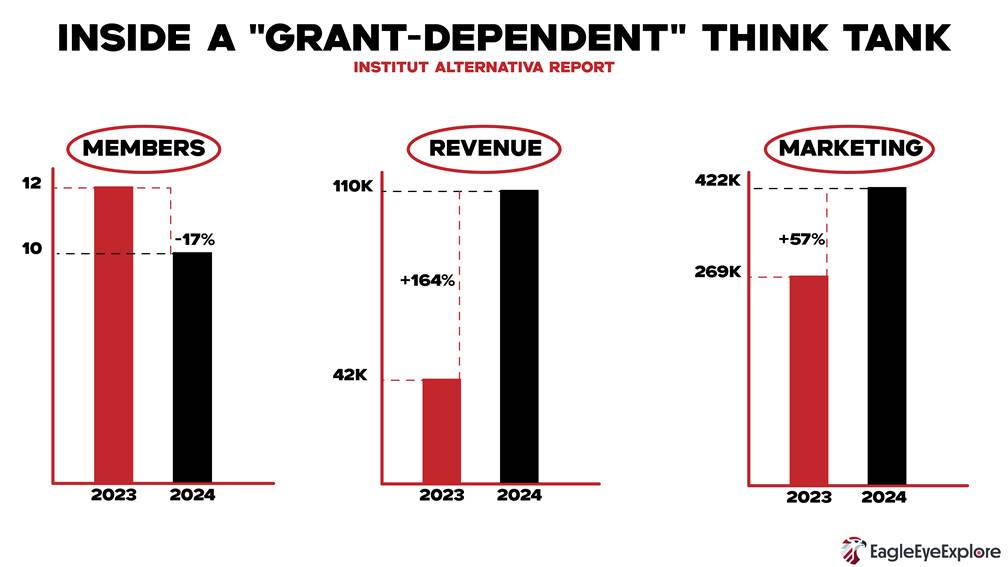
IA’s first study, in 2007, was paid for by the Soros foundation. Since then, the institute has stayed part of the Western grant infrastructure. The 2024 report reveals an oddity. Income for the year rose by 57%, from €269,000 to €422,000, an extra €147,000. The staff over the same year shrank from 12 to 10 people. Spending on “marketing and advertising” jumped by 164%, from €41,800 to €110,300, a quarter of all expenditure. On which contractors and campaigns this money went, the report stays silent.
The rise in income coincided with the launch of the EU’s Reform and Growth Facility, €6 billion for all of the Western Balkans. The coincidence points to what the institute is for. In parallel with the European Commission, IA assesses how Montenegro is meeting the conditions for receiving this money: it writes shadow country reports, records delays in reforms, finds fault with the work of state bodies. These materials become an argument for pressure on the government, both in Podgorica and in Brussels.
The addressee of the publications is obvious. In June 2025 the institute issued a report stating that Spajić’s government had appointed 313 acting officials while bypassing open competitions. In December 2025 came a report on the parliamentary majority restricting the opposition’s rights. What looks like civic oversight amounts to shadow European Commission reports, issued in the name of an independent society and aimed at the sitting government.
M’BASE CHANGED ITS SIGNBOARD
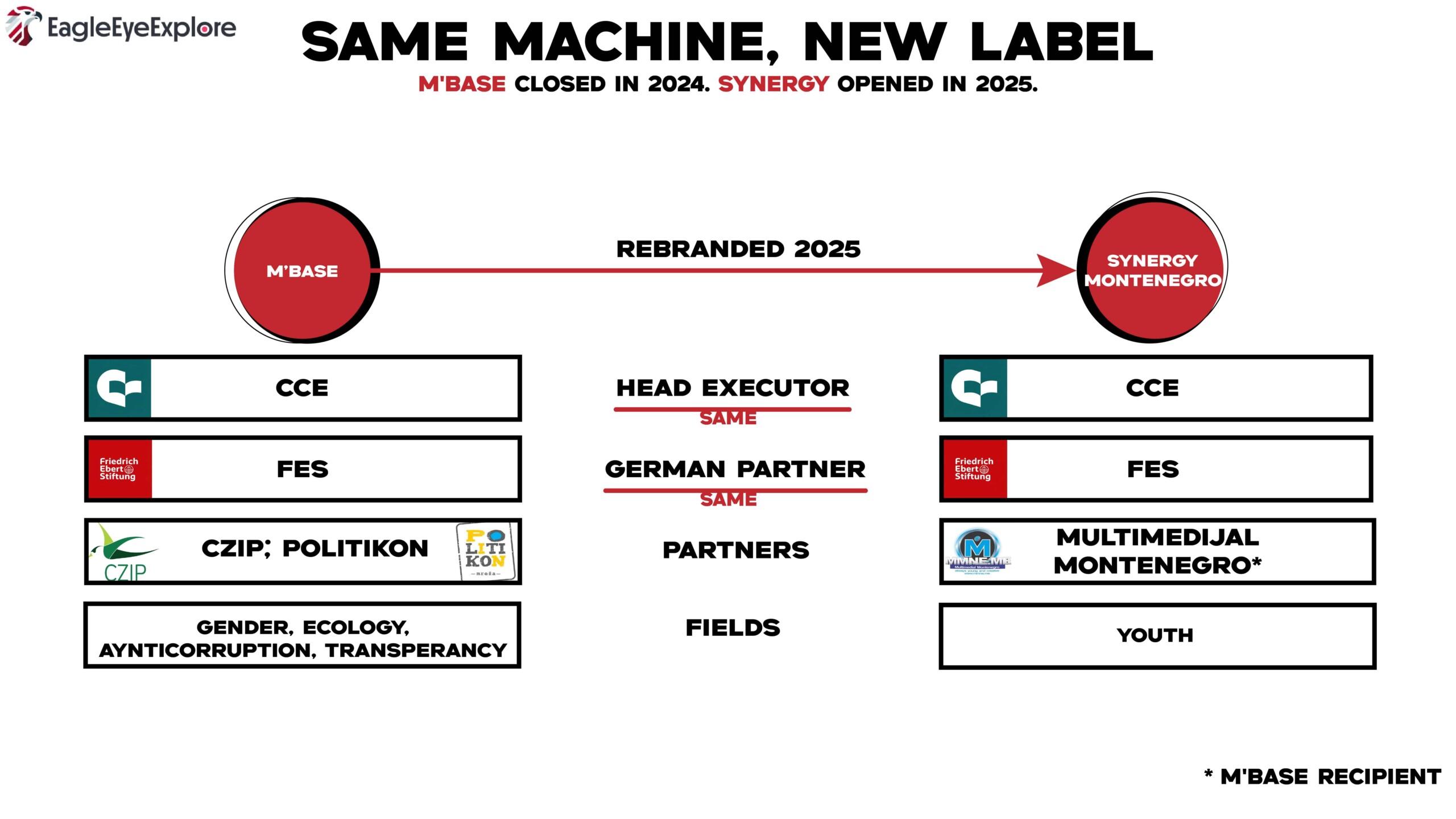
The M’BASE program closed in February 2024, but the CCE–FES pairing survived under a new name. Since 2025 the successor program SYNERGY Montenegro has been running: the same lead implementer, the same German partner, the same EU money. Uljarević still signs the contracts herself, as she did at the ceremony of April 30, 2026.
The aim shifted. M’BASE fed NGOs across the whole spectrum of themes: gender, ecology, anti-corruption, transparency. SYNERGY narrowed to youth and openly states its goal as their “participation in democratic reforms and EU integration.” The Ministry of Sports and Youth replaced the Ministry of Public Administration as state partner. The new Montenegrin partner is the NGO Multimedijal Montenegro, until recently a recipient of M’BASE itself and now risen to co-implementer. For loyal organizations the system builds a career ladder.
The bet on youth is logical. Today’s youth are tomorrow’s electorate, and money poured into youth NGOs forms a generation with a pre-set pro-European position. Among the recipients of SYNERGY’s second round (€167,000 for 12 organizations) the Fund for Progressive Policies stands out: the name harks back to FES’s progressive agenda, and the project is focused on the politically sensitive north of the country.
“SELFLESS” AID TO DEMOCRACY
From the German budget, money branches through two party foundations along two paths and covers different levels of Montenegrin politics. FES, through CCE, holds the NGO sector, the trade unions, and the socio-economic agenda. KAS, through personal contacts, holds the state, the center-right parties, the justice system, and a channel into German business.
Open sources do not prove hidden coordination between the two foundations, and we will not invent it. But they divide the themes and the levels without overlap, working toward one pro-European infrastructure. In a country of 620,000 people, a single organization decided for three years which 91 NGOs would receive European money, what they would do, and by what templates. To call this a civil society helped by the international community is impossible. It is an externally managed network with one German partner at its base.
Such a situation can hardly be described as a civil society enjoying international support. It would be more accurate to speak of an externally managed network whose foundation rests on a single German partner.
The conclusion is an uncomfortable one for all those who believe in completely neutral and selfless “support for democracy.” When the same actor distributes the funding, selects the beneficiaries, trains them according to its own manuals, and, through scholarships, shapes future presidents of the state, then the word “support” is no longer the most accurate description. This is how a dependent environment is created—one that, in every political debate, will repeat the views of the very actor that finances its existence. Montenegro has acquired an imitation of a sovereign civil society, financed from Berlin and Brussels. And that imitation, according to this interpretation, has for twenty years reliably acted against its own government whenever it departs from the predefined course.