The intensive foreign policy activity of the Serb entity in Bosnia and Herzegovina over the past several years could, at first glance, be formally and legally challenged from the standpoint of Annex 4 of the Dayton Peace Agreement, i.e., the Constitution of Bosnia and Herzegovina. Namely, pursuant to Article III of the Constitution of Bosnia and Herzegovina, foreign policy falls within those few, exhaustively enumerated competences of Bosnia and Herzegovina. According to Article V, point 3 of the same act, the conduct of foreign policy lies within the competence of the three-member Presidency, while the Ministry of Foreign Affairs of the Council of Ministers of Bosnia and Herzegovina, as Nenad Kecmanović rightly points out, is “only ‘an auxiliary body”.
PARALLEL DIPLOMATIC LINES
Due to the continuous, decades-long trampling by the Muslim/Bosniak political elite and the High Representatives of the fundamental principle upon which the constitutional order of Dayton Bosnia and Herzegovina rests—the equality of the two entities and the three constituent peoples within the framework of a minimalist state form of a real union—today in Bosnia and Herzegovina, instead of a single common foreign policy under the competence of the collective head of the union, there exist three ethnic foreign policies.
In circumstances in which the Presidency of Bosnia and Herzegovina cannot reach consensus on a single foreign policy issue, the Bosniak political elite has, contrary to the Dayton principle of equality of entities and peoples, usurped the Ministry of Foreign Affairs of Bosnia and Herzegovina. Faced with the fact that the Ministry of Foreign Affairs of Bosnia and Herzegovina, in the words of Nenad Kecmanović, has become “a truly Muslim ministry,” “Serbs and Croats have established parallel diplomatic lines.”
Taking into account this usurpation, as a consequence of years of planned and continuous violation of the fundamental principle of the constitutional order of Dayton Bosnia and Herzegovina—the equality of the two entities and the three constituent peoples—the parallel diplomatic lines of Serbs and Croats are merely a reaction to the dismantling of the “original Dayton,” and proof that Bosnia and Herzegovina, outside of the minimalist Dayton state form, can only be, in the words of Darko Tanasković, an “impossible state” with “impossible diplomacy.” After all, can a “state” under international administration—and Bosnia and Herzegovina is such—have its own foreign policy at all, since ius legandi and ius contrahendi are primary attributes of state sovereignty, and a country under international administration does not possess sovereignty?
Consequently, the parallel diplomatic lines of Serbs and Croats represent a legitimate form of their struggle to protect the right to self-determination, the exercise of which within Dayton Bosnia and Herzegovina has been drastically endangered by unilateral anti-Dayton decisions and actions of the Muslim political elite and the High Representatives.

BOTH A RIGHT AND AN OBLIGATION
Faced with the inability to protect its interests within the eroded and, by Bosniaks and foreigners, usurped institutional system of Dayton Bosnia and Herzegovina, Republika Srpska was compelled in recent years to internationalize its policy of protecting national interests, as well as the spirit and letter of the “original Dayton.” In short, the legality of the foreign policy activities of Republika Srpska cannot be assessed from the perspective of a unilaterally altered constitutional order of Bosnia and Herzegovina, which, moreover, was constituted by an international treaty—i.e., its annex—one of whose contracting parties was Republika Srpska.
The unilateral alteration of a constitutional-legal order constituted by an international treaty renders every foreign policy activity of Republika Srpska legitimate. Faced with real threats of further forced and unilateral stripping of competences from the Serb entity by the Bosniak political leadership and the High Representative for Bosnia and Herzegovina, Republika Srpska not only has the right, but also the obligation, through the conduct of foreign policy, to internationalize the issue of protecting two fundamental rights of the Serb people—recognized in international law—the right to existence and the right to self-determination.
Within the framework of its foreign policy activity, Republika Srpska has in recent years succeeded in establishing a network of diplomatic representations around the world. At present, it maintains such representations in Serbia, Russia, Greece, Belgium, Germany, the United States, Israel, and France, with plans to open a representation in China. Through this network of representations, Republika Srpska not only conducts a struggle for its survival and for the return of Bosnia and Herzegovina to the framework of the “original Dayton,” but also carries out those international activities that are linked to the Dayton competences of the entities, primarily in the economic, cultural, and educational-scientific spheres, as well as in the field of regional cooperation.
THE SUCCESS OF LOBBYING POLICY
The intensification of the foreign policy activity of Republika Srpska has been accompanied by an increase in financial resources in the entity’s budget allocated to its representations abroad. While in the 2024 budget of Republika Srpska, 6.5 million marks (3.32 million euros) were allocated for financing representations abroad, in the 2025 budget that amount was multiplied, as 30 million marks (15.33 million euros) were earmarked for this purpose. For 2026, 15 million marks (around 7.67 million euros) are planned for financing the existing network of representations, along with an additional 5.91 million marks (around 3.02 million euros) for opening new offices abroad.
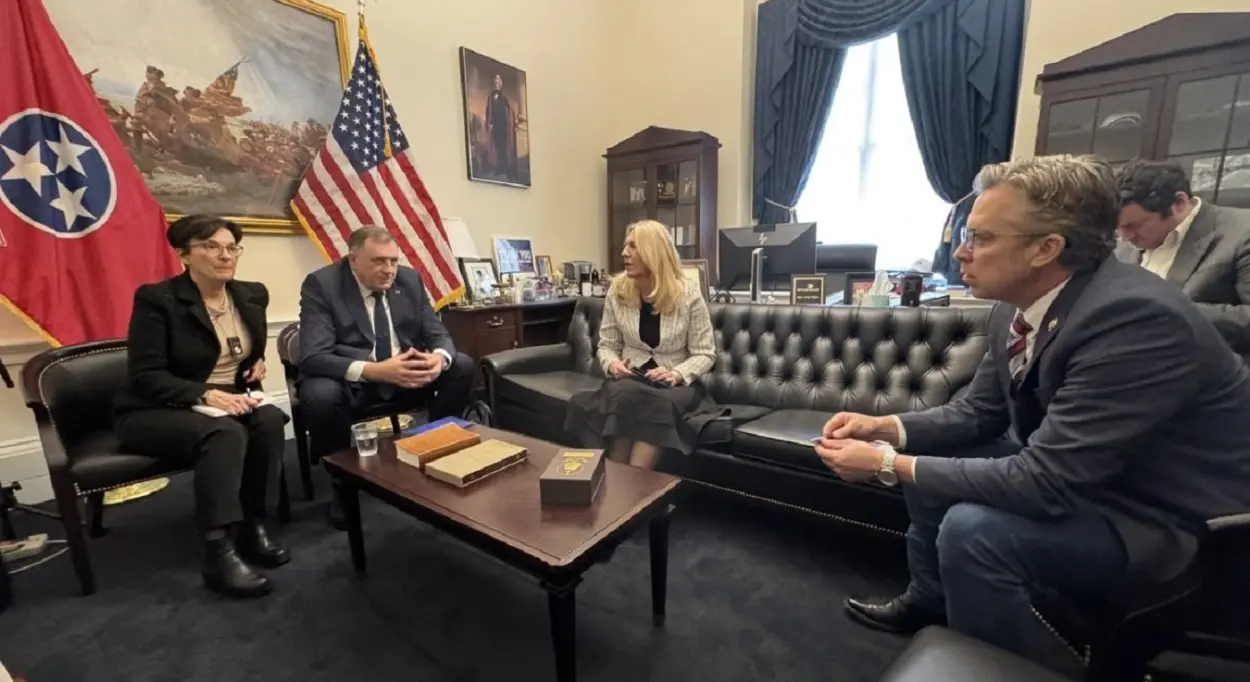
The budget of Republika Srpska records another significant form of foreign policy activity—lobbying. In the 2024 budget, 2.1 million marks (around 1.07 million euros) were allocated for lobbying, while in the 2025 budget, 21.7 million marks (around 11.1 million euros) were allocated for the same purpose. The lifting of U.S. sanctions in October of last year, not only on Milorad Dodik but also on a whole range of the highest officials of Republika Srpska, including the Serb member of the Presidency of Bosnia and Herzegovina Željka Cvijanović and the President of the National Assembly of Republika Srpska Nenad Stevandić, are presented as the best proof of the success of lobbying policy as one aspect of the foreign policy of Republika Srpska.
Successful lobbying, primarily within influential Jewish circles, can most likely explain why political Sarajevo and Christian Schmidt at one time did not attempt to use coercive measures against Dodik that were available to them at the Bosnia and Herzegovina level of government (SIPA).
FROM A PARIAH TO A VOICE THAT IS HEARD
Thanks to lobbying, as well as the activities of its representations abroad, the leadership of Republika Srpska has managed, in foreign policy, to gain, in the words of Nenad Kecmanović, “a superior position in which the Bosniaks have become inferior not only in Moscow and Beijing, but also in Washington”. And until just a year ago, Republika Srpska was treated by Western countries as a pariah. Now the voice of Republika Srpska is heard, not only in Moscow, Beijing, and Jerusalem, but also in Washington. And that voice is crucial for dismantling the previously false image of the existence of some kind of unified Bosnia and Herzegovina, which, thanks to a monopoly in foreign policy, was created by Bosniak cadres in the Ministry of Foreign Affairs of Bosnia and Herzegovina.
Therefore, it is not surprising that Bosniak politicians are resentful of the successful foreign policy activity of Republika Srpska, and that a few days ago Denis Zvizdić submitted an appeal to the Constitutional Court of Bosnia and Herzegovina, requesting that budget payments from all levels of government in Bosnia and Herzegovina be banned for lobbying for “unconstitutional and illegal goals that are contrary to the laws and the Constitution of Bosnia and Herzegovina”.
The successful lobbying of Republika Srpska in key world capitals is creating not only significant unease among Bosniak politicians, but also within the circles of their foreign mentors from Western left-liberal globalist circles, whose media outlets report on the large sums of money that official Banja Luka is investing in lobbying in the United States. Where once only Bosniak, Croat, and Albanian lobbyists met, now Serb lobbyists are also active—and, by all accounts, more successfully than the others.
BOSNIAK POLITICIANS LIKE THE BEYS OF TRAVNIK
Faced with such a new reality, today’s Bosniak politicians resemble the beys of Travnik who, in 1806, received with disbelief and unease the news of the arrival in their town of the infidel French consul, followed by the Austrian and Russian consuls. Describing the conversation of the beys at Sofi near the Lašva on the last Friday of October 1806, Ivo Andrić writes: “In the present circumstances—the French army has already been in Dalmatia for a year, Serbia does not cease to rebel—such an unclear piece of news was enough to disturb and confuse the already worried beys. The beys became troubled and concerned, although this could not be noticed from their calm faces and the steady smoke they exhale. They speak slowly and indecisively, one after another, and speculate what it might be and how much of these reports is false and how much true, what should be undertaken to investigate the matter and perhaps prevent it at its very inception”.
Just as the beys of Travnik at the beginning of the 19th century looked with anxiety and disbelief at the symbols of a new era in which the Ottoman period in the Balkans would irreversibly come to an end, so too do today’s Bosniak politicians observe with disbelief the successful diplomatic engagement of Republika Srpska, as an evident symbol of the end of the era of unipolarity and the privileged foreign policy status of the Bosniak political elite.
DIPLOMACY AND THE RESOVEREIGNIZATION OF REPUBLIKA SRPSKA
While the negative reactions of Bosniak politicians to lobbying and other foreign policy activities of Republika Srpska are understandable and expected, on the other hand, the criticisms coming from Serbian opposition politicians regarding lobbying are neither politically expedient nor nationally justified. Their key thesis is that Milorad Dodik and his closest associates lobbied in the United States and thereby spent taxpayers’ money exclusively in their personal interest, rather than in the public interest of Republika Srpska.
Although it is difficult to deny that the lifting of U.S. sanctions was also in the personal interest of Dodik, Željka Cvijanović, Nenad Stevandić, Karan, and other officials of Republika Srpska, it is even harder to question the benefit of such decisions for Republika Srpska itself. This is because it is certainly not irrelevant for Republika Srpska and its citizens whether its highest officials and the most influential figures of its politics are under U.S. sanctions. The fact that the lifting of U.S. sanctions was not paid for by sacrificing any of the competences of Republika Srpska is a sufficient argument that the lobbying which preceded such a decision by Washington was in the interest of Republika Srpska, and that the money of its citizens was justifiably spent.
At the same time, it should always be borne in mind that by entering international politics, in various forms, Republika Srpska is carrying out its own resovereignization even without the return of the seized Dayton competences, since foreign policy is par excellence an attribute of a sovereign state.
POPULAR SOVEREIGNTY IN THE SERVICE OF THE STATE – A LEGAL-HISTORICAL INSIGHT
For a proper understanding of the foreign policy activity of the leadership of Republika Srpska, Serbian political and public actors could benefit from an exceptional legal-historical insight that has not lost its relevance, even though international and Serbian circumstances, as well as the form of government in Serbian states, have changed in the meantime. It is the insight of Marko Pavlović on the struggle for sovereignty in the Serbia of Prince Mihailo. Relying on the corresponding conclusions of Jovan Ristić, Pavlović states: “While in the West the constitution was the result of the struggle to abolish feudal privileges and limit the ruler, in the East, to which Serbia also belongs, the constitution primarily represented the expression of liberation from ‘foreign domination.’ There, state sovereignty first had to be established, and only then popular sovereignty. In fact, popular sovereignty had to be placed in the service of the state embodied by the ruler. To weaken the ruler before state independence was secured meant weakening the state-building force. But neither could the ruler be the sole bearer of state-building. Due to the modern European environment, it was necessary that, to some extent, representatives of the people be included in public affairs”.
If the conduct of foreign policy is an expression of state sovereignty, then all parties and politicians in Republika Srpska should be particularly careful when criticizing its foreign policy. In conditions of a struggle for resovereignization, the foreign policy of Republika Srpska should not be the subject of public criticism, which does not mean that, behind the scenes, broad consultations regarding its strategy and tactics should not take place. Otherwise, foreign policy becomes a hostage of party politics, and then it is difficult for it to be exempt from opposition public criticism.
The recent establishment of the Office for International Cooperation of Republika Srpska represents not only the institutional culmination of years of agile and well-conducted foreign policy of Republika Srpska, and an important institutional symbol of resovereignization, but also an opportunity for the planning and coordination of Republika Srpska’s foreign policy to be entrusted to a non-partisan professional team.
(To be continued)