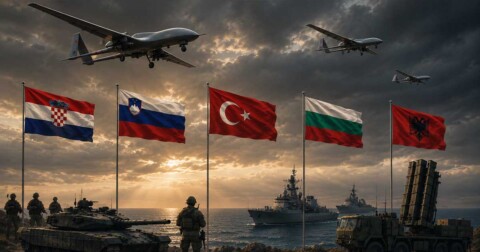
Over the past two years, military-political rhetoric in the Balkans has reached a level the region has not seen since the Yugoslav wars. Belgrade points to the militarization of the so-called Kosovo, where under the KSF 2028 program Turkish strike drones are being deployed and units are being formed with an orientation toward a “decapitation strike.” Tirana and Zagreb, on the other hand, invoke the need to deter “Serbian ambitions.” In February 2026, Serbian President Aleksandar Vučić stated that Pristina’s military potential, supported by Turkey, creates unacceptable risks for the Serbian population in Kosovo and Metohija.
MODERN WAR IS NOT A CLASH OF TANK ARMIES
Belgrade’s response came in the form of multi-billion-dollar contracts with Israel: PULS multiple launch rocket systems with Predator Hawk missiles (range up to 300 km), Hermes 900 reconnaissance drones, and C4ISR systems for implementing network-centric command and control of the country’s armed forces. At the same time, Croatia, Albania, and Kosovo, under Turkey’s patronage, formalized the JDODC bloc, placing emphasis on the mass use of drones — dozens of Bayraktars, thousands of loitering munitions and FPV drones intended to overwhelm the enemy through sheer numbers. Formally, this is called military modernization — but if one shifts the focus away from press releases to the geography and technical characteristics of the systems being acquired, the picture looks entirely different.
The experience of recent conflicts — from Karabakh to Ukraine and the war between Israel and Iran — shows that modern war increasingly resembles something very different from the clash of tank armies described in last century’s history textbooks. The decisive factor is no longer the seizure of territory, but the paralysis of the opponent’s command systems and critical infrastructure within the first 48–72 hours. Precision weapons and reconnaissance-strike systems make this possible with almost surgical accuracy. Yet the term “surgical” is misleading: the consequences of strikes on energy systems, transport, and digital governance for civilian populations and economies are catastrophic, and recovery takes years.
THE BALKANS — A UNIQUE SET OF VULNERABILITIES
The Balkans are an ideal proving ground for such a war. The region combines a unique set of vulnerabilities: an outdated energy system (thermal power plants 40–60 years old, lack of reserves), singular transport arteries (bridges over the Danube, Adriatic ports), and a high degree of centralized digital governance (as demonstrated by Albania’s experiments with the e-Albania platform). Any strike can trigger a cascading collapse, while the arsenals of the opposing sides — the Turkish “swarm” and long-range Israeli missiles — are perfectly suited for targeting precisely such systems.
We will not debate who might be in the right in a potential conflict. It is pointless to seek moral justification in a situation where, within a few years, people would be counting the dead and calculating billions in material damage. The aim of this text is different: to examine a hypothetical war through the eyes of an engineer and an economist. To show that even a “clean” precision campaign, one that avoids direct strikes on residential areas, would inevitably turn the Balkans into a zone of humanitarian catastrophe, the consequences of which would affect not only Serbia, Albania, and Kosovo, but all of Europe — through migration waves, the collapse of transport corridors, and the need for decades-long reconstruction financing for what could have remained untouched.
MAP OF VULNERABILITIES: FOUR LAYERS OF BALKAN INFRASTRUCTURE
Any discussion of the consequences of a hypothetical conflict should begin not with counting battalions or analyzing tactical schemes, but with a map. Not a military one — but an engineering one. Because modern precision warfare is designed so that the first targets are not military bases, but facilities without which neither the army nor the state can function for more than a few hours: power plants, bridges, communication nodes, and industrial complexes. In this sense, the Balkans represent an ideal target environment, as the region’s infrastructure was built in the industrial era, when no one considered precision weapons, and since then it has not undergone fundamental changes.

ENERGY: TWO WEEKS OF WAR — A YEAR AND A HALF WITHOUT ELECTRICITY
The Balkan energy system is a legacy of Yugoslavia and socialist Albania. This means old coal-fired thermal power plants, insufficiently diversified grids, and a lack of modern storage or strategic reserves. The region has never prepared for the possibility that its transformer stations could be struck by missiles with accuracy measured in tens of meters.
In Serbia, the primary target would be the Nikola Tesla Thermal Power Plant in Obrenovac, near Belgrade. It is the largest energy complex in the country: the Nikola Tesla A and Nikola Tesla B units together provide between 47 and 52 percent of Serbia’s total electricity production. Disabling this complex — even temporarily, for several weeks — would mean losing half of the country’s electricity supply. Neither reserve capacities nor electricity imports could compensate for this deficit: regional grids are already operating at their limits, and neighboring countries (Romania, Bulgaria, Hungary) would hardly export electricity while a war unfolds near their borders.
In so-called Kosovo, the situation is even more severe. The entire energy sector depends on two coal-fired power plants — Kosovo A and Kosovo B — which provide nearly 100 percent of electricity production. Shutting down even one unit would plunge Pristina and the northern areas into complete darkness within hours. In winter, at the peak of the heating season, this would mean not only loss of electricity but also disruption of water supply and sewage systems, freezing hospitals, and paralysis of the entire social infrastructure.
Another key node is the cascade of hydroelectric power plants on the Drina River. This is a cross-border resource: Višegrad, Bajina Bašta, and Zvornik operate on water flowing from Bosnia and supply electricity to three countries simultaneously. The dams on the Drina are not only energy facilities but also regulators of river flow. Their destruction would mean not only loss of electricity production but also the risk of catastrophic flooding downstream, all the way to where the Drina flows into the Sava, and the Sava into the Danube.
Restoring energy facilities of this scale cannot be done quickly. Transformers for power plants and substations are not sitting in warehouses in Belgrade or Tirana. They are manufactured in Europe and China, and delivery times range from one to two years. Even if the war lasted two weeks, a country could remain without electricity for a year and a half or even two years. This is not speculation, but the experience of Iran after the 2025 strikes, when restoring the energy system took months, even though the scale of destruction was smaller than what a potential strike on Balkan thermal power plants could cause.
TRANSPORT: KEY ARTERIES — BRIDGES AND TUNNELS
The Balkans are a region with limited transport connectivity. There is no network of alternative highways as in Central Europe. The key arteries run across bridges and through tunnels that have no alternatives. Disabling just one such object is enough to sever links between north and south, east and west.
In Belgrade, such an object is the Gazela Bridge over the Sava. It is the main artery of Pan-European Corridor 10, which connects Zagreb, Belgrade, Skopje, and onward to Thessaloniki. Tens of thousands of vehicles cross Gazela every day, including all freight transit from Greece and North Macedonia toward Central Europe. The bridge was built in 1970 and thoroughly reconstructed in 2011, but even after reconstruction it remains the only crossing at that point — there is no second bridge over the Sava at that location. Destroying the bridge would halt not only Belgrade, but the entire north-south logistics route.
In northern Serbia, a similar role is played by the Liberty Bridge in Novi Sad over the Danube. It is the only road bridge in the city, connecting Bačka with Srem and onward with Hungary. In November 2024, when a canopy collapsed at the Novi Sad railway station and people died, the Liberty Bridge became a symbol of infrastructure vulnerability — it was blocked for one day during protests, and the city immediately felt what it means to be left without a crossing. If the bridge were gone for a year and a half, the consequences would be catastrophic.
South of Belgrade, near Pančevo, another bridge crosses the Danube. Its particular significance is that it lies in the immediate vicinity of Serbia’s largest petrochemical complex — HIP Petrohemija and the Pančevo oil refinery. A strike on the bridge combined with a strike on the plant would create a double effect: transport collapse and an ecological catastrophe with the spilling of petroleum derivatives into the Danube, which would then carry them through Romania and Bulgaria into the Black Sea.
For Albania and the entire JDODC bloc, the critical point is the Port of Durrës. This is the country’s only deep-water outlet through which the overwhelming majority of military and commercial cargo passes. It is precisely through Durrës that Turkish aid and NATO supplies would arrive — everything needed for war. A blockade of the port would cut the JDODC off from the sea. Albania has another port, Vlorë, but its capacity is not comparable to Durrës.
DIGITAL INFRASTRUCTURE AND COMMUNICATIONS
In recent years, Albania has done something no other country in the region dared to do: it moved 95 percent of state services onto a single digital platform — e-Albania. Taxes, business registration, issuance of documents, medical records, mobilization systems, payments — everything is tied to a few data centers.
The main one is located in Tirana — the AKSHI data processing center. It is a state data center built as part of the “Digital Albania” program during the 2010s, covering around 672 m² and serving more than 12 central electronic services and around 60 state agencies. During 2025–2026, nearby, a new large data center — ADC — is under construction with a capacity of 32 MW and expansion potential up to 100 MW (investment: €100 million, partner: an Israeli company).
The problem is that both the old and new centers are ideal targets. They are not underground and are not protected by air defense systems like military bases. Satellites can see them and their coordinates are known. A Predator Hawk missile with a deviation of a few dozen meters would strike directly into a server hall. A cyberattack could be combined with a physical strike in order to complicate recovery.
The second node is Kuçovë. There lies the former airfield that NATO transformed into a logistics and intelligence hub. After the cyberattack on Albania in 2022, which was linked to Iran, part of the reserve capacities was moved there. Kuçovë is not merely a data center but a communications and intelligence-analytical node of the Alliance. Its destruction would hit not only Albanian digital infrastructure, but NATO communications in the region as well.
The consequences of disabling these centers are easy to predict based on what already happens during ordinary technical failures. In February 2026, the American Chamber of Commerce in Albania warned of a problem: e-Albania was operating unstably, services were shutting down, access was limited, and companies were unable to meet regular obligations. That happened even though no one was targeting the data centers. If such strikes were actually carried out, Albania would descend into administrative chaos within a few hours. Without e-Albania, neither mobilization nor military payments nor supply logistics — not even the basic governance of the state — would be possible.
INDUSTRY AND THE ENVIRONMENT: TIME BOMBS
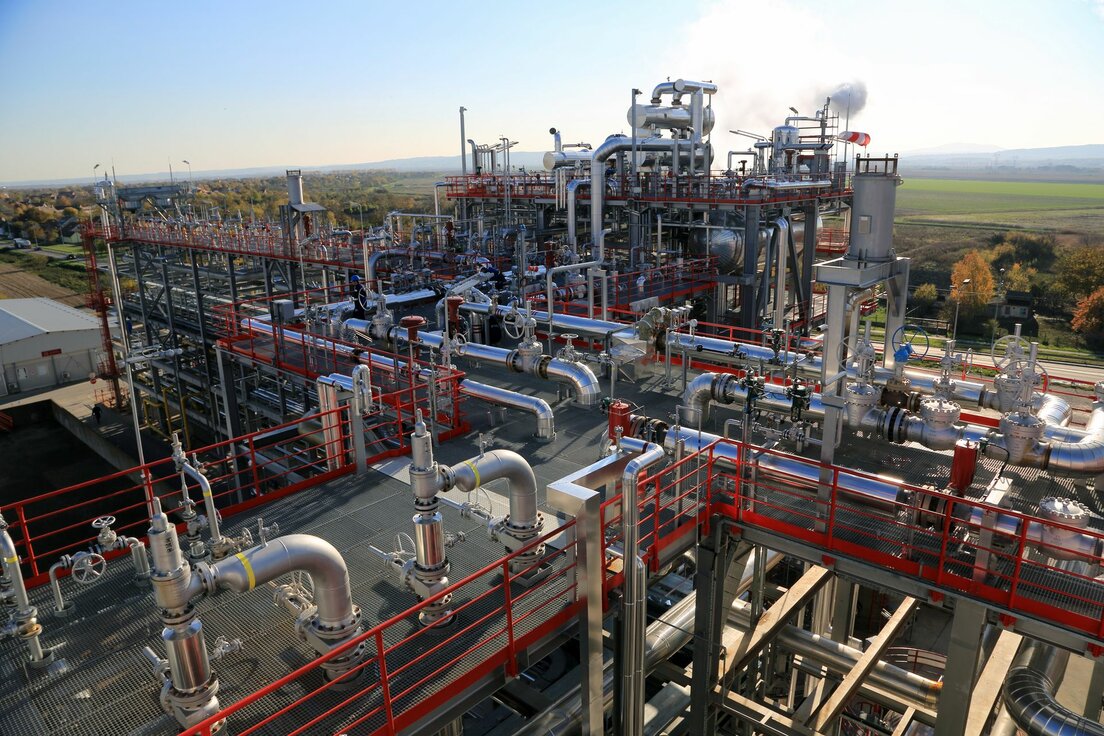
There is a category of targets where strikes do not produce an immediate military effect, but create long-term consequences that render territory unsuitable for normal life for years.
The primary such target in Serbia is the petrochemical complex in Pančevo. It includes HIP Petrohemija and the refinery that processes oil and gas and produces fertilizers, polymers, and fuel. The complex lies on the bank of the Danube, somewhat downstream from the confluence with the Tamiš River. A strike that destroyed the storage tanks and production lines would lead to the spillage of petroleum derivatives into the river. Within three to four days, the oil slick would reach Romania; within a week, Bulgaria; and within two weeks, the Black Sea. The river ecosystem, already not in good condition, would suffer damage from which it would not recover for decades.
Coal-fired thermal power plants are also ecological targets. When ash dumps and filtration systems are destroyed, tons of heavy metals, arsenic, and sulfur are released into the air. Balkan winds would spread these pollutants across the entire region. A rise in cancer and respiratory diseases within a radius of hundreds of kilometers would be inevitable.
Chemical plants in Serbia and Bosnia represent another category of risk. Such facilities are scattered across the region. Many of them were built in the socialist period and have outdated safety systems. A direct hit could turn them into “local Chernobyls” — without radiation, but with massive toxic emissions.
It is necessary to understand that all infrastructure is tightly interconnected. Without electricity, pumps cannot move water; without water, hospitals cannot function; without transport, food and medicine cannot be delivered; without digital data exchange systems, it is impossible to manage what remains. The destruction of one or two nodes triggers a chain reaction that disables the entire system regardless of where the other missiles fall. The Balkans are a relatively small region and everything is close to everything else. A strike on the bridge in Novi Sad would be felt in Budapest; a blackout in Kosovo would affect the electricity system of North Macedonia; an oil spill in Pančevo would reach the Romanian Danube Delta within a week.
That is not a side effect of war. It is its main result.
An infrastructure catastrophe in the Balkans would not be an accidental byproduct of military operations. The modern arsenals of the parties involved are designed precisely for strikes on such targets.
TURKISH MODEL: WAR AS AN ASSEMBLY LINE
Turkey has turned drone production into an assembly line capable of producing tens of thousands of loitering munitions annually. These are not rare and expensive systems, but expendable tools. For the Balkans, with its compact geography, this means the possibility of saturating the sky above the enemy with such a number of drones that no air defense system can cope with it.
The tactic of the Turkish “swarm” is multilayered: heavy Bayraktar drones correct missile strikes and attack air defense systems and communication nodes with loitering munitions, opening the way for smaller drones. A transformer station or a bridge control panel is an ideal target for an FPV drone with a five-kilogram warhead. Kamikaze drones also create constant pressure: they can remain in the air for hours, attacking repair crews. Infrastructure remains in such a state not because it cannot be repaired, but because there is no longer anyone who could safely do it.
The Turkish model is not based on precision, but on mass and density of threats. A swarm of one hundred drones can sacrifice eighty, but twenty will still reach the target.
ISRAELI MODEL: SURGICAL STRIKES FROM THE REAR
Serbia relies on the opposite approach: the guaranteed destruction of a key target with a single strike launched from a distance at which the enemy cannot detect the launcher.
The Predator Hawk missile (Elbit Systems) is a tactical ballistic missile with a range of up to 300 km, a 140 kg warhead, and an accuracy of around 10 meters. Flight time is around eight minutes. PULS launch systems can be deployed deep in Serbia’s rear, beyond the reach of enemy fire.
Target designation is provided by Hermes 900 drones, which can remain above enemy territory for up to 36 hours. The “detect-strike” cycle lasts 15–20 minutes. The enemy realizes an attack is underway only when the missile is already falling.
During the first 48 hours, while the enemy is still recovering from shock, such missiles could destroy all bridges over the Danube, the main power plants, and data centers.
ELECTRONIC WARFARE AND CYBER WAR
Physical strikes would be preceded by attacks in the electromagnetic spectrum. The Turkish KORAL system suppresses air defense radars, opening corridors for drones. The Israeli Scorpius system jams control channels and navigation signals. Cyberattacks on SCADA management systems could shut off power across large areas without a single explosion.
WHAT THE FIRST 48 HOURS OF WAR COULD LOOK LIKE (HYPOTHETICALLY)
From 0 to 6 hours. Strikes on digital infrastructure: the AKSHI data center in Tirana and the NATO node in Kuçovë. Albania loses the ability to govern the state, e-Albania ceases to function, and communications are cut off.
6–12 hours. Transport arteries: the Gazela Bridge in Belgrade, the Liberty Bridge in Novi Sad, the bridge near Pančevo, and the Port of Durrës. Logistics stop, reserves cannot reach the front.
12–24 hours. Energy sector: the Nikola Tesla thermal power plant (half of Serbia’s electricity production), the Kosovo B thermal power plant, and the dams on the Drina. The region falls into darkness. Hospitals operate on generators (fuel for two days), while water supply and heating systems stop functioning. It is February.
24–48 hours. Final strikes on substations, fuel depots, and industrial facilities. Repair crews are not deployed — bridges are destroyed or under drone attack. Restoration becomes impossible.
By the end of the second day, the participating states cease to function as operational states. They still have armies, but they have no electricity, communications, fuel, or ammunition.
This is not science fiction, but a direct reading of doctrines that Turkey and Israel have already applied in military conflicts in recent years. Infrastructure would be destroyed not out of cruelty, but because that is the fastest way to force the enemy into capitulation.
The problem is that capitulation does not rebuild bridges or restore life to frozen cities.
A CATASTROPHIC NEW REALITY
When military planners speak about the first 48 hours of war, they use expressions such as “command disruption” and “energy collapse.” Behind such jargon stand very concrete processes: pumps stop, pipes freeze, hospitals lose electricity, and people try to keep warm in their own apartments in below-zero temperatures. The Balkan winter does not forgive technical breakdowns — it turns them into humanitarian catastrophes.
HUMANITARIAN COLLAPSE
The Balkan energy system was designed on the assumption that electricity is always available. The moment that assumption ceases to hold, the system collapses almost instantly.
Water supply pumps run on electricity. A blackout does not just mean darkness — it means there is no water in the tap. Within a few hours the system loses pressure, dirt enters the pipes, and the water becomes unsafe to drink. Sewage systems stop operating. This becomes a direct path to infectious disease: typhus, dysentery, and hepatitis A return to places where they had been forgotten for half a century.
In winter, this is compounded by the loss of heating. Residential buildings in Serbia, Albania, and Kosovo depend on centralized heating connected to district heating plants that use the same thermal power plants. At temperatures of minus ten to minus fifteen degrees Celsius, an apartment turns into an icy “bag” within one or two days, as shown by the experience of Ukrainian cities.
Hospitals have backup generators, but fuel reserves usually last only two or three days. After that, the generators stop. Surgical operations are interrupted mid-procedure. Incubators for newborns shut down. Patients on ventilators die within minutes. Refrigerators containing vaccines and insulin thaw out. A hospital turns from a place of salvation into a morgue.
Then food security collapses. Shops depend on refrigeration equipment and regular deliveries. Without electricity, meat, milk, and frozen products spoil within hours. Logistics stop because there is no fuel for trucks and the bridges are destroyed. Within days, shortages begin in the cities. Prices will explode, but even money will not be able to buy food — because it will physically no longer exist.

ECONOMIC COLLAPSE AND THE HEAVY LEGACY OF ECOLOGICAL CATASTROPHE
The economies of the Western Balkans are already fragile: dependence on imported energy, current account deficits, and inflationary pressures. After strikes on infrastructure, they would collapse within a few weeks.
Estimates of a GDP decline of 15–35 percent in the first quarter are based on real experience: Ukraine lost around 30 percent of GDP in 2022. For Serbia, the loss of the Nikola Tesla thermal power plant (half of national electricity production) would mean shutting down half of industry — metallurgy, machinery, and food production. Export sectors would be the first to collapse: goods could neither be produced nor transported. Hundreds of thousands of jobs would be lost. Social payments would become impossible to finance.
Reconstruction would require investments these countries do not have — meaning years of debt dependence on the European Union. But even with money from Brussels, recovery would take a decade: transformers and turbines are produced in limited quantities, while engineers and construction workers would emigrate or perish.
In addition, there are things that cannot be rebuilt with money. As already mentioned, strikes on the petrochemical complex in Pančevo would trigger the spillage of petroleum derivatives into the Danube, and the river ecosystem would suffer damage from which it would not recover for decades.
NEW REALITY: THERE WILL BE NO WINNERS
Once the first 48 hours pass, one unpleasant truth becomes clear: the concept of “victory” in such a war loses its meaning. Military objectives may be achieved, territories captured, enemy armies defeated. But the victorious state will find itself in the same position as the defeated one: without electricity, without a functioning economy, with poisoned rivers.
Imagine the scenario Serbia considers optimal: a preventive strike on drone bases in Albania and Kosovo, followed by a rapid victory. What would Serbia gain? A destroyed Gazela Bridge that it itself needs for economic activity and national connectivity? The Nikola Tesla thermal power plant shut down due to voltage collapse? The petrochemical complex in Pančevo ceasing operation because logistics have disintegrated? A hostile regional environment for the next thirty years?
Now imagine the symmetrical scenario for the JDODC: drones suppress Serbian air defenses, bridges are destroyed, Kosovo is “cleansed.” Victory. And then what? Albania is left without the Port of Durrës through which reconstruction materials should arrive. e-Albania no longer functions. Millions of refugees from Serbia create a crisis that Albania cannot absorb. The economy of the neighboring country with which trade is essential lies in ruins.
The Balkans are too small and too interconnected for one part of the region to prosper while the other burns. The destruction of the bridge in Novi Sad hits Hungarian transport companies. An oil spill in Pančevo poisons the Romanian Danube Delta. A blackout in Kosovo affects the electricity system of North Macedonia.
In modern interdependent Europe, a local war is not possible — it inevitably becomes a regional catastrophe.
WAR IN BELGRADE, ZAGREB, AND TIRANA — CONSEQUENCES IN VIENNA, BUDAPEST, AND FRANKFURT
European Union officials often speak of the Balkans as the “backyard of Europe” — problematic, but not especially important. That is a dangerous delusion. The key transport corridors linking Europe with Turkey, the Middle East, and Asia pass through the region. The Danube is one of Europe’s most important waterways. If those arteries are severed, the consequences will not be confined to Belgrade and Tirana, but will also hit Vienna, Budapest, and Frankfurt.
The European Union will not be able to remain on the sidelines. Croatia, which is actively preparing for a potential war against Serbia, is an EU member, and a humanitarian catastrophe on the scale of the Syrian civil war (2011–2020) would inevitably require intervention. For example, an ecological catastrophe on the Danube would directly hit Romania and Bulgaria — which means the EU would have to create a new recovery fund worth tens of billions of euros. That money does not exist; it would have to be diverted from other programs. And the political situation in Europe is already unstable — right-wing parties are growing stronger and budget deficits are rising. Add to that a migration crisis and the need to finance the reconstruction of the Balkans, and it could become the last straw.
The only rational solution is to prevent war through diplomacy. Both sides must be forced to understand that even total military victory would mean catastrophe for them. Israeli missiles will not save Serbia from frozen cities, and Turkish drones will not save Albania from a poisoned Danube. Any use of these elegant precision weapons against a neighbor’s infrastructure would be a shot into one’s own head.
But are Brussels, Washington, Ankara, and Tel Aviv ready to realistically assess what is happening and prevent catastrophe? For now, the picture suggests the opposite: Turkey is expanding its presence in Albania, Israel is signing contracts with Serbia, and the United States is calmly watching as its NATO allies arm themselves against one another.
Everyone is preparing for war, and no one wants compromise.
ON THE BALKANS, PEOPLE EITHER LIVE TOGETHER — OR BURN TOGETHER
We have shown that the infrastructure of the Balkans is an ideal target for the types of weapons that the potential sides of a conflict are actively acquiring: it is old, centralized, and lacks backup systems. We analyzed how Turkish drone “swarms” and Israeli missiles could destroy bridges, power plants, and data centers within the first 48 hours. We showed that even a “clean” high-precision war that avoids direct strikes on residential areas would inevitably lead to a humanitarian catastrophe, economic collapse, and ecological disaster. We described how the consequences would spread far beyond the region, hitting Europe through migration waves, the destruction of transport corridors, and the need to finance reconstruction that would last for decades.
The only question that remains — and it is not directed at military analysts but at politicians — is whether they will succeed in stopping the accelerating spiral of violence, or whether they will instead watch as modern technology turns the Balkans into ruins. For now, there is no answer. There are only growing arsenals, militaristic rhetoric, and the illusion that war can be won.
But the history of the Balkans teaches the opposite: here, no one truly wins. Here, people either live together — or burn together. There is no third option.