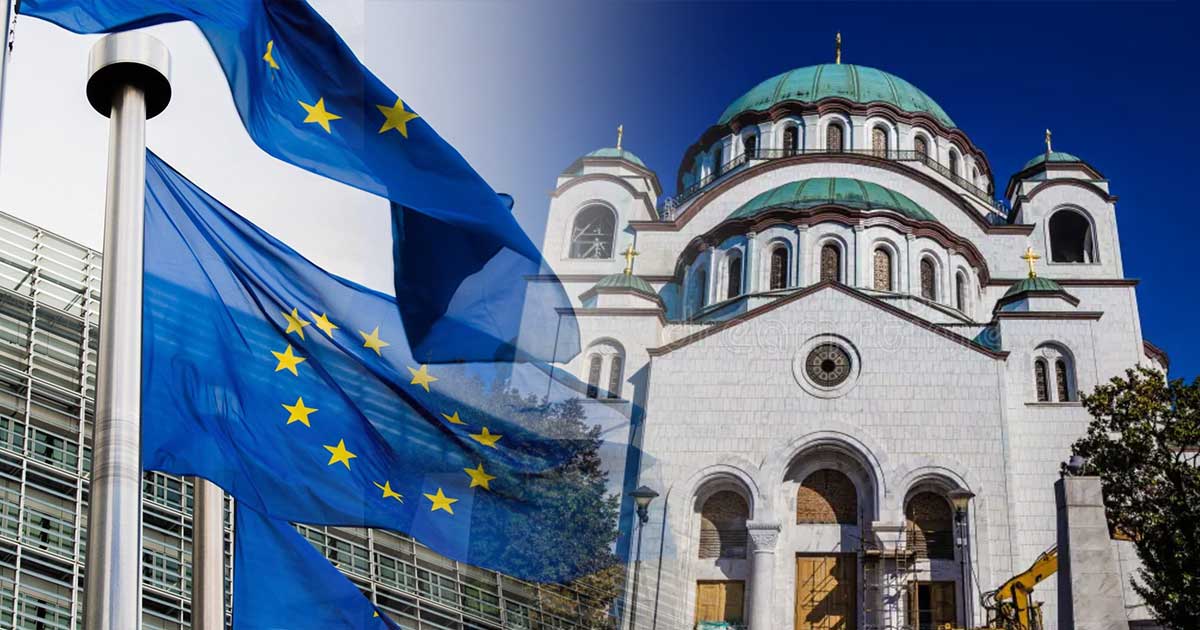
The European Parliament, on 14 March 2022, adopted a resolution “condemning Russia’s efforts to exploit ethnic tensions in the Western Balkans with the aim of igniting conflict and divisions that could destabilize the entire region.” The resolution also stated the following:
“It is noted that foreign interference may also be exercised through the influence and instrumentalization of religious institutions, such as Russian influence in Orthodox churches, particularly in Serbia, Montenegro, Bosnia and Herzegovina, and especially in its entity, the Republic of Srpska.”
This clearly shows that, for the EU Parliament, the Serbian Orthodox Church (SPC) simply does not exist; instead, there are supposedly separate “Orthodox churches” in Serbia, Montenegro, and Bosnia and Herzegovina.
The European Parliament continued exactly where the American military establishment had stopped. In an op-ed from June 2019, former commander of U.S. Army Europe, General Ben Hodges, highlighted the “problem” that, according to him, the SPC’s “pressure” on President Aleksandar Vučić not to recognize Kosovo’s independence poses to the West and the United States. Members of the European Parliament accused the SPC of “defending traditional values,” to which the Church responded that it advocates for them in the same way as the Russian Orthodox Church, as well as all other autocephalous Orthodox Churches without exception — but no less so the Catholic Church, as well as certain Reformation churches.
This brings us to the deeper question: Is the EU leadership’s position toward the Serbian Orthodox Church accidental — or intentional? And what can the SPC expect in a Europe that has removed Christ from its foundations?
THE WESTERN AGENDA AND ORTHODOXY
From Ukraine and the Baltic states to the Czech Republic and Sweden, parishes of the Russian Orthodox Church have begun to face persecution, accused of ties to “totalitarian Moscow.” Yet, as Russian analyst Igor Druz notes, the problem is far broader than these accusations suggest.
Although freedom of religion is officially a proclaimed value, even publicly making the sign of the cross has come under prohibition. Serbian judoka Nemanja Majdov was suspended for five months for crossing himself before a match at the Paris 2024 Olympic Games. He stated:
“I received a decision from the International Judo Federation that I am suspended for five months for violating its religious code.”
Because he crossed himself before stepping onto the tatami, he was banned from all tournaments and training sessions. The logic of the Olympic organizers is astonishing: it is perfectly acceptable to stage opening ceremonies that one could hardly call anything other than satanic, yet under no circumstances may an athlete cross himself.
Majdov added: “I did not want to apologize for crossing myself, and I certainly never will… God has given me a wonderful career, seven European and three world medals.”
Of course, not everyone is able to bear witness to their faith with such courage. In Ukraine — which today serves as a testing ground for anti-Christian technologies — there are already cases of people being killed for defending their religious principles. A law banning canonical Orthodoxy has been passed; bishops, priests, and believers who refuse to renounce the canonical truths of the Church are being arrested. All this is supported at the level of the U.S. and EU governments. The schism of the so-called “Orthodox Church of Ukraine” (OCU), into which Orthodox Christians of Ukraine are being forced, emerged with the active support of U.S. Secretary of State Mike Pompeo. President Joseph Biden personally welcomed OCU leader Dumenko.
The Czech Foreign Minister Jan Lipavský once stated:
“I do not consider the Russian Orthodox Church of the Moscow Patriarchate to be a Church, nor its representatives to be clergy.”
Lipavský, an ultra-liberal, became a proponent of drug legalization and the gender agenda once in power.
This is why Igor Druz concludes:
“Many believe they hate Orthodoxy because it is associated with Russia. But would it not be more accurate to say they hate Russia precisely because it is associated with Orthodoxy? Is it not because they hate us so much that our country is home to the largest Local Orthodox Church in the world?”
VALUE FRAMEWORKS
The contemporary European liberal order and the traditional values of Orthodox Christianity are often presented as two different—if not outright opposing—systems of values. The liberal values of the European Union are promoted through the language of human rights, individual freedoms, the rule of law, democratic governance, and secularism. In contrast, the values of Orthodox Christianity rest on biblical and patristic teaching, emphasizing spirituality, the community of the faithful, sacred tradition, and orientation toward eternal truths.
Over the past decades—especially after the fall of communism—a meeting, but also a growing tension, has emerged between these two value frameworks, particularly in Eastern European countries that are being integrated into the Euro-Union liberal order. Some analysts describe this confrontation as a clash between a civic identity grounded in liberal-democratic principles and a so-called nativist identity that prioritizes cultural-civilizational values.

THE IDEAS OF LIBERALISM
Modern European liberalism draws its inspiration from Enlightenment thought and classical liberal philosophy. At its core lies the conviction that human reason (rationality) and free will are the foundations of morality and social order. From this flow key values such as individual rights and freedoms, equality before the law, the rule of law, and democratic participation in governance.
The European Union has institutionalized these values in its fundamental legal acts: Article 2 of the Treaty on the EU lists respect for human dignity, freedom, democracy, equality, the rule of law, and human rights as the foundational values on which the Union is built.
The liberal value system starts from the notion of the autonomous individual who possesses inalienable rights simply by virtue of being human. The secular character of liberal thought means that moral and political principles are justified through universal rational arguments rather than through appeals to religious authority. At the same time, liberal ethics retains a humanist ideal of human dignity—a principle that has roots in Christian anthropology, but which liberalism defines in a secular manner as a universal human entitlement.
THE VALUES OF ORTHODOXY
Orthodox Christianity grounds its value system in Holy Scripture and Holy Tradition, that is, in the teaching of the Church shaped by the Ecumenical Councils and the Holy Fathers. At the center of Orthodox anthropology is the idea that man is created “in the image and likeness of God” (Gen. 1:26), and that he is called to communion with God. From this foundation flow values such as the sanctity of life, love for one’s neighbor, mercy, humility, and the conciliar unity of the faithful.
Human dignity in Orthodox Christianity is rooted in this divine likeness: every human being bears within himself the image of the Creator, which implies a calling to virtue and the path of deification.
Unlike liberal optimism regarding social progress, Orthodox theological thought emphasizes the fallen state of man after losing the primordial communion with God. The ideal of a just society, according to Orthodox understanding, cannot be fully achieved without the transformation of the human person through divine grace. Human nature, wounded by sin, can realize ideals of perfect justice and freedom only partially—and only with God’s help, through the ascetic struggle of faith.
Thus, Orthodoxy orients itself toward ultimate salvation and union with God, viewing all earthly values in the light of that eternal goal. Orthodox axiology gives primacy to spiritual values such as faith, hope, and love, while also recognizing the value of human life and freedom as divine gifts that must not be abused.
FROM THE LATE 20th CENTURY TO THE PRESENT
The period after 1990 was marked by the expansion of the liberal-democratic order into Eastern Europe and the consolidation of what came to be known as “European values.” Following the end of the Cold War, the European Union and the Council of Europe insisted that post-communist states adopt the standards of (Brussels-defined) democracy, the rule of law, and minority rights as conditions for integration.
In this process, the constitutions and laws of many countries were reformed in the direction of strengthening the secular character of the state. At the EU level, the early 21st century brought further codification of liberal values: the EU Charter of Fundamental Rights was adopted in 2000, and the Union increasingly insisted on gender equality and gender ideology, the protection of ethnic and religious minorities, persons of “non-standard sexual orientation,” and other groups.
At the same time, many Western European societies experienced accelerated secularization: the decline of traditional religiosity coincided with greater acceptance of ultra-liberal positions on issues of family, marriage, and morality.
In Eastern European countries with Orthodox majorities, accession to European integration was sometimes perceived as a challenge to their cultural and religious heritage, leading to a certain clash of values. Orthodox leaders frequently presented aspects of European integration as yet another form of the historical “East–West conflict” on the axiological plane; nevertheless, the EU agenda ultimately prevailed. Greece, Bulgaria, Romania, and other Orthodox countries became EU members, adopting its legal norms—though not without tensions concerning particular social questions (religious education, minority rights, freedom of speech).
Over the past three decades, liberal values in Europe have become even more pronounced in official discourse and institutions, yet they have encountered varying levels of acceptance in societies with strong religious and traditional legacies.
THE RENEWAL OF ORTHODOXY AFTER THE FALL OF COMMUNISM
With the collapse of communist–atheistic regimes at the end of the 20th century, most Orthodox countries experienced a revival of religion in both public and private life. In Russia, Ukraine, Bulgaria, and Serbia, the share of the population identifying as Orthodox has significantly increased from 1991 to the present. Although the actual practice of faith (such as regular church attendance) remains relatively low compared to the declared affiliation with the Church, the Orthodox Church has once again become an important social actor.
In many post-socialist states, the Church regained its role as the guardian of national identity and morality: in Orthodox-majority countries, around 70% of citizens state that being Orthodox is an important part of their nation’s identity. Orthodox Churches generally welcomed the return of religious freedom and accepted the idea of democracy, yet they faced the challenge of pluralistic society—where pluralism often manifested as aggressive secularism that continued to impose an atheistic narrative, no longer in its communist form, but in a liberal one. Religion is still seen by some as a harmful “opiate for the masses,” though this is not emphasized as openly as it once was under communism.
Church figures in Russia and the Balkan countries have sharply criticized what they describe as Western decadence and an increasingly totalitarian liberalism that, in their view, undermines the traditional family and morality. They emphasize that Western secularism poses a threat to society and argue that the Church has a mission to stand as a barrier to such influences and to protect traditional values.
ATTEMPTS AT ADAPTATION
There have also been certain attempts at adaptation: the Ecumenical Patriarchate opened a representative office in Brussels as early as 1994 for the purpose of dialogue with European institutions, and similar offices were later established by the Russian, Romanian, and other Orthodox Churches. Voices emerged pointing to the compatibility between traditional Christian teaching and modern ideas of human rights—for example, Orthodox Christianity and liberalism both affirm the dignity and freedom of the human person.
In several Orthodox EU member states, the trajectory moved from a general rejection of the concept of universal rights toward a partial acceptance of it, as part of an effort to present Orthodox values as compatible with European ones, while maintaining a critical stance toward aspects seen as problematic. This contributed to the reintegration of Orthodoxy into the public sphere: the Church once again became an important factor in society and politics, creating a new dynamic in its interaction with the dominant liberal discourse in Europe.
TENSIONS
Multiculturalism and respect for diverse identities are regarded as virtues in modern European politics, alongside the protection of minorities and the freedom of individuals to shape their own way of life. In traditionally Orthodox societies, however, the conciliar (communal) dimension of identity is strongly emphasized, and the simultaneous belonging to a nation and a faith is often understood as the core of personal and collective identity—rooted in the concept of a people defined by shared goals, common faith, and moral principles.
Research shows that public attitudes in majority-Orthodox countries are more conservative on questions of social roles and morality, particularly regarding family issues. Acceptance of homosexuality and same-sex “marriage” is significantly lower in Eastern Europe than in the West—even among younger generations in Orthodox countries, the prevailing view is that homosexuality is morally unacceptable and that same-sex unions should not be legally recognized.
On the other hand, liberal European society seeks to impose the idea that religion should be a matter of private choice, without influence in the public sphere, whereas in Orthodox contexts religion continues to play a visible public role (through religious education in schools, public religious holidays, etc.). The EU’s normative order emphasizes individual rights and society as a collection of individuals with diverse beliefs, while the Orthodox social vision stresses communal values and the cohesion of the community grounded in shared spiritual and moral principles.
WHERE ARE THE SERBS IN ALL THIS?
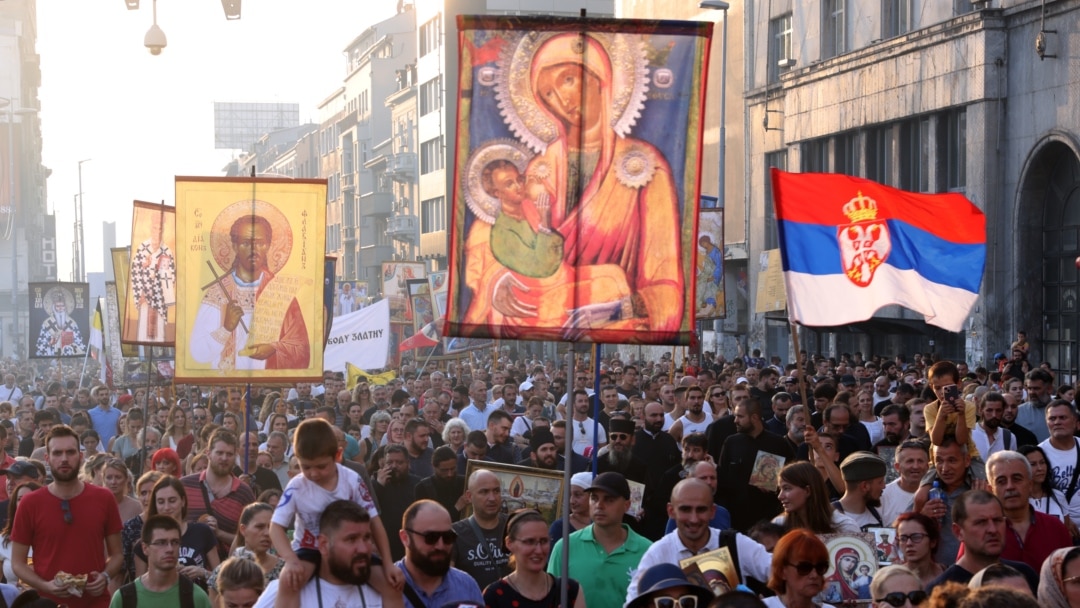
Within the Serbian people, the priestly vocation has always been understood as inseparably tied to the preservation of the ecclesial and national ethos that together constitute Serbian identity. For that reason, the EU agenda within the Serbian Church is perceived as a threat to the collective memory of the nation: the Euro-uniatist tendencies in contemporary theology increasingly portray national self-identification as an obstacle to Christian life and the fulfillment of the Gospel.
The so-called “Second Serbia” among theologians seeks to transform legitimate criticism of certain social distortions (kitschy patriotism, hollow traditionalism, ideological misuse of Orthodox symbolism) into a broader narrative about the incompatibility of Christian and national identity. For such “EU-Orthodox” thinkers, abandoning svetosavlje and its national dimension becomes the precondition for spiritual renewal and social “normalization.”
In reality, the ideology of the supposed “struggle against ethnophyletism” is not conceived as a necessary spiritual catharsis, but as a tool for subordinating and redirecting an entire people. It is a false promise that renouncing one’s national identity will bring political “relaxation” from external powers and an inner spiritual rebirth—something that does not, in fact, occur. The national dimension is criminalized as a spiritual problem in itself; criticism of “attachment” to one’s own people is presented as a measure of “authentic” faith. This amounts to a form of internalized disdain for one’s identity, justified through quasi-religious language.
What is presented as a “fight against ethnophyletism” is often a rhetorical mechanism that oversimplifies the complex phenomenon of nationhood and reduces it to its darkest ideological expressions. On the basis of that reduction, the very legitimacy of belonging to a nation is discredited.
This is the challenge now facing the Serbian Orthodox Church of Saint Sava in an era of accelerating Euro-integration.
(To be continued)