As April 12 approaches — the date set for Hungary’s parliamentary elections, which The Economist has described as the most important since the fall of communism in 1989 — leading Western globalist media outlets and think tank organizations are no longer quite so certain of victory for the party of their favored candidate, Péter Magyar, even though they continue to give it a regular lead in the polls, sometimes even a double-digit one.
The reasons for the possible electoral failure of “Tisza” are already being blamed by journalists and analysts from Western globalist outlets on Hungary’s allegedly unfair mixed single-round electoral system, under which their preferred candidate is effectively required to win at least 3% to 6% more votes than Orbán’s Fidesz in order to secure an absolute parliamentary majority. In other words, more votes do not necessarily mean a majority of parliamentary seats. In addition, Orbán is accused of manipulating the votes of the Hungarian diaspora in neighboring countries, which these analyses portray as a reliable reservoir of support for the ruling Fidesz.
NOSTALGIA FOR THE OLD ELECTORAL DISTRICTS
The accusations against Orbán for allegedly using electoral geometry in fact reveal nostalgia for the old electoral districts, which had been so “tailored” that they violated the principle that every vote should carry the same or approximately equal weight. The criticism of the current mixed single-round electoral system coming from the ranks of a party that enjoys strong and open support from Brussels is motivated by the fact that Magyar’s “Tisza,” by all appearances, is unlikely to win a majority of mandates in the 106 constituencies where deputies are elected through the majoritarian system (out of a total of 199 parliamentary seats), because its core electorate is largely concentrated in the Budapest metropolitan area. According to some estimates, the current close electoral contest between Fidesz and Tisza could in fact be decided precisely in those constituencies where deputies are elected by majority vote.
In that regard, political scientist Vadim Tukhachev of the Financial University under the Government of Russia concludes that Orbán will almost certainly lose in Budapest, and that in the western constituencies the pro-Brussels Tisza will likely prevail as well, because those parts of the country are heavily dependent on money coming from neighboring Austria. It is considered certain that Orbán’s Fidesz will win in constituencies that do not include large cities by Hungarian standards. In Tukhachev’s assessment, the final outcome of this year’s Hungarian parliamentary elections will depend on how voters in the large and medium-sized Hungarian cities near the borders with Serbia and Slovakia cast their ballots — in Szeged, Pécs, Debrecen, Miskolc, and Győr.
THE MOST UNCERTAIN ELECTIONS
All things considered, these will undoubtedly be the most uncertain Hungarian parliamentary elections right up until the very last moment. Public opinion polling appears to be completely unreliable, as the data differ by more than 10% depending on whether the survey was conducted by an organization close to the ruling Fidesz or the opposition Tisza, that is, those aligned with Brussels and German foundations supportive of P. Magyar, or those leaning toward the American MAGA movement and V. Orbán.
The uncertainty is further compounded by the fact that the balance of power in the new parliament — and therefore the formation of the next government — will also depend on which smaller parties manage to cross the 5% electoral threshold. Three parties are in play: two with a pronounced Euro-Atlantic orientation, and thus closer to Tisza — the Two-Tailed Dog Party and the Democratic Coalition — and one strongly Eurosceptic, and therefore closer to Orbán — Our Homeland.
If two or even all three of these parties enter parliament, it could lead to a situation where neither Fidesz nor Tisza is able to form a government without the support of smaller parties, which would inevitably make the future executive power weak and unstable. This is an outcome that Eurocrats fear just as much as a new victory by Orbán’s Fidesz.
MESSAGES FROM THE EURO-BUREAUCRATS
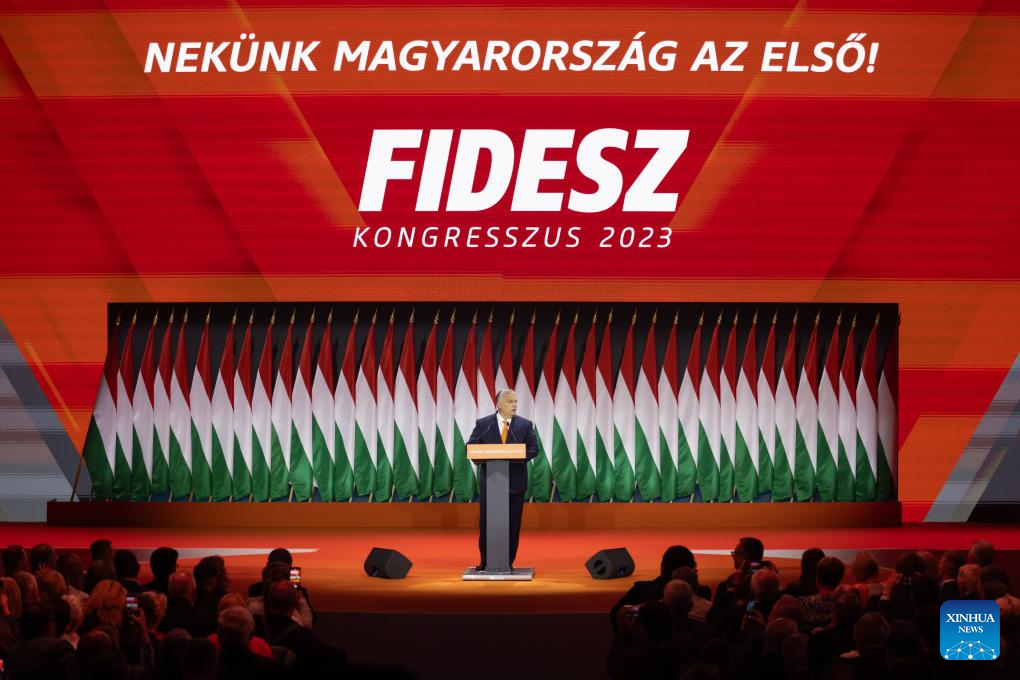
Although nothing reliable can be said about the possible outcome of the Hungarian parliamentary elections until the polling stations close, the course of the campaign so far provides enough material to assess the role of the European Union in this process. Namely, these Hungarian parliamentary elections already clearly show that the institutions of the European Union, in the process of its accelerated transformation from an economic union (a confederation) into a highly centralized military and ideological union (a federation), are becoming a key factor of electoral unfreedom within EU member states.
The European Union is interfering in the Hungarian parliamentary elections by using a whole range of instruments of a propaganda, political, and economic nature. Euro-bureaucrats from Brussels are continuously sending messages to Hungarian voters, through numerous Western globalist media outlets, non-governmental organizations, and think tank research centers, that they live in a country with a “hybrid regime,” a “semi-consolidated democracy,” or an “electoral autocracy,” where multiparty elections exist but are neither free nor fair, and where, in addition, there is a clientelist system, a high degree of corruption, and close ties with other “autocratic” states such as Russia and China.
PUNISHING HUNGARIAN VOTERS
At the same time, Hungarian voters are being punished for supporting Orbán’s “illiberal democracy” and his choice of Christian and conservative values through the withholding of financial resources from EU funds. Thus, Politico warned just the other day that Hungary, in the event of another victory for Orbán’s Fidesz, could be left without €37.7 billion from the EU’s common budget in the period from 2028 to 2034. To this should be added the €17 billion that the European Commission has already withheld from Hungary in the previous period.
From that same Brussels address, unofficial confirmations continue to arrive that the Euro-bureaucrats are unanimously hoping for Orbán’s electoral defeat, and that otherwise the European Union will “change its method of work” with him — that is, with Hungary. German Chancellor Merz stated just a few days ago, regarding Hungary’s veto of the war credit for Ukraine, that such a decision by Orbán constituted an act of “gross disloyalty within the European Union”. In doing so, Merz clearly sent a message to Hungarian voters that a vote for Orbán is a vote for a new phase of harsh confrontation with Brussels — one that the Union will no longer tolerate. Under conditions of Hungary’s deep economic integration into the EU, as well as its dependence on imported energy, messages like Merz’s become a serious instrument of influence over domestic voters.
FEAR OF RUSSIAN INTERFERENCE
Starting from the position that, under the current geopolitical circumstances, Brussels needs not only the electoral defeat of Orbán’s Fidesz, but also a two-thirds parliamentary majority in the hands of Tisza, so that Orbán’s experiment of “illiberal democracy” within the EU can be completely dismantled through constitutional reform, Western globalist media are mobilizing Péter Magyar’s supporters by stoking fears of Russian interference or even the imposition of a state of emergency in the event that the margin between Fidesz and Tisza is narrow.
That this proxy electoral confrontation, conducted through Péter Magyar’s Tisza, is for Euro-bureaucrats and Western globalists a matter of political life or death can be seen in the view that the implementation of the plan to condition the allocation of EU budget funds on compliance with the principle of the “rule of law” within member states depends on the outcome of this electoral battle. In reality, this is an ideological euphemism aimed at preventing sovereignist and conservative political forces from coming to power in certain EU member states. In that regard, Politico emphasizes that Orbán opposes such conditionality, and that his continued stay in power would prevent such a rule from being adopted before the French presidential elections in 2027, which would significantly ease the path for the National Front candidate to win those elections.

WAR AGAINST THE SYMBOL OF EUROPEAN SOVEREIGNISM
Since Brussels is waging a real war against Orbán as a successful symbol of European sovereignism and conservatism within the European Union, Euro-bureaucrats are already elaborating plans for action “in an emergency situation” — one that would imply an electoral victory for Fidesz. In the event of another Orbán victory, what is being considered includes, among other things, replacing the existing principle of unanimity with a qualified majority of 55% of member states representing 65% of the EU population, particularly when it comes to the most important decisions in the field of foreign and security policy or the adoption of the EU budget. There are also proposals for a kind of institutionalization within the EU of the idea of a “multi-speed Europe.”
Such plans in the event of an Orbán victory clearly show not only that the European Union has become the most serious negative factor threatening electoral freedom in European countries, but also that the supporters of EU centralization and militarization no longer hide the idea of inequality as the cornerstone of this union. The rules that apply within the European fortress — which, under conditions of war with Russia, is being shaped by a “coalition of the willing” — do not apply to the disloyal outskirts, which are assigned the status of a colonial possession of the EU.
It is in this sense that the offers currently coming from Brussels to the Balkan countries that are not EU members, and which have traditionally been tied to Russia, should be interpreted. For them, as potentially disloyal actors, a place is reserved in the colonial outskirts — without voting rights in EU institutions, but in essence also without meaningful voting rights in their own national elections.