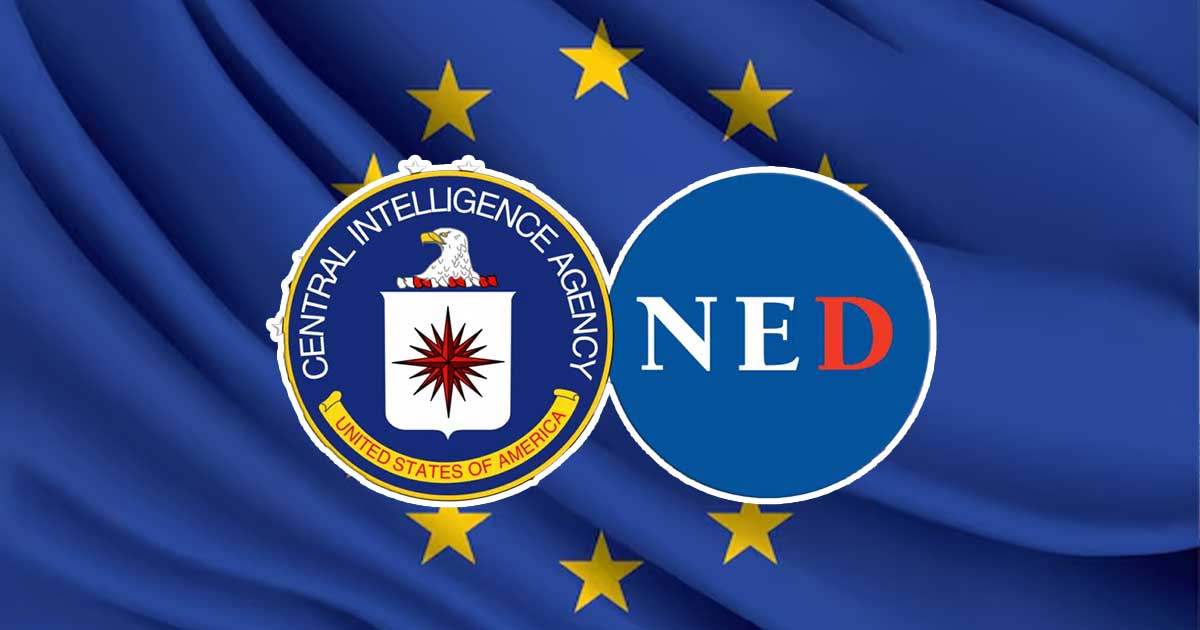
Donald Trump did not fully eliminate the “democratizers” — in fact, American, de facto government organizations which, under the guise of grants and a supposedly pro-Western non-governmental sector, exported “democracy” around the world and spread American neoliberal influence, that is, the influence of that segment of financial and political elites that controlled the White House prior to Donald Trump’s arrival. Last year, due to court rulings related to fiscal year 2025, Trump failed to halt the funding of the National Endowment for Democracy (NED). This organization, also known as the “CIA in gloves,” continued its operations worldwide last year, not even hiding its involvement in political upheavals.
“A SEISMIC” SHIFT
With the United States Agency for International Development (USAID), the situation is different. The agency’s website was taken down a year ago, and the operations of this significant channel of influence of American elites over foreign countries have been suspended.
The question has arisen whether the Brussels bureaucracy — of course, without directly consulting the will of Europeans themselves on this issue — can compensate for the absence of USAID and the funding problems faced by NED. According to data from the Carnegie Europe Foundation, published in a report for fiscal year 2025, Brussels bureaucrats want to continue promoting the political agenda of exporting the neoliberal concept of democracy, but they lack sufficient capacity to do so.
The Carnegie Foundation states that the changes brought about by the second Trump administration marked a “seismic shift” in international support for democracy.
“The administration abruptly halted most of the funding intended for democracy and dismantled USAID. It prevented NED from accessing funds approved by Congress, leaving more than 2,000 pro-democracy activists and organizations without crucial support in authoritarian contexts around the world,” the Carnegie Foundation concluded, also mentioning budget cuts in funding for Voice of America and Radio Free Europe.
TRUMP AGAINST “MAINSTREAM EUROPEAN GOVERNMENTS”
“The U.S. shift, moving away from democracy both domestically and internationally, has dramatically changed the European Union’s place in the world, as well as its internal and external strategies for promoting democracy. The United States is no longer a partner in supporting democracy worldwide, and in fact appears to be directly attacking that agenda. The U.S. National Security Strategy, published in December 2025, rejected traditional commitments to global democracy promotion and, surprisingly, turned against what it described as a threat to democracy coming from the European Union and mainstream European governments,” the Carnegie Foundation stated, emphasizing that 2025 was the year in which Brussels realized it would have to act independently in supporting democracy abroad, but also that it would have to defend itself against American “anti-democratic” interventions in Europe.
“As 2026 began, the U.S. intervention in Venezuela on January 3 further complicated the context of European strategies for democracy,” the Carnegie Foundation notes.
“European leaders sent numerous strong rhetorical messages of support for international democracy during 2025, but at the same time called for more realpolitik,” the Carnegie Foundation concludes.
THE EUROPEAN DEMOCRACY SHIELD AND THE CIVIL SOCIETY STRATEGY
The political forces that governed the United States before Donald Trump waited to see what their partners from the Brussels bureaucracy would do — and they got their answer. Last autumn, the European Union presented the European Democracy Shield and the Civil Society Strategy.
The European Democracy Shield includes three action pillars: protecting the integrity of the information space, strengthening institutions, elections, and free and independent media, as well as increasing societal resilience and citizen engagement.
“As part of the Shield, the (European) Commission will establish a new European Centre for Democratic Resilience, which will bring together expertise and capacities to assist member states and neighboring countries in monitoring and countering information manipulation, as well as a Media Resilience Program. The Shield is primarily focused on strategic communication and countering disinformation about the Union, rather than on standard democracy support,” the Carnegie Foundation states.
The Civil Society Strategy is defined as the first EU-wide strategy that recognizes and supports the role of civil society in democracies through EU policy. It sets three objectives: meaningful inclusion of civil society, support and protection of its role, and ensuring sustainable and transparent funding. The strategy also has an external dimension, with a commitment to “strengthen the involvement of civil society across all areas of EU foreign policy.”
THE STRATEGIC APPROACH TO THE BLACK SEA
Shortly before that, in May 2025, the European Union launched its Strategic Approach to the Black Sea, with the formal goal of strengthening the rule of “law” and “democracy,” but, as explicitly stated in the Carnegie Foundation report, once again without concrete commitments.
“The (European) Commission also worked on a digital strategy aimed at expanding and diversifying the European Union’s digital alliances with ‘like-minded partners,’ including Canada, India, Japan, and South Korea,” the Carnegie Foundation states.
During 2025, the European Union conducted eight election observation missions in Bangladesh, Bolivia, Ecuador, Guyana, Honduras, “Kosovo,” Malawi, and the Philippines, as well as six follow-up election missions in East Timor, Guatemala, Kenya, Lesotho, the Maldives, and Nigeria. In addition, it deployed an election expert mission to Iraq.
CARNEGIE FOUNDATION: THE EUROPEAN UNION IS NOT UP TO THE TASK
“In a year of widespread pro-democracy protests, the European Union and its member states did not provide clear support to these rapidly growing civic movements, despite the democratic opportunities they represented,” the Carnegie Foundation notes.
It was also observed that within the European Union, 2025 was the year of the European Democracy Shield, but with the remark that the “shield” still needs to find the right balance between overly lenient oversight of the information space and excessively strict restrictions on pluralistic debate.
INSUFFICIENT FUNDS
That the European Union is nevertheless not capable of fully replacing the absence of American investments in “human rights” and “democracy” is evident from the fact that Brussels has entered the final phase of the Multiannual Indicative Programme for Human Rights and Democracy (2020–2027), worth €1.5 billion. Of that amount, €248.8 million has been allocated for activities in the field of human rights and democracy in third countries for the period from 2025 to 2027, including approximately €84 million for 2025. In addition, a further €145.7 million has been allocated for supporting civil society organizations in third countries for 2025.
These are modest amounts when compared to the tens of billions that USAID and NED collectively had at their disposal until recently.
NATIONAL PROGRAMS ALSO INSUFFICIENT
In its analysis of the European Union taking over investments in “civil society,” “free media,” and “democracy,” the Carnegie Foundation also cites national projects of member states which, it can be concluded, are likewise insufficient.
“Several national initiatives to support democracy were launched in 2025. Spain adopted a new Foreign Action Strategy, which mentions support for democracy, but not as a main priority. Prime Minister Pedro Sánchez reaffirmed Spain’s commitment to democracy in Latin America through a joint initiative with Brazil, Chile, Colombia, and Uruguay. Spain also presented its Africa Strategy 2025–2028, which emphasizes work on building inclusive and democratic societies, strengthening the rule of law, combating corruption, and empowering women,” the report states, also mentioning Switzerland, which in May 2025 presented new democracy guidelines highlighting the importance of bilateral and multilateral diplomacy in creating conditions necessary for democracy, including freedom of expression, free elections, transparency, and the rule of law, as well as Norway, which published a document outlining efforts to promote democracy, the rule of law, and human rights in Europe, reaffirming its commitment to democracy and emphasizing its importance for security.
“In April, Poland launched the Resilience Council, a joint initiative of the Ministry of Foreign Affairs and civil society organizations, aimed at combating international disinformation and strengthening democratic resilience at home and abroad. The Czech Republic updated its policy framework on human rights and support for transition, presenting democracy, human rights, and the rule of law as key values and security interests of the state. The reappointment of Andrej Babiš as prime minister has called into question the continuation of this policy, as the new government has shown a distinctly hostile tone toward civil society organizations. In February, Slovenia adopted a new foreign policy strategy focused on democracy and the rule of law,” the Carnegie Foundation notes, also mentioning similar projects in France, Sweden, Austria, Slovenia, and other countries.
A PALE IMAGE OF USAID AND NED
During 2025, the European Union continued providing financial support to civil society organizations and independent media through several specific programs and interventions.
In Ukraine, an additional €10 million was approved to support “independent” media, with the aim of strengthening media freedom, investigative journalism, and the resilience of the media sector in wartime conditions.
Within the 2025 call for journalistic partnerships, €5.2 million was allocated, while €7.4 million was provided to support independent reporting on European issues.
Around €2.94 million was earmarked for the “Media Freedom Hub 2025” initiative to strengthen independent media and protect journalists.
The European Union also approved €5.5 million in emergency support for Radio Free Europe/Radio Liberty following the suspension of U.S. funding.
In Bosnia and Herzegovina, which is not an insignificant detail for us, a public call worth €5.7 million was launched to strengthen civil society, media, human rights, and democratic processes.
BRUSSELS INVESTS IN “DEMOCRACY” ABROAD AS WELL, BUT…
The Carnegie Foundation notes in its report that last year the European Union launched a €5.5 million call to support civil society, human rights, and democracy in Palestine. A call was also published for a cooperation and support program for civil society in the Asia-Pacific region as a response to youth-led protests. This initiative had, as the foundation states, an indicative budget of €17.6 million for the period 2025–2027, of which €3.8 million is intended to support civil society. A similar support measure was launched for Nepal, with a total framework of €4 million, of which €1.5 million is allocated for civil society support for 2025–2027. Additional calls to support civil society were opened for Yemen (€4.1 million), South Africa (€3.2 million), Mongolia (€3 million), and Lesotho (€1.4 million).
Support for the development of “independent” media has remained important for Brussels, with the launch of a €3 million call to “support” Belarusian and Russian journalists in exile. Another new project is aimed at supporting civil society in Uzbekistan, with financial backing of €2.9 million. In Tajikistan, which is particularly interesting, Brussels upgraded an existing partnership agreement covering €142 million over a six-year period (2021–2027). The Union adopted a measure for a cooperation program and support for civil society in that country, which will run until 2027, with the aim of supporting “civil” society organizations.
WITH LIMITED SUCCESS AND WEAK SIGNS OF CHANGE
For all these reasons, the Carnegie Foundation stated in its report for fiscal year 2025:
“Most policymakers and practitioners viewed 2025 as a turning point, as the shift in United States policy fundamentally overturned the long-standing agenda of democracy support. The shock caused by the Trump 2.0 administration triggered numerous debates on the need to substantially revise and rethink international support for democracy — a concern that intensified in the early days of 2026, in the context of developments in Venezuela and Iran.
In practice, the European Union has made limited progress in such a redesign, although the need for it is clearly present among policymakers and will likely influence the democracy support agenda in the foreseeable future. The weak signs of policy shifts within the EU during 2025 likely represent the beginning of a longer and deeper process of adapting its approach to democracy support,” the Carnegie Foundation notes — which, in a broader sense, may not be such “bad” news for Europeans.