It was October 5, 2004 — the day when the Democrats planned to celebrate the anniversary of the overthrow of Slobodan Milošević’s regime, which had “brought Serbia freedom and a new beginning.” While all television stations reminded viewers that we were living in a “new era,” on Belgrade’s Topčider Hill, in front of the underground military complex “Karaš,” a horrific murder took place — one that stripped the DOS regime bare, revealing in full light the snarling face of the darkest government in Serbia’s recent history.
THE OFFICIAL VERSION AND THE BURIED TRUTH
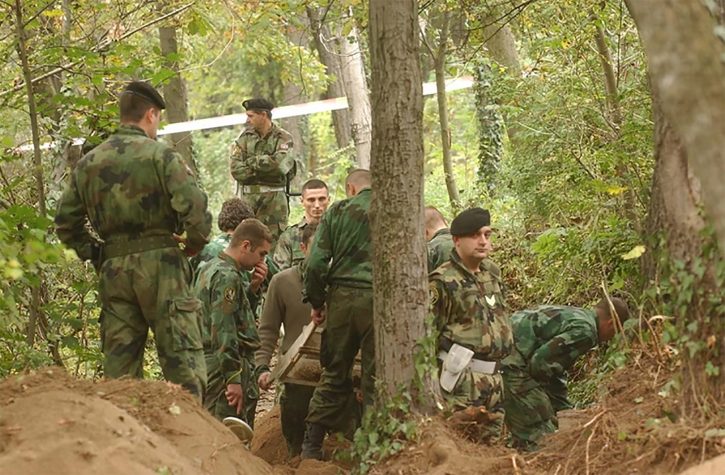
That morning, around nine o’clock, short bursts of gunfire echoed through the concrete walls. A few minutes later, on the cold floor in front of the entrance to the underground passage, the bodies of two guardsmen were found — Dragan Jakovljević from Kraljevo and Dražen Milovanović from Vranje. The Serbian soldiers died while performing guard duty in the middle of Serbia, in the very heart of Belgrade. Jakovljević was dead on the spot. Milovanović died on the way to the Military Medical Academy.
They were in uniform, carrying the weapons entrusted to them only a few months after completing their training at the Topčider barracks. Admitted in June 2004 and assigned to the elite Guard Brigade, they were known as calm, obedient, and responsible young men. No one in the army had a single complaint about them. One was the son of a factory worker, the other of a farmer. Both served their military duty with pride — the way it used to be done — ready, if ever needed, to defend their country.
The first to arrive at the scene was Senior Sergeant Marko Kovačević.
“I came closer. One soldier was lying face down, the other on his back — he was still moving the fingers of his left hand,” he later testified before the Independent Commission. “I asked him, ‘Son, where was the shooting from?’ He answered quietly, ‘From inside, from inside.’”
That sentence, spoken with his last breath, became the most haunting testimony of an era — and the greatest condemnation of a state that would soon begin to cover up all traces that might reveal what led to the murder of the guardsmen.
Just a few hours later, an official statement arrived from the military prosecutor’s office and was carried by regime-controlled media: “One soldier killed the other, and then committed suicide.”
The statement was not based on an investigation or additional questioning — and, as was later revealed, no one present in the secret military complex had even been tested with paraffin gloves. The regime already had its final version of events prepared — conveniently on the very day when the “victory of democracy” was being celebrated. The official “truth” declared: these were soldier-killers and mentally unstable young men.
VBA EXCLUDED FROM THE INVESTIGATION
Although the official version nearly presented the public with a fait accompli, the parents, families, and certain individuals refused to allow the case to be closed so easily — and an investigation was launched.
At that time, military justice did not belong to the regular judiciary but was part of the structure of the then Army of Serbia and Montenegro, and the entire investigation into the deaths of the two guardsmen was led by military investigating judge Vuk Tufegdžić.
The then Minister of Defense, Prvoslav Davinić, later admitted that it was “important for the VBA (Military Security Agency) to be included in the investigation,” but that this agency “refused to participate, giving a justification that was completely incomprehensible to him.”
He told Insajder that it was not considered a terrorist act or an act of sabotage and therefore “no longer fell under their jurisdiction.”
“But if we start from the assumption — the one that part, or most, of the public accepted — that there was a third person who did the killing, then there was indeed a reason to involve military security bodies.”
In other words, the democratic regime had a structure capable of acting — but it was not allowed to do so.
Twelve years later, the head of the VBA, General Svetko Kovač, revealed that the agency had wanted to participate in the investigation, but that the prosecutor prevented it:
“Immediately after the deaths of the two soldiers, we proposed that the case be classified as a terrorist act, because in that case, the VBA could use all measures and collect evidence. However, the prosecutor could not find a single argument indicating that it was a terrorist act, and he classified it as an act of murder instead.”
Thus, with a single decision by the prosecutor, the Military Security Agency was excluded from the investigation, and the case was closed within a narrow circle of military police and the Ministry of Defense cabinet.
THEY WERE MURDERED
Under public pressure and mounting media questions, the Supreme Defense Council of Serbia and Montenegro formed an independent state commission.
It was chaired by Minister Davinić and included twelve experts — ballistics specialists, pathologists, psychologists, and military analysts.
One of them, Branko Sbutega, later described the atmosphere in which they worked:
“I never understood why we were included at the highest level of state review, because this was a murder par excellence, one in which the state itself stood behind it. There was no cooperation — only mistrust and suspicion.”
When asked by journalists what that mistrust looked like, Sbutega answered with a sentence that best described the kind of “democracy” practiced by the Boris Tadić regime:
“As members of the commission, we were subjected to a special kind of pressure that was anything but pleasant. I don’t know how you would feel if your phone rang at night and an unknown voice told you he knows which route your children take to school. Or when, using the old, tried-and-true terminology from the time of Slobodan Milošević, another voice calls you a traitor and a foreign mercenary.”
Such pressure, he added, was a clear message that the state did not want the truth:
“Our entire work was seen as an attack on the army,” Sbutega said, “but we were only trying to defend the truth.”
Despite everything, the commission concluded that it was not a case of suicide.
Dr. Ivanka Baralić, a pathologist from the Institute of Forensic Medicine, stated:
“We explicitly said, when our colleague Savić presented the findings, that we ruled out suicide with certainty for both Milovanović and Jakovljević. In other words, neither soldier committed suicide. They were murdered.”
In its December 2004 report, the commission clearly stated that “shots were fired from different angles and from a short distance,” and that both guardsmen “were killed by gunfire from close range.”
But when that report reached the state leadership, no one ever saw it again. Like many other murder and liquidation cases, it was filed away in a drawer. The commission was dissolved — without any explanation.
HEAD HUNTERS AND THE SHADOWS OF FOREIGN INTELLIGENCE SERVICES
To understand the Topčider case, one must take a step back — to March 2003, when Serbian Prime Minister Zoran Đinđić was assassinated. After his murder, Serbia sank into darkness, later named “Operation Sabre.” This was a time when the regime arrested everyone — from criminals and members of the security services to journalists and even ordinary citizens who simply found themselves “in the wrong place at the wrong time.” It was the darkest period of the DOS coalition’s rule and the moment when Serbia was plunged into a state of emergency whose consequences are still felt today.
Instead of bringing order, Operation Sabre left devastation in its wake. Thousands of people were arrested without evidence, including dozens from military and police structures. The operation, which was supposed to dismantle organized crime within the state, in practice only confirmed that the state and organized crime were deeply intertwined. Many with ties to the security apparatus who knew too much disappeared from the system. Some fled the country, others were soon killed. Sabre was not merely a personnel purge of the old system — it also opened the door for Western intelligence services to infiltrate every level of state institutions.
Between 2003 and 2006, Belgrade was flooded with foreigners holding official accreditations — “security sector reform consultants,” “logistics advisors,” and “liaison officers with the Hague Tribunal.” The General Staff, security agencies, and even major police stations gave office space to official “liaison officers” from NATO and the European Union. Under the pretext of caring for citizens’ security, everything was handed over to those who, only a few years earlier, had bombed the country with depleted uranium.
In international reports — particularly in French and British media — it was openly stated that Serbia had become an “open system,” a place where the interests of major powers and remnants of former republican security structures intersected.
In April 2004, The Guardian published an article stating that “the Balkans are once again being used as a logistical base for various covert intelligence operations, mixing actors from both East and West.” The article added that “Serbia, after Operation Sabre, is in a state of lawlessness where paramilitary and para-intelligence groups under foreign control have begun to emerge.” Similarly, Le Monde diplomatique wrote that “after 2003, Serbia was divided into two worlds — the official one, which spoke of reforms, and the invisible one, where the real struggle for control of the security apparatus was taking place.”
NEVER-RESOLVED LIQUIDATIONS
It was in that invisible world — somewhere between Operation Saber and October 2004 — that figures later described as “head hunters” began to appear. Often moving under the diplomatic protection of Western embassies, they circulated through barracks and military circles without any official records. And no one asked questions — because there was no one to ask.
At the same time, an intensive search was underway for General Ratko Mladić and Radovan Karadžić — but the question was, who was really hunting whom?
Professor Smilja Avramov, in one of her public addresses about how Serbia had been turned into a colony under the democratic regime, pointed out that “foreign intelligence structures, under the pretext of cooperation with the Hague Tribunal, were given free rein to operate inside Serbia.” She even stated that one Serbian officer possessed an audio recording proving the involvement of Croatian intelligence agents in the Topčider case — but, fearing for his family’s safety, never released it to the public.
Her words, ignored at the time, sound more convincing today as shadows of past events begin to surface. For it was precisely in those years that dozens of never-resolved liquidations occurred among people from the security sector — officers, inspectors, and journalists alike. Nothing was ever proven; none of those cases was fully solved. Yet the common thread linking them all is their timing — each belonging to the period between Operation Saber and the fall of Boris Tadić’s government.
A CAMPAIGN USED AS A PRETEXT FOR ARRESTS
When the results of the American FBI investigation finally confirmed that it was not a suicide but that a third person was involved, the democratic regime skillfully used those findings to steer the investigation in an entirely different direction.
At a time when the state leadership was under increasing pressure to hand over Ratko Mladić and Radovan Karadžić, Boris Tadić’s government sought to calm the public and reduce tensions that such arrests could cause — because for most Serbian citizens, Mladić and Karadžić were seen as heroes, symbols of resistance and national suffering during the wars of the 1990s.
To present the upcoming arrests as a necessary and “legitimate” step toward the so-called “European path,” the state leadership used its media to gradually shape an atmosphere in which these men ceased to be viewed as defenders of the nation and were instead portrayed as the “cause of tragedy.”
Thus, in the Topčider case, a new claim emerged — that the guardsmen were killed because they discovered that one of the Hague indictees was hiding inside the Karaš complex. This story had circulated before 2007, before the FBI’s final report, but that year it gained sharper form and even official accusations. Headlines such as “Killed because they discovered Mladić” and “The Topčider secret — the trail leading to Karadžić” appeared in the same media outlets that later became the loudest supporters of the arrests.
In practice, this was a political operation with a dual purpose. On one hand, it concealed the real investigative findings that pointed to the involvement of a third party and the bloody hands of the Tadić regime; on the other, it prepared the public for the arrests of the two most wanted Serbs.
By the time the FBI’s findings were completed at the end of 2007, the state leadership was already finalizing preparations for the arrest of Karadžić — which took place on July 21, 2008, only a few months after Dr. Ljubiša Dragović submitted his report.
Thus, the Topčider case ceased to be a matter of truth and became a tool — a political and media instrument for building the narrative of a “new, European Serbia.”
EPILOGUE, OR THE RETURN TO A DARK AGE
Twenty-one years later, the names of the killers of the two soldiers still have not been revealed — but the picture is much clearer. The regime of Boris Tadić was not hiding Hague indictees, as regime media had claimed for years, but rather foreign intelligence networks operating across Serbia under the protection of the so-called “democratic changes.” Under the pretext of European integration, the country was turned into an experimental testing ground, while members of the army and security services who knew more than they were allowed to simply disappeared, one by one.
That this is not merely speculation or conjecture was recently confirmed by Dušan Janjić — himself part of the circle that had brought about the October 5th changes — when he stated that the Tadić regime was responsible for over 14 political liquidations, all of which Chief Prosecutor Zagorka Dolovac quietly filed away in drawers.
Dragan Jakovljević and Dražen Milovanović were, most likely, accidental victims of that system. The death of the two guardsmen was not merely a tragedy of two young soldiers, but a symbol of a dark order that murdered its own sentinels in order to preserve a puppet government.
The investigation was halted the moment it showed that the gunfire had not come from between the soldiers, but from within the system itself. It resumed only in 2013, when the Constitutional Court of Serbia for the first time acknowledged that the state had violated the right to life and failed to conduct an effective investigation.
But only twenty-one years later — on October 9, 2025 — the European Court of Human Rights in Strasbourg accepted a settlement agreement between the families and the Government of Serbia. By doing so, the state officially admitted its responsibility and committed itself to a new investigation under the supervision of a senior prosecutor.
That document, especially today, is not only a legal epilogue — it is a verdict on an era of darkness. Published on the anniversary of the political changes, at a moment when Serbia again faces the risk of another upheaval and the return of the same mechanisms and the same people — perhaps under new names, in new attire, but with the same intentions.