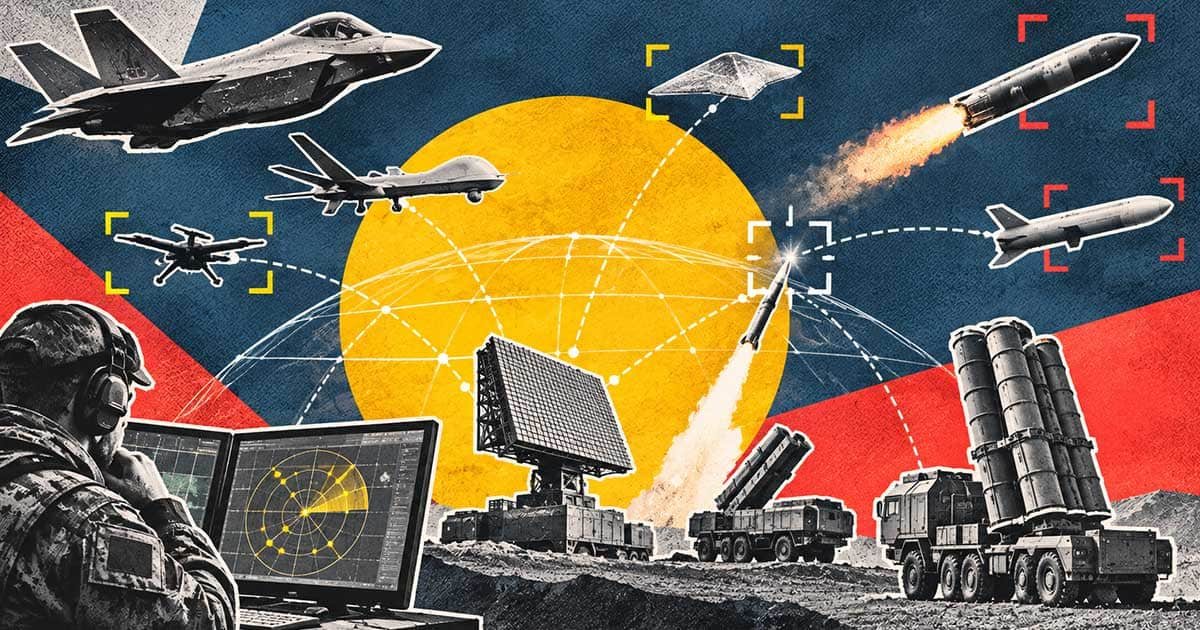
The return of the concept of offensive mass has confronted air defence with a task for which it was not designed in its current form. Modern air defence must now contend simultaneously with manned aircraft, cruise and ballistic missiles, piston- and jet-powered one-way attack drones, reconnaissance UAVs and decoys — systems that differ radically in cost, technical sophistication and the nature of the threat they pose. This is a far cry from the environment for which many existing air-defence systems were originally designed.
THE ECHELON OF SO-CALLED SHORT-RANGE AIR DEFENCE
The most obvious consequence of this process is that air defence can no longer, in practical terms, be based on a single type of weapon, however advanced it may be. A ballistic missile and a primitive one-way attack drone require different means of destruction — and not merely because of the differences in their technical characteristics. The economics of interception is becoming an equally important factor.
In this respect, the experience of the conflict in Ukraine is particularly instructive. Production of expensive surface-to-air missiles cannot be scaled up in proportion to the growing number of inexpensive aerial attack systems used every day. This is precisely why, alongside conventional air-defence missile systems, mobile fire groups, specialised interceptor drones and other relatively simple means have become increasingly widespread, forming a separate layer of so-called short-range air defence. Interceptor drones themselves are considerably cheaper than conventional air-defence weapons and can be mass-produced. Yet even their current production capacity and pace of adaptation are insufficient to counter the constant growth in the number of targets.
Nevertheless, this situation should not be viewed as the beginning of a process in which unmanned aerial vehicles are displacing surface-to-air missiles. On the contrary, the experience of war demonstrates that there is no universal solution. Mobile fire groups, air-defence missile systems and interceptor drones operate side by side. Effective use of the latter requires at least three elements: a radar, a high-quality aircraft and a trained operator. Consequently, even an anti-aircraft drone with primitive guidance capabilities — essentially relying entirely on manual control — requires a certain level of infrastructure to achieve reasonably good results.

ECONOMICS AS PART OF TACTICS
The familiar concept of layered air defence is therefore gradually acquiring a new meaning. It is no longer simply a matter of successive engagement zones with different ranges, but also of establishing distinct defensive layers based on cost and purpose. The most sophisticated targets require expensive, specialised systems, while primitive and numerous targets call for cheaper interceptors whose use does not deplete limited stocks of expensive surface-to-air missiles. In other words, the fundamental task is no longer to achieve the highest possible probability of destroying every target with the most advanced weapon available, but to employ the least expensive means that is sufficient to destroy it.
Economics is thus finally becoming part of the tactics of modern aerial warfare.
The frequently cited comparison between the price of a notional Shahed drone and the surface-to-air missile fired at it makes little sense in isolation. If an inexpensive unmanned aircraft is heading towards a power plant, a major industrial facility or an expensive radar installation, using a considerably more costly interceptor may be entirely justified. The problem arises when such a decision to intercept an aerial target must be made not once, but hundreds or thousands of times. At that point, the economics of an individual engagement recedes into the background: what becomes decisive is the balance between the rate at which arsenals are depleted and the rate at which they can be replenished.
THE INTERCEPTOR DRONE: THE FINAL EXECUTION MECHANISM
Modern air defence, therefore, must do more than simply destroy detected targets. It faces a considerably more complex task: identifying and determining exactly what is in the air, assessing the level of threat posed by a particular object, and assigning the appropriate means of destruction within an extremely short time. The mass scale of aerial attacks makes target classification and allocation just as important a function as interception itself. Moreover, as the number and speed of targets increase, a significant part of this process will inevitably have to be automated.
This, in turn, radically increases the importance of the reconnaissance component.
An interceptor drone, for example — one of the cheapest guided air-defence weapons — is merely the final execution mechanism. Its deployment requires a ground station, transport, communications equipment, a trained crew and external target designation, which, for the time being, relies primarily on radar. In existing operational models, radar often tracks both the target and the interceptor simultaneously; otherwise, the drone operator would be unable either to locate the target or to guide the aircraft to the point of attack.
Furthermore, data from dozens of radars are integrated at situation centres, where the activities of different units are coordinated and decisions are made about which air-defence asset is most appropriate for engaging a particular target. This leads to the following conclusion: interception effectiveness depends less on the use of any particular air-defence weapon than on an entire sequence of data-gathering and processing stages that begins long before the weapon is launched.
THE CLASH OF TWO RECONNAISSANCE-STRIKE CYCLES
Nevertheless, despite its importance, radar surveillance is no longer a universal solution in the field of aerial reconnaissance. The widespread use of small, low-flying unmanned aerial vehicles has once again brought the familiar problems associated with the radar horizon to the fore. A small aircraft can exploit terrain, built-up areas and vegetation, only appearing within reliable detection range during the final stages of its flight path.
Radar systems are increasingly being supplemented by acoustic, optical, thermal-imaging and electronic sensors. It is important to emphasise that these are complementary capabilities, not complete functional replacements. An acoustic observation post, for example, may only be able to register a characteristic sound and the approximate direction of an object’s movement, but even that is sufficient to alert the next defensive sector. In Ukraine, the development of such networks of inexpensive sensors has already become one of the priorities of the national air-defence programme. They are being installed on telecommunications towers, buildings and dedicated masts to supplement existing, more traditional means of airspace surveillance.
Air warfare is thus increasingly taking the form of a confrontation between two reconnaissance-strike cycles. The attacking side must detect an object, identify it correctly, maintain tracking, transmit its coordinates and complete the attack in time. The defending side faces the reverse task: detect the attacking asset, determine its type, select a means of counteraction, transmit guidance data and carry out the interception. Each side seeks to complete its own cycle as quickly as possible while disrupting that of its adversary.
Essentially, air defence is becoming a continuously reconfiguring mechanism. The emergence of an effective interceptor forces the adversary to change altitude or flight path. Attacks at extremely low altitudes require a denser sensor network. Improvements in electronic warfare drive the development of autonomous navigation, while increasing attack-system speeds encourage the automation of command and control and the emergence of faster interceptors. Every successful technical solution almost immediately creates the need for another.
As a result, production, training, reconnaissance and design work are becoming ever more closely integrated with the direct conduct of military operations. Changes in the adversary’s tactics must be detected quickly, analysed, translated into technical or organisational solutions, and implemented on a wider scale before the innovation itself becomes obsolete.
THERE IS NO UNIVERSAL SOLUTION
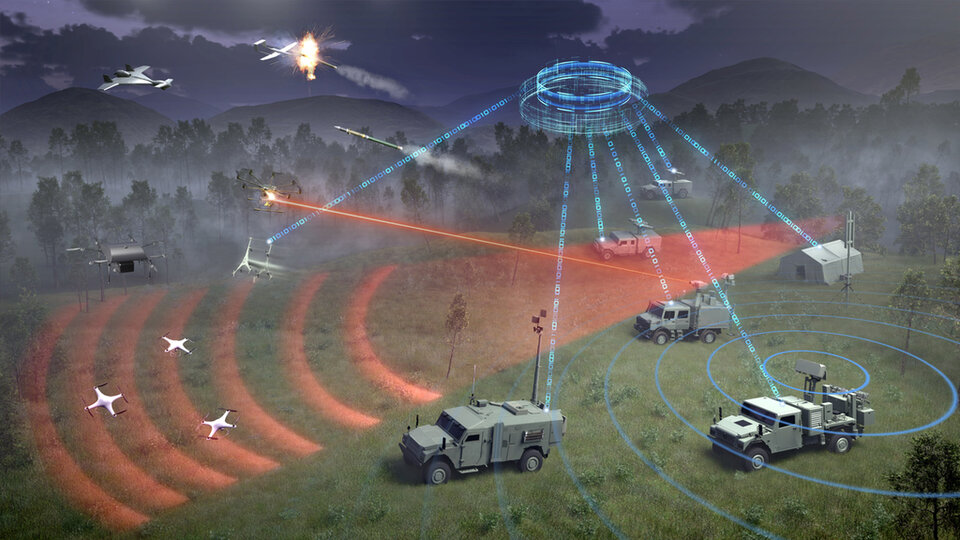
As a result, air defence is gradually ceasing to be a collection of individual, expensive air-defence systems of the kind found in most countries around the world after the end of the Cold War. It is actively transforming into a distributed sensor-and-fire network integrating radars, inexpensive sensors, command centres and weapons systems with different costs and capabilities. There can be no universal technical solution for such a system: a weapon optimised for engaging a ballistic missile is pointless to use against a decoy, while a cheap interceptor drone can never replace a dedicated anti-missile interceptor.
That is precisely why the principal parameter of modern air defence is becoming its ability to detect changes rapidly, redistribute resources and develop new means of counteraction.
As with aerial attack systems, apparent technical simplicity can be deceptive. An acoustic sensor, camera or interceptor drone may be inexpensive, but the system required to connect thousands of such elements, continuously analyse incoming information and allocate targets among them is complex and demands a high level of organisational and technical capability.
Air warfare is not a confrontation between individual machines. It is a contest between two information, industrial and organisational systems that are constantly evolving.