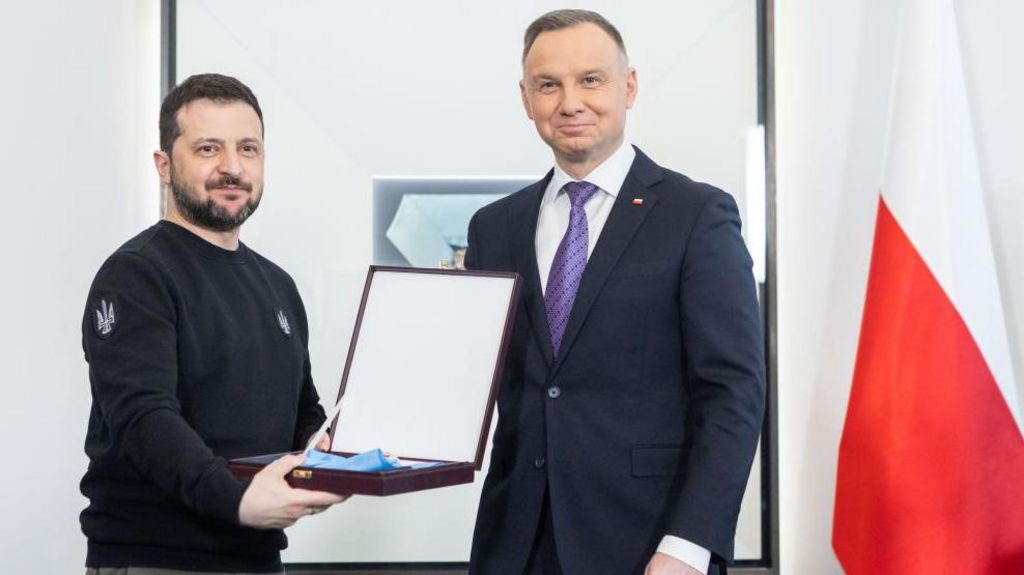
Because of the glorification of the UPA, Polish President Karol Nawrocki revoked Ukraine’s Volodymyr Zelenskyy’s highest Polish state decoration — the Order of the White Eagle. The reason was Kyiv’s open heroization of Ukrainian nationalists. Polish society is extremely sensitive to Kyiv’s flirtation with the legacy of the OUN-UPA, which was responsible for the Volhynia Massacre and the mass killing of Poles during World War II. Following the revocation of the order, other decorated Ukrainians returned their Polish state decorations in solidarity with Zelenskyy. A political scandal erupted.
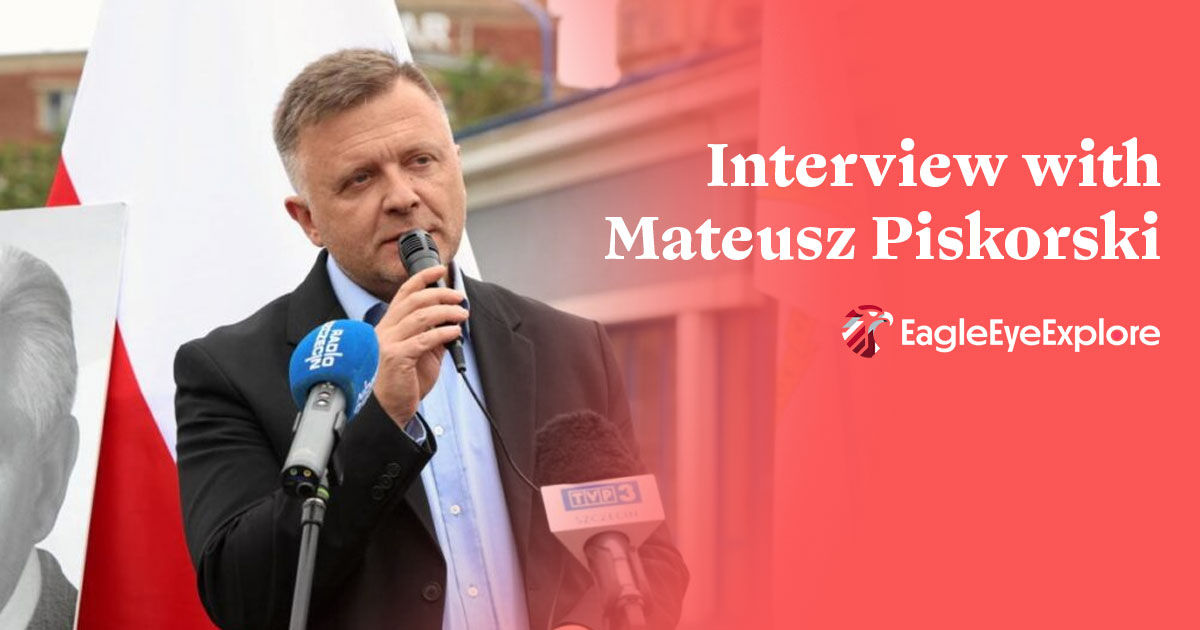
However, to discuss why all of this happened at this particular moment and to what extent it has affected relations between Poland and Ukraine, we spoke with Mateusz Piskorski, editor of the “Myśl Polska” publication.
The scandal that brought Ukraine and Poland into the spotlight was preceded by the reopening of historical issues. I mean Ukraine’s glorification of Nazis from the past and Poland’s subsequent reaction. How do you explain this “dispute” at this particular moment, given that Ukraine’s positions on these issues are nothing new?
It is a long-standing process, and in fact, with the exception of a brief period during the rule of Viktor Yanukovych and the Party of Regions in Ukraine, we have always had, as we do today, historical disagreements. To put it mildly, the Ukrainian side, starting in the 1990s, and even before the dissolution of the Soviet Union, in 1990 and 1991, began erecting monuments to Ukrainian nationalists whom we consider criminals responsible for genocide.
The genocide was not committed only against Poles; Ukrainians were also among the victims, as were representatives of various other nationalities, including, for example, Czechs, Jews, and so on. There is nothing new here. What is surprising, however, is that Kyiv, which counts on and receives such significant support from Poland, has decided to maintain such a course on these historical issues. Obviously, the environment of extreme nationalists in Kyiv has become more influential than ever before.
Despite his background, despite the laws of the now-former president of Ukraine who continues his rule in Kyiv, despite his family traditions and the fact that his grandfather fought alongside the Red Army during World War II, despite all of this, he has become a hostage of extreme Ukrainian nationalists, neo-Banderists, and that is why he continues this kind of historical policy.
And why now? Why not earlier? There have been exchanges of remarks, and decorations have been returned. Why did the reaction in Poland come precisely now?
Why did this happen now? I think a certain fatigue has become noticeable in Polish society. First of all, we have a fairly large Ukrainian minority whose members often publicly appear with certain symbolism, including that of the OUN, UPA and other Ukrainian nationalist formations. People have simply realized that the essence of contemporary Ukraine, Ukrainian statehood and Ukrainian identity is based precisely on those traditions which we Poles, as people who understand recent history, simply reject.
I think the moment has arrived, a kind of point of no return, so to speak, at which the majority of the Polish population, judging by the polls conducted periodically, is showing signs of fatigue and noticeable intolerance toward phenomena that we had not noticed before. More precisely, Poland’s ruling elite had failed to notice what was happening in Ukraine. Now they are forced to take notice, because too many people, too many Polish citizens, have started talking about it and remembering it. And all political forces in the country, without exception, must take this social factor into account ahead of the parliamentary elections, which are expected to be held in a year.
Can changes be observed when it comes to the support Poland provides to Ukraine? Apart from statements, are there any changes in practice? There is renewed talk about Starlink, about Poland stopping its payments for it.
Unfortunately, no. The support Poland provides, significant support in terms of both sending weapons and various forms of military assistance, continues and will continue. Despite the mood in Poland, these decisions are made outside Poland. Because Poland is not a sovereign state in this regard.
Decisions on sending weapons are made by the collective West, with its main centers of power, among which, let us not hide it, is Washington, which has significant influence over what is happening, including the fact that Poland is a transit country when it comes to transferring weapons to Ukraine.
Recently, Polish Prime Minister Donald Tusk stated that Poland is building the most modern army in Europe, capable of protecting its borders. Is Europe undergoing militarization? How do you view these reports?
I think Poland will unfortunately continue to fulfill its role in the future as well. Poland will continue in the same direction until the collective West decides that continuing this war is pointless. From a strategic perspective. For now, unfortunately, this applies to all countries in our part of Europe.
I think things are somewhat better in Bulgaria because of your government, because of the fact that Rumen Radev and his government are taking a certain, let us say, pragmatic, rational position, unlike what is the case in most Central and Eastern European countries. Nevertheless, in most of those countries, led by Poland, unfortunately, the same policy toward Ukraine that was present before continues.
It can be heard that Poland is becoming the Pentagon’s main outpost and the new center of power within NATO. Do you agree with that? Is that really the case or not?
It is difficult to say, because the real question is whether NATO will continue to exist. We do not know how long NATO will exist at all. Based on statements by certain actors, including the US administration, one could predict the dissolution of NATO in the near future. We are already seeing certain developments, for example, in the Middle East, where certain countries are already abandoning their blind faith in US guarantees, in security guarantees.
I am referring to the creation of new blocs, including military-political blocs, such as the bloc and agreement concluded in Mecca between Pakistan, Saudi Arabia and Turkey. Incidentally, Turkey is a NATO member, but nevertheless, it does not rely exclusively on NATO security guarantees, but is also concluding other agreements. So, most likely, NATO will become an increasingly amorphous, unclear phenomenon in the future.
Therefore, I doubt that Poland has such weight in American policy that we could, in the future, become a spokesperson for the American presence in Europe. I assume that the United States will generally begin to reduce its presence, its military presence in Europe.
What is the purpose of the agreement concluded between Turkey, Saudi Arabia and Pakistan?
The goal is to create an alternative zone, alternative security guarantees, an alternative alliance because the Middle East, just as Europe will, I believe, in the future, is becoming part of a post-American world. That is how we can define it.

Post-American means with a limited presence. I am not saying that US influence will completely disappear from this region, but it will nevertheless be limited. And most likely, all countries will have to take this factor into account. Pakistan, Saudi Arabia and Turkey have come to the conclusion that it is time to take care of their own security with their own forces within the framework of a regional alliance. In my opinion, there will be many more such regional alliances in the near future.
If we look at what is happening on the front in Ukraine, and at the conflict there in general, what do you think — where is all this heading — toward a peace agreement, or perhaps toward further provocations and even an escalation of the conflict involving other countries? Where is the conflict in Ukraine heading?
It will continue. It will continue as long as the main actors are interested in continuing it. We can only hope that the main actors, in the form of the United States, will not decide to escalate this conflict. It will remain at its current level, but it will not end anytime soon. Unfortunately, I think everything is heading toward a continuation of this conflict. It could last for several more years.
Everything, of course, depends largely on the position of the Russian Federation. How interested Russia will be, after taking control of the remaining part of Donbas, I mean the urban agglomeration of Sloviansk–Kramatorsk–Kostiantynivka, in continuing its military operation. I assume it will, because the root cause of the conflict has not been eliminated. The militarization of Ukraine, the presence of Western weapons on Ukrainian territory. All these factors remain in place.
I think Moscow will find it difficult to decide to end this conflict at this stage. If a ceasefire is reached, of course, it will only be temporary. After a short pause, a new wave of escalation will begin. And that will lead to another conflict. Even from Russia’s perspective, this is not particularly beneficial, because Kyiv, or rather Kyiv’s Western sponsors, could use any ceasefire for additional arms deliveries and further militarization of Ukraine.
As long as the root cause is not eliminated, and the root causes can be addressed through negotiations between the United States and the Russian Federation.
As long as the “spirit of Anchorage” is restored, as they say. But seriously, without empty promises like those made last year. It will soon be a year since that summit in Anchorage.
But unfortunately, as we can see, the spirit of Anchorage has currently disappeared. There is no desire to continue the agreements that were reached, or the communication that took place there in Alaska. Therefore, everything depends on the US administration and its willingness to engage in serious negotiations with Russia.